Ranked a Top Canadian Book Blog
Twitter: @DCYakabuski
Facebook: Doreen Yakabuski
Instagram: doreenyakabuski
Threads: doreenyakabuski
Substack: @doreenyakabuski
Bluesky: @dcyakabuski.bsky.social

Monday, April 28, 2025

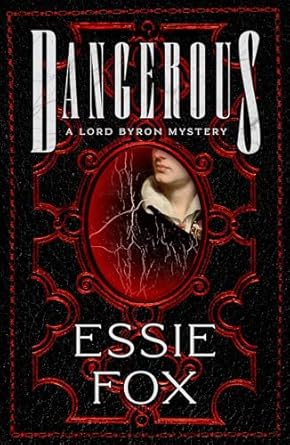
Review of DANGEROUS by Essie Fox (New Release)

4 Stars 

Because I majored in English literature, it is no surprise that I enjoy novels which use English writers as main characters. In Dangerous, a gothic thriller, Lord Byron, one of the major figures of the Romantic movement, is the protagonist.

Lord Byron, famous poet and infamous philanderer, has taken refuge in Venice. When two women with wounds on their throats are found dead, rumours spread that Byron may be the killer. The recent publication of a novel entitled The Vampyre, written in a style similar to Byron’s, has people speculating that the book is autobiographical. When his own life and that of his daughter are threatened, he has to play detective to find out who is behind the crimes.

The novel employs many of the common plot elements of gothic fiction. There’s violent death, vengeful persecution, and imprisonment. Gothic literature often uses a framing device, a story within a story to create mystery and suspense; in Dangerous, manuscripts are discovered in a crypt.

The novel is so rich in gothic atmosphere. Byron lives in an old, decaying palazzo where some rooms smell of rot and damp. Byron’s valet is convinced there are ghosts in the palazzo. When it is hot, the canals stink. Rats from the canals are known to invade buildings. And “So many villains with stilettos crept through Venice, sleek as rats. The sort of men who’d stab a man then push him into a canal without the slightest pang of guilt.” Byron spends some time in a prison where he becomes inured to his surroundings, “barely noticing the tickle of [rats’] whiskers, or the needle sting of pain when, now and then, one tried nibbling his toes. The same with the bats roosting in rafters overhead, or the swarming buzz of flies hatched from maggots in the buckets full of slops and excrement.”

And then many of the events take place at night or in the shadows. I love these descriptions: “Now holding the lamp, the woman’s trembling hands caused its light to throw black shadows juddering around the walls. The dizzying effect left Byron feeling nauseous” and “Here, their shadows were distorted, two elongated silhouettes taking the form of freakish monsters, one of them more erect, his movements swift and elegant, whereas the other lagged behind, his sliding gait as sinister as some predatory beast” and “their shadows looked like phantoms trapped by the bars of cage.”

Byron was a flamboyant figure famous for his unconventional lifestyle. He was handsome but moody and irritable but also possessed a magnetic and affable personality. The author of this novel captures his many-faceted nature, portraying both his positive and negative traits. A friend tells him, “’you have always been a slave to your passions. I’ve often found your hedonistic tendencies to be offensive. But, deep down, inside your soul, I know you are an honest man.’” Byron is self-aware, acknowledging his life of dissipation, self-indulgence, and fitful passions. He has a sense of humour: he dismisses killing himself when he thinks of the resulting gore staining the boat’s upholstery and “Worse still, to imagine the pleasure it would bring to his mother-in-law.” He treats his servants well, admitting he has been fortunate to be born not just a man but a man of wealth: “As a man of wealth and fame, the rules were always in his favour with little consequence or danger, whereas for her – one careless night, and a young woman was abandoned to a world of pain and sorrow.” His personal life was full of scandal but there is a possible explanation for his behaviour because of what happened to him as a young boy.

Gothic fiction is not a genre I love, but I loved Essie Fox’s The Fascination (https://schatjesshelves.blogspot.com/2023/07/review-of-fascination-by-essie-fox.html) and this novel does not disappoint either. I thoroughly enjoyed it.

Thursday, April 24, 2025

Review of THE RETURN OF ELLIE BLACK by Emiko Jean

 3 Stars

Ellie Black is found after having gone missing two years earlier. Detective Chelsey Calhoun wants to find where Ellie was held, especially when it is discovered that other girls may be at risk. Ellie, deeply traumatized, refuses to co-operate with the investigation, but Chelsey is very invested in continuing; the death of Lydia, her sister, 20 years earlier destroyed her family, and she wants to help other families from suffering as hers did.

The novel provides Chelsey’s perspective but also that of Ellie. In Ellie’s sections, the reader learns about her abduction and imprisonment. As a consequence of this narrative approach, we sometimes know more than Chelsey does. Of course the name changes mean the reader doesn’t guess identities too quickly, and there is also some plot manipulation in not having Ellie reveal too much about her escape.

I found the characters, including the protagonist, flat. The death of Lydia and subsequent events in her family obviously affected Chelsey; most of her actions can be attributed to that trauma. Otherwise, there’s little of her personality developed. Intelligence is expected of a detective, but there’s little evidence of that because most of her discoveries are by luck or chance, not skill.

The book focuses on misogyny and does so in a heavy-handed way. There are statements like, “I wish this wasn’t what it means to be female – it is not a matter of if something bad will happen, but when” and “the most dangerous thing in the world . . . is unremarkable men with beautiful smiles and even bigger promises” and “When will it be enough? How society accepts women dying at the hands of men.” Then the ending suggests a simplistic explanation: misogyny is caused by family breakdown.

I had real issues with the later parts of the novel. The identity of the guilty is implausible but even more so of a problem is the reason for the behaviour. The motive for kidnapping, torture, rape, and murder is something that many people experience in their lives, yet in this novel three men react so extremely?! And the specific trigger for each kidnapping is also weak. The final twist is also not fair play because readers are misled about the fate of a character. This last soap opera turn of events cheapens the novel.

What’s with the name changes? I understand that they are used to obfuscate and keep the reader guessing as to characters’ real identities. But is there supposed to be significance behind the names (Hope, Charity, and Grace) with their religious overtones?

This is a quick read, but readers are expected to turn off their critical thinking at the end.

Monday, April 21, 2025

Review of THE BOOK CLUB FOR TROUBLESOME WOMEN by Marie Bostwick (New Release)

 3.5 Stars

In 1963 in an exclusive suburb in Northern Virginia, four women (Margaret, Viv, Bitsy, and Charlotte) come together to form a book club. They name themselves The Bettys, after the author of the first book they read: The Feminine Mystique by Betty Friedan. As they read and bond together, they embark on journeys of self-discovery and each emerges transformed.

The women are all married but their home lives differ. Nonetheless they all struggle with a feeling of dissatisfaction; they all want more from their lives, finding that the lives they are leading and have been told to strive for as American women are not fulfilling. The traditional roles imposed on them are limiting and do not take into account personal hopes and ambitions.

The novel is well-intentioned, but it lacks subtlety. Charlotte describes The Feminine Mystique as “’a treatise on the conditions and suffocating boundaries of American womanhood.’” At times this novel feels like that – a treatise. The author crams so much information: for instance, we learn about how women cannot open a bank account or be prescribed birth control pills without a husband’s permission, how women “are denied the chance to pursue certain professions because it’s assumed they’ll quit after marriage,’” and how men’s control of a family’s finances can leave women vulnerable should a husband die. We are told that certain traits in a woman are dangerous: “’intelligence, stubbornness, creativity, and drive – are really neuroses that make her sick and unfeminine, even unlovable.’” It feels as if the author felt compelled to mention every obstacle and judgment women faced.

It’s obvious that the author did considerable research and that is commendable. But, again, it seems as if she wanted to mention every detail: the food and drinks and clothing styles popular at the time. Is it necessary to mention that “Bitsy ordered a strawberry shake, Margaret a cherry cola, Viv a banana split,” that one woman wore “a cream-colored skirt of wool and silk and a matching jacket with navy-blue trim,” and that another woman wore “a green bouclĂ© knit suit with a pencil skirt, asymmetrical collar, and oversized buttons aligned on the left side”? I get the desire to add local colour, but . . . On the other hand, I did like the appearance of actual historical people and the references to current events.

Besides detailing the obstacles faced by women, the book also examines the power and joy of female friendships. It is the support that the women give each other that helps them overcome their fears. “’Why do you think [men] join all those clubs – the Elks? The VFW? The Masons? Congress? . . . To support one another, that’s why. Why do you think they call them booster clubs? Because they’re trying to boost each other over the wall or bend the rules in their favor, help the group. If women stuck up for one another the way men do, this would be a very different world.’”

Generally men do not fare well. There are a couple of good guys, but many are sexists, hypocrites and manipulators. What is concerning is the lack of redeeming qualities in the men like Howard, Dr. Barry, and G.G. (How is it that Charlotte, a married woman in 1963, uses her maiden name?)

I found the plot predictable, and those who enjoy a warm and fuzzy ending will definitely find it here. The book brought to mind Lessons in Chemistry by Bonnie Garmus, another book with a positive message about female empowerment also delivered in a heavy-handed fashion. Though slow paced at times, the book is entertaining enough but its tone feels didactic and its style, forced.

Note:  I received an eARC from the publisher via NetGalley.

Friday, April 18, 2025

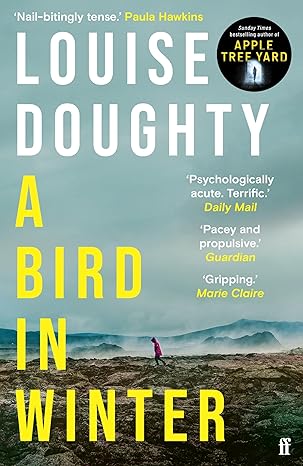
Review of A BIRD IN WINTER by Louise Doughty

 2.5 Stars

I’ve enjoyed other of Doughty’s books so thought I’d listen to this one on my morning walks. Unfortunately, it was a disappointment.

Heather, nicknamed Bird, is a middle-aged woman who works for the British secret service. She suddenly goes on the run but the reason why and whom she is fleeing is unknown. Only slowly, through flashbacks, are details filled in.

This book is marketed as a thriller but it’s the slowest thriller I’ve ever read. Heather is on the run but because she withholds information and reveals it only in dribs and drabs, I wondered whether she is really in danger. Maybe she’s an unreliable narrator. She spends a lot of time reflecting on her past and how stunted her life has been because of her chosen career. As she moves from place to place, there are detailed descriptions of the towns and landscapes she encounters. At times I felt I was reading a travelogue. Neither introspection nor setting descriptions are hallmarks of thrillers.

There is not a great deal of suspense. Except for one incident, threats are vague and there are extended periods when she lives like a tourist. This is my polite way of saying that I was bored a great deal of the time. There is so much information about a past friendship and so much description of the scenery, especially in her last location, that it’s difficult to determine what is relevant.

Some events are just implausible. Heather gets into debt because of a real estate deal but then has unlimited funds for extended travel; not once does she express any concern about running out of money. Even in the remotest or smallest places, she easily finds accommodation? And then there’s the ending with so many unanswered questions, though the identity of the person manipulating everything is no surprise since it’s been hinted at from the beginning.

When I reached the end, I wondered whether I’d missed something because I’d listened to an audiobook rather than read a physical text. The misleading marketing is definitely a problem; the novel is not a thriller in the traditional sense. Instead, the book explores the impact of a woman’s past choices and the emotional toll of being forced to flee and leave everything behind.

Monday, April 14, 2025

Review of THE BOY FROM THE SEA by Garrett Carr (New Release)

 4 Stars

The novel is set in Killybegs, Ireland’s largest fishing port, in County Donegal. In 1973, an infant is found on the beach and is eventually adopted by Ambrose and Christine Bonnar who already have a two-year-old son named Declan. They name the boy Brendan. The novel covers approximately 18 years, telling the story of the Bonnar family: Ambrose’s struggles to provide for his family as a fisherman, Christine’s contentious relationship with her sister Phyllis, Declan’s bitter jealousy of Brendan, and Brendan’s always feeling like an outsider. We also learn about life in the community.

Point of view is especially interesting. The omniscient narrator, using the first person plural, is the townspeople. The effect is that of a Greek chorus. The reactions of the townspeople to events are documented. As seasons pass, a summary of the fates of others outside the Bonnar family is included: “The season turned. The vocational school had its first public exams and the students did well. The Ros Finn went up on rocks and two of the crew were treated for hypothermia. Johnny the Matchbox won good money on the sweepstakes and we all despaired as he was sure to waste it.”

This narrative approach suggests a story told over a Guinness in an Irish pub. The reader is addressed as someone familiar with the townspeople: “[Pat Ward] wasn’t belonging to the coal dealer Wards, but the Straoughter Wards, the ones with the freckly faces.” What emerges is a real sense of a real place.

Certainly the portrayal of life in a small town is conveyed accurately. Everyone knows everyone’s business and gossip spreads quickly. But there is also support for each other; when tragedy strikes, the entire community shows up to help. What is also shown is the challenges faced by a tight-knit community in a changing world: people leaving the town to find work elsewhere.

Changes in the fishing industry are described. Ambrose is a skilled fisherman with a deep connection to the sea. At first he does well but then he faces competition from larger and larger trawlers. Fishing becomes an increasingly commercialized industry and the ocean is viewed “like it was a factory floor”; near the end of the book, there is reference to dwindling stocks.

The novel also examines other subjects. Sibling relationships are explored: there’s Declan’s unwillingness to accept Brendan as his brother and their intense competition for their father’s love and attention. Both boys make decisions based on rivalry. Christine and Phyllis are close and need each other but disagreements arise: Phyllis feels trapped because she has to care for her father and she objects to Brendan’s adoption so there are clashes and times when the sisters don’t speak to each other.

Another topic that stands out for me is men’s lack of self-reflection and their inability to articulate their feelings: Ambrose belongs to “a lineage of quiet men, each contained to the point of self-repression, generation after generation of horizonwatchers, preferring to look out at a wordless intensity than have even a second of introspection.” The reader is told that “Ambrose had all the language required to define precisely the meaning of a cloud, the character of a sea, an attitude of rain, but to describe his own emotional weather he was limited to ‘Been better,’ ‘Been worse’ and ‘You know yourself.’” Love is seldom expressed; when Declan states he’d love to try a certain fishing ground, Ambrose thinks, “Love was a strong word, everyone listened with interest.” Ambrose leaves for a fishing trip by kissing Christine on the cheek and saying “’Mind yourself.’” One particular description is so fitting: “Donegal men had strikingly big key fobs, we tended to have many padlocks in our lives.”

Despite the novel’s seriousness, there are sprinkles of gentle humour: “If there was a trophy for not mentioning things Tommy would’ve won it, then kept it at the back of his wardrobe and never mentioned it.” A member of Ambrose’s crew complains about his wife wanting an extension built on their home: “’And I don’t even want another room, I’m happy enough to go sit in the car when we’ve a row.’” Phyllis and Christine discuss how it would be better to die than to survive a nuclear bomb: “’but they’ll have no reason to drop a bomb here. Donegal will be ignored again.’”

Some readers might object to the sometimes meandering plot, but I loved the book. Its portrayal of life in a small community is so authentic; I definitely saw my family and childhood reflected in the book and I think many readers will as well.

Note: I received an eARC from the publisher via NetGalley.

Friday, April 11, 2025

Review of THE CURE by Eve Smith (New Release)

 4 Stars

This dystopian thriller is narrated from the perspectives of two women: Ruth and Mara.

Ruth, years earlier, while searching for a cure for the disease that led to her daughter’s premature death, accidentally discovered a vaccine against age-related diseases. Erik Grundleger, a colleague, hijacked this vaccine known as ReJuve and, with the help of a billionaire obsessed with immortality, created an upgrade, SuperJuve, which extends human life span. There were disastrous consequences so laws were passed to limit life to 120 years. Supers who took SuperJuve are tracked down by Omnicide investigators and executed. One of these investigators is Mara who hesitantly teams up with Ruth to find Grundleger.

The reader comes to understand the two women and what drives them. Ruth is easy to like from the beginning. Her intention was always to help people like her daughter, and she even tried to insure that her discovery would not be misused. Mara, known as The Blade, is more difficult to like. She’s a relentless, merciless hunter of Supers but the reason for her obsession becomes clear; like Ruth, she experienced a trauma that profoundly affected her.

The novel is very thought-provoking. It forces us to consider what might happen if people lived longer. The novel suggests that if the population of the planet increased, there could be housing and food shortages. Natural environments are devastated leading to extinction of animals as land is needed to build homes: “open grasslands no longer exist. They were razed for food production and housing.” The old outnumber the young who become resentful: “crime is rising amongst the younger generations who are out of work, out of an inheritance, and out of patience.” Amongst the many centenarians, there’s an emotional toll of living longer. Loneliness and depression are major concerns: “there’s an increasingly anxious and disconnected generation of elders who lack purpose and fulfilment.”

What the novel also emphasizes is the extreme disparity between the ultra-wealthy and the rest of the world. To receive ReJuve, citizens must meet criteria, one of which stipulates that they must pay into an accredited pension scheme for a minimum of sixty years. Not everyone qualifies for ReJuve so the lives of the disadvantaged have not improved. As for SuperJuve, it can only be afforded by the ultra-rich who obviously will do whatever is necessary to access it. And what if SuperJuve had side-effects which were dangerous for everyone?

The name of the SuperJuve investor is Jeff Busk who has a “net worth of over three hundred billion dollars.” Is the name an amalgam of Jeff Bezos and Elon Musk, two people with unlimited wealth and power? I can imagine these two men would concur with the choices made by Grundleger and Supers. Channeling the names of two of the richest men in the world just adds to the realism of the novel. We are already seeing extreme financial inequality in the world and the devastation of ecosystems so what the author is suggesting is certainly not far-fetched.

In the latter part of the novel, the thriller elements come to the fore. Ruth and Mara find themselves in increasing danger so tension also increases. And, as expected in thrillers, there are some plot twists. There are a couple of instances where there was reliance on coincidence but it was not enough to affect my enjoyment of the novel.

Because what is described is plausible, this is a terrifying cautionary tale. The book entertains and informs – a perfect combination for me.

Monday, April 7, 2025

Review of THE GRANDDAUGHTER by Bernhard Schlink

 4 Stars

Bernhard Schlink is best known for his 1997 novel The Reader, but I’ve enjoyed other of his books and so picked up The Granddaughter, his most recent offering.

Seventy-one-year-old Kaspar Wettner is a bookseller in Berlin grieving the death of his wife Birgit. When going through her papers, he discovers she had left behind a baby in East Berlin when she fled to West Germany. He decides to search for his stepdaughter Svenja and eventually finds her living in a rural community of Völkisch people – far-right, white supremacist nationalists. Svenja and her husband Björn have a daughter, 14-year-old Sigrun, who is an enthusiastic believer in far-right ideology. Kaspar manipulates her parents into allowing Sigrun to spend time with him, time he hopes he can use to broaden Sigrun’s worldview.

Kaspar is the grandfather most people would like to have. He is patient and tolerant. When he learns about Brigit’s daughter, he is determined to find her, and when he meets Sigrun, he is determined to establish a relationship with her. Liberal and progressive in his views, he finds Sigrun’s anti-Semitic, xenophobic, Holocaust denying comments offensive, but he admires her curiosity, strength, and loyalty. A cultured man, he takes her to concerts and introduces her to books she would not encounter in her insular world. When he discovers she has a talent for the piano, he pays for lessons. He takes her on a trip to broaden her horizons.

Of course, Kaspar has to tread carefully as he tries to correct Sigrun’s understanding of German history. Her parents certainly fear Kaspar’s influence because they insist on strict rules while she visits Kaspar: for example, she cannot wear jeans, use the internet, or go to the cinema. He doesn’t want to alienate them because they might deny him visitations. He is also afraid to contradict Sigrun too forcefully for fear that she herself might choose to end their relationship. This leaves him wondering if/how he can challenge her radical opinions.

It is not just Sigrun’s views which are challenged. Kaspar is forced to confront his prejudices. For instance, Sigrun draws attention to his attitude of superiority. He does not agree with how Sigrun has been parented, but he comes to understand the reasons for Svenja and Björn’s decisions regarding their daughter. Kaspar also has to acknowledge the complexities of German reunification which has not solved all the problems. Even Kaspar’s understanding of Birgit increases.

I enjoyed the book and recommend it. Readers who do not like ambiguous endings may not be satisfied by the novel’s partial resolution, but given the book’s subject matter, the ending is appropriate. Though the focus is political radicalization in Germany, I found the book timely: it made me consider the political radicalization so obvious in the U.S., especially following the most recent presidential election.

Friday, April 4, 2025

Review of THE RESISTANCE PAINTER by Kath Jonathan (New Release)

 3 Stars

This is a dual timeline novel.

Irena Marianowska is an art student living in Warsaw with her mother and sister when the Nazis invade Poland. She immediately joins the Home Army and remains involved in the resistance movement throughout the war, becoming an expert in navigating the sewer system of the city to transport people and goods.

In Toronto, 2010, Jo Blum looks after her grandmother Irena, a decorated war hero and renowned painter. An artist herself, Jo creates sculptures for grave sites based on the lives of her clients. She is hired to do one for Stefan Cegielski. When Jo comes to interview him, she discovers parallels between his wartime past and that of her grandmother. Intrigued, she starts investigating further and uncovers some surprising family secrets.

One issue with the novel is the number of names one character can have. It’s easy to remember that Jo is Josephine and Mati is Mateusz, but things become more confusing: Irena Marianowska, Irena Iwanowska, Renka, Ala, and Wit are the same person; Alexandra, Ola, Olenka, and Zofia are the same person; and Szarlota, Lotka, and Charlotte are the same person. I’m not sure there’s a need for so much obfuscation.

I enjoyed learning about the Armia Krajowa, the Home Army, which was the dominant resistance movement in German-occupied Poland during World War II. Though my ancestors come from Poland, I knew little about his period in the country’s history. I had never heard about how the sewer system allowed the Polish Home Army to move supplies and people between isolated districts. The descriptions of the smells and rats emphasize the horrors of navigating these underground routes.

I found it difficult to believe that Jo knows so little about her grandmother. Jo, her mother, and her grandparents lived together yet Jo asks, “How is it that I know so little about my grandmother’s life?” Then as she becomes more curious, she avoids asking, more than once using the weak excuse “Now is not the time to ask.”

There are other issues with Jo’s behaviour. Despite her Polish heritage, she can’t differentiate German and Polish when spoken? She has a confidentiality agreement with her client Stefan but she breaks it so unthinkingly, telling what she’s learned not only to Irena but also to Irena’s art dealer? She looks after Irena as her health fails, yet only at the very end does she notice “for the first time a small, deep scar on her left leg above her ankle”? She struggles to make doctor’s appointments for her grandmother, but then she doesn’t insist on Irena going?

There are a lot of coincidences that had me shaking my head in disbelief. How many times does Ala encounter Davey just by chance? Irena doesn’t figure out the clue about meeting at the bakery, but she manages to arrive just at the right time?

To add local colour, the author added some Polish words, but I found the repetition of cholera (23 times) tedious after a while. Some terms like łapanka and Hitlerow are not explained.

The book is unnecessarily long. It drags at time; for instance, Jo’s avoidance of questioning her grandmother feels like plot manipulation. There’s interesting information, but there’s also some unnecessary repetition.

Note: I received an eARC from the publisher via NetGalley.