Ranked a Top Canadian Book Blog
Twitter: @DCYakabuski
Facebook: Doreen Yakabuski
Instagram: doreenyakabuski
Threads: doreenyakabuski
Substack: @doreenyakabuski
Bluesky: @dcyakabuski.bsky.social

Friday, May 30, 2025

Review of WHILE JUSTICE SLEEPS by Stacey Abrams

 2.5 Stars

Though I’m Canadian, I’ve heard of Stacey Abrams, an American lawyer, politician, and voting rights advocate. I admired her efforts which have been widely credited with boosting voter turnout in Georgia. When I learned that she is also an author, I decided to read one of her books. I chose this legal thriller, the first in the Avery Keene series.

Supreme Justice Howard Wynn falls into a coma just before an important vote concerning a controversial case before the court. The case has to do with the merger of an American biotech company and an Indian genetics firm. To everyone’s surprise, Wynn named his young clerk, Avery Keene, as his legal guardian. He has also left Avery with clues to decipher, clues which imply a conspiracy involving the most powerful in Washington. As she follows the clues to uncover the truth, she and her accomplices find themselves in danger.

This is supposed to be a suspenseful thriller, but its pace is slow. That is a fatal flaw in a suspense novel. Much has to be explained to the reader (chess plays, genetics, legal procedures) so there are information dumps. The amount of information given, about things like genetics and government protocols and abbreviations, often creates confusion rather than suspense. Undoubtedly, Abrams has inside knowledge of the Supreme Court and the political landscape, but she includes unnecessary details.

Another issue is Avery. She is supposed to be very intelligent; indeed, she knows a lot about chess, bioethics, French philosophers, and astronomy. She even has an eidetic memory. However, she does some very stupid things. A law clerk would sign papers without reading them? A law clerk would find a murder victim and just flee after leaving evidence of her presence? Though instructed to destroy a paper after reading it, she takes a photo of it? She has an eidetic memory so doesn’t need a photo which can be accessed by the wrong people, something the instruction is intended to prevent!

Then there are Avery’s assistants. Wynn’s son, Avery’s roommate, and Wynn’s lawyer appear at opportune times. Of course each has specific knowledge and skills that Avery needs at the time. This all seems so contrived. The fact that the three supporting characters are all bland with little personality means they are even more obviously just plot devices. Don’t get me started on the burgeoning romance! Though everyone is well-educated, having them all speak in an erudite, polished manner in the most ordinary of conversations makes no sense. The dialogue is just so stilted.

With its focus on intricate puzzles and conspiracies, at times this book reminded me of a Dan Brown novel. Why did Wynn leave a trail of such opaque clues? He expected Avery to know obscure chess moves and to recall past conversations. Okay, that’s within bounds of plausibility. But she also has to connect with his son and he has to take her into his childhood bedroom?!

I was disappointed with this novel. Though plot-driven, it lacks suspense and there is only superficial character development. Much feels contrived. I will not be continuing with the series.

Monday, May 26, 2025

Review of UNIVERSALITY by Natasha Brown

 2 Stars

The book jacket describes the book as a “thrilling novel” which focuses on words: “what we say, how we say it, and what we really mean.” I found the book anything but thrilling and found that it lacked focus.

Hannah, a struggling freelance journalist, writes an article on a violent attack at a rave on a Yorkshire farm owned by Richard Spencer, a wealthy banker. The victim is Pegasus who tried to start a self-sustaining community on the farm. The attacker is Jake, the son of Lenny, a provocative conservative columnist who had a sexual liaison with Richard. The first third of the book is Hannah’s article; the rest of the novel explores the consequences of the article for various people involved like Hannah, Richard, and Lenny.

I’ve described the entire plot. Not much else happens. And that’s the problem because the book feels less like a novel and more like an essay. All that’s missing is a clear thesis statement, though my guess is that the author believes media cannot be trusted because everyone has his/her own agenda and will manipulate the truth to fit his/her purposes.

Characters are unlikeable and are developed primarily to serve as mouthpieces for a particular viewpoint. Lenny is a perfect example. She manipulates Hannah to write the story which brings attention to Lenny. Her treatment of her son is despicable though she uses him as an example to support her opinions about government policies. She believes she thinks most clearly when she’s had a couple of drinks. Her attack on an interviewer is downright vicious.

The book can be viewed as an analysis of modern-day British politics, but I found many parallels between Lenny’s opinions and those of the current Trump administration: “’The fastest-growing sectors of our economy are disproportionately hiring and promoting minority workers’” and “’We didn’t notice that the “myth” of meritocracy was turning into a curse’” and “’Look, we’ve got to stop with the self-policing. We’re so busy apologizing for ancient history and imagined offenses that we’re losing our economic edge.’” Lenny criticizes diversity, equity and inclusion programs which are one of Trump’s targets.

I guess my point is that there’s nothing new here. The comments about classism and the economy and the media have been expressed by many others so I don’t understand the effusive praising of the author’s intelligence. Maybe I’m not intelligent enough to understand the book?

The book jacket states that the book “dares you to look away,” but I had no difficulty looking away. I was bored much of the time and found it a plodding read. What saved it is the book’s brevity (152 pages). Obviously I was not the intended audience. Reviewers on the jacket use adjectives like “unputdownable” and “thrilling” and “tons of fun” but none of these describe my reaction.

Thursday, May 22, 2025

Review of SHATTER CREEK by Rod Reynolds (New Release)

4 Stars 

This novel begins two months after the end of Black Reed Bay, the first book in the Detective Casey Wray series.

Now partnered with Billy Docker, Casey is called to a shocking daytime double homicide. Was one victim the intended target and the other an innocent bystander? The best possible witness, a young woman with a baby, disappears. When another person is killed, the search narrows to focus on one man who may be on a murderous rampage. But the body count does not stop at three and the case unravels, so Casey’s investigation is led in an entirely different direction.

I highly recommend that people read Black Reed Bay before this sequel. A recap is included but much of what happens in Shatter Creek is a direct result of events in the first book. Reading the first book will help the reader fully see the nature and extent of the corruption Casey uncovered in the Hampstead County Police Department and understand its impact on Casey. Then, when characters from the first book appear (Billy, Jill, Dana, McTeague), it’s satisfying to already know their personalities and understand their relationship with Casey. (And why not treat yourself to two great books, instead of just one?)

Casey has been cleared of any involvement in police corruption, but not everyone thinks she’s innocent. Her new boss doesn’t trust her and makes it clear that she expects her to transfer to another department; she says, “’either you were in it with Carletti but smart enough to cover your tracks, or he kept you around to manipulate and you were too naive to notice.’”

So Casey feels a lot of pressure; she needs to perform and prove herself while superiors demand a quick resolution because of the high profile of one of the victims. Fortunately, she’s as determined as ever and perseveres despite a paucity of clues but an abundance of obstruction and political interference. To complicate matters even further, there are personal issues among members of her team so they sometimes have difficulty staying focused. All this leaves Casey wondering whether she even wants to continue in this job that “had taken up so much of her.” She’s a fictional character, but I wanted Casey to feel less alone, and I’m certain most readers will find themselves likewise wanting to support her. Like one of the characters, I wanted to tell Casey, “’stop letting other people decide your self-worth.’”

The plot can be described as twisty, and there is plenty of suspense. There may be a killer on the loose who has other targets, so identifying and finding him/her is of the utmost importance. And it’s not just others who are in danger: Casey herself receives strange phone calls and is followed. Then, when she’s closest to the truth, her superiors pull her back from the investigation.

Oh, then there’s that cliffhanger ending. Aaaghhh!!! I guess I’ll have to wait for the next book in the series, but I’m feeling as frustrated as Casey is at times when she hits a wall in her investigation.

This is a fast-paced book, a compelling read. I’m hooked! When’s the next book being released??!!

Monday, May 19, 2025

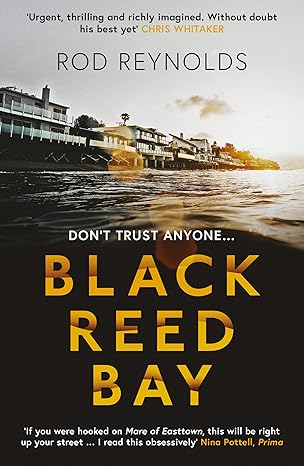
Review of BLACK REED BAY by Rod Reynolds

 4 Stars

I’ve received an advance reading copy of Shatter Creek by Rod Reynolds. When I discovered that it is the second in the Detective Casey Wray series, I decided to read the first installment, Black Reed Bay.

A young woman named Tina Grace makes a frantic 911 call in the middle of the night from an exclusive community on Long Island. Then she disappears. Casey leads the investigation, assisted by her team, especially her partner Dave Cullen. From the beginning she feels that people are not being truthful, but things become more complicated when bodies of young women are found near where Tina disappeared. And then there are office politics and the possibility of corruption in her department which make it difficult for Casey to know who can be trusted.

Since this is the first of the series, I paid particular attention to character development. If I do not engage with the protagonist, I will not continue a series. This is not an issue here because I found myself liking Casey right from the beginning. Now in her late 30s, she faced challenges when she was a rookie but has proven herself and earned the respect of colleagues. Married to her job, she has virtually no personal life; her partner tells her that “the job was so far under her skin, she’d need an exorcism to be free of it.” Her intelligence is obvious in her constant questioning of the information they uncover. Her determination is also noticeable; she may become frustrated as promising leads become dead ends, but, motivated by a desire for justice, she never gives up. She is also highly principled: she has a clearly defined sense of right and wrong and conscientiously does what is right.

It is Casey’s relationships with others that caught my attention. I loved her snappy, sassy banter with her co-workers. The wise-cracking lightens the mood and gives a real sense of camaraderie amongst the team. Casey knows her team members well, supporting them and helping them build self-confidence. Her relationship with Tina’s family is also noteworthy. She sees Tina as a person, not just a victim, and does not judge Tina’s choices or those of other family members.

Though a strong character, Casey is not perfect. She’s capable, honest, hard-working, and compassionate, but she also has insecurities and vulnerabilities. In the middle of the novel, she is involved in a traumatic event that shows her fragile side. I love such a complex and credible main character.

The novel starts slowly but gains momentum. As the investigation continues, it’s obvious that people are keeping secrets. And as one would expect, there are some surprises. An incident in the middle of the novel is a real shocker! And then it seems that Casey herself is in danger so tension ramps up.

This is a solid, satisfying police procedural which kept me engaged from the beginning. I want to spend more time with Casey Wray so I’m off to read Shatter Creek.

Friday, May 16, 2025

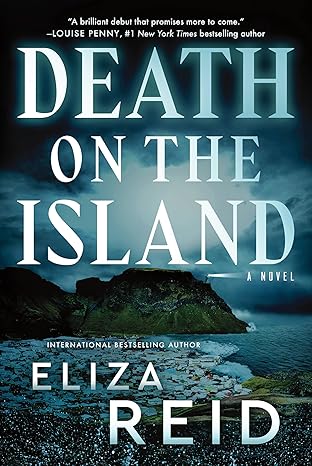
Review of DEATH ON THE ISLAND by Eliza Reid (New Release)

 3 Stars

I was interested in reading this debut novel written by a Canadian who served as First Lady of Iceland for eight years. Unfortunately, I was disappointed because it very much has the hallmarks of a debut.

The novel is set on Heimaey, the only inhabited island of the Westman Islands archipelago off the south coast of Iceland. Kavita Banerjee, the deputy ambassador of Canada, is killed at a dinner party. Everyone present becomes a suspect, including Graeme Shearer, the Canadian ambassador. His wife Jane decides to investigate.

This is described as a locked room mystery because everyone is stranded on the island when a storm prevents the ferry from operating. Some suspense is created in Part II which begins with Chapter 15 entitled “Thirty-Seven Hours Before He Dies”; this foreshadows a second death, though the reader knows only that the second victim will be a male.

My problem with the novel is that there are a lot of events that are not credible. First of all, as the author mentions, “Canada’s real embassy in Iceland is so small it doesn’t have a deputy ambassador or someone serving at that level. In fact, Canada has very few embassies with a position of deputy ambassador.” So why give Kavita this position? There’s a refugee subplot and, again, the author acknowledges that this is an “unlikely scenario” which requires the reader to suspend disbelief. So why not devise a more logical subplot?

Also in the Acknowledgments, Ms. Reid mentions that “of course there would be more officers on duty on Vestmannaeyjar than I have allowed the story to have.” The use of the incompetent/inexperienced policeman trope is carried to an extreme. When senior officers return to the island, why is Jónas allowed to remain in charge, especially because he makes such basic errors like allowing suspects to leave the scene so everyone has “’ample time to get stories straight and destroy anything incriminating’”? He doesn’t even question suspects individually, letting other suspects listen!

There are other plot issues. A man would allow virtual strangers to go through the personal papers of his recently deceased husband? A random person knows all the details of the dinner party and has even heard the initial medical findings? Then there are the unbelievable coincidences like Jane impulsively stealing some random papers which prove to be of utmost importance. And, finally, how can someone find a manuscript and know that there are two more books or that a short passage from another manuscript proves that it is “’clearly meant to be the third part of a trilogy’”?!

Because there are so many implausible actions, astute readers will be left less than impressed. In addition, the characters feel flat. They are really only sketched, not fully developed. What differentiates the characters is their occupations or pre-occupations more than their personalities. This is even the case with Jane whose perspective is presented the most.

For me the strongest element is the Icelandic setting. Though I’ve visited Iceland, I’ve not been to the Westman Islands so I enjoyed the descriptions and the historical information.

In an interview, the author mentioned that there will be another book featuring many of the characters from this story. I hope its plot will be less meandering with a faster pace, more tension, and fewer implausibilities.

Note: I received an eARC from the publisher via NetGalley.

Monday, May 12, 2025

Review of FOG AND FURY by Rachel Howzell Hall (New Release)

3.5 Stars 

Sonny Rush, after 10 years with the LAPD, takes a job as a private investigator with her godfather’s firm in Haven, California. Her first case is to find Figgy, a missing goldendoodle. Figgy’s case is brought by Mackenzie Sutton and her mother, London Sutton. The twist is that London is married to Cooper Sutton, Sonny’s long-term lover, who had told her that he was getting a divorce. Around the same time, the body of Xander Munroe, a gifted teenager, is found, and Sonny offers to help his family because she fears that because they are Black, Xander’s death will not be investigated thoroughly. It does not take long for Sonny to realize that Haven is not the idyllic place that it may initially seem to be.

This is obviously the first of a series because at the end there is a cliffhanger ending and a lot of unanswered questions. I dislike such endings. Though I understand the desire to entice people to read the next book in the series, I think that creating a relatable protagonist and developing a suspenseful plot are usually sufficient to hook readers into following a series. In this case, the ending just seems manipulative.

Sonny is certainly the strong and feisty main character. Her determination is what stands out; she’s “ready to burn through the heavenly veneer of this charming seaside town and expose the truths lurking beneath.” She has a vulnerable side and personal demons. Sonny has to care for her mother who is experiencing memory issues, and events in Los Angeles have left her with self-doubts and “addicted to guilt.” In many ways, her world has been turned upside down. I loved Sonny’s sarcasm but for some reason I had difficulty connecting with her.

What is emphasized about Haven is that it’s a community with a lot of tensions, especially between long-term residents and newcomers. Cooper, the wealthiest man in the town, wants to renovate the town and create it into a tourist destination. The town is predominantly white; Sonny mentions that the “only obvious diversity was the flavors of Gatorade in their bottles.” She is one of only a handful of Black residents in the town. Because of her colour, she is an outsider and she becomes even more of one when she starts investigating Xander’s death with more seriousness than the police who definitely have a racial bias.

I guessed the villain because there are a lot of clues; it’s actually difficult to believe that Sonny doesn’t see the obvious. I didn’t guess the twist at the end but even there I suspected someone because of the vagueness that surrounds that character.

The title is perfect. Both fog and fury play significant roles. Fog almost becomes a character; it is ever present, emphasizing Haven’s hidden secrets and adding danger and thereby heightening tension.

I can’t say that the novel offers anything exceptional; it is like so many other crime fiction novels. I will probably pick up the next installment in the series, but I can’t say that I’ll be anxiously awaiting its arrival.

Note:  I received an eARC from the publisher via NetGalley.

Friday, May 9, 2025

Review of WATCHING YOU WITHOUT ME by Lynn Coady

 3.5 Stars

I discovered that I’d missed this novel by Lynn Coady when it was released in 2019 so decided I’d catch up.

In her mid-forties, Karen Petrie returns to Nova Scotia after her mother’s death. Aside from dealing with grief and guilt at virtually abandoning her mother for years, Karen also becomes the caregiver for her older sister Kelli who has a developmental disability. Trevor, a home care worker, arrives to take Kelli for walks but quickly begins to insert himself into their lives. Though uneasy with his overbearing personality, Karen gives in to Trevor’s eagerness to help and allows him to go “above and beyond his designated role” as she struggles with achieving balance in her life so care for Kelli doesn’t take over her life as she feels it did her mother’s.

The increasingly dangerous situation with Trevor frames the narrative, but it is also very much a story about Karen’s relationship with her mother and her sister. Karen comes to realize how selfish and self-centred she was in her younger years and comes to understand her mother and her motivations. I enjoyed seeing her personal growth in this regard; however, her unwillingness or inability to see the danger Trevor poses is unbelievable.

From the beginning, Trevor’s behaviour is creepy. He goes from being manipulative to vaguely threatening. Karen’s mother had apparently given him a key and he uses it to make unexpected visits to the house. He becomes upset when Karen makes unilateral decisions and steers her away from what seem like sensible decisions about Kelli’s care.

Other people like a neighbour, another care worker, and Karen’s friend Jessica see Trevor’s problem with boundaries. Even Karen makes observations like “he sometimes took things weirdly personally and had kind of bullied my sister and me into accepting various acts of kindness on his part” and he was “a little pushy. He could be bossy, and moody when he didn’t get his way. But most of all, he was presumptuous.” Nonetheless, she ignores warnings and makes excuses for his behaviour. Karen is middle-aged and well-educated, “holder of two advanced degrees” – a lawyer working as a legal consultant – yet she doesn’t recognize obvious warning signs? She’s basically a doormat, allowing herself to be bullied and emotionally manipulated. She is dealing with a lot of heavy emotions but surely that doesn’t mean all critical thinking skills are turned off.

Karen is the narrator and she speaks in a conversational tone. It’s obvious that she is telling a story because she makes comments like “What was wrong with you, friends always ask when I get to this part of the story” and “What was I planning on doing, exactly? People always stop me, when I get to this part of the story, to ask that question, because I can never quite articulate what it is I had in mind” and “To this day I shake my head at those instincts. I shake it right along with all the people I tell this story to.” Besides emphasizing Karen’s poor judgment, these comments weaken suspense because it’s obvious that in the end all will work out. This is a problem for a book described as a suspense novel.

This is not a bad novel, but it didn’t grab and hold my attention as I expected.

Monday, May 5, 2025

Review of THE LOTUS SHOES by Jane Yang

 4 Stars

This historical novel, set in 19th-century China, has two narrators, Little Flower and Linjing, from very different backgrounds whose lives become intertwined.

When she is six years old, Little Flower is sold as a maidservant to Linjing, the daughter of the prominent Fong family. Little Flower is an unusual servant: she has bound feet, a sign of her good character, which should also improve her chances of a good marriage. She is also extraordinarily gifted at embroidery, a skill associated with the highest class. Little Flower hopes her bound feet (golden lilies) and her skill might lead her out of slavery, but Linjing does all she can to keep her by her side. When scandal strikes the Fong family, Little Flower sees opportunities to improve her status, but Linjing is determined to prevent her chances of advancement.

The reader will learn a great deal about Chinese culture in the 1800s. For example, foot binding, the importance of marriage and child-bearing for women, social hierarchy, and filial responsibilities are detailed. What is also significant is that Christianity and Westernization are making inroads so there is a clash between Chinese traditions and Western ideas and values.

Little Flower is a likeable character. She is intelligent and compassionate and determined. She wants freedom but her attempts are thwarted by Linjing so Little Flower learns that “promises from the genteel class were not to be relied upon if my safety clashed with their self-interest.” Linjing is less likeable. She’s a privileged girl whose father spoils her so she is accustomed to getting what she wants. Selfishness is her dominant trait; Little Flower’s comment that Linjing’s selfishness “had cost me everything” is definitely not exaggeration. Linjing becomes jealous of Little Flower’s embroidery talent and so treats her cruelly. She sees Little Flower not as a person but as her property.

Linjing, because of her upbringing, has difficulty growing and changing. For instance, though she pretends to be Little Flower’s friend, Linjing admits, “I couldn’t alter my sentiment, but I would change my conduct: outwardly. I would treat her as an equal – surely the latter mattered more.” Only much later does she acknowledge her flaws: “I had been too attached to privilege to stand on my own feet. All my life, I had enjoyed these advantages of class without sparing a thought for the women who had forfeited their freedom, and often their dignity, to serve ladies like me.”

Little Flower describes the difference between her status and that of Linjing: “She lived in a world of boundless streams and rivers, each waterway feeding into another until they converged in a vast ocean of opportunity. I inhabited a shallow, fenced-in pond.” Later, however, Little Flower comes to understand that “in this world only men had the freedom to act, to roam, to live.” Linjing also realizes “we lived in a hierarchy that favored men” because, though she is of high status, her life is shaped by the decisions of men like her father.

The novel explores the complexities of female relationships in a male-dominated society. Women are often cruel to each other but that behaviour is understandable given women’s constrained lives. Linjing mentions, “Women, be it peasant or lady, first wife or minor wives, were pitched against each other, fighting among themselves for scraps of power and security.”

I enjoyed this novel, quickly becoming emotionally invested in Little Flower’s fate. The pace is sometimes slow, but my interest was maintained. I recommend the book to those who enjoy the novels of Lisa See, especially her Snow Flower and the Secret Fan.

Thursday, May 1, 2025

Review of THE WINEMAKER'S WIFE by Kristin Harmel

 2.5 Stars

Three years ago, I read Kristin Harmel’s The Book of Lost Names and I was not impressed. The Winemaker’s Wife is a bit better but has similar flaws.

There is a dual timeline, both focused on the Champagne region near Reims, France. One plot is set during World War II, and the perspectives of two women, Inès Chauveau and Céline Laurent, are given. The other timeline is 2019; the perspective of Liv Thierry Kent is provided.

Michel Chauveau owns a winery specializing in champagnes which he manages with the help of his winemaker, Theo Laurent. Theo’s wife Céline ably assists the men. Michel’s younger wife Inès tries to help but she is new to the business, unlike the other three, and she feels useless. When the Germans invade and occupy northern France, lives for the four change. Michel becomes involved in the Resistance. Theo’s sole focus is wine-making, despite his wife becoming increasingly worried because she is half Jewish. Like Theo, Inès tends to be dismissive of the seriousness of the actions of the German occupiers.

In the modern timeline, Liv, a woman in her forties who has recently divorced, is taken by Edith, her 99-year-old grandmother, to Paris and eventually to Reims where she says she has some business. There, Liv meets Julien, the grandson of her grandmother’s longtime lawyer. Liv eventually comes to realize that her grandmother wants her to know about events that happened during the German occupation, events involving her family members that changed the futures of many.

The novel requires some suspension of disbelief. Edith is 99 years old, but shows little evidence of her advanced age. Is it really necessary for her to fly from Paris to New York just to pick up Liv and fly back to Paris a few hours later? Edith’s reluctance to speak of her past is understandable to some extent, but given that she delayed too long to tell David, wouldn’t she be anxious to tell Liv before time runs out?  And if Edith is 99, how old is the person who shows up at the end?!

There are other problematic events. Liv and Julien’s relationship happens so quickly, and does there really have to be that mix-up about Julien’s marital status? There’s certainly a lot of coincidence, especially in the current timeline. I could certainly have done without that scene where a character is welcomed into heaven. And the number of characters who are thought dead but are actually not dead stretches credibility.

There are events which are supposed to be a surprise, but I anticipated many of them. For instance, the title would not be appropriate if the eponymous character were dead. Then there’s the vagueness about the fates of at least a couple of the characters. When Liv gives a newspaper interview, it would be impossible not to guess who will appear. And the ending tying up everything ever so conveniently is predictable.

Most of the characters are unlikeable. Though her youth is obviously a factor, Inès is so immature, selfish, shallow, and naive. She doesn’t like being dismissed or thought of as stupid, but then makes stupid, reckless choices that endanger everyone. We are to believe that growth does happen, but I wasn’t convinced. Edith, at 99, has learned some important lessons, but her comments to Liv sometimes seem almost cruel. And Liv believes that “her grandmother had never really stopped being the naive girl from Lille.” Liv herself just seems oblivious most of the time. And Céline’s choices do not cast her in a positive light.

And the men are no better. Michel chooses a younger wife but then is surprised and frustrated when she behaves like a young woman who does not have his worldly knowledge or experience. He’s so patronizing and impatient. Theo’s treatment of Céline is hard to excuse; he makes no effort to understand her situation.

This novel is less historical fiction and more historical romance, light on history and heavy on the romance. Historical details are glossed over. The focus is on love triangles and extra-marital affairs. The motivation for many events is who loves whom or who cheats on whom or who is jealous of whom.

This book is entertaining, provided the reader is willing to ignore the plot holes and coincidences and enjoys a predictable, sentimental narrative about not particularly sympathetic characters. Learning about the making of champagne was the highlight for me.