Ranked a Top Canadian Book Blog
Twitter: @DCYakabuski
Facebook: Doreen Yakabuski
Instagram: doreenyakabuski
Threads: doreenyakabuski
Substack: @doreenyakabuski
Bluesky: @dcyakabuski.bsky.social

Monday, June 30, 2025

Review of DOUBLE ROOM by Anne Sénès (New Release)

 4 Stars

I found this novel a perplexing, unsettling read.

In the late 1990s, Stan is a French composer living in London. He meets Liv with whom he immediately falls in love. They marry and have a daughter whom they name Lisa. Life is happy until a tragic accident. Totally bereft, Stan moves to Paris to live in a house, known as the Rabbit Hole, which he inherited from an aunt. He is joined by Babette and her son Téo. Though romantically involved with Babette, it is obvious that Stan does not have the same intense relationship with her that he had with Liv. To complicate matters, Stan built an AI assistant (like Amazon’s voice assistant Alexa) which he endowed with Liv’s voice and named Laïvely. When Laïvely seems to take on a life of its own and becomes a somewhat malevolent presence, things start to go awry.

Actually, awry is a good adjective to describe my thoughts about the book as I read: from the beginning I felt that something was amiss. Clearly Stan is a haunted man, unable to move past his loss and grief. When Laïvely seems to gain autonomy, Stan wonders, “had I imagined things that didn’t exist in order to fill the interior solitude in which I had been abandoned after the death of my lover?”  He asks, “Is this the first time that I’ve given the objects that surround me gifts they are far from able to possess? Is this parallel universe my downfall, or, on the contrary, my salvation? Does my equilibrium come from my belief in their talents, or is this the definitive proof that I am losing my mind?” Later, he ponders, “Is this electronic thing nothing but a receptacle for my wandering moods? Or is she gifted with what might be called a conscience?”

Stan is a synesthete. He explains, “Tastes, sounds and colours all form an amalgam within me” so, for example, he describes Liv’s voice as containing “the purity of a nightingale’s song, the grace of the gentle summer tide in La Baule, the lightness of the wind in the Corsican pines. It was powder pink, with a touch of raspberry red at its heart. It had the aroma of orange blossom.” Synesthesia is a different way of experiencing and processing information, but that is not all that makes Stan unique. He speaks about being a strange child and refers more than once to childhood visits to doctors. He mentions “I distorted reality when I was really caught up in a composition” and “Sometimes I’d have blackouts . . . when I remained focused on myself for too long.” And of course it could be said that, like Alice who falls down a rabbit hole into a bizarre world, Stan is on a strange journey which becomes increasingly stranger.

The great reveal at the end didn’t come as a great surprise to me, but I’m not certain if I’ve figured out everything about what has been going on. I’m troubled by phrases like Stan feeling “the powerful sensation of being alive” and, at another time, stating “I was absolutely alive.” Yet at one other time, he describes himself as “nothing but a slightly delayed robot with a wobbly gait, powered by a jumble of wires and cords, some of which had been cut.” Near the end, he comments, “I no longer know where to situate my absences from the world, or my place within it. I no longer know what is dream and what is reality.”

This last comment, the epigraph quoting "The Double Room" by Charles Baudelaire, and the book’s final image leave me uncertain about what really happened and what did not. More than one possible interpretation seems plausible, just as there are three returns from Oxford. Am I overthinking?

As I said at the beginning, this is a disconcerting book. I think it’ll be on my mind for some time. And I know it’s one I will re-read when I have some time.

Thursday, June 26, 2025

Review of THE FROZEN RIVER by Ariel Lawhon

 3.5 Stars

This historical novel is set in Hallowell, Maine, between November 26, 1789 and April 30, 1790.

Martha Ballard, 54, married to Ephraim, is the mother to six surviving children. She is a midwife who also takes on the role of amateur sleuth when a murder occurs in their small community. Rebecca Foster was raped by two men, Joshua Burgess and Colonel Joseph North. Burgess’ body is found in the river, though Martha’s examination leads her to conclude he was beaten and hanged before his body was dumped in the river. Did North kill Burgess, the only witness to their crime, or did Rebecca’s husband exact revenge or was someone else the murderer? There are complications to the case: North is a judge in the local court, North controls the Ballard family’s lease on their property, Rebecca is pregnant as a result of the rape, and Martha’s oldest son Cyrus was seen fighting with Burgess the night of his death.

In some respects this book is a murder mystery. There is however, not a lot of suspense and the pace is slow. The book does highlight the lack of women’s rights and the injustices they faced. If a woman had a child out of wedlock, she was fined and ostracized by the community; the man went unpunished and, even if named as the father, faced no obligation to provide for the child. Men are never found guilty of sexual assault unless there is a witness to the attack. Martha points out that during one court date, “’The jury acquitted ever man tried of rape . . . But they fined a woman into poverty for spreading lies.’”

Martha is certainly a feminist. My problem is not with her attitude towards the poor treatment women receive but to the accuracy of such a portrayal. Martha’s views are those of a modern woman, not those of someone living in the late eighteenth century. There is also the issue of the number of children born out of wedlock; it’s almost an epidemic. Attitudes to sex outside marriage were censorious, and the consequences for women harsh yet in this novel extra-marital sex is almost a norm: there’s Lucy (Martha’s eldest daughter) and May Kimble and Sarah White and Sally Pierce and her four sisters, and those are just the ones that are specifically identified.

Martha is a problematic character for another reason. She is strong, independent, capable, and intelligent, yet I found her difficult to like. She comes across as self-righteous and condescending. She believes she knows best and looks down on anyone who disagrees with her. She’s quick to judge others like the wives of Colonel North and Dr. Page, viewing them as guilty by association. Of many men she is dismissive, but her husband is a paragon.

Indeed Martha and Ephraim’s relationship seems over-the-top. He’s the perfect husband who supports his wife in every way and has done so for the 35 years of their marriage. Their sex life seems like that of a modern couple; when first married, Ephraim restrained himself for weeks, but now they have sexual encounters in various settings. The sex talk doesn’t fit the time period. Would a man in the 1700s really say something like, “I wouldn’t mind if you hardened my shaft tonight”?

The novel is longer than it needed to be. There are some elements that seem superfluous. For instance, the scenes with the fox are unnecessary. And how many times must we be told that women are the ones who choose a man? There are a lot of secondary characters to keep track of. What is needed however is some character development. North is a caricature of a villain; he possesses no redeeming qualities. And Dr. Page is another cliché: a vengeful misogynist.

The book is entertaining, but its literary quality is not exceptional, and I’m not convinced of its historical accuracy.

Monday, June 23, 2025

Review of THE HOMEMADE GOD by Rachel Joyce (New Release)

 4 Stars

Much of this family drama is set at a beautiful but decaying villa on an island in Lake Orta in northern Italy.

Four siblings – Netta, Susan, Goose, and Iris, aged between 33 and 40 – gather at the villa after the sudden death of their father, Vic Kemp. Vic, a commercially successful artist, had recently married Bella-Mae, a woman 50 years his junior, and then left London for Italy to work on what he claimed was going to be his life’s masterpiece. When they arrive, the siblings can find no sign of a will or of the painting. Fearing that Bella-Mae may have played a role in Vic’s death, they insist on an autopsy and stay at the villa to await the results. They are joined by their stepmother and her cousin Laszlo. The time spent together after their father’s death forces them to confront their pasts. What they learn about themselves and their father ends up tearing them apart.

I really appreciated how the three sisters and their brother emerge as fully differentiated characters. Each has secrets and scars from past wounds. There are flashbacks to pivotal events that shaped them. Netta, the eldest, was forced into a parental role at an early age after the death of their mother. She wants to be in charge and is quick to anger. Susan has always wanted to be like Netta but resents living in her shadow. Susan’s entire life seems to be a compromise as she settled for second-best. Goose (Gustav) is artistic but believes that creating his own art led to his mental breakdown so he’s a lost soul. Iris, praised by her father for her ability to be still, is withdrawn and anxious.

Vic is present only in flashbacks, but it’s obvious he, with his larger-than-life personality, was someone impossible to ignore. He was a narcissist who needed to be the centre of everyone’s attention. Such a self-centred individual is not the best of fathers. He hired au pairs to look after his children and did virtually nothing to support or encourage them to pursue their dreams. Only as an adult does Goose realize “the acute loneliness of those four children, staring up into other people’s houses while their father worked, waiting for the lights to come on.” I found it difficult to like Vic but it’s understandable that his four children adored him; having lost their mother, they clung to their father. Their relationship was not healthy but makes sense given the circumstances and Vic’s domineering personality.

The four lived in the shadow of Vic’s ego and were negatively affected by his focus on himself. After his death, the adult children physically travel to Italy but also take journeys of self-discovery. They are forced to realize things about their difficult father that they denied or repressed. Their lives were stunted by their father; though of an adult age, they have not actually grown up. It’s only his death that allows them to realize their potential. It is Vic’s treatment of Goose that is particularly shocking though perhaps understandable given Vic’s obsession with being recognized as an artist.

I’ve enjoyed many of Rachel Joyce’s novels (The Music Shop, Miss Benson’s Beetle, and the Harold Fry trilogy) so looked forward to reading her latest. I was not disappointed. It explores how children’s lives can be shaped well into adulthood and how family relationships can be fractured and, hopefully, mended.

Note: I received an eARC from the publisher via NetGalley.

Friday, June 20, 2025

Review of FOX by Joyce Carol Oates (New Release)

4 Stars 

This is a disturbing book with dark subject matter (pedophilia), but its psychological insight is impressive.

Francis Fox is a charismatic middle-school English teacher at a prestigious New Jersey private school, Langhorne Academy. His students love him, his colleagues regard him highly, and parents are enchanted as well. When his car is found submerged in a pond in a nature preserve and his body eventually identified, an investigation uncovers the truth behind his facade. Detective Horace Zwender discovers that Mr. Fox was aptly named; he was a fox hunting for kittens, a master manipulator and predator who was able to hide in plain sight, leaving a trail of damaged lives.

The book presents multiple points of view. Besides that of Fox, the reader is given the perspectives of his prepubescent victims, as well as various adults like parents of students, the headmistress of the school, friends, and others who are really secondary victims of Fox’s abuse. There’s even a chapter from the point of view of Princess Di, the dog belonging to the school’s headmistress. The narrative moves back and forth through time, so we learn about Fox before his arrival at Langhorne Academy and we follow the investigation after his death. At the end, the reader sees the long-term effects on Fox’s victims.

The book is a whodunnit, but it is also very much a character study. Fox is a repellent narcissist who has no difficulty justifying his abhorrent behaviour. He knows how to charm people. An interesting example is P. Cady, the headmistress, who is determined not to add a white male to the school’s staff but ends up being totally conned by Fox and becomes one of his staunchest supporters. He gives women false flattery so they will befriend him and provide him cover should his behaviour be scrutinized.

Fox’s victims are prepubescent girls, usually with an absent father. Fox grooms them by making them feel special. Because their thoughts and feelings are included, the reader comes to understand how a vulnerable young girl would fall victim to Fox. What chance does she have when even intelligent adult women are captivated? Zwender comments on the blurred boundaries between predator and prey: “The serial pedophile is like a serial killer: hiding in plain sight. He’s usually a nice guy, everyone likes him. It’s rare that a young girl isn’t in love with her abuser, that’s how the abuse is possible.”

The novel explores the abuses of power – how people like Fox are able to evade responsibility and how institutions are often complicit in enabling abuse by their inattention and passivity. The ripple effects of abuse are examined; it is not just victims who are impacted but their community as well. The book also touches on other topics like how socio-economic barriers can impede people from achieving their potential and how abuse can be facilitated by poor or inadequate parenting.

At almost 650 pages, this is a lengthy book, and there is certainly some repetition. However it is so well-written that my interest did not wane. The author excels at similes and metaphors. Those who accuse him of inappropriate behaviour, Fox thinks of as “Harpies. Shrieking beaks, razor-sharp talons, small beady-glaring eyes of raw jealousy.” Before P. Cady falls for Fox’s flattery, her smile “might be measured in single-digit millimeters.” When he first arrives at Langhorne Academy, Fox makes his way at a gathering of colleagues “like a sea lamprey through a school of oblivious lake trout.” When Fox thinks that he should marry so as to suggest a normal life, he observes one potential mate “with the grim-smiling resolve of a hungry carnivore contemplating a head of cabbage” and another “as if he’s wearing one of those lead-lined vests dental patients are made to wear when enduring X-rays.”

The novel examines the darkness of the human soul and uncomfortable truths so is a difficult and unsettling read. However, its psychological insight and emotional depth make it a worthwhile read. It is not a book a reader will soon forget.

Note: I received an eARC from the publisher via NetGalley.

Monday, June 16, 2025

Review of SHAW CONNOLLY LIVES TO TELL by Gillian French (New Release)

 3.5 Stars

Shaw Connolly is a fingerprint analyst living in a rural Maine community. Besides the stresses of her job, Shaw is still suffering with the trauma of losing her sister. Sixteen years earlier, in 2007, her sister Thea went missing and has never been found. Thea is never far from Shaw’s thoughts; in fact, Shaw is obsessed with finding out what happened. Her marriage has suffered, as has her relationship with her youngest sister, and the lives of her two young sons are impacted by her relentless pursuit of the truth.

Shaw receives taunting calls from a man named Anders Jansen who implies that he had something to do with Thea’s disappearance. The calls become more threatening as it becomes obvious that Anders has been stalking Shaw. She is desperate to end the sinister calls, but she is also desperate to learn exactly what knowledge Anders has of Thea’s fate. A game of cat and mouse ensues.

Shaw is an interesting character. She is skilled at her job and remains unflinching in face of the horrors she witnesses at crime scenes. She has a tough exterior and is often bold and brash. A softer side is revealed in her nurturing of her young colleague whom she has been asked to mentor. And Shaw is so loving and protective of her family. Her vulnerability is obvious in how, even sixteen years later, she is haunted by her sister’s disappearance from their lives.

The pace of the novel is uneven. It begins very slowly with little suspense. There are scenes which seem to have little or no relevance. For instance, Shaw testifies as an expert witness for a court case. Her testimony goes on and on; it does emphasize her personality but we’ve already seen these traits. Then there’s the romantic subplot which also seems unnecessary and lessens the suspense one would expect in a book marketed as a thriller. Tension does build in the later part of the book when Anders’ threats become more menacing and overt so danger to both Shaw and her family escalates.

I found the relationship between Shaw and her surviving sister Mads especially interesting. Being younger, Mads has fewer memories of Thea and resents having her life defined by somebody whom she doesn’t remember clearly: “’Maybe we could start living for ourselves instead of some memory of a seventeen-year-old who never even had a chance to grow into somebody interesting, and some depressing old step-by-step story about the last time we saw her alive.’” Mads points out how obsessed Shaw is: “’Maybe you’re the one who should sit down and look at the Thea you think you remember. See if you can even separate her from yourself at this point.’” All of this has Shaw worried that she is going to lose her surviving sister as she searches for the truth about the one who didn’t survive.

There are some unanswered questions which irked me. What happens with Shaw’s relationship with McKenzie after her admission about Ryan? Does Aphrodite recover? Anders’ answer to Shaw’s question, “’Why do you hate me so much?’” is unconvincing. And that answer would surely result in a more emotional reaction after she’s had time to consider its implication, or does she interpret it merely as calculated manipulation?

Gillian French is known as a young adult author, this novel being her first foray into adult suspense fiction. The book does have some of the weaknesses found in a debut but is nonetheless entertaining.

Note: I received an eARC from the publisher via NetGalley.

Friday, June 13, 2025

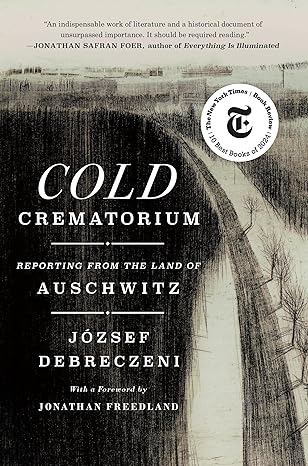
Review of COLD CREMATORIUM: REPORTING FROM THE LAND OF AUSCHWITZ by József Debreczeni

 5 Stars

Occasionally I like to intersperse my fiction reading with some non-fiction so I chose this memoir which was recommended to me.

This book was first published in 1950 but was only translated into English last year. József Debreczeni was a Hungarian poet and journalist. After three years as a forced labourer, he was deported to Auschwitz in May of 1944. As prisoner 33031, he spent twelve months of incarceration and slave labour in a series of camps, ending in the Cold Crematorium, the so-called hospital where prisoners too weak to work awaited execution or death.

I’ve read Holocaust literature in the past but found this book offers a unique perspective: it was written soon after the war by an adult journalist and focuses not on death camps but on the slave-labor camps. As Jonathan Freedland writes in the Foreword, József’s “are the recollections of a fully conscious adult . . . [and] he writes as a professional, highly skilled observer . . . with a journalist’s eye for the telling, human detail.”

The book may not have new information for students of history, but I certainly learned things I did not know. For instance, I had never heard of the network of sub camps around “the capital of the Great Land of Auschwitz.” I had never heard of Dörnhau which Debreczeni calls a cold crematorium. I also did not know that the Nazis began construction of an underground city in Lower Silesia.

Of course what stands out is the unimaginably horrific suffering of the prisoners, the häftlinge: dehumanization, starvation, beatings, backbreaking labour in dangerous working conditions, disease, mental illness, etc. Even if a häftling worked hard, he might not escape death. After a group’s best worker was identified, a German officer shot him: “’A little demonstration . . . an example of how even the best Jew must croak.’”

It is descriptions of conditions in Dörnhau that I cannot forget: “The November cold pours in through the broken windows, and yet the stench is unbearable all the same. A suffocating stink oozes from the walls. Rising between the rows of bunks, several centimeters high, is an odious yellowish slurry of dung. Naked skeletons are sloshing through the putrid river. . . . Everyone has diarrhea. Hence the horrid yellow streams along the rows of beds.” Beds are shared: “Two or even three half- or completely naked men occupy each bunk. Only a few have blankets.” Debreczeni comments, “No tranquility here, that’s for sure. . . . A dizzying cacophony of moaning, whimpering, shrieking, whining, and delirious snarling.” Dörnhau is a death factory: “In Dörnhau, those whose turn has come depart mostly after dark. The nights belong to struggling moans, screaming farewells and delirious wails for homes.” Sometimes, “The nights drag off forty or fifty every twenty-four hours.” Debreczeni estimates, “I’ve passed eight nights pressed up against a cooling cadaver.”

What is also emphasized is “the camp aristocracy, the wretched gods of this wretched world.” The Nazis created a hierarchy among the inmates, those entitled to better food, better clothes, the opportunity to steal, including gold teeth from corpses, which can be traded for food, and “that most intoxicating opiate of all. Boundless power over life and death.” Debreczeni understands the reasoning: “the best slave driver is a slave accorded a privileged position” and “This aristocratic hierarchy reflected the Nazis’ modern interpretation of the concept ‘divide and conquer’.”

This book is a very difficult read but a very necessary one. The suffering endured by Nazi victims must not be forgotten. And there’s the aphorism that “Those who cannot remember the past are condemned to repeat it.” Debreczeni is convinced “that the average Nazi who had dealings with us imagines, more or less, that standing there before them are a bunch of ex-convicts, common criminals, and that every Jew had notched up at least one murder. . . . they had been taught to believe exactly this sort of thing.” Current events – rounding up of immigrants in the U.S., Russian justification for its war on Ukraine, and the indiscriminate killings in Gaza – suggest we have forgotten what can happen when those who are different from us or do not share our beliefs are vilified and dehumanized.

Monday, June 9, 2025

Review of WHALE FALL by Elizabeth O'Connor

 4 Stars

When I read Clear by Carys Davies and posted my review, a follower of my blog recommended Whale Fall because it also deals with life on an isolated island.

This novel is set in the last four months of 1938 on an island with a population of 47 off the Welsh coast. The narrator is 18-year-old Manod Llan who lives with her father and her younger sister Llinos. She spends her time helping her father, looking after her sister, and doing embroidery. When Edward and Joan, two English ethnographers, arrive to study and document the islanders’ lives, customs, and folklore, Manod is hired to translate for them and to transcribe interviews because she is fluent in English and Welsh. Manod is anxious to leave the island and she thinks that she might be able to go with them to the mainland after they’ve finished their field work, especially as they provide her with glimpses of life outside her small community.

Manod is a memorable character. Her intelligence is obvious, as is her love for her family. She is very attuned to the rhythms of island life; her descriptions show her awareness of both the beauty of the island and the hardships of life on that island. Marriage is what is expected of a young woman her age, but she is resistant to the idea and yearns to expand her horizons. She’d love to study at a university. However, her desire to escape is in conflict with her loyalty to home and obligation to look after Llinos.

Life on the island is disrupted by a whale that washes up on shore. That whale serves as an omen in many ways; it washes up just before the two unprincipled foreigners arrive. The rotting carcass is also a physical representation of the community’s death. I thought of Edward and Joan as scavengers picking at a decaying corpse.

When she first meets them, Manod admires Joan and Edward, but that admiration turns to disillusionment once she realizes that in their desire to write a compelling book and to advance their careers, they are writing a false narrative. Reading what the two write about the islanders, she comes to see their lack of understanding and their romanticization of life in an isolated community. For example, Edward and Joan have a fisherman, who cannot swim, go into rough water so they can have an action photograph for their book. Manod tells them that this not the way the island fishermen actually fish, but accuracy is not their concern. Instead of realistically writing about the culture on the island, they distort it. How they have betrayed her trust is obvious in Manod’s comment that “’The island that’s in your head. I don’t think it exists.’”

Both Joan and Edward are despicable. They are manipulators, liars, and thieves. Joan tells Manod that she must study at university but then does nothing to help her. Then there’s her use of Manod’s embroidery! She is so patronizing: “Often my conversations with Joan went that way: me telling her something she did not know before, her arguing with it.” Edward is no better: when Manod explains that during World War I, all the men had to leave to fight and the women were left to farm and fish themselves, Edward laughs and comments, “’Like Lesbos . . . Sounds idyllic.’” In his behaviour towards Manod, Edward is just weaselly. His comments about dresses are just cringy!

The writing style is lyrical but understated. Dialogue is spare. It is the precise, evocative language that is beautiful in its simplicity. Visual imagery abounds: “rust-sick boats” and a filthy and grey sea “covered in a horrible yellow foam” and rocks “covered in white lichen, its fronds shaped like minuscule hands” and “whole crowds of crabs scuttled in, washes of red and green. In the cliffs, the gorse grew thick with copper heather and white butterflies. The cow parsley curled brown.”

This is a quiet, understated book but it’s definitely memorable.

Friday, June 6, 2025

Review of THE CATCH by Yrsa Daley-Ward (New Release)

 3 Stars

This is an esoteric novel that will be loved by some readers; unfortunately, I am not one of them.

Clara and Dempsey are 30-year-old twin sisters abandoned by their mother who presumably drowned in the Thames River. The girls were adopted separately and lived very different lives. Though they have reconnected, theirs is a difficult relationship. One day Clara sees a woman who looks exactly like their birth mother and even has her name, Serene Marie Nkem Droste, though she is the same age as the twins. Clara and Serene form an intense relationship, but Dempsey is skeptical and suspects Serene is a con artist. To complicate matters, Clara is a celebrity author who has written an autofiction book which she describes as “’a terrible tale about my mother, as though she told it to me herself.’” The book casts Serene “as some kind of witch-like siren from a bad part of town who cons everyone with her looks and ends up causing disaster.”

Both Clara and Dempsey are narrators in alternating chapters. Both are unreliable because both struggle with addiction and trauma which cloud their judgments. Each admits to hating her twin so comments need to be filtered by the reader. A couple of times, one sister narrates her version of a past event and then the subsequent chapter gives the other sister’s memory which may be contradictory. So what is the truth? Chapters of Clara’s novel are included as well; they add to the confusion because events in the book seem to mirror what is happening to Serene in the present. So what is going on?!

The writing style will catch the reader’s attention. Clara speaks about her body in an interesting way: “holding the head that is on my body” and “The body of mine gets into the car. The body of mine takes its trembling hands” and “These legs go to cross the road anyway.” Then there’s the imagery; the colour orange is mentioned 22 times. There are 46 references to “blue” though sometimes the word refers to colour and sometimes to mood. Olfactory imagery abounds: “vetiver-and-smoke scent” and “night-old brandy smell” and “smelling of geranium and patchouli” and “hints of musty river water.” Tactile imagery is also noticeable: “scaly skin” and “itchy rash.” It is the lyrical prose that most impressed me.

Much of the time it is difficult to understand what is real and what is imaginary. Confusion is compounded by references to shapeshifting and time travel, a character not belonging on this planet, a character feeling as if she is not real, and a character feeling like she is disappearing. There’s often a strange dream-like quality which is disorienting. Magic realism with its blurring of reality and fantasy is not a style I always enjoy.

To be perfectly honest, I struggled to keep reading. Pace at the beginning is slow, and because the characters are untrustworthy, they are unlikeable. I had problems connecting with anyone. There are poignant moments emphasizing “Not everyone gets a chance to have a mother, and life isn’t fair. You lose parts of your insides when you lose a mother.” However, these moments were not enough to overcome the disorientation I felt.

Though the writing style is descriptive and engaging, The Catch did not really catch me.

Note: I received an eARC from the publisher via NetGalley.

Monday, June 2, 2025

Review of HOME FIRES BURN by Anthony Bidulka (New Release)

4 Stars 

This, the third in the Merry Bell trilogy, has two parallel narratives, both focusing on relationships with parents and their secrets and private struggles.

Merry, at the behest of Evan, her first love in high school before she transitioned from Joey Dzvonyk to Merry Bell, investigates the death of John Whatley, Evan’s father. John’s death was determined a death by misadventure: he froze to death when locked out of his car on a frigid night in rural Saskatchewan. Evan is not convinced however. As Merry tries to ascertain if John’s death was the result of an accident or due to malevolence, she delves into his past and uncovers discrepancies and secrets.

At the same time, Merry begins hesitantly reconnecting with her estranged family whom she hasn’t seen since she transitioned. We learn more how Merry’s relationships with her parents fractured. Her tentative contacts result in her discovering that, just like Evan doesn’t know all about his father, she doesn’t know everything about her mother and father. But will she be able to forgive and move on?

My previous two visits to Livingsky were enjoyable and this third was as well. Merry is as engaging as ever; though flawed in a relatable way, she tackles both personal and professional challenges with aplomb. Members of Merry’s support network, whom we’ve come to know and like, re-appear: Roger/Stella, Brenda, Gerald, and Veronica. And my favourite of course – the decrepit but dependable Doreen.

As I’ve come to expect from Mr. Bidulka, the writing style is eminently readable. I enjoyed the pop culture references and the sprinkles of gentle humour throughout. I liked the descriptions as well. For instance, the details of an emerging winter storm reminded me of my years in northern Ontario and had me nodding in agreement: “Merry loved how the air smelled right before a storm. She respected how the wind asserted its presence – acting like a bully, yanking at your clothing and hair – and how snowflakes danced in the air, pretty and harmless but preparing for ferociousness.”

What also stands out is the author’s sensitivity. His books feature underrepresented peoples; in this book, for example, there’s the transgender Merry, the gay Evan, and the cross-dresser Roger, as well as sex workers. Each is treated with thoughtfulness and care. This treatment also extends to a person suffering from dementia. A chapter from the perspective of a dementia sufferer is so poignant.

I recommend that this book be read as the third of a trilogy, rather than as a standalone. Home Fires Burn has several references to the previous two books in the series; knowing the background certainly added to my interest. Besides just the enjoyment of reading Livingsky and From Sweetgrass Bridge, there is much to be gained in knowing how Merry first encountered some of the characters who appear in this book. Relationships develop over time, and Merry experiences growth since her arrival in Livingsky, a growth that is highlighted by the fate of her Louboutin boots.

This novel is certainly a satisfying ending to the trilogy, but I’d love to encounter Merry again! She feels like a friend and I don't want to lose touch.