5 Stars
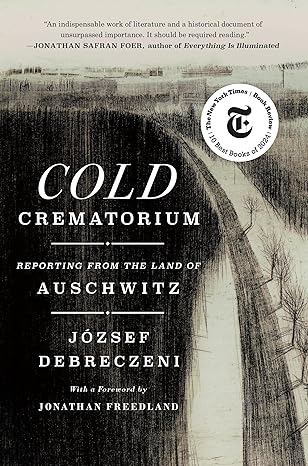
Occasionally I like to intersperse my fiction reading with some non-fiction so I chose this memoir which was recommended to me.
This book was first published in 1950 but was only translated into English last year. József Debreczeni was a Hungarian poet and journalist. After three years as a forced labourer, he was deported to Auschwitz in May of 1944. As prisoner 33031, he spent twelve months of incarceration and slave labour in a series of camps, ending in the Cold Crematorium, the so-called hospital where prisoners too weak to work awaited execution or death.
I’ve read Holocaust literature in the past but found this book offers a unique perspective: it was written soon after the war by an adult journalist and focuses not on death camps but on the slave-labor camps. As Jonathan Freedland writes in the Foreword, József’s “are the recollections of a fully conscious adult . . . [and] he writes as a professional, highly skilled observer . . . with a journalist’s eye for the telling, human detail.”
The book may not have new information for students of history, but I certainly learned things I did not know. For instance, I had never heard of the network of sub camps around “the capital of the Great Land of Auschwitz.” I had never heard of Dörnhau which Debreczeni calls a cold crematorium. I also did not know that the Nazis began construction of an underground city in Lower Silesia.
Of course what stands out is the unimaginably horrific suffering of the prisoners, the häftlinge: dehumanization, starvation, beatings, backbreaking labour in dangerous working conditions, disease, mental illness, etc. Even if a häftling worked hard, he might not escape death. After a group’s best worker was identified, a German officer shot him: “’A little demonstration . . . an example of how even the best Jew must croak.’”
It is descriptions of conditions in Dörnhau that I cannot forget: “The November cold pours in through the broken windows, and yet the stench is unbearable all the same. A suffocating stink oozes from the walls. Rising between the rows of bunks, several centimeters high, is an odious yellowish slurry of dung. Naked skeletons are sloshing through the putrid river. . . . Everyone has diarrhea. Hence the horrid yellow streams along the rows of beds.” Beds are shared: “Two or even three half- or completely naked men occupy each bunk. Only a few have blankets.” Debreczeni comments, “No tranquility here, that’s for sure. . . . A dizzying cacophony of moaning, whimpering, shrieking, whining, and delirious snarling.” Dörnhau is a death factory: “In Dörnhau, those whose turn has come depart mostly after dark. The nights belong to struggling moans, screaming farewells and delirious wails for homes.” Sometimes, “The nights drag off forty or fifty every twenty-four hours.” Debreczeni estimates, “I’ve passed eight nights pressed up against a cooling cadaver.”
What is also emphasized is “the camp aristocracy, the wretched gods of this wretched world.” The Nazis created a hierarchy among the inmates, those entitled to better food, better clothes, the opportunity to steal, including gold teeth from corpses, which can be traded for food, and “that most intoxicating opiate of all. Boundless power over life and death.” Debreczeni understands the reasoning: “the best slave driver is a slave accorded a privileged position” and “This aristocratic hierarchy reflected the Nazis’ modern interpretation of the concept ‘divide and conquer’.”
This book is a very difficult read but a very necessary one. The suffering endured by Nazi victims must not be forgotten. And there’s the aphorism that “Those who cannot remember the past are condemned to repeat it.” Debreczeni is convinced “that the average Nazi who had dealings with us imagines, more or less, that standing there before them are a bunch of ex-convicts, common criminals, and that every Jew had notched up at least one murder. . . . they had been taught to believe exactly this sort of thing.” Current events – rounding up of immigrants in the U.S., Russian justification for its war on Ukraine, and the indiscriminate killings in Gaza – suggest we have forgotten what can happen when those who are different from us or do not share our beliefs are vilified and dehumanized.
No comments:
Post a Comment