3.5 Stars
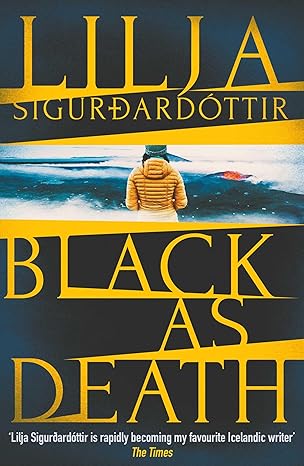
This is the fifth installment in the Áróra Investigation series. It is being marketed as the finale since it provides answers to what happened to Áróra’s sister Ísafold.
In the previous book, Dark as Night, Ísafold’s body was discovered as well as that of Björn, the man who was suspected of killing her. Of course the circumstances of her sister’s death continue to haunt Áróra, especially after she learns a detail the police have not made public. As the police continue to investigate the murders, Áróra works on a potential money-laundering case by Kaffikó, an Icelandic coffee chain. It does not take long for the reader to realize that there is a connection between the two cases.
Interspersed throughout the chapters set in the present are flashbacks from Ísafold’s point of view. She describes her life with Björn, her abusive boyfriend. Blinded by love, she finds herself trapped in a life of violence and abuse she chooses not to escape. These sections are very difficult to read because the reader knows her fate. She is offered help and opportunities to escape, but she doesn’t take them, believing that “Everyone had their selfish reasons for everything. Friendship was never just friendship.” It is difficult to comprehend that it takes her so long to see the truth about Björn: “What had been staring her in the face all along, and she’d half chosen to ignore, was now clear as day.” Unfortunately, the situation described is very realistic. Björn exhibits a 3-stage behavioral pattern typical of abusers: a honeymoon phase, tension building, and a violent incident. Then there’s remorse and a promise to change which instills hope.
I know little of the Icelandic justice system but was astonished that a man who admits to a mutilation is set free. Though an investigation continues, he is led to believe only minor charges will result. He knows that “In other countries he would be in prison, on remand, while the police took their time searching for evidence against him.” Is this true? As a Canadian, I was also disturbed to read that photos of people taken when they enter Canada are not used to compare them to their passport photograph but to “’compare them with a list of photographs of wanted people, to check whether the individual is a known terrorist or criminal.’” The CBSA site clearly states that identity confirmation is the purpose of airport photos.
At the end, the circumstances of Ísafold’s death are explained. There is a sense of closure for Áróra because she learns the truth: “for the first time since she received the fateful phone call when her mother told her that her sister had disappeared, Áróra felt able to breathe fully, deep down into the bottom of her lungs, so that the oxygen flowed through her veins, to her muscles and her heart. She was free.”
For the reader, however, the ending is somewhat open-ended. I’ve enjoyed the company of Helena, Sirri, Bisi, and Lady Gúgúlú, but their stories are just dropped. All make an appearance in the novel, but I found myself wanting more. And then, of course, there’s Daníel!?
Those who have followed the series will certainly want to read this book. Those who haven’t should begin with Cold as Hell, and continue with Red as Blood, White as Snow, and Dark as Night before reading Black as Death.

From the publisher: "So thrilled that you enjoyed your time with this chilling series finale, Doreen! And we agree, best read with the series, although it can be read independently! Thank you so much! x" (https://x.com/OrendaBooks/status/1979229367172518061)
ReplyDelete