Friday, November 28, 2025

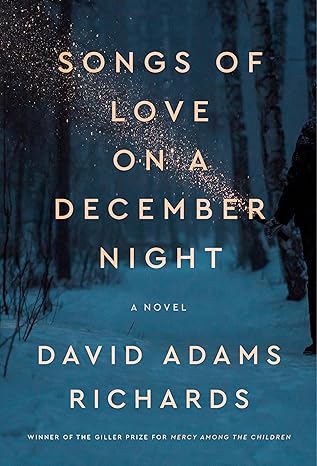
Review of SONGS OF LOVE ON A DECEMBER NIGHT by David Adams Richards

 4 Stars

David Adams Richards is a Canadian author whose books I always purchase as hardcovers as soon as I learn of a new release. This is the twelfth novel of his that I have read.

Colonel Musselman dies of a gunshot wound. Six years later, despite his claims of innocence, Jamie Musselman is convicted of his father’s murder. His fiancée Gertie is among the very few that believe there has been a miscarriage of justice. Very early in the novel, the reader comes to understand that others are responsible for the Colonel’s death: one person shot him but others were present and another provided crucial information. The focus of the novel is on the events that led to the killing and what happens after Jamie has been convicted and imprisoned.

This book has all the hallmarks of a David Adams Richards novel. Of course there’s the rural setting of New Brunswick’s Miramichi River valley which is found in most of his novels. There’s an innocent person charged with a crime (like in Mary Cyr). There are exaggerated rumours and sensationalized gossip (as in Crimes Against My Brother). There are criticisms of certain groups like academics, feminists, and activists (as in The Tragedy of Eva Mott and Darkness and Principles to Live By). As in Mary Cyr, Canada is criticized: “Canada became insipid, a country hollowed out by intellectual conceit and sanctimonious self-reflection. . . . to the rest of the world, in many respects, it was [invisible].” Of course, some of the comments cannot but elicit a smile: one character “did not know that Ottawa was the capital of Canada, and believed it was Washington. Well, what the matter – more than one of our professors and political gurus did as well.” As in The Lost Highway, there is repetition of how non-believers inspired by reason rather than faith have become lost souls.

What is always impressive about DAR’s books is the memorable, authentic characters.  The author takes great pains to explain the motivations of characters – why they make the choices they do.  Sometimes people lash out because they feel betrayed; some are concerned about appearances and status; and some place personal ambition above all else. The backgrounds of characters are also detailed so the reader comes to understand why they behave as they do. Even someone who behaves despicably earns some sympathy when we learn about his/her past. As in previous books, the wisest characters are often those without a formal, academic education.

What is emphasized is that choices have ramifications, sometimes spanning generations. One professor tells a student, “’sometimes whatever we do affects the lives of many not yet born, or those born we do not yet know.’” For example, Gertie’s father wants to make an impression on someone, so he tells a man about money in Colonel Musselman’s house; passing on this information has disastrous consequences. A woman makes a decision to lie to save a man from a jail sentence, “And everything from that moment on changed dramatically in everyone’s life. Though none of them knew it then. All of this happened as if there would be no consequence.” One man, thinking back to events, ponders “When did it all begin?”

As in DAR’s previous novels, what also stands out is the inter-connectedness of all the characters. I grew up in a small town and know first-hand how everyone knows everyone, but sometimes the way people’s paths cross by chance seems contrived. Coincidences occur too: Pruty overhears conversations and finds a crucial letter; Marsha has a visitor when Little Nin calls.

This is not a light read; readers familiar with DAR’s books will not find this surprising. There is theft, infidelity, rape, murder, lying, family disintegration, loneliness, chronic pain, police ineptitude, and heartbreak. Several of the seven deadly sins come into play. So many elements in his books are familiar, but what most impresses is his deep understanding of the human condition and human behaviour.  

Monday, November 24, 2025

Review of VENETIAN VESPERS by John Banville

4 Stars 

I loved this novel set in Venice at the turn of the twentieth century.

Evelyn Dolman, a self-described “Grub Street hack,” is married to Laura Rensselaer, daughter of an American oil baron. Though they have been married for about six months, theirs is really a mariage blanc. The trip to Venice is their honeymoon, delayed because of the sudden death of Laura’s father.

The first night in the city, Evelyn goes for a walk and stops for a drink at the Caffè Florian. There he encounters a man, Frederick FitzHerbert, who claims to have attended the same boarding school, though Evelyn has no recollection of him. When Evelyn is introduced to Cesca, Frederick’s sister, he is immediately smitten. The next morning, Laura disappears. Other strange things happen and Evelyn suspects that he is a pawn being manipulated by someone, but he doesn’t know by whom or for what reason.

Evelyn is the narrator of his own story, and he reveals at the beginning that “In telling my tale I am trying to be as I was then, still happily ignorant of all that I know now.” So the reader struggles, like Evelyn, “to penetrate through successive veils of obfuscation.” He describes his time in Venice as a “time of confusion, fear, and ultimate disaster” during which “a woman died.” He experiences doubts and more than one “tremor of misgiving” and wonders whether he has been spotted “as someone who would be easily gulled,” yet he acknowledges that he rushed “forward heedlessly to embrace my own destruction.” So the reader’s interest is grasped: What exactly happened? Who died? And what were Evelyn’s “worst miscalculations . . . [and] most calamitous errors”?

Since Evelyn is the narrator, there is always the question of his reliability. Can his version of events be trusted? What there is little doubt of is his unlikeability. He is self-absorbed, self-important, self-satisfied, self-righteous, self-pitying, self-serving, and self-justifying. What he is not is self-aware. There is one episode in particular, with Laura the night before she goes missing, during which Evelyn behaves in an unforgivable way, but he constantly makes excuses for his actions. Before beginning his story, Evelyn adds, “There is no doubt of it, I deserved all I got.” At the end, the reader must consider if this is true.

The author certainly plays fair, providing many clues. In dialogue, a motif emerges: “appearances are deceptive” and “one never can tell what’s going on behind one’s back” and “this is Italy, remember, where there’s hardly a person who is what he claims to be.” There is repeated reference to twins: Laura’s sister is Thomasina, which means “twin”; Frederick and Cesca are twins; Laura and Cesca look like twins; and the palazzo in which Laura and Evelyn take residence is the Palazzo Dioscuri which refers to Castor and Pollux, the legendary twins from mythology. Evelyn even speaks of himself as two people: “on the outside manly and self-satisfied while the inner midget seethed with unquenchable ressentiment and spleen.”  Even the name Evelyn, a gender-neutral name, may be significant.

Banville excels at creating an atmosphere with strong gothic elements. There’s a decaying palazzo that “might have been Bluebeard’s Castle,” which wallows “in the noisome shallows of the Canal Grande, that sluggish waterway coiling itself like a fat, grey-green worm through the very bowels of the city.” “The night was foggy, and there was a sulphurous glow that seemed the breath of some ghoulish thing” and during the day, “a low, seamless stretch of cloud laid upon the city like a soiled cotton bandage.” Venice itself is described as “this most elusive, this most crafty, of cities,” a place “of glancing lights, distorting reflections, looming shadows” and a “pestilential town lodged in the fetid crotch of the Adriatic.”

I enjoyed the book for many reasons. Besides the creepy atmosphere of the setting and the constant doubts surrounding characters and events, I love Banville’s writing style with its lush, poetic language. I had to pause to look up certain words like quondam and Latin phrases like vade mecum, but the book was a page turner for me. And the ending provides resolution, but had me thinking that, like Evelyn, “I didn’t yet know the half of it.”

Saturday, November 22, 2025

Novel Recommendations for Christmas Gifts


For my hometown newspaper, The Madawaska Valley Current, I've written my annual article recommending fiction titles to gift at Christmas or to include on a to-read list.  Go to https://madvalleycurrent.com/2025/11/20/novel-recommendations-for-christmas-gifts/ to read my suggestions which include Canadian titles (including a trilogy) as well as books by writers from the U.S., England, France, Norway, and New Zealand.

Thursday, November 20, 2025

Review of DID I EVER TELL YOU? by Genevieve Kingston

 3.5 Stars

I don’t especially enjoy memoirs and read this one only because it was chosen by my book club. I hate reviewing the genre because any criticism can seem like a disparagement of the writer’s experiences.

When the author, known as Gwenny or Gwen, was three, her mother Kristina was diagnosed with breast cancer. The cancer metastasized and the prognoses became more dire, but she survived for eight more years. She leaves behind a box full of gifts and letters for each birthday until the age of 30 as well as major life milestones. These tokens give Gwen a connection to her mother, but also allow her to learn about her.

She also continues to understand her mother through the stories shared by Kristina’s friends: “’Did I ever tell you . . . ?’ they’d begin, and I’d have one more memory to add to my collection.” In the end she comes to see her mother as an individual with a life separate from her children and her illness.

The book is a testament to a mother’s love which is stronger than death. I can’t imagine being Kristina: experiencing physical and emotional pain knowing that death is looming. Then there’s the act of choosing gifts and writing letters to her son and daughter; despite her personal anguish, she has “an overwhelming desire to comfort and protect.”

Kristina’s message to her daughter is to know yourself, love yourself, and remain true to yourself. And the message to the reader seems to be to collect and hold memories of loved ones. But, actually, the most impactful statement for me is a comment about a man’s death by suicide. Gwen mentions that her mother fought so hard to live and the aunt replies, “’there’s no reason to think that he did not fight just as valiantly.’”

I loved that photos of the gifts Gwen received are included. What I would have liked, however, is to know more about the gifts and letters Jamie, Gwen’s brother, received. The only gift specifically mentioned is an engagement ring. Of course, the fact that Gwen is an extrovert and Jamie is an introvert explains why she, not her brother, wrote a book.

This is a heavy read. From the beginning it is sad, and there is little to relieve that sadness. Parts of it are repetitive – Kristina’s anguish and Gwen’s grief – but, undoubtedly, anyone who has lost a parent will relate to at least parts of the memoir.

Monday, November 17, 2025

Review of LISTEN by Sacha Bronwasser (New Release)

4 Stars 

This novel was first published in Dutch in 2023 (Luister).

The narrator is Marie living in Paris in September of 2021. She looks back at her life as a young woman in the 1980s. She addresses her story to Flo (Florence de Silva), one of Marie’s photography instructors who took a special interest in her when she was a student at an unnamed university in the Netherlands. Marie begins by stating that every story rests on three points and the three points in the story she is going to tell are Philippe Lambert, Flo, and herself.

She begins with Philippe Lambert, a middle manager living in Paris, who has the curse of foreknowledge: he is able to anticipate impending disaster though he cannot do anything to stop it. Marie focuses on the events of 1986 when Paris is experiencing a wave of terrorist attacks and Philippe and his wife Laurence hire Eloïse, a young German girl, as an au pair for their son Nicolas.  Then the narrative switches to 1989. Marie, after abandoning her studies, moves to Paris and becomes an au pair for the Lamberts who now have two sons. Flo’s story is set in 2015 and ends with the November 2015 Paris attacks which bring together the stories of the three characters.

Throughout, there are questions which pique the reader’s interest. What happened between Flo and Marie that resulted in her leaving school and escaping to Paris? Why does Philippe react so strongly when he first meets Eloïse and why does he behave so strangely around her? What happened to Flo during the terrorist attacks? How do the stories of the three come together?

Of course, the seemingly disparate stories do come together and in such a way that one cannot but be impressed by the intricate and masterful plotting. I think this book offers rewards to those who have the time to re-read it. A quick re-reading of the prologue, for instance, has snippets like these in which Marie directly addresses Flo: “I didn’t see your face among the talking heads. Your story wasn’t told; you’ve always remained silent. Again, those images, but you will never see them” and “You’ll have to make time for [our story] too. Listen.” Only after knowing what happens did I fully appreciate the meaning of these words.

The title is perfect. There’s Marie telling Flo to listen to her story. There’s Philippe who has no choice but to listen to his fears, though when he tries to warn others of impending danger, “nobody wanted to listen.” There’s Marie listening to a new language when she first arrives in Paris and what happens when she finally discovers she understands French conversation. And then there’s the ending which adds so much to the relevance of the title.

There are a number of themes, but the one that stood out for me is the issue of appropriation of people’s stories. Flo argues that “It’s not up to us to form a moral judgment about how far a photographer is allowed to go. If you really want to say something, you have to be shameless.” The philosopher Roland Barthes is quoted as saying that photographs are dangerous and gluttonous because “They turn the photographed person into an object. What is an object? A thing, something, without a soul.” And then there’s the question of whether Marie reclaims her agency, her story, and appropriates Flo’s.

This is a thought-provoking read which I think would impress even more on a second reading.

Note:  I received an eARC from the publisher via NetGalley.

Friday, November 14, 2025

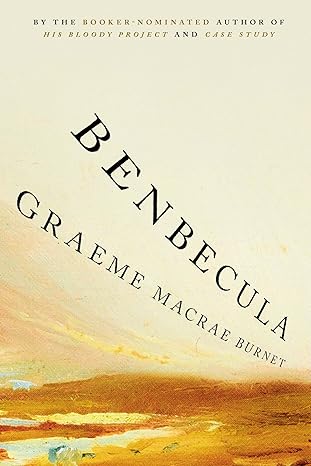
Review of BENBECULA by Graeme Macrae Burnet (New Release)

 4 Stars

I’ve read a couple of this author’s books: His Bloody Project (https://schatjesshelves.blogspot.com/2016/08/review-of-his-bloody-project-by-graeme.html) and Case Study (https://schatjesshelves.blogspot.com/2022/10/review-of-case-study-by-graeme-macrae.html). Both of these I enjoyed, and this third one is equally good.

This historical novel, based on an actual crime committed in 1857, is set on Benbecula, an island of the Outer Hebrides. The narrator, Malcolm MacPhee, is living in the family home where a few years earlier, his younger brother Angus killed their father, mother and aunt. A recluse ostracized by his community, he seems to be slowly losing his grip on sanity.

Malcolm suggests that Angus was always unstable, though just prior to the murders, his fits of madness become more frequent and more violent. Young women feel unsafe in his presence: he “had a shameless fascination for those parts of his body and their functions that decency normally dictates are kept private.” Angus’ family, because they do not have the funds to have him placed in an asylum, are told to keep him under control. There is little doubt that he is suffering from a mental illness.

As Malcolm continues his story, it becomes increasingly obvious that he too may be suffering from a similar illness. From the beginning, he confesses to wanting to differentiate himself from his brother, “yet I was haunted by the sense that I was not his opposite but his mirror image” and adds, “He sometimes even came to me in my dreams so that I felt that Angus penetrated my whole being.” After the murders, Malcolm has become a recluse and has given up working, though earlier he was outraged that “there was not a fellow in the entirety of Benbecula more dedicated to the practice of Sloth than Angus.” He fantasies about rape. Even his youngest sibling tells him, “You’re a tyrant and a bully, Malcolm.” He also admits to seeing phantoms.

Malcolm starts questioning his own sanity. He talks about his mind being “a devious thing” and admits to hearing voices: “And I find myself wondering, when these dialogues run in my mind, whether I am the mind that goads me or I am the mind that reasons with the other mind. And I feel that I am not one man but two men. If I am the brain contained within my skullhouse, then there is another self contained within my skull. Were I to give him a name, I would call him Angus. It is Angus that goads me. It is Angus . . . that gives me no peace. There are times I confess when I have been driven to beat my head against the walls of the house to drive him out but that does no good.” But he clings to being normal: “I have heard other men say, I’m in two minds about such and such a thing. It is quite commonplace this being in two minds. I am a man just like other men and they are men just like me.”

What is most telling is Malcolm’s use of words. For example, he states, “I am still capable – through the careful weighing of evidence – of distinguishing between reality and illusion. The certainty that the tormented voices I hear are only inside my head convinces me that I remain in possession of my reason. A madman could surely not achieve such clarity of thought.” Words like still and surely undermine his certainty. He comments, “I am careful to behave like other men. To speak the way they speak and act the way they act for I am still capable of doing so.” The repetition of “am still capable” is telling.

All of this leaves the reader wondering about the origins of insanity. Is it a hereditary trait? (More than once, Malcolm speculates about how those possessed of fine features marry others with similar traits while “The less fortunate are left with what scraps they can find – the disfigured or feeble-minded – and through procreation combine the worst characteristics of each parent . . . [so] the rest of us become more degraded with each passing generation.” This almost implies inbreeding, and Malcolm’s relationship with his sister Marion left me wondering about the possibility of incest.) Or is Malcolm’s descent into madness a reaction to the killing of his family?

I found this novella thoroughly absorbing, especially the gradual revelation of Malcolm’s troubled state of mind. I suspected him of being an unreliable narrator from the beginning, but his last sentence still caught me by surprise. And the extended Afterword provides even more information for the reader to consider.

When a book lingers in my mind after I finish reading it and when I’m considering re-reading it, I have no hesitation in recommending it to others.

Note:  I received an eARC from the publisher via Edelweiss.

Monday, November 10, 2025

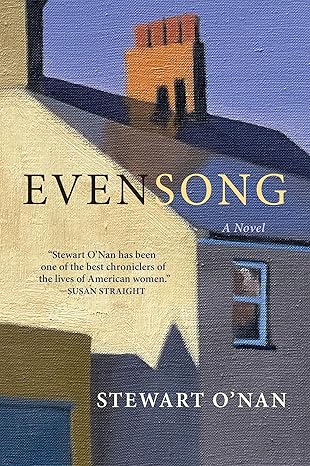
Review of EVENSONG by Steward O'Nan (New Release)

 4 Stars

Having enjoyed the author’s last book, Ocean State (https://schatjesshelves.blogspot.com/2022/03/review-of-ocean-state-by-stewart-onan.html), I was anxious to read his upcoming release, Evensong.

This novel, set in Pittsburgh between September 2022 and January 2023, focuses on four members of the Humpty Dumpty Club, a volunteer club dedicated to helping seniors needing assistance. They drive people to appointments and pick up groceries and prescriptions. The four women, Emily, Arlene, Kitzi, and Susie are also seniors. We follow them as they carry on helping others while also coping with the realities of aging.

Emily, a widow, struggles with trusting her daughter who is an alcoholic. Arlene, Emily’s sister-in-law, is suffering from memory lapses. (Emily and Arlene appear in the Maxwell Family trilogy consisting of Wish You Were Here; Emily, Alone; and Henry, Himself.) Kitzi is caring for a husband with severe heart disease while also taking over as the club’s leader after the previous leader fell down a flight of stairs. Susie, at 63 the youngest of the group, is trying to build a new life after a divorce.

The women, though flawed, are admirable nonetheless. Despite their personal struggles with loss and physical decline, they get up every morning ready to engage with and serve their community. They help others and look after each other, even Emily and Arlene who “couldn’t stand each other.” There is no sentimentality in their portrayal; the characters emerge as people to admire, not pity, as they near the end of their lives.

The novel is slow-paced, as is appropriate to the characters and their lives which are more mundane than full of drama. Neither does the book offer a dramatic lesson. If there is a message, it is that people should be kind to each other. It also does suggest that we should avoid making judgments of others. Just as the women learn about the interesting and impactful lives of Jean and Gene who live in unsafe and unsanitary conditions, readers are indirectly encouraged not to make assumptions about others, especially seniors. Certainly, these four women contribute meaningfully to their community.

The tone is generally serious. Scenes like Arlene losing her way while driving to Emily’s are intense and sad. The episodes with pets are often heart-warming. But there are also touches of dry humour. For example, a move to a senior’s apartment is described “like Florida, a land of no return.”

Though I initially had difficulty differentiating among the characters, once I came to know them better, I enjoyed the book. I think it will appeal to readers who love Elizabeth Strout’s novels.

Note:  I received an eARC from the publisher via Edelweiss.

Friday, November 7, 2025

Review of BROKEN COUNTRY by Clare Leslie Hall

 3.5 Stars

Beth and Frank Johnson are happily married and living on the family farm in Dorset. Though life for Beth has not turned out as she dreamed, she is content. Then the arrival of Gabriel Wolfe, Beth’s first love, changes everything. Beth and Gabriel reconnect over his son Leo who reminds Beth of her own son Bobby who died in a tragic accident. Thus begins a love triangle which sets in motion a chain of events that will change the lives of several people.

There are three timelines. In 1955, we learn about Beth and Gabriel’s short-lived love affair. In 1968, we witness Gabriel’s return and his entry into the lives of his neighbours, the Johnsons. The last timeline is 1969 when there’s a murder trial which Beth attends daily, though the identities of both the victim and the person charged with murder remain unknown until half way through the novel.

I know that we are to have sympathy for Beth because of the death of Bobby, but I found it difficult to like her. She is selfish and self-absorbed and emotionally immature. Over a decade has passed since the end of her romantic relationship with Gabriel, but there’s no evidence of any emotional growth. As soon as Gabriel appears, she is drawn to him and believes they have to be together, but then she also claims “it’s Frank I have to be with.” She admits, “It’s selfish of me to carry on like this,” but we don’t really see her trying not to hurt her husband. She knows the situation is untenable, but “I refuse to think about how it is going to end.” In order for characters to be realistic, they need to be flawed, but she just seems delusional. It takes another death for her to make a choice?!

On the other hand, Frank is just too good to be believable. He’s kind, reliable, hard-working, understanding, and unfailingly loving and forgiving. His misplaced atonement is unnecessary; if the truth had been revealed, the consequences would have been minimal. Addressing the trauma directly would also be beneficial. Instead, additional guilt is placed on a person who must contend with it for the rest of his life.

Other characters are also problematic. Gabriel’s mother is just so manipulative, a virtual stereotype of the rich woman who views everyone as her inferior who can only do as she dictates. It’s inevitable that she will play a role in shaping events. The same is true for Jimmy, Frank’s brother. His behaviour is definitely foreshadowing. In some ways, therefore, much of what happens is predictable. And the ending, set in 1975, is just too melodramatic, though after the heartbreak and death looming over the entire narrative, it provides some relief.

This book has received glowing reviews, but though I found it entertaining, it’s not what I consider exceptional.

Monday, November 3, 2025

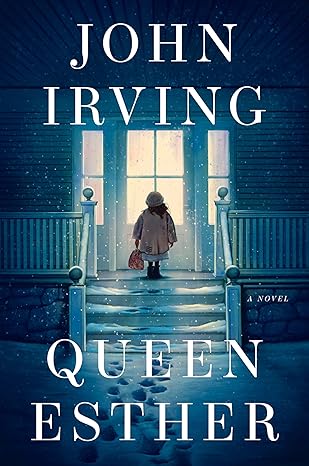
Review of QUEEN ESTHER by John Irving (New Release)

 3 Stars

Some of my favourite novels have been written by John Irving, but this is not one of them.

Esther Nacht, born in 1905, becomes an orphan after her mother is killed by anti-Semites in Portland, Maine. When she is fourteen, Esther is adopted by Constance and Thomas Winslow, a couple living in New Hampshire. Though they are not Jewish, they despise anti-Semitism and are the only people open to adopting a Jewish child. Esther helps care for Honor, the youngest of four daughters, but becomes very much a part of the family. Despite its title however, the novel focuses on Jimmy Winslow, Esther’s biological child born in 1941 but raised by Honor. It is very much his coming-of-age story. Though it covers 40 years of his life, a large portion of the book details Jimmy’s study year in Vienna where he works on writing a novel and makes life-long friends.

One of the themes is that of identity. Jimmy questions his identity from an early age. He believes in his “intrinsic foreignness” because “Jimmy was a nobody’s boy. This much was understood: his mother had adopted him; his father was an unknown. As for the boy’s birth mother . . . she was an orphan.” He’s not considered “a real Winslow” so who is he? His biological mother is Jewish so is he Jewish? He thinks of himself as “just a New Hampshire boy” but travels to Vienna, Esther’s birthplace, in hopes of connecting with her. The last paragraph begins with “At last, James Winslow knew who he was” and outlines what he has realized.

Irving’s novels often center on non-traditional families, with strong but sometimes profane mothers, absent fathers, and unconventional sexual dynamics. This is certainly the case here. Constance and Thomas have four daughters, but also adopt four more. Jimmy has two mothers and he creates a type of family with Claude and Yolanda, his roommates in Vienna. Then there’s Jimmy’s daughter who also has two mothers. There’s an asexual mother and a lesbian one.

Of course it is not just the theme of identity and the unconventional families that signpost an Irving novel. Readers of his books will see many familiar motifs: the New England and Vienna settings, wrestling, the presence of at least one writer, a prominent animal role, sex workers, and quirky characters in absurd circumstances. And there are frequent digressions often found in his books; in this one, the reader is given histories of abortion and circumcision and analyses of Dickens’ novels.

Though engaging in parts, I found some sections too long and drawn out. Jimmy’s year in Vienna (1963-64) goes on and on, with constant reference to Honor’s scheme to keep her son from being drafted and sent to Vietnam. The subplot with the dishwasher and her thugs is also excessive and left me wondering what the point is. Needless repetition is a problem. Is it really necessary to have Thomas say, “’Right you are, Connie’” two dozen times? This wordiness, rambling, and lack of cohesion left me struggling to maintain interest.

Esther, though the title bears her name, remains a secondary character. We see little of her and learn most about her from others. She keeps a distance from her family and she is kept at a distance from the reader. She becomes a larger-than-life, mythical character and I guess that’s the point. However, her perspective would have added to the themes of Jewish identity, anti-Semitism, and the historical Israel/Palestine conflict, “this eternal conflict, this everlasting hatred.”

I was disappointed with this book; it did not resonate with me as Irving’s other novels have. My 3-star rating may seem insulting but is actually generous.

Note:  I received an eARC from the publisher via Edelweiss.