3.5 Stars
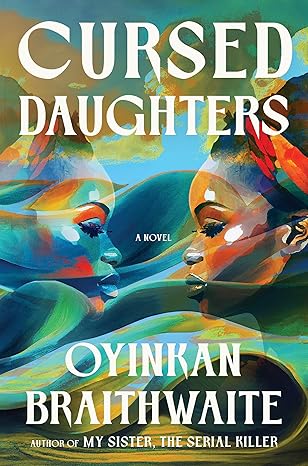
The Falodun women are cursed to be heartbroken and unable to hold on to a man: “’all the women . . . will suffer for man’s sake.’” Over time, all end up returning to the family home in Lagos. The novel focuses on three of those women: Ebun, Eniiyi, and Monife. The plot begins in 2000 with Monife committing suicide by drowning. On that same day, her cousin Ebun gives birth to her daughter Eniiyi. Eniiyi bears an uncanny resemblance to Monife and she begins to wonder if she is the reincarnation of her aunt.
The narrative moves back and forth in time, ranging from 1994 to 2025, and amongst the three women. What comes to the forefront is the similarities between Monife and her niece: physical appearance, including an almost identical scar, depressive episodes, and the same relationship dynamics with their boyfriends who are also very similar. Eniiyi hates the constant reminders of her resemblance to Monife and wants to be her own person. She also wants to break free and defeat the curse that seems to have affected the women in her family. There are seven chapters, all entitled “Falodun Family Curse,” each of which details how the curse impacted the life of a Falodun woman.
What I did not like is that the Falodun women are all obsessed with men. They envision no other path to happiness and see their worth only in relation to a man. For instance, Bunmi, Monife’s mother, is a respected headmistress at the local school but “behind closed doors, . . . flirted with strange spirits and gods.” She spends her money on the services of a mamalawo who performs rituals she claims will lure back Bunmi’s husband, “despite the fact that he had a new wife and two children.” Kemi, Ebun’s mother, is always disappearing “with one of several wealthy suitors into Lagos society. She was caught up in a quest to ensnare a fourth husband.” This obsession with men is also seen in the romances of both Monife and Eniiyi. Monife falls in love with a man she calls Golden Boy as soon as she sees him. This love-at-first-sight trope is then repeated with Eniiyi who has the same reaction to Zubby.
Women in the family teach their fatherless daughters to prepare for betrayal and abandonment by men. Ebun wants no discussion of the curse in front of her daughter, but her behaviour towards men, especially towards Osagie, suggests her belief in its existence. She refuses to give a man a choice in a relationship, claiming that he might not have a choice because of the curse. This comment suggests to me that the curse is just a self-fulfilling prophecy: the constant references to the curse influence the women’s behaviours which over time become generational patterns.
The frequent switching among perspectives and time periods can be confusing. But I did find that the women emerge as interesting and distinct characters. The trait they share is obstinacy. Because they are all headstrong, there are inevitable clashes. But what is also clear is the love that binds them. What is particularly sad for me is how damaged the lives of the women are because of their belief in the curse. Happiness and fulfillment are possible, but they don’t see a way forward because of their fixations on men and the curse.
I did not find this novel as entrancing as My Sister, the Serial Killer but enjoyed it. I especially liked the characterization, the occasional touches of humour, and the cultural elements.
You’re the first reviewer I find that I share the same opinion with. Didn’t find the novel particularly catchy, but especially I didn’t like the women obsession about men, like you say. All their lives revolve around men in a way or another, some of them not even considering themselves as ‘agents’ in the relationships but just ‘being controlled by destiny’. Didn’t enjoy this at all, took all the interest out of the characters for me.
ReplyDelete