Ranked a Top Canadian Book Blog
Twitter: @DCYakabuski
Facebook: Doreen Yakabuski
Instagram: doreenyakabuski
Threads: doreenyakabuski
Substack: @doreenyakabuski
Bluesky: @dcyakabuski.bsky.social
Showing posts sorted by date for query voynich. Sort by relevance Show all posts

Tuesday, July 25, 2017

Was the Voynich Manuscript written by a Jewish physician living in Italy?

Last summer, I posted about the Voynich Manuscript, a medieval manuscript written in an unknown, apparently encrypted language which no one has been able to decipher (https://schatjesshelves.blogspot.ca/search?q=voynich).

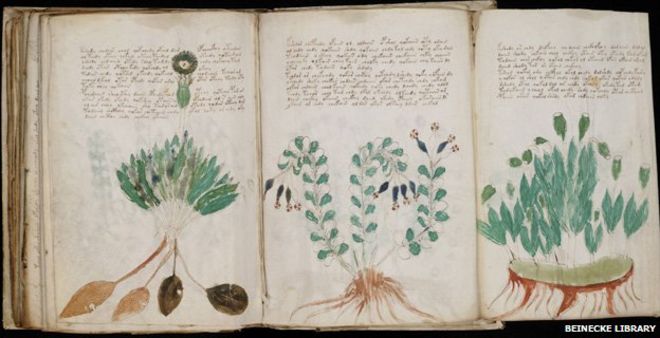
Now, Stephen Skinner, an expert in medieval esoteric manuscripts, claims that the author of the as-yet untranslatable Voynich Manuscript was a Jewish physician based in northern Italy.  He bases his theory on the many illustrations which include plants and astrological charts.  For the complete story, go to https://www.theguardian.com/books/2017/jul/05/author-of-mysterious-voynich-manuscript-was-italian-jew-says-scholar. 

 
Yesterday, I blogged about transcribing old manuscripts.  Can you imagine doing this one?

Monday, September 12, 2016

A Humourous Look at Rare Book Sales

Recently, I’ve devoted several blogs to old and rare books.  I discussed the Voynich Manuscript on August 31, the world’s most expensive books on September 10, and the Kelmscott Chaucer yesterday.
Most of us, of course, will never be able to afford any of those books. 

Should that thought cause bibliophiles to be a bit saddened, I thought I’d share a humourous piece that recently appeared in The New Yorker, a magazine to which I have had a subscription for many years and never fails to provoke thought and laughter, sometimes in the same article.

Some of the descriptions are wonderful.
 A signed first edition of A Farewell to Arms:  “The pages are crisp, and accented by water rings where the original owner no doubt sat a few whiskeys down while mulling the narrative and yelling at someone belligerently in a bar. (Light urine damage.)”
The first goddam edition of The Catcher in the Rye:  “The edition has mild foxing to end corners, as you would expect, because everything good always ends up ruined.”
A newly discovered first edition of To Kill a Mockingbird:  “This rare first edition was recently recovered in mint condition from the knothole of a tree, a fact that, although astounding, is less so than the lack of progress in race relations since the time of publication.”

Wednesday, August 31, 2016

Voynich Manuscript


Until a week ago, I had never heard of the Voynich Manuscript, a medieval manuscript  named after the Polish-American book dealer who bought it in 1912 (though ownership can be traced back to the 16th century).

It came into the news when it was announced that a small publishing house in northern Spain - Siloe – which specializes in very small runs of carefully re-created manuscripts has secured the right to replicate the document.  Siloe will release 898 volumes and sell them for about €8,000.

The 246-page quarto is written in an unknown, apparently encrypted language and is illustrated with imaginary plants, strange astrological charts, and drawings of nude women.  Carbon dating indicates that the parchment dates to the early 15th century. To protect the book, the only copy is locked away at Yale University.

Countless cryptographers have dedicated themselves to deciphering the language but to no avail.  Some people have apparently devoted years to trying to solve the puzzle.  “Those familiar with the manuscript say it should come with a warning. ‘The Voynich Manuscript has led some of the smartest people down rabbit holes for centuries,’ Folger Shakespeare Library exhibit curator Bill Sherman told The Washington Post in 2014. He was about to open a new exhibit featuring the book:  I think we need a little disclaimer form you need to sign before you look at the manuscript, that says, ‘Do not blame us if you go crazy’” (http://news.nationalpost.com/arts/books/spanish-publisher-to-release-copies-of-voynich-manuscript-a-book-no-living-person-can-understand).

There is the possibility that the manuscript is a hoax, though one study has argued that this is unlikely because the manuscript does follow the structural patterns of language — based on linguistic theories that were unknown in the 1500s.

If you, like I, will not be able to afford one of Siloe’s replicas, the Yale University Press has a printed facsimile being printed this fall.  And a digitized version is available through the Yale University Library's website (http://www.bibliotecapleyades.net/ciencia/esp_ciencia_manuscrito07a.htm). 

Various news sources have written about this story if it intrigues you: