Ranked a Top Canadian Book Blog
Twitter: @DCYakabuski
Facebook: Doreen Yakabuski
Instagram: doreenyakabuski
Threads: doreenyakabuski
Substack: @doreenyakabuski
Bluesky: @dcyakabuski.bsky.social

Tuesday, June 21, 2016

Happy birthday, Jane Urquhart! (Review of THE NIGHT STAGES)

Today, June 21, is the 67th birthday of one of my favourite Canadian authors:  Jane Urquhart.   A new book of hers will be released on October 11:  A Number of Things: Stories About Canada Told Through 50 Objects.

“From one of our nation’s most beloved and iconic authors comes a lyrical 150th birthday gift to Canada. Jane Urquhart chooses 50 Canadian objects and weaves a rich and surprising narrative that speaks to our collective experience as a nation.  Each object is beautifully illustrated by the noted artist Scott McKowen, with Jane Urquhart conjuring and distilling meaning and magic from these unexpected facets of our history.  The fifty artifacts range from a Nobel Peace Prize medal, a literary cherry tree, a royal cowcatcher, a Beothuk legging, a famous skull and an iconic artist’s shoe, as well as an Innu tea doll, a Sikh RCMP turban, a Cree basket, a Massey-Harris tractor and a hanging rope, among an array of unexpected and intriguing objects.  Bringing the curiosity of the novelist and the eloquence of the poet to her task, Jane Urquhart composes a symphonic memory bank with objects that resonate with symbolic significance. In this compelling portrait of a completely original country called Canada, a master novelist has given all of us a national birthday bouquet like no other” (https://www.amazon.ca/Number-Things-Stories-Through-Objects-ebook/dp/B01AFYTQSC/ref=sr_1_1?ie=UTF8&qid=1466265796&sr=8-1&keywords=A+number+of+things).

I’ve already featured my review of one of her books, Sanctuary Linehttp://schatjesshelves.blogspot.ca/2015/12/book-advent-calendar-day-20-sanctuary.html.

In honour of the author's birthday, here’s my review of her latest novel which was released last year, The Night Stages:
3 Stars
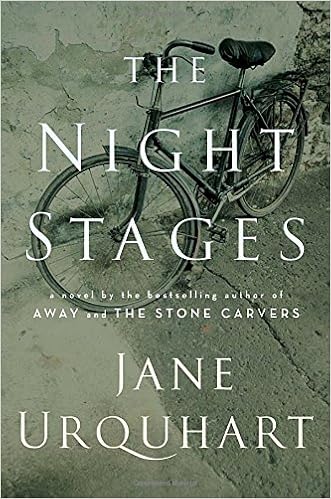
On a flight from Ireland to New York, Tam is stranded for three days at the Gander Airport because of fog, “’fog that blinds and deafens and causes that stillness . . . followed by the kind of clarity that causes you to wince’” (229). The fog grounds her, but it is a mural in the terminal which inspires her to reflect – on her past life as an auxiliary pilot in WWII; her relationship with Niall, an emotionally remote meteorologist whom she has just left; and Niall’s search for Kieran, his missing brother. Interspersed with her reflections are vignettes of the life of Kenneth Lochhead, the artist who painted the mural, and that of Kieran after he left home.

The mural is entitled Flight and Its Allegories and a major theme in the book is that of flight: Tam’s “ridiculous joy” (118) when flying a plane and her fleeing from Niall; Kieran’s flight from his family home after a tragedy and his happiness when exploring on his bicycle, “always happiest on higher ground” so he is described as a climber “’Always heading for the sky’” (156); Niall’s withdrawals from Tam, retreats so frequent that they form a “familiar pattern” (197).

It is flight that becomes the sustaining metaphor throughout. When her job as an auxiliary pilot comes to an end after the war, Tam talks of having “lost her compass” (130) and finding herself “so essentially adrift” (254). In her relationship with Niall she realizes she has become “in every possible way, a passenger” (10) and feels she has “lost her bearings. Her instruments were lying to her. She would not be able to make her way, even with familiar territory under her, toward any kind of landing strip” (331).

The characterization of Tam is unsatisfactory. In her youth she was adventurous as evidenced by her transporting planes throughout the war. When Niall entered her life, she exchanged her “then-vivid life” for one that is “very likely uninteresting”: “The young pilot she had been then, the young woman behind the controls, would have been disdainful of what she has become: a sombre person” (10). In her thirties she acquiesces to a life with a “Lack of certainty, ambivalence, impossibility, and no hope whatsoever of resolution” (385)? Why? The mural with its exploration of “speed and stasis” (221) is perhaps a symbol of Tam’s life but, unfortunately, she also seems as flat and inert and unknowable as the figures on the mural.

I am unclear as to why Kenneth Lochhead is included as a major character. The flashbacks into his life before his painting of the mural suggest how his experiences affected his rendering, but he has no connection to Tam, Niall or Kieran. (I almost felt Lochhead was inserted because he was a friend of Urquhart’s husband.) For this reason, I take exception to Claire Messud’s assertion that Urquhart has a gift “for the melding of ideas, events and individuals into a significant whole.” I was not left with a sense of a whole.

The book, until the An Post Rás, is very slow-paced. The first 350 pages have the reader feeling as if he/she is in the night stage of the bicycle race but there is no drinking nor does it serve as “an antidote of sorts to the day’s suffering” (355). I guess Tam’s interrupted journey in Gander is a night stage of sorts with the race resuming once she makes her decision about where she will continue from Gander. Unfortunately, if the night stage is too prolonged, interest is lost in the rest of the race though, indeed, “’It’s not finished yet’” (389).

Though I have read and enjoyed most of Urquhart’s other novels, I was not as enamoured with this one. Though the language is lyrical, the novel does not feel like a cohesive unit, and parts are tedious like a long delay in a journey. I do, however, want to go and see Lochhead’s mural!

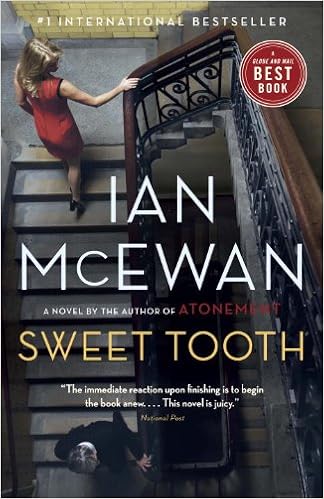
Happy Birthday, Ian McEwan! (Review of SWEET TOOTH)

Today, June 21, is Ian McEwan’s 68th birthday.  I’ve loved all of his novels which I’ve read:  Enduring Love, Amsterdam, Atonement, Saturday, On Chesil Beach, Solar, Sweet Tooth, and The Children Act.

The great news is that a new book by McEwan will be released September 13:  Nutshell.  “Nutshell is an altogether original story of deceit and murder, told by a narrator with a perspective and voice unlike any in recent literature. Love and betrayal, life and death come together in the most unexpected, moving ways in this sensational new novel from Ian McEwan, which will make readers first gasp with astonishment then laugh with delight. Dazzling, funny and audacious, it is the finest recent work from a true master, beautifully told, brilliantly executed” (https://www.amazon.ca/Nutshell-Ian-McEwan/dp/0345812409/ref=sr_1_1?ie=UTF8&qid=1466264165&sr=8-1&keywords=Nutshell).

I’ve already posted My review of his latest novel, The Children Act (http://schatjesshelves.blogspot.ca/2015/12/review-of-children-act-by-ian-mcewan.html), so in honour of McEwan’s special day, I thought I’d post my review of his penultimate novel, Sweet Tooth.

4 Stars  
Serena Frome, after graduating from Cambridge, gets a position with the British Intelligence Service after being groomed for MI5 by an older man with whom she has an affair. Eventually she is given the job of covertly recruiting a writer who has shown anti-communism tendencies, in the hopes that his writing will balance the bias of conventional media. Of course Serena falls in love with her recruit, Tom Haley. As their relationship develops and becomes “mired in deceit” (319), Serena faces a dilemma: should she tell Tom the source of the stipend he receives that allows him to devote all his time to writing and thereby risk losing him because of her betrayal?

The novel is set in 1972, and there is much reference to domestic politics of the time: miners’ strikes, energy crises, and IRA bombings. At times I found the political ramblings rather tedious. The other section of the book that is tedious is the retelling of Haley’s short stories - which Serena reads prior to deciding if his political views make him an appropriate candidate to be recruited as a soldier in the cultural war against communism. Reading the actual stories would have been much more interesting that being given not very succinct synopses.

Serena is not a likeable character. She has led a sheltered life, growing up “inside a walled garden, with all the pleasures and limitations that implies” (1). She is shallow and self-absorbed. For example, when she fears Tom might throw her out of his apartment, she thinks, “I would need to remember my hairdryer” (277). On her way to first meet Tom, she observes, “And how could anyone resist me in my confection of red, white and black . . . “(136). As she admits at the very beginning, she is not especially good at her job: “Within eighteen months of joining, I was sacked, having disgraced myself and ruined my lover . . .” (1). She has her positive traits such as “cleverness, beauty and tenderness . . . love of sex and fun . . . wry humour and sweet protective instincts” but for me these are outweighed by her “impulses of snobbery, ignorance and vanity, . . . minimal social conscience . . .[and]self-pity” (318).

The novel is a story of deceptions and half-truths. Serena certainly deceives Tom, but there are several other characters who also hide the truth. Furthermore, McEwan plays a trick on the reader, as becomes evident with the twist in the final chapter. At one point, when reading Tom’s stories, Serena comments, “Vulgar curiosity made me wonder if every sentence confirmed or denied or masked a secret intention” (109). Readers familiar with other of McEwan’s novels (Atonement) will wonder as well as they read this novel. Upon finishing, my immediate reaction was to begin the book anew to examine it from the new perspective given by the ending.

Of course, there is foreshadowing, so the reader should be prepared. Tom and Serena have a discussion about literature: “I said I didn’t like tricks, I liked life as I knew it recreated on the page. He said it wasn’t possible to recreate life on the page without tricks” (184). Since Tom shares several biographical details with McEwan, it is a logical assumption that there will be a trick, that he will be the “double agent” Serena despises: “I wasn’t impressed by those writers . . . who infiltrated their own pages as part of the cast . . . So, no tricksy haggling over the limits of their art, no showing disloyalty to the reader by appearing to cross and recross in disguise the borders of the imaginary. No room in the books I liked for the double agent” (66).

I enjoyed the discussions about the different types of literature. Serena prefers the realist approach; she believes writers “should make use of the real world, the one we all shared, to give plausibility to whatever they made up” (66). She goes so far as to admit, “I suppose I would not have been satisfied until I had in my hands a novel about a girl in a Camden bedsit who occupied a lowly position in MI5 and was without a man” (65). What a telling comment! Tom, on the other hand, is a modernist who admires the experimentalists (184-185). There is also reference to the “lower grade of fiction, like a mass-market romance” (65). The woman who writes “’a soppy romantic novel’” (264), what is commonly known as “’Commercial stuff’” (260), is paid “’a bloody fortune’” and the film rights are bought for her “’pulp fiction’” (295). Meanwhile, Tom, the serious writer, wins a prize but is still dependent on “an independent source of income” (319).

I shall return to this book again. I think McEwan’s technique is worth examining more closely, although at times I got the impression that the writing of the book was very much a metacognitive exercise, and I could almost sense a smugness in his cleverness. In my opinion, it does not rank as highly as Atonement, but it would be unfair to expect every novel to be such a dazzling achievement.

Monday, June 20, 2016

Review of EVERYONE BRAVE IS FORGIVEN by Chris Cleave

3.5 Stars
Everyone Brave Is Forgiven by [Cleave, Chris]This historical novel, set in London and Malta during World War II, examines how political events beyond personal control influence the private lives of people.  Mary North is the cosseted daughter of an affluent family who volunteers for the war effort.  She is assigned a teaching job through which she meets Tom Shaw who works for the Education Authority and with whom she begins a love affair.  Tom’s roommate, Alistair Heath, an art conservator, enlists for active duty and is deployed to France and later to Malta.  Though Mary tries to set up her best friend Hilda with Alistair, Mary and Alistair have an instant connection when they meet, despite Mary’s insisting that she is in love with Tom.  The book follows these four young people and shows how the realities of war affect their lives.

Each of the characters changes.  No one escapes untransformed after experiencing the horrors and losses of war.   Some suffer physically; others, emotionally; some, both.  Certainly, all lose their naivety and innocence.  Mary certainly undergoes a change.  At the beginning, the war is just an opportunity for adventure; she signs up 15 minutes after war is declared, leaving “finishing school unfinished . . . desperate not to miss a minute of the war.”  She has her own view of war:  “What was war, after all, but morale in helmets and jeeps?  And what was morale if not one hundred million little conversations . . . The true heart of war was small talk, in which Mary was wonderfully expert.”  She agrees to go with Hilda to see the effects of the first bombing of the city: “’I’ll be damned if we’ll be the only ones who haven’t.  It’s all anyone will be talking about.’”   Later, as the Blitz continues, she reflects:  “If we truly wanted to help, we could have hosted this whole street in your place and mine, instead of digging through their rubble. . . . We’ve never done anything, have we?  We’ve no talent but conversation.’”  And, later, she summarizes how she is different:  “London’s circle had seemed quite equal to the earth’s equator.  Now she saw the smallness of it.  How vain she had been in her nest, feathering it with mirrors.”

The love story is unconvincing.  Mary’s love for Tom seems superficial perhaps because she tries “extremely hard to show it.”  It is almost as if she wills herself to fall in love with him because of her rebellious nature; she enjoys discomfiting her family by choosing a man from a lower social class.  And her love for Alistair begins after one meeting and survives all obstacles?  Perhaps we are to think that the shallow Mary doesn’t understand real love until she meets Alistair, but the “love at first sight” theme doesn’t work for cynical old me.

Another difficulty I had with the book is that all the characters engage in relentless witty banter.  Certainly, some people use humour as a way to help them deal with traumatic events, but in the book everyone uses clever repartee:  Tom, Alistair, Mary, Hilda, Mary’s mother, Alistair’s comrades-in-arms like Duggan and Simonson, even children like 10-year-old Zachary.  Surely not everyone is capable of snappy dialogue and clever witticisms. 

There are aspects of the book that I enjoyed.  I knew little about the siege of Malta so that historical element was enlightening as was the blatant racism in WWII-era England.  At one point, Hilda tells Mary to forget about a young black child:  “’You’re not his family, or even his species.’”  Mary, who embraces racial equality, reflects, “It was simply a peculiarity of the British that they could be stoical about two hundred and fifty nights of bombing, while the sight of her with a Negro child offended their sensibilities unbearably.”  I enjoyed some of the biting commentary:  “’I see the wealthy untouched by this war and the poor bombed out by it, and yet rich and poor alike make not a murmur.  I see Negro children cowering in basements while white children sojourn in the country . . . We are a nation of glorious cowards, ready to battle any evil but our own.’”

Despite the fact that the novel deals with serious issues, it is not totally pessimistic; in fact, it is a narrative of redemption.  War strips people down to their essentials, showing their best and worst.  For their worst, the novel suggests people can be forgiven:  “Everyone would be excused, for everything they’d done.”  The titles of the three parts of the book hint at the theme:  Preservation, Attrition, and Restoration.  A life may not be able to be preserved but it can be rebuilt “if everyone forgiven was brave.”

The book is slow-moving and so not always a compelling read, but it is nonetheless worthwhile.  

Sunday, June 19, 2016

Some Reading for Father's Day

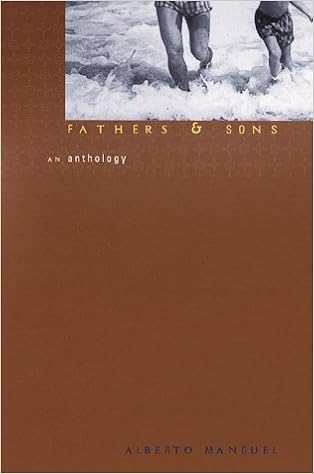
Today is Father’s Day so I thought I’d highlight a short story anthology found on Schatje's Shelves.  Fathers and Sons, edited by Alberto Manguel has 20 stories and features such writers as William Faulkner, Steven Crane, Franz Kafka, Ben Okri, F. Scott Fitzgerald, Richard Ford, and Rohinton Mistry.  The typical male themes of war, sports, and the outdoors appear along with more unusual and introspective pieces (https://www.amazon.ca/Fathers-Sons-pb-ALBERTO-MANGUEL/dp/0811816303/ref=sr_1_fkmr0_1?s=books&ie=UTF8&qid=1466017516&sr=1-1-fkmr0&keywords=fathers+and+sons+alberto+manguel).


In honour of the day, I also thought I’d share an article I recently read entitled “21 Women On The Best Advice They Got From Their Dads”:  http://www.refinery29.com/2016/06/113729/dad-words-of-wisdom-fatherly-advice#slide.

Saturday, June 18, 2016

Celebrating Book Clubs

Today, June 18, is National Group Reading Day in Great Britain.  The day is sponsored by The Reading Agency, “a charity whose mission is to inspire more people to read more, encourage them to share their enjoyment of reading and celebrate the difference that reading makes to all our lives” (https://readingagency.org.uk/about/).


The first book club to which I belonged has minutes of meetings dating back to 1938, making THE Timmins Book Club one of the oldest in North America.  We were featured on LitLovers.com:  http://www.litlovers.com/featured-clubs/timmins-book-club.


In honour of the day, I also thought I’d feature popular reading group books.  A British perspective is offered by The Reading Agency which conducted a survey and released its list of the most popular reading group books: 
To Kill a Mockingbird by Harper Lee
Elizabeth is Missing by Emma Healey
We Need to Talk About Kevin by Lionel Shriver
The Book Thief by Markus Zusak
The Guernsey Literary and Potato Peel Pie Society by Annie Barrows and Mary Ann Shaffer
The Miniaturist by Jessie Burton
A Thousand Splendid Suns by Khaled Hosseini
The Unlikely Pilgrimage of Harold Fry by Rachel Joyce
The Goldfinch by Donna Tartt
The Help by Kathryn Stockett
I was amazed to realize that I’ve read 9 of the books on that list; The Miniaturist is the only novel I have not read.

Recently, BookRiot also recently issued a list of the top 12 book club books:
All the Light We Cannot See by Anthony Doerr
The Immortal Life of Henrietta Lacks by Rebecca Skloot
Me Before You by Jojo Moyes
The Nightingale by Kristin Hannah
The Book Thief by Marcus Zusak
Americanah by Chimamanda Ngozi Adichie
Big Little Lies by Liane Moriarty
Life After Life by Kate Atkinson
The Light Between Oceans by M.L. Stedman
Orphan Train by Christina Baker Kline
Room by Emma Donoghue
Cutting for Stone by Abraham Verghese
I’ve read 7 of these; The Immortal Life of Henrietta Lacks, Me Before You, The Nightingale, Americanah, and Big Little Lies are the 5 I haven’t yet read.

And for a lighter look at book clubs, see http://www.cbc.ca/baroness/blog/book-club?utm_content=buffer2a78c&utm_medium=social&utm_source=twitter.com&utm_campaign=buffer

Thursday, June 16, 2016

Margaret Atwood: PEN Pinter Prize Winner

The PEN Pinter Prize is an annual literary award launched in 2009 by English PEN in honour of the late Nobel Literature Prize-winning playwright Harold Pinter, who had been a Vice President of English PEN and an active member of the International PEN Writers in Prison Committee.   The award is given to a writer of outstanding literary merit who, in the words of Pinter’s Nobel speech, casts an “unflinching, unswerving” gaze upon the world and shows “a fierce, intellectual determination … to define the real truth of our lives and our societies.”

Wednesday, June 15, 2016

Lambda Literary Awards Winners


Image result for lambda literary awards
Lambda Literary Awards (also known as the "Lammys") are awarded yearly by the US-based Lambda Literary Foundation to published works which celebrate or explore LGBT themes.  To qualify, a book must have been published in the United States in the year current to the award.

“The Lambda Literary Awards were founded in 1989 to elevate the profile of LGBT literature,” said Lambda Literary Board President, KG MacGregor. “In so doing, we also elevate the lives of those who find themselves authentically portrayed in our stories.”


Canadian author Hasan Namir’s novel God in Pink took the prize in the Gay Fiction category.  This novel  tells the story of Ramy, a closeted university student in war-torn Iraq in 2003, who struggles to balance his sexuality, religion and culture as a queer Muslim against a violent backdrop (http://www.cbc.ca/books/2016/06/lambda-literary-award-winners-2016.html).