Ranked a Top Canadian Book Blog
Twitter: @DCYakabuski
Facebook: Doreen Yakabuski
Instagram: doreenyakabuski
Threads: doreenyakabuski
Substack: @doreenyakabuski
Bluesky: @dcyakabuski.bsky.social

Tuesday, June 28, 2016

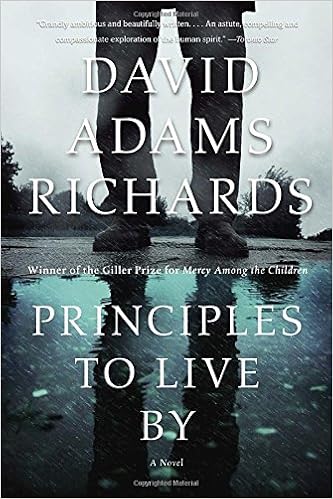
Review of PRINCIPLES TO LIVE BY by David Adams Richards


3.5 Stars
The protagonist, John Delano, is an RCMP officer nearing retirement in Saint John, New Brunswick.  He receives a letter which suggests that a 13-year-old boy went missing from a foster home twelve years earlier.  Delano feels he must investigate but there seems no record of such a boy since he was never reported missing and even his name is unknown.  His very existence is questionable, though the novel’s opening flashback shows that he did indeed exist and explains what happened.  Delano is thwarted every way he turns, a colleague even suggesting Delano is planting evidence.  Regardless he persists.

Delano is a broken man.  His health is failing, his career has stalled, his marriage has failed, and he is tormented by the unsolved disappearance of his stepson and by the horrors he witnessed during the Rwandan genocide.  Delano arouses sympathy in the reader.  He has suffered a great deal.   He feels responsible for his stepson’s disappearance since he wasn’t at home because of work; the boy’s last words to Delano were, “’Dad, you forgot to say goodbye’” (178).  When his psychiatrist asks if he has ever considered suicide, Delano replies, “’Oh – not so often.  Four, maybe five times a day’” (171).  When asked if he has friends, he says, “’Not that you’d notice’” (201).  His professional reputation has suffered; his actions and comments have been incorrectly interpreted to label him a racist and sexist. 

He also arouses admiration.  Delano is a brilliant man with uncompromising ethics.  He has a personal code of honour.  Believing that evil exists in the world (69), Delano feels that he must root out evil wherever he suspects it lies.  If his pursuit of evil means that he must suffer, so be it:  “If Saint Catherine’s heart could be pierced by the cross of Christ, why shouldn’t his be” (178)?  Delano is very much David in a David versus Goliath struggle between good and evil.  He and his goodness are at odds with a society in which political correctness and appearances take precedence, in a world in which “common decency” (117) is exceptional.   His decisions and actions often complicate the struggle; his unwillingness to deviate from his principles means his enemies can portray him as an inflexible troublemaker. 

There is one major problem with how Delano works on the case.  At the beginning, he mentions that though he is no longer an active officer, he does get called in to work on cases:  “He was better than good at them.  Why this was he wouldn’t have been able to tell anyone.  He had in fact been around the globe doing work.  He had been an officer for many years” (11).  His reputation proves to be deserved, but his powers of observation seem almost superhuman.  Everywhere he searches he finds objects that are clues to a decades-old disappearance.  Every object he finds turns out to be relevant to the case.  From the flimsiest of clues, he builds a narrative that always proves to be correct.  Some of his leaps of logic are astounding.  Often he seems to rely only on supposition.  It is understandable, therefore, why he is often regarded with suspicion; evidence does appear by chance and he always makes astute analyses and uncanny predictions.  At the end, one colleague is astounded and asks, “’I know he is good, but is he that good?’” while another replies, “’Except . . . he is that good.  He always has been that good’” (255).

In terms of characterization, another issue is the portrayal of the villains.  Melissa Sapp, for example, seems to be the embodiment of evil.  A career politician, she seeks revenge against Delano because he openly opposed her decisions many years earlier.  She portrays herself as an altruist but she is a hypocrite because she does only things that will aid her ambition and bring her more power.  She is beautiful and intelligent and uses those traits to be unscrupulously manipulative.  The author takes pains to state that Sapp “did have one entirely admirable trait. . . Although not in her marriage, she did have loyalty in most other things that concerned [her husband]” (266).  The author, however, “doth protest too much, methinks.”  Velma Cheval is another villain who, likewise, seems to have no redeeming qualities. 

The tone of the novel is sometimes troubling; the author’s anger almost overpowers the narrative.  He lashes out at academics, social workers, feminists, political bureaucrats, and even writers.  For example, Canada’s special envoy to the UN is described:  “This special envoy had the pallid, studied look of a world-weary intellectual and a practised, face-saving inscrutability when he spoke of delicate matters – matters when to actually be concise and forthright was critical.  That is, like so many diplomats, the more vital the need the more tenuous the response” (75 – 76).  Then there are comments like, “[John] had seen as many self-serving and wounded feminists as chauvinists.  A few of them had murdered.  But more of them had done something even worse, in John Delano’s mind unforgivable: Like some of the writers he had got to know from Newfoundland to Saskatchewan, they had pandered” (60).  Professors do not fare well:  “the security professors had, the safety they enjoyed, the coddling they experienced, . . . and the monies they received seemed disproportional to anything they had achieved.  If there was an ideal idle class, a class that pretended to have great experience, even great suffering, without experiencing the pain, professors certainly came close” (160).

Another weakness in the book is the interconnectedness of characters.   Saint John is not a huge metropolis, but it is not a small town either.  It is unlikely that everyone will have a direct connection to Delano.  When the relationship between Delano and a petty criminal is revealed at the end of the novel, it explains a lot, but then everyone seems related to everyone else.  “By some trick of fate” (77), a political mandarin is the father of a man Delano once arrested.  That son influenced the decisions of the parents of the missing boy and is a friend of Melissa Sapp.  So many tricks of fate seem excessive. Certainly, Melissa Sapp’s involvement in so many aspects of Delano’s life over so many years stretches credulity.

My review of this book seems negative, and I feel there are definite problems.  Nonetheless, I would recommend it.  David Adams Richards has been a favourite novelist of mine for many years; in my blog, I’ve mentioned that his  Incidents in the Life of Markus Paul is a book that should be read by all Canadians.  Though this book is not his strongest, I still found it enjoyable.  A damaged detective solving a case suggests a police procedural, but this is anything but a conventional mystery.  It seems that David Adams Richards always surprises and offers something out of the ordinary.

Monday, June 27, 2016

Saying Goodbye (Literary Quotations about Brexit?)

The United Kingdom has voted to leave the European Union, but there are many questions and concerns about what happens next.  Signature (@SignatureReads) featured a list of quotes on parting entitled “All We Need of Hell:  9 Quotes on Parting in the Wake of Brexit” (http://www.signature-reads.com/2016/06/all-we-need-of-hell-9-quotes-on-parting-in-the-wake-of-brexit/?ref=BEBF7DBE6741).  That inspired me to brainstorm my favourite quotes on saying farewell; here are 15 statements by authors that might apply as withdrawal negotiations are begun:

“Parting is such sweet sorrow.” – William Shakespeare

“To say goodbye is to die a little.” ― Raymond Chandler

“Ever has it been that love knows not its own depth until the hour of separation.” ― Kahlil Gibran

“Only in the agony of parting do we look into the depths of love.” ― George Eliot

“They parted at last with mutual civility, and possibly a mutual desire of never meeting again.” ― Jane Austen

“I have more care to stay than will to go.” ― William Shakespeare

“It was one of those ridiculous arrangements that couples make when they are separating, but before they are divorced – when they still imagine that children and property can be shared with more magnanimity than recrimination.” – John Irving

“He loved her; in some ways he was devoted to her. But he couldn’t reach her, and it was the same on her side. It was as if they’d drunk some fatal potion that would keep them forever apart, even though they lived in the same house, ate at the same table, slept in the same bed.” – Margaret Atwood

 “This is all. It’s been very rare to have known you, very strange and wonderful. But this wouldn’t do — and wouldn’t last.” – F. Scott Fitzgerald

“They who go feel not the pain of parting; it is they who stay behind that suffer.” - Henry Wadsworth Longfellow

“The reason it hurts so much to separate is because our souls are connected.” - Nicholas Sparks

“Taking leave of our friends resembles taking leave of the world, of which it has been said, that it is not death, but dying, which is terrible.”  - Henry Fielding

“Thou hast but taken up thy lamp and gone to bed; I stay a little longer, as one stays to cover up the embers that still burn.” - Henry Wadsworth Longfellow

“Such parting breaks the heart they fondly hope to heal.” - Lord Byron

“Faithless is he that says farewell when the road darkens.” - J. R. R. Tolkien

Saturday, June 25, 2016

Book Titles

Last week, a former student of mine (@NathAt) tweeted about the number of novels published in 2016 with titles including the word wife:               The Photographer's Wife by Suzanne Joinson
                                                                                The Ringmaster's Wife by Kristy Cambron
                                                                                The California Wife by Kristen Harnisch
                                                                                The Restaurant Critic's Wife by Elizabeth LaBan
                                                                                My Husband's Wife by Jane Corry
                                                                                The Missing Wife by Sheila O'Flanagan
                                                                                The Railwayman's Wife by Ashley Hay
                                                                                The Imperial Wife by Irina Reyn

That got me to brainstorming other titles I’ve read with wife as a key word:
                                                                                The Zookeeper's Wife by Diane Ackerman
                                                                                The Time Traveler's Wife by Audrey Niffenegger
                                                                                The 19th Wife by David Ebershoff
                                                                                The Kitchen God’s Wife by Amy Tan
                                                                                The Paris Wife by Paula McLain
                                                                                The Tiger's Wife by Téa Obreht
                                                                                The Silent Wife by A. S.  A. Harrison
                                                                                The Nazi Officer's Wife by Edith H. Beer

 And this thinking about titles reminded me of a blog post I read a while back:  “Ten Things About Book Titles That Keep Me Up at Night” (http://karingillespie.net/2014/03/12/ten-things-about-book-titles-that-keep-me-up-at-night/).

Coincidentally, The New Yorker also posted a humour piece about book titles last week, “Famous Novels Retitled like Episodes of ‘Friends’” (http://www.newyorker.com/humor/daily-shouts/famous-novels-retitled-like-episodes-of-friends?intcid=mod-latest).

Friday, June 24, 2016

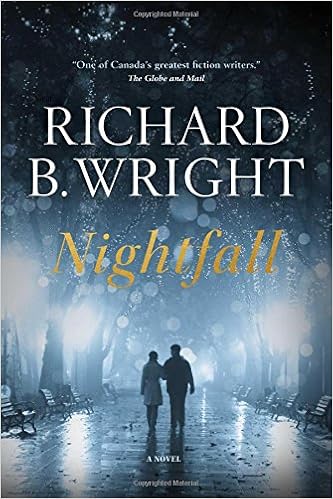
Review of NIGHTFALL by Richard B. Wright

3.5 Stars
This short novel revisits the characters of Wright’s earlier novel, October.  Readers might want to read this latter book first though they might then find Nightfall repetitive because passages from October are directly inserted.  On the other hand, October does, as the author’s note in Nightfall states, “clarify the relationship between James and Odette at quite different stages in their lives.”

James Hillyer is a 76-year-old widower and retired professor.  Despondent after the death of his daughter, he starts thinking about happier times in the past.  He decides to try and find his first love, Odette Huard, whom he last saw in Gaspé, Quebec, in 1944.  The two of them do reconnect and start a new relationship after 62 years.

Chapters are narrated from various viewpoints (James, Odette, Odette’s developmentally challenged sister, Odette’s former boyfriend) but always in third person.  This narrative structure allows the reader to see events, like the first meeting between James and Odette, from the perspective of both characters.

This approach, however, has a drawback.  There is considerable repetition.  For example, we learn, in one of Odette’s chapters, that she worked at the Green Mermaid when she was young; then in a conversation with James, she gives him that same information.  Frequently, things are mentioned via a character’s thoughts and then repeated via dialogue.

One of the aspects I most enjoyed is comparing the elderly characters with their younger versions.  They have had numerous life experiences, but both James and Odette are much like their young selves.  When James first hears Odette’s voice on the phone, he comments, “Hints of the old Odette.  Temperaments never change.  We are what we were, only in old bodies” (23).  Odette remains blunt and worldly; James is sedate and continues to have “a rather melancholic side” (160). 

What is also emphasized is that though the two are old and their expectations have been tempered by time and life, they have the same emotions as the young.  They want companionship and love and even sex, that “old itch” (103).  Odette comments that, “it was good to have the comfort of someone to love and to share whatever time was left to them” (165).  Both are aware that they are in their twilight years, but they hope they “would have some time together.  And it must be time well spent.”  And isn’t that a lesson for everyone?

The book is a short, easy read, a meditation on love and aging.  It suggests that people, regardless of their age, are capable of being happy.  James comments that   “’happiness is largely a matter of temperament, a disposition or attitude, a genetic inheritance.  It helps, of course, if the circumstances in your life are agreeable; if you’re not worried about, say, money or health. . . . I do believe that our culture is obsessed with happiness and people try too hard to find it.  I sometimes think happiness finds you, and you don’t need to look for it all the time. . . . It could come from something as simple as listening to, say, a cardinal singing in a tree on a spring morning’” (159 – 160).  And isn’t that, too, a lesson for everyone?

Thursday, June 23, 2016

Canadian Debut Novels

Yesterday, I posted about the Kobo Emerging Writers Prizes given to Canadian authors.  That got me to thinking about debut novels and I came across this list of 25 Canadian debut novels compiled by CBC Books:  http://www.cbc.ca/books/2016/06/the-25-greatest-canadian-debut-novels.html.

I’ve read 14 of the titles on that list, and some of them are among the best novels I’ve ever read.  I would highly recommend                         What the Body Remembers by Shauna Singh Baldwin
                                                                Three Day Road by Joseph Boyden
                                                                River Thieves by Michael Crummey         
                                                                A Student of Weather by Elizabeth Hay
                                                                Obasan by Joy Kogawa
                                                                Fall on Your Knees by Ann-Marie MacDonald
                                                                No Great Mischief by Alistair MacLeod
                                                                Annabel by Kathleen Winter
                                                               
To the CBC list of great Canadian debut novels, I would add the following:
                                                                Tamarind Mem by Anita Rau Badami
                                                                The Good House by Bonnie Burnard
                                                                Rush Home Road by Lori Lansens
                                                                Crow Lake by Mary Lawson
                                                                The Birth House by Ami McKay
                                                                Kit’s Law by Donna Morrissey
                                                                Cool Water by Dianne Warren

So those are my 15 suggestions for Canadian debut novels.  

Wednesday, June 22, 2016

Kobo Emerging Writers Prize Winners

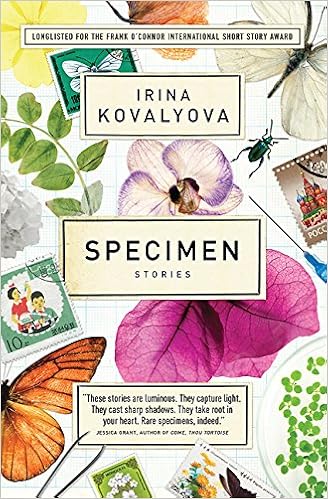
The Kobo Emerging Writer Prize winners were announced yesterday.  The winner in the literary fiction category is Irina Kovalyova for her short story collection, Specimen.

The stories in Specimen are an exploration of science and the human heart; the place where physical reality collides with our spiritual and emotional lives.  In “The Blood Keeper,” a young academic travels to North Korea to work on her dissertation and embarks on a dangerous affair. In “Mamochka,” an archivist at the Institute for Physics in Minsk, must come to terms with her daughter’s marriage to a Chinese man in Vancouver. In “Peptide P,” scientists study a disease that seems to affect children after they eat hotdogs. In “Side Effects,” a woman’s personality is altered, and not necessarily for the better, by botox injections. In “The Big One,” a woman and her daughter find themselves trapped in the rubble of an underground parking garage after an earthquake. Stylistically varied and with settings that range from North Korea and Minsk to Vancouver and Gdansk, Kovalyova is a new voice in Canadian fiction (https://www.amazon.ca/Specimen-Stories-Irina-Kovalyova/dp/1770898174/ref=sr_1_1?ie=UTF8&qid=1466602683&sr=8-1&keywords=specimen).

Kobo awards an annual prize to emerging Canadian writers in the categories of literary fiction, non-fiction, and genre fiction (with a different genre recognized each year).  In 2016 romance is the chosen genre.  The prize is open to both traditionally published and self-published authors from Canada who released their debut title the year prior. Of course, the title must be available on Kobo.com.

For information about the prize and other winners, go to https://store.kobobooks.com/p/emergingwriterprize.

Tuesday, June 21, 2016

Some Satire: Donald Trump on Books

I am not a political person, but I do enjoy satire.  I found this online earlier this morning.  (I await a Hillary Clinton version.)

http://www.themillions.com/2016/06/make-western-canon-great.html


ANNALS OF JAPERY

Make the Western Canon Great Again!

By  posted at 6:00 am on June 21, 2016 

Let me ask you a question, my friends. When was the last time an American won the Nobel Prize? Do you know the answer? It was 1993, and it was an African-American woman! Nothing against African-American women, okay? African-American women, some of them, they’re gorgeous. Perfect 10s. But still, you gotta wonder: 23 years ago, and it was a black lady. Before that, you have to go back to 1976 – and it was a Jewish guy! Now, I love the Jewish people, and we all know the African Americans love me, but seriously, it tells you something when you have to go back to 1962 to find a real American Nobel Prize winner in Literature.
Our literature is slipping, folks. We’re losing our edge. It’s sad. It’s just so damn sad. You know why we’re slipping? Because our colleges are run by politically correct guilty white liberals who hate America. Oh my God, America’s college professors are so dumb. I could have been a professor, okay? Believe me, I’m a terrific teacher. People love it when I explain stuff to them. It’s a gift I have. But why would want to be a professor? Sure, I could sleep with some cute coeds. But think about it: Do you see many college professors married to supermodels? Do you see college professors with personal brands worth $5 billion. No, you don’t. And you know why? Because they’re so dumb.
You know how you can tell they’re dumb? From the books they teach. The Brief Wondrous Life of Oscar WaoThe Interpreter of MaladiesThe House on Mango Street. Anybody here read The House on Mango Street? I haven’t, either. I’m a businessman worth $10 billion. I don’t read books unless I wrote them, and even then I’m selective. But they’re teaching The House on Mango Street like crazy in English Departments across America – or at least they were in the 1990s, which just goes to show you how current my information is. The author of that book is Sandra Cisneros, who is, I believe, a Mexican. She was born in the United States, okay, but her parents are Mexican. So she’s Mexican. It doesn’t matter where you’re born, not if you’re black or brown. President Obama was born in Hawaii and his mother was a white woman, and yet the man’s Kenyan. It’s so obvious, if you think about it.
Anyway, there she is, this Sandra Cisneros, on college reading lists along with Edwidge Danticatand Jhumpa Lahiri and Junot Díaz  and all these other foreigners, and THEY’RE TAKING JOBS FROM AMERICAN AUTHORS. Good, hard-working American authors like Jonathan Franzen and John Irving and Richard FordTime magazine, which is, to be honest with you, this close to losing its press credentials with me, but anyway, Time called Jonathan Franzen “The Great American Novelist.” “The Great American Novelist,” my friends, and he can’t get onto a university syllabus to save his life. He’s too “commercial,” they say. He doesn’t play nice withOprah. And, oh yeah, they never say it because they’re too politically correct, but he’s too white. That’s the real problem with Jonathan Franzen. He’s too white, too male, and too straight. Sorry, Jonathan. Three strikes and you’re out.
We’re going to take back the Western canon, folks. We are going to build a big beautiful wall around books written by white people and we’re going to make the immigrants and the African-American writers pay for it. Foreign writers are eating our lunch right now. We used to dominate the world of letters. The Russians, the Chinese, even the French – they all read our books. We used to be feared and loved around the world. And now look at us. Look who’s winning Nobel prizes these days. Svetlana AlexievichPatrick ModianoMo Yan? I mean, what the hell kind of name is Mo Yan? Is that a guy? A girl? Which bathroom does Mo Yan use in North Carolina? Hah! Ha! Ha! Ha! Damn, I’m funny. I’ve gotta tweet that. But this is serious stuff, folks. These foreign writers are winning the Nobel Prize year after year, and we’re letting it happen. They’re shlonging us and we’re so stupid and lazy and politically correct that we like getting shlonged!
Well, no more.
When I’m President, I’ll ban all books by immigrant writers until we can figure out what the hell is going on with the Western Canon. I’ll ban translations by foreign authors, too. We’ll ban so many books it’ll make your head spin, folks. We’ll empty out the university book stores! We’ll clear whole shelves from the library! We’ll fire all the politically correct professors who hate America! We’ll build piles of books as high as one of my big, beautiful, classy hotels, and we’ll burn them all to ashes!
And when we’re done, my fellow Americans, we will make the Western Canon great again.
(Hat tip to frequent Millions commenter Moe Murph, who supplied the headline for this piece.)