Ranked a Top Canadian Book Blog
Twitter: @DCYakabuski
Facebook: Doreen Yakabuski
Instagram: doreenyakabuski
Threads: doreenyakabuski
Substack: @doreenyakabuski
Bluesky: @dcyakabuski.bsky.social

Thursday, April 6, 2017

Lengthy Novels


Yesterday, I posted a review of my latest lengthy read (700+ pages).  Since I started my blog, I’ve read and discussed a few such books: 


If you like reading tomes, you might be interested in this list:  http://www.vulture.com/2016/11/long-books-worth-your-time.html?linkId=35070188.  It lists 26 lengthy books, though it does treat some trilogies (The Lord of the Rings) and tetralogies (The Neapolitan Novels) as single books.  From that list, the one I would recommend is A Suitable Boy by Vikram Seth. 

Wednesday, April 5, 2017

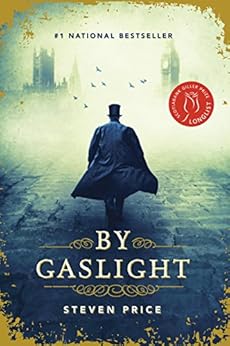
Review of BY GASLIGHT by Steven Price


4 Stars
At 731 pages, this is a doorstopper of a book.  I usually hesitate to read such lengthy tomes for fear of wasting my much-treasured reading time.  I finally decided to take the plunge because this novel was nominated for the 2016 Giller Prize.  I understand why it made the shortlist. 

This is a great example of Victorian detective fiction.  Set in 1885 London, it tells the intertwined stories of two men.  William Pinkerton, son of the founder of the Pinkerton Detective Agency, is in the city looking for Edward Shade, an elusive master criminal whom William’s father never managed to arrest.  Now that his father is dead, William has picked up the chase.  He manages to find Charlotte Reckitt, a supposed acquaintance of Shade’s, but she takes a fatal jump into the Thames; then, to William’s surprise, her dismembered body washes up. 

The second protagonist is Adam Foole, a thief and con-artist, who also travels to London to find Charlotte, a woman he loves though he hasn’t seen her for a decade.  He contacts William and the two become allies in searching for the truth about Charlotte’s fate.  The two men eventually come to realize that their lives have overlapped in the past, especially during the American civil war. 

This book is a mystery thriller; there are certainly a number of questions that need to be answered:  Who is Edward Shade?  Is he dead or alive?  Does he even exist?  Why was Allan Pinkerton never able to find him?  Why does William become obsessed with finding Shade?  How/why did Charlotte, after her leap into the river, end up dismembered and with shorn hair? 

Suspense is abundant.  Besides the questions, there is danger for both men.  There’s a cat and mouse game that will have the reader cheering for one side and then another.  Foreshadowing is used frequently:  “It was, he would reflect later, a most impressive performance” (645) and “it was a thing he had felt before and he knew by this that something that day would go wrong” (672).  Dramatic irony is also used:  the reader knows what William and Adam are hiding from each other. 

The author excels in creating atmosphere.  There are detailed descriptions of perpetually foggy and grimy cobblestoned streets.   Scenes are set in soot-filled fog and dank alleys and opium dens and séance parlours and filthy sewers.  One can see the squalor and smell the stench and feel the cold rain.

There are several lengthy flashbacks to the pasts of both William and Adam.  It is clear that the two were shaped by their pasts.  William’s troubled relationship with his father certainly influences his behaviour:  “William feared him and loved him and loathed him every day of his life yet too not a day passed that he did not want to be him” (151).  Adam had a more difficult childhood and his experiences, including his relationship with Charlotte, motivate his actions. 

Characterization is a strong element.  Both protagonists are fully developed.  They are flawed people but they have redeeming qualities.  There are several minor characters like Molly and Japheth Fludd who also capture the reader’s attention.

I found this an engrossing read.  The flashbacks sometimes slow down the pace, but they are important in explaining characters and events in the present.  Themes are not always developed strongly, but the book is a very entertaining read that would make a great movie.

Tuesday, April 4, 2017

Protest Screenings of 1984

If you live in any of 187 American or 4 Canadian cities (or England or Sweden or Croatia or The Netherlands or New Zealand), you might want to go out and see a movie tonight.  Theatres in these cities will be screening Michael Radford's adaptation of George Orwell's dystopian classic 1984 in protest of Donald Trump. 

Radford's adaptation was released, fittingly, in 1984, and stars John Hurt as Winston Smith.  The movie follows Smith as he navigates a dystopian world overcome by war and under surveillance by Big Brother.  Independent thought is outlawed and individuality is condemned.  While working in the Records Department in the Ministry of Truth, rewriting history, Winston, as a way of rebelling, decides to keep a diary, an act punishable by death.  The April 4th event date is a nod to the date Smith begins his journal with the following sentence:  “It was a bright cold day in April, and the clocks were striking thirteen.”

A joint statement on behalf of the participating theatres reads, “Orwell's portrait of a government that manufactures their own facts, demands total obedience, and demonizes foreign enemies, has never been timelier. The endeavor encourages theaters to take a stand for our most basic values: freedom of speech, respect for our fellow human beings, and the simple truth that there are no such things as 'alternative facts.' By doing what they do best - showing a movie - the goal is that cinemas can initiate a much-needed community conversation at a time when the existence of facts, and basic human rights are under attack. Through nationwide participation and strength in numbers, these screenings are intended to galvanize people at the crossroads of cinema and community, and bring us together to foster communication and resistance against current efforts to undermine the most basic tenets of our society."

The protest screening is also aimed at Trump’s alleged proposed cuts on cultural programs which are seen as “an attack on free speech and creative expression through entertainment.”

To find out which theatres in which cities are screening the film, go to http://www.unitedstateofcinema.com/. 

Monday, April 3, 2017

Shortlist for 2017 Baileys Women's Prize for Fiction


The shortlist for the 2017 Baileys Women’s Prize for Fiction was announced today.

There are six finalists:

Stay with Me by Ayobami Adebayo
This is a tale of grief and jealousy set in the south-western Nigerian state of Osun.  Society resolutely demands children of Yejide, but two years of her marriage have resulted in only failure.

The Power by Naomi Alderman
Overnight, the balance of a power – both metaphorically and literally – shifts to teenage women across the world, who suddenly gain the ability to kill by mere touch.

The Dark Circle by Linda Grant
World War II is over, a new decade is beginning but for an East End teenage brother and sister living on the edge of the law, life has been suspended. Sent away to a tuberculosis sanatorium to learn the way of a patient, they find themselves in the company of army and air force officers, a car salesman, a mysterious German woman and an American merchant seaman.

The Sport of Kings by C. E. Morgan
The novel is a portrait of lives cast in shadow by the enduring legacy of slavery.

First Love by Gwendoline Riley
Neve, a wife in her mid-30s, teases apart the strands of incident that have led her to the uneasy, compromised calm of the now.

Do Not Say We Have Nothing by Madeleine Thien
The novel tracks the interwoven lives of three Chinese musical prodigies from the foundation of the People’s Republic in 1949 through to the present day.  See my review  of this Canadian book at http://schatjesshelves.blogspot.ca/2016/10/review-of-do-not-say-we-have-nothing-by.html.

The winner of the £30,000 prize will be announced on June 7.

The Benefits of Reading


I’ve already  written about how studies have shown that people who regularly read literary fiction possess more emotional intelligence (http://schatjesshelves.blogspot.ca/2016/08/literary-fiction-and-emotional.html) and that book reading is associated with an extra 23 months of survival (http://schatjesshelves.blogspot.ca/2016/08/book-readers-live-longer.html). 

I was interested, therefore, to come across an article that argues that reading improves mental health, something that most readers certainly believe.  “Books have long-since been one among many art forms that have provided comfort and support.  Reading is certainly not a cure-all for people's mental health concerns but it can improve overall mental health” (https://www.bustle.com/p/5-proven-ways-reading-can-improve-your-mental-health-43367).  I found a similar argument in an article in The New Yorker:  “Reading has been shown to put our brains into a pleasurable trance-like state, similar to meditation, and it brings the same health benefits of deep relaxation and inner calm. Regular readers sleep better, have lower stress levels, higher self-esteem, and lower rates of depression than non-readers” (http://www.newyorker.com/culture/cultural-comment/can-reading-make-you-happier).

Last November, The Expert Editor had an infographic of 14 ways the body can help the mind and body: https://experteditor.com.au/blog/brain-books-benefits-reading/

Bibliotherapy has become quite popular.  Bibliotherapy, the practice of encouraging reading for therapeutic effect, takes many different forms, from literature courses run for prison inmates to reading circles for people suffering from dementia.  The New Yorker article mentioned above discusses the history and practice of bibliotherapy. 

This article also mentions a book, The Novel Cure: An A-Z of Literary Remedies, written by Susan Elderkin and Ella Berthoud, two bibliotherapists.   I actually discussed this book in one of my first entries in this blog:  http://schatjesshelves.blogspot.ca/2015/07/some-literary-prescriptions-for-your.html.  I was unaware, however, that the book, which has been translated into several languages, has different reading recommendations to fit each particular country’s readership: “In the Dutch edition, one of the adapted ailments is ‘having too high an opinion of your own child’; in the Indian edition, ‘public urination’ and ‘cricket, obsession with’ are included; the Italians introduced ‘impotence,’ ‘fear of motorways,’ and ‘desire to embalm’; and the Germans added ‘hating the world’ and ‘hating parties’ (http://www.newyorker.com/culture/cultural-comment/can-reading-make-you-happier).

And now Elderkin and Berthoud have written a children’s version, The Story Cure: An A-Z of Books to Keep Kids Happy, Healthy and Wise.  It’s described as “a manual for grownups who believe that the stories which shape children's lives should not be left to chance.  In these pages bibliotherapists Ella and Susan recommend the perfect children's book - from picture books to YA novels via the golden world of chapter books - for every hiccup and heartache. Whether the young child you know is being bullied, the toddler can't sleep, or the teenager has fallen in love for the first time - or just doesn't know what to read next - the right story will help them feel themselves again” (https://www.amazon.ca/Story-Cure-Z-Books-Healthy-ebook/dp/B01E7JWITU/ref=sr_1_fkmr0_1?ie=UTF8&qid=1489597386&sr=8-1-fkmr0&keywords=a+spoonful+of+stories+Berthoud+and+Elderkin).

Well, I’m off to self-medicate!

Sunday, April 2, 2017

International Children's Book Day


Today is International Children's Book Day (ICBD), a day to inspire a love of reading and to call attention to children's books.  April 2 was chosen because it’s Hans Christian Andersen’s birthday.  For information about the day, go to http://www.ibby.org/awards-activities/activities/international-childrens-book-day/.

Hans Christian Andersen, born in 1805, is best remembered for his children’s fairy tales; among them are "The Emperor's New Clothes", "The Little Mermaid", "The Nightingale", "The Snow Queen", "The Ugly Duckling", "Thumbelina" and “The Princess and the Pea”. 

Last year, on what would have been HCA’s 211th birthday, BookRiot posted a list of eleven things to do on his birthday.  Though it’s a year later, the activities are still appropriate.  Check out the suggestions at http://bookriot.com/?p=94814.

If you don’t have any of HCA’s tales on hand, Fairy Tales of Hans Christian Andersen is available through Project Gutenberg and can be downloaded for free:  http://www.gutenberg.org/ebooks/27200?msg=welcome_stranger.

Saturday, April 1, 2017

On April Fool's Day - Shakespeare's Wise Fools


The Fool is a recurring character type in the works of William Shakespeare.  Shakespearean fools are usually clever peasants or commoners that use their wits to outdo people of higher social standing. 

Here are some of my favourite lines by Fools: 

Feste, Twelfth Night, or What You Will
“Many a good hanging prevents a bad marriage.”

Touchstone, As You Like It
“The more pity, that fools may not speak wisely what wise men do foolishly.”

The Fool, King Lear
“Thou shouldst not have been old till thou hadst been wise”

The Fool, King Lear
“Have more than thou showest,
Speak less than thou knowest,
Lend less than thou owest,
Ride more than thou goest,
Learn more than thou trowest,
Set less than thou throwest.”

BookRiot suggests 8 more examples of “knavish wisdom of the Bard’s merriest philosophers”:  http://bookriot.com/2012/03/30/8-wisest-lines-from-shakespeares-fools/.   

If you are interested in the evolution of fools in Shakespeare’s plays, check out this article on the British Library website:  https://www.bl.uk/shakespeare/articles/shakespeares-fools.