Ranked a Top Canadian Book Blog
Twitter: @DCYakabuski
Facebook: Doreen Yakabuski
Instagram: doreenyakabuski
Threads: doreenyakabuski
Substack: @doreenyakabuski
Bluesky: @dcyakabuski.bsky.social

Wednesday, April 19, 2017

Judge a Book by Page 69


We’ve all heard the adage about not judging a book by its cover.  So how do you decide if a book will interest you?

Well, you could start reading it.  The first chapter is designed as the hook.  It’s the part of the book that almost certainly went to the publisher first.  The problem is that the opening doesn’t always give you a good feel for the book as a whole.  I can’t begin to count how many books I’ve read where the introduction piqued my interest but then it quickly waned thereafter. 

Recommendations from friends are often a good indication as to whether you will enjoy a book.  The caveat is that you need to have similar reading tastes or that word-of-mouth suggestion has little value. 

Personally, I like reading book reviews.  They often help me decide if I want to make a purchase or borrow from the library.  Of course, I’d like to think that some of you use Schatje’s reviews posted on this blog to help you add to your to-read pile. 

If you haven’t tried it, there is the page 69 test.  Marshall McLuhan, the Canadian philosopher, academic, and prophet of the modern media age, had a theory:   read page 69. If you like it, then chances are you'll like the rest of the book too.  The idea is that page 69 gives you the chance to see the story in the early stages of its full flow:  a bit of action without any spoilers.

Try it for yourself.  Grab a book you’ve already read and see if page 69 would have grabbed your attention.  Then the next time you are considering a book, carry out a similar experiment.  I think it’s a great way to discover new books and authors in a brief but surprising encounter.

Tuesday, April 18, 2017

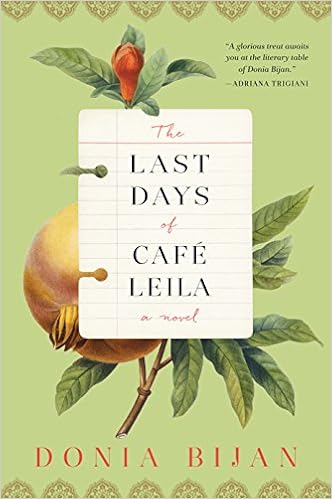
Review of THE LAST DAYS OF CAFÉ LEILA by Donia Bijan (New Release)


2 Stars
I enjoy books which illuminate other cultures so I really looked forward to reading this book.  Though it does indeed provide details about Iranian culture, it does so in a narrative that I can only describe as awkward and unsophisticated. 

Noor, recently divorced, returns to Iran after a 30-year absence to visit her aging father Zod.  Noor is accompanied by her recalcitrant teenaged daughter Lily.  In Tehran, Zod continues to run a restaurant, Café Leila, which is a neighbourhood gathering place started years earlier by his parents.  Noor is returning home but Lily has difficulty adjusting to life in Iran. 

There are numerous flashbacks.  The reader learns about the emigration of Zod’s parents from Russia; Zod’s studies in Paris and his marriage to Pari; Pari’s death; Noor’s life in California and her marriage and divorce.  There are even flashbacks describing the lives of the employees at the café. 

The story is narrated from multiple perspectives:  Zod, Pari, Noor, Lily, Lily’s father, Noor’s brother, Zod’s estranged brother, Zod’s sister-in-law, the café’s errand boy, etc.  The author obviously wanted to create well-rounded characters, but the effect is a lack of focus. 

The impression is that the author didn’t know whom to focus on so she put a spotlight on everyone.  For example, it is not necessary to go on and on about Karim’s becoming besotted with Lily.  We are told that he can’t stop staring at her and that he can’t concentrate at school and that he keeps repeating her name to himself and that he gets her a kitten and that he will do anything for her and . . .  Karim is a minor character and there seems little purpose to being repeatedly told that he is in love with Lily.  For all the references to him, Karim remains a flat character. 

Zod is a major character but he is not believable.  He is just too good to be true.  He cares about everyone, is wise, is unfailingly optimistic, and is loved by everyone.  He is given the homage “never seen but for martyrs and mullahs”?!  His behaviour, however, is inconsistent.  He tells his daughter to visit him and to bring Lily with her:  “Pack a bag for you and Lily and come visit your old father” but then he scolds her:  “You brought Lily into danger and discomfort . . .”  He even asks, “What lesson did Noor aim to teach by bringing her here?” 

There is much telling and little showing in the book.  Noor is supposed to be a dynamic character who grows, but we are only told that she grows.  We are given a thorough description of her flaws:  “Blinded by her troubles, unable to raise her head, to exert herself, clinging to the exaggerated memories of her youth.  When had this girl, who defied them in childhood, who never got her way fast enough, grown timid and undemanding, so frustratingly passive in the face of humiliation?  Why did she think herself so undeserving of love, merely enduring life like a pebble in her shoe and side stepping people’s shortcomings, talking as though she had caused Nelson’s infidelity – a watchfulness grown inward, doubtful and wary of her own child even.”   Her parenting is thoroughly criticized:  “For too long Noor had auditioned for motherhood, fun mom one day to authoritarian the next, careening from affectionate to cool, indulgent to critical, hands-off to hovering, and if Nelson was the arbiter, the easygoing dad, there to keep the peace and make their meals festive, it only heightened the pitch of her pendulum.  It was exhausting being Noor, but she meant well.  She always had meant well.”

Then we are told that Noor’s “reaching out to Nelson, recognizing she couldn’t sway Lily without him, was a big step for her” and “Noor eventually came to learn that we see what we want to see.”  We don’t see her learning these lessons; we are told she has these insights.  Noor’s only observation about her own behaviour is that she has taught her daughter to be afraid:  “’all I’ve ever done is show you how to be afraid.’”  Of course Lily’s behaviour with Karim does not seem like that of someone who is afraid.  Her father, in fact, loves her because “she could not be depended upon to comply with form.  Her bold, brutal honesty was what he admired.”  And Noor’s decision at the end suggests she is still auditioning for motherhood so there is little growth in her character. 

One of the major techniques of showing is dialogue.  This novel has little dialogue and certainly no extended conversations that would reveal character.  The dialogue that is included seems to serve little purpose.  For instance, a discussion about the ingredients in piroshkies is hardly revealing; Noor asks her father, “’Didn’t you used to put cream in the spinach filling?’” and Zod answers, “’Mm.  And sometimes hard-boiled eggs.’” 

There are intrusive statements and comments throughout.  In case the reader wouldn’t realize it, he/she is told “Neither Lily nor Karim could be expected to understand a world where such things were possible, that an innocent girl would be burned alive for refusing a ludicrous marriage proposal.”  The narrator even addresses the reader:  “Maybe if you’ve lived as long as he had, you knew all too well that looking for blame was futile, that you need not go back and ask for explanations.”  And the tone can be downright preachy:  “Because if our parents didn’t exalt us, we spend our adult lives blaming them – for not doing this, and not doing that, not being ‘supportive,’ not making an appearance at our first recital, being overprotective or aloof, damaging our self-esteem.  Yet at our best or worst, who sees everything?  Who knows us best?  Who waits and waits to see what we yet may be?  Then one day they’re gone and it’s just you, and there’s nothing left to squeeze, no one to blame for the dismay over the course your life has taken.”

As I mentioned at the beginning, I love books that highlight other cultures.  The problem with this book is that it sounds like an essay at times:  “The cuisine of Northern Iran, overlooked and underrated, is unlike most Persian food in that it’s as unfussy and lighthearted as the people from that region.”  And “It’s customary in Iran for a family member to wash the body of the deceased; there are no undertakers and no viewings, burial is swift.”  We are told that Noor’s sister-in-law “was incapable of tarof (a custom of self-deference exclusive to Iranians)” and then the reader is given several examples of her lack of decorum.  Since this sister-in-law never appears in the novel, is the purpose of this paragraph just to discuss an Iranian custom?  And the descriptions of food go on and on:  “He filled the pockets not just with beef and onions, but peach jam, saffron rice pudding, smoked sturgeon, potatoes and dill, cabbage and caraway apples, duck confit and chopped orange peel . . .”

The author has included some Farsi to add local colour but, again, the translations are awkwardly inserted in parentheses immediately afterwards:  “’Agha (Mr.) Nejad, how are you feeling?’”  A reader shouldn’t have to be told that tarof means self-deference when the subsequent sentence (“She spoke frankly and without decorum”) indicates its meaning.  And would a person actually use a conjunction, and only a conjunction, in another language:  “’It’s been a good adventure for her, and you, pero (but) –‘”   When Lily asks Karim, who speaks little or no English, “’How do you say brother?’” he understands her question and immediately replies, “’Baradar’”? 

I fear I have been rather harsh in my review, but I honestly find little to recommend this book.  I read an eARC so perhaps changes will be made.  

Note:  I received an eARC of the book from the publisher via NetGalley.

Monday, April 17, 2017

Capturing the Odour of Books


For many bibliophiles, there’s nothing that beats the smell of books.  That’s the reason why some readers prefer the printed book to ebooks. 

A team of researchers concluded that the smell of books is a combination of grassy notes with a tang of acids and a hint of vanilla over an underlying mustiness.  Of course, there’s more to the book smell than just a blend of pleasant scents.  It’s memories aroused by that smell.  The nose is connected to the limbic system responsible for our emotions, so smell is one of the strongest ways to trigger happy memories of reading.  If you are interested in why people love the smell of old books, watch this video:  https://ebookfriendly.com/love-smell-old-books-video/.

There are a number of fragranced candles which claim to recreate the book smell.  For an overview of book-scented candles and perfumes, see this blog:  https://ebookfriendly.com/book-smell-perfumes-candles/. 

There’s an interesting experiment involving the smell of books happening at the Morgan Library and Museum in Manhattan.  Researchers are capturing the smell of its old books to reconstruct the building’s 1906 aroma.  “Their main tool, in addition to their curious noses, is a small glass dome that can gently rest on a centuries-old book without damaging it, collecting its character with molecules on a wax needle.  Later these odors can be analyzed with a mass spectrometer, and ultimately, with scents of weathered leather books . . . a profile of the Morgan Library in 1906 can be created” (http://hyperallergic.com/360698/smelling-the-old-books-of-the-morgan-library/).

I love the motivation of Christine Nelson, curator of literary and historical manuscripts at the Morgan, for getting involved :  “One of the reasons I was very drawn to working with this project was that for years people have come to me and said: ‘Oh God, it must smell so great where you work! I remember that old book smell from my favorite library so well.’ Everybody has some sort of olfactory memory of a library that probably had an effect on their lives” (https://www.nytimes.com/2017/03/03/arts/morgan-library-book-smell.html?emc=edit_cnda_20170304&nl=canada-today&nlid=65852785&te=1&_r=1).

And I came across another article, this one in The Guardian newspaper, about researchers creating a historic book odour wheel:  “In a paper published this week in the journal Heritage Science, Cecilia Bembibre and Matija Strlič describe how they analyzed samples from an old book, picked up in a second-hand shop, and developed a ‘historic book odor wheel,’ which connects identifiable chemicals with people’s reactions to them. Using fibers from the novel, they produced an ‘extract of historic book,’ which was presented to seventy-nine visitors to Birmingham Museum and Art Gallery. Chocolate, cocoa, or chocolatey were the most frequent words used to describe the smell of a copy of French writer Panait Istrati’s 1928 novel Les chardons du Baragan, followed by coffee, old, wood, and burnt … The researchers believe the historic book odor wheel could become a useful diagnostic tool for conservators across a wide range of areas, helping them to assess the condition of objects through their olfactory profile” (https://www.theguardian.com/books/2017/apr/07/the-smell-of-old-books-science-libraries).

Saturday, April 15, 2017

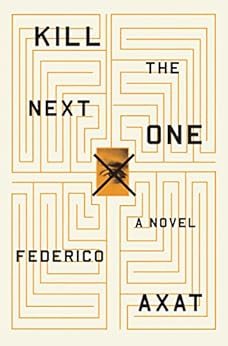
Review of KILL THE NEXT ONE by Federico Axat

4 Stars 
This psychological thriller, the first book of this Argentinian writer to be translated into English, begins with an attention-grabbing opening: “Ted McKay was about to put a bullet through his brain when the doorbell rang.  Insistently” (3).   The rest of the book is a roller-coaster ride.

Justin Lynch, the man at the door, convinces Ted to kill a man who escaped punishment for murder and Wendell, a man who also wants to die.  In return, Ted will then be killed.  Having an inoperable brain tumor and believing it would be easier for his family to cope with his murder than his suicide, Ted agrees.  Then things become really weird:  the intended victims are not exactly as Justin described and Ted starts having bizarre dreams and feels he is being watched.  He goes to see Dr. Laura Hill, his therapist.  Through his conversations with her, we are given some insight into his family life and his past.  To avoid spoilers, I can say no more except that nothing is as it seems. 

There are many puzzling questions for which the reader craves answers:  Is Ted a good guy or a deranged killer?  Is his brain tumor causing hallucinations?  How did Justin come to know about Ted’s plans to commit suicide?  Is Laura a trustworthy, caring professional or an ambitious manipulator? 

At times the plot is very confusing.  It is like Ted’s mind which is full of elusive memories, “just bits and pieces, all jumbled together.”  As Ted tries to put together those pieces into a sensible whole, the reader must try to do the same to the plot.  Readers who do not like plots which are difficult to understand should probably stay away from this book.  I must admit that after the first 100 pages, I was ready to give up, but then I got to Part III and I became fully engaged.

There are numerous twists and turns in this very fast-paced narrative.  Some suspension of disbelief is required, but I found the book so interesting that it was easy to suspend disbelief.  I just got sucked into the multiple layers and possible alternate realities.  The epilogue left me puzzled in a way that inspires me to re-read this book at a later date. 

The game of chess is significant for Ted and is mentioned several times.  I had heard of the paranoia of Bobby Fischer and the strange behaviour of other grand masters of the game, so I was interested in a theory suggested by Laura:  “’Chess is a little paranoia-provoking in itself.  You constantly have to be anticipating threats that might never materialize, and the possible variations are virtually infinite.  Brilliant chess minds analyze those variations, the possible moves, one after another, each one leading to limitless ramifications.  Apply that same structure off the chessboard and the result is catastrophic’” (187). 

It’s difficult to say too much about the book for fear of ruining it for other readers.  If you like a devilishly twisted and convoluted plot, this novel is for you.  If you like books with psychological layers, this novel is for you.  It is certainly a book I enjoyed as a totally immersing escapist read. 

Friday, April 14, 2017

Shakespeare Commonplace Book Found


On April 2, the BBC Antiques Roadshow featured a tiny commonplace book, written in a seventeenth century hand, on the subject of William Shakespeare’s Comedies and Tragedies. The gentleman who brought it in was a distant descendant of eighteenth-century antiquarian John Loveday.  He had found it among his mother’s possessions.  The notes were written “by an unknown seventeenth century William Shakespeare scholar”.  The book included notes in Latin; the jottings could have been the work of a student analyzing the playwright's work.

Manuscript specialist Matthew Haley placed a value of £30,000 on the book.  Its real value will probably be in providing evidence of how Shakespeare was received during or shortly after his lifetime. 

For a video about this find, go to http://www.bbc.com/news/uk-england-berkshire-39452558.

Thursday, April 13, 2017

Graphic Novel Adaptations


In graphic novel adaptations, artists have the freedom to reinterpret the original texts, so these adaptations provide readers with an opportunity to revisit those texts with fresh eyes.

If you’re thinking of checking out graphic novels based on classic literature, here are three sites which suggest some titles: 
and
and

Wednesday, April 12, 2017

Audiobooks Surge in Popularity

Apparently audiobooks are the fastest-growing format in the book business.  According to the Audio Publishers Association, sales in Canada and the U.S. jumped 21% in 2015 from the previous year.  The global audiobook industry is currently evaluated at $3.5 billion dollars.  The most popular audiobook genres in 2016 were mystery, thriller, romance, and fantasy/science fiction.


On the topic of audiobooks, three Canadian authors have been named finalists for this year’s Audie Awards, administered by the Audio Publishers Association to recognize excellence in the audiobook format.  Louise Penny is shortlisted in the Mystery category for the latest installment in her Chief Inspector Gamache series, 2016’s A Great Reckoning, narrated by Robert Bathurst.  Debut author Sylvain Neuvel is nominated in the Science Fiction category for Sleeping Giants; and Canadian actress Sunny Leone is nominated in the Erotica category for her novel Sweet Dreams (http://www.quillandquire.com/awards/2017/02/09/sylvain-neuvel-louise-penny-sunny-leone-among-22nd-annual-audie-awards-finalists/).  Winners will be announced on June 1. 

If you are wondering what audiobook to listen to, The Telegraph recently compiled a list of 20:  http://www.telegraph.co.uk/books/what-to-read/20-best-audiobooks-of-all-time/.