Ranked a Top Canadian Book Blog
Twitter: @DCYakabuski
Facebook: Doreen Yakabuski
Instagram: doreenyakabuski
Threads: doreenyakabuski
Substack: @doreenyakabuski
Bluesky: @dcyakabuski.bsky.social

Tuesday, October 17, 2017

Man Booker Prize Goes to George Saunders


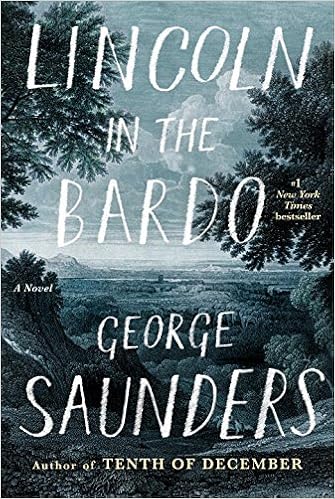
The winner of the 2017 Man Booker Prize was announced today:  George Saunders took the prize for Lincoln in the Bardo.  I’ve read 3 of the 6 finalists; as my reviews indicate, I was certainly routing for this book.


Here are my reviews of the other two finalists I have read:

I loved a feature in The Telegraph newspaper which highlighted “the dazzling highs (and cringe-making lows) of this year's finalists”:  http://www.telegraph.co.uk/books/what-to-read/2017-man-booker-prize-shortlist-best-worst-lines/?utm_source=dlvr.it&utm_medium=twitter.

Monday, October 16, 2017

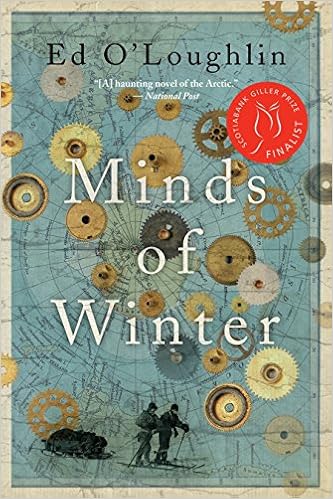
Review of MINDS OF WINTER by Ed O'Loughlin

3 Stars
This book came to my attention because of its nomination for both the Walter Scott Prize for Historical Fiction and the Giller Prize.  The plot description also hooked me in, though I now wish I had resisted.

At the end of the Acknowledgements, the author thanks his three editors for working “long and hard to turn a self-indulgent mess of cobbled-together myth and mystery into something like a novel.”  I’m afraid the editors did not succeed because the book, for me, still seems a “mess of cobbled-together myth and mystery.” 

The characters who are present throughout the novel are Nelson Nilsson and Fay Morgan who are both in Inuvik trying to solve mysteries involving family members.  Gradually, Fay finds information about her enigmatic grandfather in the research conducted by Nelson’s brother who has disappeared.   There are just too many coincidences in this plot line to be believable.  (I have not been able to figure out why the author chose for his female lead a name which alludes to Morgan le Faye, the enchantress of Arthurian legend.) 

The majority of the book is multiple stories covering a span of 175 years.  Historical figures like Sir John Franklin, Roald Amundsen, and Jack London make an appearance.  Likewise the settings cover much of the world; Tasmania, Tuktoyaktuk, Antarctica, eastern Siberia, Norway.  Timelines are not chronological so they add to the confusion already present because of the number of characters, some of whom are loosely connected and some of whom just disappear from the narrative without explanation. 

I am certain that I am not the only reader who will recall Aristotle’s statement about synergism:  "The whole is greater than the sum of its parts".  Unfortunately, in the case of this novel, the opposite is true.  The individual stories are often interesting, but the novel as a whole did not leave me feeling enthused.  Of course, the individual vignettes vary in quality; the one involving Jack London is tedious and the one focusing on one of Amundsen’s mistresses seems pointless. 

After a while, I felt that the book might have been better packaged as a collection of mysteries.  The book does touch on several unsolved mysteries:  Amundsen’s disappearance in an airborne rescue mission in the Arctic, the fate of the Franklin expedition, the identity of the Mad Trapper of Rat River, the appearance of Franklin’s chronometer disguised as a carriage clock in London.  As expected, none of these is solved.  When one of Franklin’s ships is discovered, one character mourns the loss of mystery:   “’They had to go and find her.  They had to solve a perfectly good mystery.’”  The epilogue also suggests the author’s fascination with the mysterious:  “lives don’t always end like they’re supposed to.  Some people slip through the cracks.” 

This book was just not for me.  I can appreciate the amount of research that O’Loughlin did, but I found the book just too disjointed.  At the end of his acknowledgments, the author thanks the reader for reading the book, “assuming you made it this far.”  I have to admit that for me finishing the book became a chore.   I will be checking the reviews of others in the hope that someone will be able to fully explain this novel’s worth to me. 

Sunday, October 15, 2017

Food and Drink and Reading

Though avid readers might like to claim they feast on books, it is not possible to survive without food and drink.  For that reason it is not surprising that descriptions of food find their way into literature, and I have blogged about the topic in the past:  https://schatjesshelves.blogspot.ca/2016/08/food-in-literature.html.  “Nearly any great book has moments of food in it, not just because characters have to eat, but because our relationship with food exposes so much about our identities, cultures, time, and place. What author forsakes a tool that can explore all that?” (http://lithub.com/the-ultimate-literary-ten-course-meal/)

A couple of years ago, The Telegraph did a feature on “10 Great Meals in Literature” (http://www.telegraph.co.uk/books/what-to-read/10-great-meals-in-literature/), though I was surprised to see Oliver Twist’s breakfast of watery gruel described as a “great” meal. 

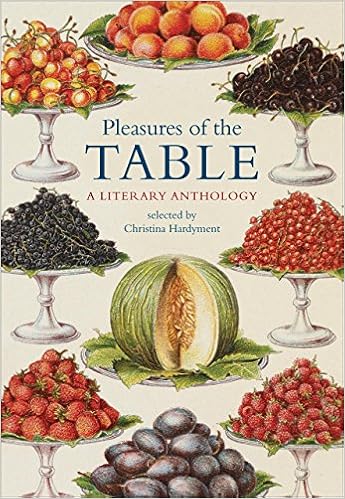
There is a book about food in literature that I’ve been wanting to get for my library:  Pleasures of the Table by Christina Hardyment.  The New Yorker had a review of the book (https://www.newyorker.com/books/page-turner/pleasures-of-the-literary-meal) and I’ve wanted it ever since.  

Here’s a description of the book:  “The anthology begins with examples of hospitality, ranging from Chaucer's convivial Franklin to Walter Scott's bountiful breakfasts and dinner with Virginia Woolf's Mrs. Ramsay. Next comes eating to impress—dazzling banquets from Flaubert to F. Scott Fitzgerald—and some great fictional love feasts. Many of our most vivid memories of food in literature were laid down in childhood, and nostalgia is to the fore in such classic scenes as Pinocchio aching with hunger, Ratty and Mole picnicking, enchanted Turkish delight in Narnia, and a seaside picnic from Enid Blyton. A section on distant times and places ranges from seethed tortoise in ancient China to seal’s liver fried in penguin blubber as a treat for Captain Scott. Those who relish simplicity rather than excess will enjoy Sdney Smith’s delicate salad dressing and Hemingway’s appreciation of oysters.” 

Like many other people, I enjoy sipping on a glass of wine while reading, so I enjoyed this article about wine and book pairings:  https://www.popsugar.com/love/Book-Wine-Pairings-42314101?stream_view=1#photo-42314138.

Saturday, October 14, 2017

Book Thievery and Books to Read in Prison

Earlier this summer, I came across an article in The Guardian about books that were most frequently stolen from bookstores in England:  https://www.theguardian.com/books/2017/jul/24/strange-world-of-book-thefts-beatrix-potter-zizek.  It makes for an interesting read.

Wondering how Canadian bookstores fared, I did some research and found a CBC article from January of this year:  http://www.cbc.ca/news/canada/toronto/haruki-murakami-toronto-theft-used-books-used-book-store-1.3923235.  This article prompted The Guardian to write a piece entitled “Stolen good books: why Canadian thieves outclass the British” (https://www.theguardian.com/books/booksblog/2017/jan/09/stolen-books-canadian-thieves-outclass-british-murakami).

Of course, book thievery is not a new crime.  A few years ago, Flavorwire explored the history of book thievery and outlined twelve shocking cases: http://flavorwire.com/405019/12-tales-of-book-thievery.  

Book lovers become understandably upset with people who steal books.  Should a book thief find him/herself in prison, this list of 20 books to read in prison might be helpful:  http://www.telegraph.co.uk/culture/books/9926784/20-books-to-read-in-prison.html?frame=2508077.

Friday, October 13, 2017

Ron Sexsmith's Fairytale for Adults

On Valentine’s Day of 2013, my husband took me to a Ron Sexsmith concert.  I have always loved the work of this critically acclaimed songwriter and musician, and I am not alone; Sexsmith has a healthy group of world class musicians who appreciate his work, including Paul McCartney, Elvis Costello, Elton John, Steve Earle, and Sheryl Crow. 

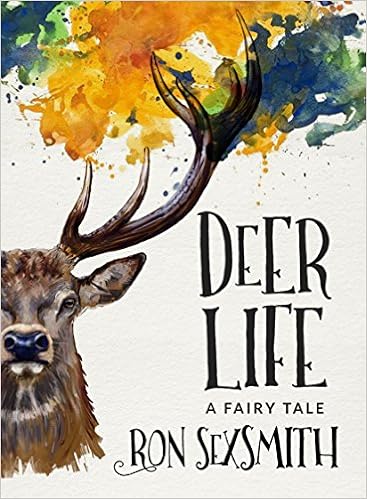
Last month, I was pleased to learn that Sexsmith has written a book.   Deer Life has been described as a fairytale for adults.  “Deryn Hedlight was not having a very good day and it was about to get much worse. He’d read stories of witches as a boy, but never believed for a second they were true. That is, until an unfortunate hunting accident turns his world upside down. What seemed like an honest mistake leads to an altogether unexpected transformation. But poor Deryn wasn’t the only wronged character tied up in these gloomy circumstances and sinister forces.”  Sexsmith also did the illustrations in the book. 

In its review, Publishers Weekly concluded, “Sexsmith’s novel has much the same effect as his music, conveying uncertainty with fearlessness and heart” (https://www.publishersweekly.com/978-1-4597-3877-5). 

Thursday, October 12, 2017

Most Popular Book in Your Birth Year?

Today is my birthday so I thought I’d share a link to a site that lets you find the title of the book that was most popular the year you were born:  http://offbeat.topix.com/slideshow/18684?utm_source=facebook&utm_campaign=18684&utm_term=4MKHGNJLTRJD77KI.

In my year of birth, that best-selling book was Not as a Stranger by Morton Thompson.  I’ve not read it but research suggests it is a melodramatic romance novel about a young doctor who lives for medicine and sacrifices everything for his career.  It describes his years at medical school, his practice in a small town and his devoted self-sacrificing wife who works to make their marriage a success.   I did find a review of the book: 

A film adaptation was made in 1955.  It was Stanley Kramer's directorial debut and featured Olivia de Havilland and Robert Mitchum in the lead roles, backed by a stellar supporting cast including Frank Sinatra, Gloria Grahame, Broderick Crawford, Charles Bickford, Lon Chaney, Jr., Harry Morgan, and Lee Marvin.

So what book was most popular in your birth year?

Wednesday, October 11, 2017

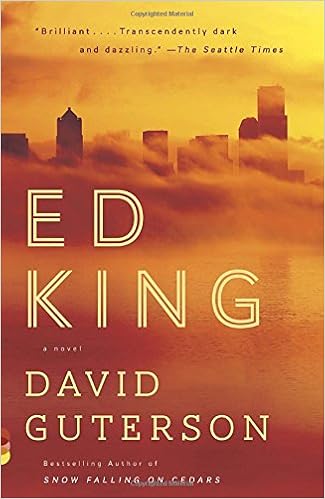
Archival Review of ED KING by David Guterson

In yesterday’s posting, I focused on some best and worst sex scenes in literature.  From the latter list, I mentioned I had read only one book, Ed King by David Guterson.  I thought I’d post my review of the book from my archives, but first I thought I’d share the comments made about the book when it won the Literary Review’s Bad Sex in Fiction Award in 2011:

“Freud bullied his way into David Guterson’s adaptation of the Oedipus myth, Ed King (Bloomsbury), which includes a lengthy description of mother–son bonding that Sophocles had seen fit to leave offstage:
“‘So she took him by the wrist and moved the base of his hand into her pubic hair until his middle fingertip settled on the no-man’s-land between her ‘front parlor’ and ‘back door’ (those were the quaint, prudish terms of her girlhood), she got him on the node between neighboring needs (both of which had been explored by johns who almost never tarried).’
“It’s hard to work out what is more excruciating, Guterson’s jarring language – we’re later treated to ‘membrum virile’, ‘skin flute’ and ‘family jewels’ – or his naive belief that a sprinkling of inverted commas is sufficient to ironise his euphemisms” (https://literaryreview.co.uk/bad-sex-report2011).

Schatje’s Review of Ed King
2 Stars
The book is a computer-age retelling of Sophocles' play Oedipus Rex which Aristotle considered the perfect tragedy. Unfortunately, Guterson's reworking of the Greek tale of patricide and incest is not quite so perfect; in fact, it won the 2011 Literary Review Bad Sex in Fiction Award for the worst description of a sex scene in a novel.

The setting is Oregon, beginning in the 1960s. Walter Cousins has an affair with his underage British au pair, Diane Burroughs, who becomes pregnant and gives birth to a son whom she abandons. The child is adopted by Dan and Alice King who name him Edward Aaron (his middle name a salute to the King of Rock and Roll). The rest of the novel covers Diane and Ed's lives. Diane constantly remakes herself; at different times she is an escort, wealthy wife, much-less-wealthy divorcee, cocaine dealer and life coach. For Ed, everything comes easily, since he has both looks and intelligence; with his attitude of superiority and entitlement, his encounter with Walter on an isolated road has predictable consequences. Ed and Diane meet and marry and become the king and queen of an internet domain. When Ed discovers that he was adopted and learns the identity of his parents, the result is a supersonic version of the myth of Icarus.

One problem with the novel is that it is long on exposition and short on dialogue. There is a definite lack of showing and much telling in the vein that this happened and then this happened and then this happened.

Another weakness is that all the characters are superficial and amoral. No one is likable, and their unrelenting superficiality and amorality begin to grate. Ed (a composite of modern America's gods of technology - Steve Jobs, Bill Gates, and Mark Zuckerberg) is no tragic hero: he is not a good man with one major character flaw.

The soullessness of the characters is intentional. It conveys a message about modern culture since the book is somewhat a social satire with commentary on such topics as cosmetic surgery, the violence of gaming, global warming, and the ruthlessness of tech-titans.

The strongest appeal of the novel is seeing how the mythical elements have been modernized. Anyone who has read Sophocles will appreciate how some of the original tale has been incorporated: Ed, like Oedipus, is born to a man of dubious morals, is abandoned, and is passed on to a "kingly" family. Both experience foot problems. Ed's attempt to create artificial intelligence can be interpreted as his attempt to crack the riddle of the Sphinx. Ed names his search engine Pythia, the name of the Oracle of Delphi. The excerpts of internet chatter at the beginning and end serve as a type of Greek chorus. Unfortunately, sometimes the parallels are made too obvious. Does Ed really have to be told that he suffers from "an overwhelming and dangerous hubris"?

It can be hoped that Guterson's book will entice people to read or re-read the original drama; its lessons about ambition and hubris need not be modernized to be seen as relevant today as they were in the time of Sophocles and Aristotle.