Ranked a Top Canadian Book Blog
Twitter: @DCYakabuski
Facebook: Doreen Yakabuski
Instagram: doreenyakabuski
Threads: doreenyakabuski
Substack: @doreenyakabuski
Bluesky: @dcyakabuski.bsky.social

Thursday, January 21, 2021

Review of WEEKEND PASS by Paul Cavanagh (New Release)

 3 Stars

Tasha has been in a rehab facility for three weeks for drug addiction when she is given a weekend pass.  The question is, as expressed by her father Milt, whether “’she’s going to survive the weekend.’”  She has to come to terms with the damage done to her family by her addiction.  Her marriage to Baker is in tatters because their 8-year-old son Jake accidentally ingested some of her painkillers and may have permanent brain damage as a result.  Tasha’s father Milt and her aunt Charlotte try to keep tabs on Tasha but some unforeseen events threaten to derail Tasha. 

The book is not a challenging read; most readers will find it very readable.  My issue with it is that there is a great deal of telling and not enough showing.  For instance, we are told that Charlotte “has always been one for getting disgruntled on someone else’s behalf” and is “fond of taking on other people’s burdens.”  Much of the narrative consists of flashbacks with paragraphs and paragraphs of exposition.  Dialogue often doesn’t appear for pages.  Though Tasha is the focus, the perspectives of Milt, Charlotte and Baker are also given.  Each of these characters has a backstory which is developed. 

The narrative often seems scattered and disorganized.  Do we need to know that one of Tasha’s favourite foods is osso bucco and Jake’s is deep-fried squid tentacles and Milt’s is Cantonese steamed dumplings?  Tasha’s having to deal with her mother’s alcoholism and her father’s infidelity have affected her so they are relevant, but is it necessary to give Milt’s thoughts about his marriage and to describe his attraction to young women?  For example, when Milt meets a friend of his son-in-law, he thinks, “She’s exactly the kind of young woman Milt would have had a crush on at Jake’s age.  Pretty, warm-hearted, and playful.  He’s observed that much in the few seconds he’s laid eyes on her.  Actually, Milt is plenty attracted to her now at the age fifty-eight. . . . If he were in Baker’s place, he’d be mightily tempted that’s for sure. . . . She reminds Milt a little of Josie, the woman he brought as his date to Tasha and Baker’s wedding, who shared his bed for nearly a year-and-a-half.”  All this musing serves little purpose except to portray Milt as a lecher.  Likewise, is it necessary to detail Charlotte’s rivalry with her sister, Tasha’s mother?

Occasionally, the writing style jars.  There are sentences with slang like “he’d been shagging” and a woman wanting to “hurl garden stones at his melon.”  Contrast these to the clinical description of a woman dying of cancer:  “her left eye had stopped tracking to the left, meaning that her eyes sometimes pointed in different directions, a rather chilling spectacle.  It was a sign that the cancer had likely spread to her sixth cranial nerve, maybe even her brain stem.” 

In terms of its portrayal of a woman dealing with recovery from drug addiction, I think this novel is very realistic.  It suggests that recovery is a long, difficult journey; one addict speaks of learning “to be thankful for what she has, even as she continues to grieve what she’s lost.”  An important message is that addictions affect not just the addict; at one point, Tasha realizes “it’s not just her going through a kind of recovery.” 

This novel is realistic and readable, but would be better if it were more focused.  Because of its extensive use of local colour, it will definitely have interest to people living in London, Ontario.

Note:  I received an eARC from the publisher via NetGalley.

Tuesday, January 19, 2021

Recent and Upcoming Canadian Fiction

Here's my latest article for my hometown newspaper, The Madawaska Valley Current:


Recent and Upcoming Canadian Fiction to Read in Your Comfy Chair

Winter is a great time for reading; there’s nothing like curling up in a comfy chair with a good book and a hot beverage on a cold day.  And in a pandemic winter, with its lockdowns and stay-at-home orders, there’s even more incentive to hunker down and read.  The good news is that there are several new novels by Canadian writers to take up.  Here are some new releases I’ve just finished or am looking forward to reading in my comfy chair.  Go to my blog (https://schatjesshelves.blogspot.com/) for full reviews of all titles.


The Push
by Ashley Audrain

This psychological drama, released on January 5, has received a lot of positive reviews.   Blythe, a young mother, has difficulty making a connection with her daughter Violet.  Is Blythe a bad mother or is Violet a bad seed?  Though I found the book somewhat predictable, it does make some noteworthy observations about the challenges of motherhood.  (I reviewed this book on my blog on January 1.)


The Historians by Cecilia Ekbäck

Though Cecilia Ekbäck was born in northern Sweden, she has made Canada her home for several years.    Her first two novels, Wolf Winter and The Midnight Sun, are historical thrillers set in Swedish Lapland.  I recommend both to those who enjoy Scandinavian noir.  Told from three different perspectives, The Historians, set in Sweden in 1943, centres on disappearances and murders that ultimately lead to the discovery of a disturbing secret many in the country will do anything to keep hidden.  (This book was released on January 18; my review is scheduled to be posted on February 2.)


A Town Called Solace by Mary Lawson

Mary Lawson is one of my favourite Canadian authors.  I loved her three previous novels (Crow Lake, The Other Side of the Bridge, and Road Ends) so was thrilled to see this new title.  In 1972 in northeastern Ontario, seven-year-old Clara keeps a daily vigil at her front window hoping for the return of her sister who has run away.  Her other daily chore is to go next door to take care of Mrs. Orchard’s cat while she is in hospital.  To Clara’s surprise, a man named Liam Cane moves into Mrs. Orchard’s house which she has gifted to him though he hasn’t seen her in 30 years.  We learn Mrs. Orchard’s secrets, as Clara and Liam become friends and Liam adapts to life in a small town.  This beautifully written story has everything:  suspense, humour, a strong plot, and realistic characters.  (The book will be released on February 16, and my review will be posted two days earlier.)


The Speed of Mercy
by Christy Ann Conlin

This is an author I’ve been meaning to read.  This book, the writer’s fifth one, is set in Nova Scotia and focuses on a childhood betrayal and a dark family secret of murder.  The book has been praised for its realistic portrayal of older, rural women.  I enjoy novels about the discovery of skeletons in family closets so look forward to opening the pages of this one.  (The book will be released on March 23; my review is scheduled for March 22.)


The Relatives
by Camilla Gibb

This novel addresses the question of what it means to be a family.  Tess and Emily, after an ugly separation, are fighting over ownership of embryos while the unknown man who served as anonymous donor is being held in captivity in Somalia.  (This book will also be published on March 23; my blog will feature my review on March 26.)


HAPPY READING!


Sunday, January 17, 2021

Review of PIANOS AND FLOWERS: BRIEF ENCOUNTERS OF THE ROMANTIC KIND by Alexander McCall Smith

 2.5 Stars

I requested a digital galley of this book because it employs an exercise I used when teaching creative writing.  Unfortunately, this collection of vignettes based on old black-and-white photographs left me unimpressed.

The author used old photos and imagined the lives of the people captured.  The subtitle suggests that there should be romance in each, but that is certainly not the case.  For example, “Pogo Sticks and Man with Bicycle” imagines how Francis Crick and James Watson, while working on building a model of DNA, might have examined the spring in a pogo stick and seen a double helix.  Another episode entitled “Urchins” imagines the lives of the boys captured in a 1920 photo; none of them has a love story of any note.

Because the pieces are so short, there is little depth.  In “Urchins” the life stories of four boys are told.  There are long sections of prose giving mundane details, so there is more background than actual action.  I guess some of the vignettes could be considered charming, but they are forgettable.

Perhaps the stories are intended to be read one at a time.  Because I read them in a couple of sittings, I noticed considerable overlap.  Margaret in “Sphinx” has a landlady who is “the widow of a dentist” while Merlin in “Iron Jelloids” lives in the house of “a police sergeant’s widow.”  Both landladies are very kind to their tenants.   In “Blackmail” there’s a dishonest “financial clerk” and another one in “Pogo Sticks and Man with Bicycle.”  Margaret in “Sphinx” is raised by an aunt who is a “district nurse”  while in “Duty” “a theatre nurse” helps raise her brother’s twins once he is widowed.   Student nurses appear in at least three stories.   In “Sphinx” Margaret “drifted into something, in the way in which we are all capable of drifting into things, without any conscious assertion of will, any firm choice, because it is easy and we feel sorry for people and we cannot find a simple way of avoiding their emotional claims.”  In “Duty” twins drift into relationships though they love someone else. 

Coincidence and unbelievable events are used liberally.  Three sisters play matchmakers to two teachers and then years later unknowingly appear in a photograph with these teachers?  Tea with St. John’s Wort cures depression and iron pills bestow confidence?  In a double ceremony, a minister marries the wrong women to the wrong men, but the brides and grooms don’t notice the mistake?

The author is prolific and popular, so my review will probably not reflect the views of the majority.  I just expected more and was disappointed. 

Note:  I received an eARC from the publisher via NetGalley. 

Wednesday, January 13, 2021

Review of THE BOY IN THE FIELD by Margot Livesey

 3 Stars

This book left me cold.

On their way home from school in September, 1999, the three Lang siblings (Matthew, 18; Zoe, 16; and Duncan, 13) find a boy in a field.  He was stabbed.  The boy, Karel Lustig, survives but their finding him changes the lives of the rescuers.  Matthew wants to find the person who harmed Karel, and besides speaking with the official police investigator, begins a secret investigation.  Zoe becomes aware of how men are attracted to her and starts exploring her sexuality.  Duncan starts searching for his birth mother.

The story is told through the alternating perspectives of the three teenagers.  The personality of each is developed:  Matthew is responsible and thoughtful; Zoe is headstrong and confident; and Duncan is observant and sensitive.  The problem is that the three are all too good to be true.  They are close-knit, loving, thoughtful, generous, and supportive.  They also are too mature for their ages, often making comments that display a wisdom beyond their years.  At one point, Duncan talks about finding his birth mother:  “’This is about finding one particular person with whom I have a particular relationship.  I didn’t want to have this idea.  It hunted me down.’”  A 13-year-old would not use a dangling preposition and would know the proper use of the relative pronoun?  A fund-raiser that would probably have most teenagers cringing has these three participating.  At times it feels like the three stepped out of an episode of Leave it to Beaver.

The title of the book suggests that the boy found in the field will be the focus of the book.  He isn’t.  In fact, there is often little connection back to the crime.  It is true that they all suffer a loss of innocence as a result of finding Karel and perhaps confront adulthood a little sooner.  But it seems a stretch to tie much of their behaviour back to discovering the boy.  After the event, Duncan imagines he sees his birth mother in the shadows of the garden and dreams about her, so he sets off to find her.  The connection between finding Karl and Duncan’s searching for his biological mother is tenuous at best.  A 16-year-old girl would be expected to be intrigued about sex, so why would her role in finding Karel be pivotal?  It is Matthew’s development that seems to be most directly tied to what happened:  he wants to understand how someone could have hurt Karel so he wrestles “with the problem of evil” and solving “the ultimate locked room [mystery that] is another person’s brain.”

The character that most interested me is Karel whom a co-worker describes as an unusual person:  “’People tend to confide in him.  And he’s very truthful.  Both make him vulnerable.’”  His fate at the end is not a surprise, but I would have loved to have more of his story.  His relationship with his brother Tomas could be more completely developed.  I also kept thinking that Karel and Duncan, despite their age difference, could have been friends.

Just as I didn’t see connections in the novel, I didn’t connect with it.  It has received many rave reviews, so perhaps it’s just me.  

Saturday, January 9, 2021

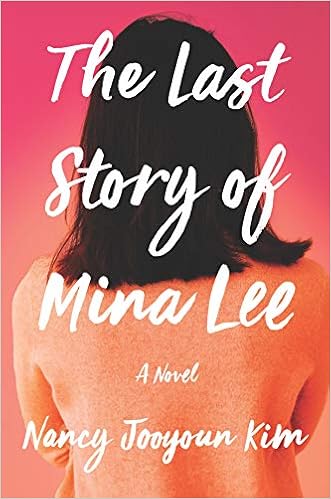
Review of THE LAST STORY OF MINA LEE by Nancy Jooyoun Kim

 2.5 Stars

I was underwhelmed by this book.

Margot returns to Koreatown in Los Angeles and finds her mother Mina dead in her small apartment.  The police rule Mina’s death as an accident, but Margot thinks someone might have killed her.  She starts asking questions and digging through Mina’s past and discovers a mother she barely knew.

The book alternates between Mina and Margot’s perspective.  Margot’s story is set in 2014, beginning with her drive from Seattle to Los Angeles; Mina’s story begins almost 30 years earlier with her arrival in the United States. 

Mina’s sections are very interesting.  We learn about her being raised in an orphanage after being separated from her parents while fleeing North Korea during the war, about her losing her husband and daughter in an accident, about her challenges as an undocumented immigrant, and about becoming a single mother after a brief romance.  I kept wishing Mina’s story would be more fully detailed. 

Margot’s sections fall flat.  She herself is a flat character.  For a 26-year-old, she seems very immature.  She does not know her mother or appreciate her at all.  She supposedly has artistic aspirations but she lacks passion.  Then, for someone who has expressed no interest in anything Korean or her mother’s story, she suddenly becomes an expert on the Korean immigrant experience!

As a personal immigration narrative, this book does work to some extent, though more focus on Mina would have strengthened it.  As a mystery, the book doesn’t work because the police are portrayed as inept and Margot is able to uncover the truth only because of implausible coincidences.  As a mother-daughter drama, this book also does not work because we are only told about the difficult relationship between Mina and Margot; we are not shown their difficulties so there is a lack of depth.  The Last Story of Mina Lee is certainly not a Korean immigrant version of The Joy Luck Club which excels at showing the complex relationships between immigrant mothers and their daughters.

I enjoy reading books which will help me learn about other cultures.  Unfortunately, this novel seems to focus only on Korean food.  The names of dishes are always given, every time someone sits down to eat, but to a non-Korean these mean nothing.  The constant reference to food just becomes tedious. 

The novel’s tone also becomes didactic.  Here’s just one example of Margot’s pontificating about the exploitation of immigrants; she argues that the U.S. repeats a lie to live with itself:  “that fairness would prevail; that the laws protected everyone equally; that this land wasn’t stolen from Native peoples; that this wealth wasn’t built by Black people who were enslaved but by industrious white men, ‘our’ founders; that hardworking immigrants proved this was a meritocracy; that history should only be told from one point of view, that of those who won and still have power.”  Rather than explicitly stating its theme, good literary fiction develops its theme.

I listened to this novel as an audiobook and that also tainted my enjoyment.  I appreciated Greta Jung’s Korean pronunciation, but otherwise her voice often set my teeth on edge.  The voice used for Mrs. Baek in particular doesn’t fit what she is saying:  she always sounds whiny and displeased, even when her words suggest otherwise.

This book does not do justice to the experience of Korean immigrants.

Tuesday, January 5, 2021

Review of THE LIAR'S DICTIONARY by Eley Williams (New Release)

 3 Stars

This novel is for readers who enjoy wordplay.  I love words and etymology but the absence of an interesting plot and engaging characters makes this book tedious after a while. 

There are two parallel stories.  One is set in 1899; Peter Winceworth is a lexicographer working on the multi-volume Swansby’s Encyclopedic Dictionary.  As a small act of rebellion, he begins to insert fictitious entries (known as mountweazels).  In the present, Mallory, an intern for the same publisher, is tasked with uncovering these mountweazels before the dictionary is digitized.  She also has to contend with threatening phone calls from an anonymous caller upset at the updated definition of “marriage."  Both narratives also have a romance element.  Winceworth falls in love with a woman already engaged to a colleague.  Mallory is in love with Pip, and though they live together, Mallory has not told anyone that she is gay. 

I connected with neither Winceworth nor Mallory.  Though the former is a bit more developed, Mallory remains vague and insubstantial.  Both are milquetoasts, afraid to speak up.  Winceworth even “concocted, affected and perfected a fake speech impediment” because he was bored, thought it made him more endearing, and “made people respond to him with a greater gentleness.”  Then he is upset when people make fun of his lisp!?  Mallory seems to have no idea what she wants in life and claims she loves Pip but is afraid to speak out and acknowledge that love.  After a while, I just got bored with them.

In terms of plot, not much really happens.  What does happen seems contrived.  Winceworth takes a train trip to Barking even though he knows he’s being set up and sent on a fool’s errand?  Of course the trip is just a plot device so Winceworth can witness an explosion and have an epiphany.  Just as an explosion serves as a catalyst for Mallory’s epiphany.  Other parallels between the two stories (the convenient but uninvited presence of the love interests at Swansby’s) also seem strained. 

The book begins very slowly.  The preface which expounds on the perfect dictionary, the perfect dictionary reader, and the perfect preface goes on and on, and were it not for the fact that I’d accepted an eARC in return for a review, I would have stopped reading when/if I got to the end.  Do we really need this list of words for “orange”:  “amber, apricot, auburn, Aurelian, brass, cantaloupe, carrot, cinnabar, citric, coccinate, copper, coral, embered, flammid, fulvous, gilt, ginger, Glenlivit-dear-god, hennaed, hessonite, honeyed, laharacish, marigold, marmaladled, mimolette, ochraceous, orangutan, oriele, paprikash, pumpkin, rubedinous, ruddy, rufulous, russet, rusty, saffron, sandy, sanguine, spessartite, tangerine, tawny, tigrine, topazine, Titian, vermilion, Votyak, xanthosiderite – “?  Do we need pages of discussion of hourglass iconography? 

Then there are the lengthy sentences that lose all meaning:  “The best benchside exoticisms January could offer were all on show – the starling, the dandelion, the blown seeds and the bird skeining against the grey clouds, hazing it and mazing it, a featherlight kaleidoscope noon-damp and knowing the sky was never truly grey, just filled with a thousand years of birds’ paths, and wishful seeds, a bird-seed sky as something meddled and ripe and wish-hot, the breeze bird-breath soft like a – what – heart stopped in a lobby above one’s lungs as well it might, as might it will – seeds take a shape too soft to be called a burr, like falling asleep on a bench with the sun on your face, seeds in a shape too soft to be called a globe, too breakable to be a constellation, too tough to not be worth wishing upon, the crowd of birds, a unheard murmuration (pl.n.) not led by one bird but a cloud-folly of seeds, blasted by one of countless breaths escaping from blasted wished-upon clock as a breath, providing a clockwork with no regard to time nor hands, flocking with no purpose other than the clotting and thrilling and thrumming, a flock as gathered ellipses rather than lines of wing and bone and beak, falling asleep grey-headed rather than young and dazzling – more puff than flower – collecting the ellipses of empty speech bubbles, the words never said or sayable, former pauses in speech as busy as leaderless birds, twisting, blown apart softly, to warm and colour even the widest of skies.”  That’s one sentence!!

Being a logophile, I enjoyed adding to my vocabulary; for instance, I learned the meaning of bletted, jouissance, squib, ouroboros, cloacae, bleurgh, perfervid, smeuse, grawlix, zugzwang, cyprine, vuln, and netsuke.  I’ve found new words for my next Scrabble game and I’m looking forward to getting my next cup of take-out coffee and asking for a zarf.  And there is entertainment in reading about characters creating neologisms and trying to detect mountweazels.   Unfortunately, after a while, the book just becomes an exercise in cleverness.  It is linguistically extravagant but suffers from a paucity of strong narrative qualities.

Anyone interested in words and language will find much to enjoy, but anyone looking for a novel with compelling literary elements should look elsewhere.  Apparently, the author’s PhD thesis focused on “meeting points between lexicographical probity and creativity.”  This book certainly showcases her knowledge of lexicography but I’m less impressed with her creativity.

Note:  I received an eARC from the publisher via NetGalley.

Friday, January 1, 2021

Review of THE PUSH by Ashley Audrain (New Release)

 3 Stars

This psychological thriller focuses on motherhood.  Blythe Connor, because she had a distant, neglectful mother, worries about being a good mother herself.  When she gives birth to Violet, she doesn’t have the natural connection she expected to have with her daughter.  Violet seems distant and rejects Blythe’s affection.  She tries to express her concerns to her husband Fox but he is dismissive; he sees only an exhausted wife struggling with motherhood. 

Violet becomes a true Daddy’s girl.  She seeks attention from Fox and shows him affection, so Blythe starts to question whether she is just a terrible mother.  After all, her own mother told Blythe, “’The women in this family . . . we’re different.’”  Indeed, there are flashbacks to Blythe’s mother and grandmother and both would certainly not have won any awards for being nurturing. 

In school, Violet is disruptive.  She seems to lack empathy.  When Blythe gives birth to a son, she immediately feels an inseparable bond.  When tragedy strikes, Blythe’s relationship with Violet deteriorates even further and Blythe suspects that Violet is just a terrible person. 

The book can be commended for its examination of the challenges of motherhood.  It questions whether every woman will be a natural mother.  Does society create false expectations?  It is no wonder that Blythe feels guilt and shame and that she and Fox both pretend “that things weren’t as bad as they were.” 

Fathers do not receive as much attention; their perspective is not given.  All the fathers tend to be weak.  Blythe’s father does little to help his daughter.  A friend calls him weak for meekly accepting his wife’s behaviour, and Blythe agrees:  “I thought of all the times he never stood up for himself . . . Of the pills he never took away, of the smashed dishes he always cleaned up.  Of his quiet retreats to the couch.  I hated that my mother had left him, but I wondered if he ever really tried to stop her.”  Fox seems to be patient with Violet and gives her attention, but Blythe sees him as a dad who loses all levelheadedness and defends his child blindly.  It would have been interesting to get his direct thoughts.   

The only thoughts given directly are Blythe’s because she is the narrator.  She writes the story almost like a letter in which she addresses Fox as “you” throughout.  She calls what she writes, “my side of the story.”

The author tries to create suspense throughout.  The reader is left to wonder whether Blythe is a reliable narrator.  Does she see her daughter as she really is when she describes Violet’s empty eyes, contempt, “manipulative, premeditated coldness,” and her “icy looks [and] complete disdain”?  Or is Blythe just another in a long line of bad mothers?  Perhaps Fox is right when he tells Blythe she is just exhausted and when he dismisses Violet’s misbehaviour as “testing the boundaries” or the result of boredom or being provoked. 

Unfortunately, I found the plot predictable.  The book just seems another addition to the sub-genre about possible bad seeds.  The ending is not a surprise because the opening gives so many clues.  The scenes involving Gemma reminded me of scenes in The Wives by Tarryn Fisher. 

There seems to be a lot of hype around the novel, but I was disappointed.  Other than its examination of motherhood, it offers little that is original. 

Note:  I received an eARC from the publisher via NetGalley.