Ranked a Top Canadian Book Blog
Twitter: @DCYakabuski
Facebook: Doreen Yakabuski
Instagram: doreenyakabuski
Threads: doreenyakabuski
Substack: @doreenyakabuski
Bluesky: @dcyakabuski.bsky.social

Thursday, February 18, 2021

Review of HOW TO PRONOUNCE KNIFE: STORIES by Souvankham Thammavongsa

 3.5 Stars

Though I am in awe of Alice Munro and I do read the fiction in The New Yorker, I rarely read short story collections.  I made an exception in this case because How to Pronounce Knife won the 2020 Giller Prize.  Though I enjoyed most of the stories, I can’t say I liked them as much as I thought I would.

The 14 stories are immigrant narratives.  They examine the struggles of people from Laos trying to make new lives in North America.  They contend with language barriers and low-paying employment.  Their lives are shaped by work, and contrary to the belief by some people that immigrants take jobs away from citizens, these immigrants have less-than-glamorous jobs as school bus drivers, nail technicians, and agriculture workers:  “Back in Laos, the men who worked in this field [harvesting worms] had been doctors, teachers, farmers with their own land.” 

The parents in the stories all want the best for their children, though they cannot always help them adjust to life in a foreign environment because they lack the language, money, knowledge, and/or time.  In “Edge of the World” for instance, the father talks about wishing “he wasn’t so busy working” and describes “’What it’s like for me at work.  They all talk so fast in English.  Barking at me all the time about keeping up.  Sometimes I don’t even feel like a human being.’”  The perspectives of several children are also given as they struggle to balance two identities and cultures. 

The first story, which gives the title to the entire collection, summarizes the predicament of both parents and children.  The father tells his daughter that knife is pronounced “kahneyff” and she insists in school that this is the proper pronunciation:  “She never gave up on what her father said, on that first sound there.”  She doesn’t tell her father he was wrong, but she does wonder “what else he doesn’t know.  What else she would have to find out for herself.”  The father takes such pride in his child; when she shows him a prize she was given, “he is delighted because, in some way, he has won it too.”   

Sometimes the children protect their parents.  The girl in “A Far Distant Thing” refuses to tell her father what thief means when he asks because others have been calling him that at work:  “I wanted him to go on liking his job, to get up in the morning with a sense of purpose and pride like he did.”  At other times, the parents protect their offspring.  In “The Universe Would Be So Cruel” when his daughter is jilted, the father takes the blame:  “But how could he tell her that the boy she loved wasn’t kind or good, that he didn’t love her, that sometimes what felt like love only felt like love and wasn’t real.  He couldn’t do anything about that but say, ‘Yes, yes, it was my fault.  It is all my fault.’” 

Of course, as the children begin to fit in, the gulf between them and their parents often widens.  One girl learns in school that the world is round, but her mother refuses to believe this:  “’Just because I never went to school doesn’t mean I don’t know things.’”  The daughter then realizes “what my mother knew then.  She knew about war, what it felt like to be shot at in the dark, what death looked like up close in your arms, what a bomb could destroy.  Those were things I didn’t know about, and it was all right not to know them, living where we did now, in a country where nothing like that happened.”  And then there’s “You Are So Embarrassing” in which 13-year-old Chantakad insists on being called Celine and tells her mother, “’That’s who I am now.  I’m Celine.  And can you not talk to my friends, please?  You are so embarrassing.’” 

It is not only parent-child relationships that suffer.  Husband-wife relationships become strained as well.  In “The School Bus Driver” Jai is upset at his wife’s behaviour but says nothing because “she would just remind him how men in this country do not raise their voices at women.  Or tell him to practice his English. . . . ‘English is the only language that matters here.’ . . . And if he was going to live here, he had to learn to adapt and fit in and not be so uptight.”  In “Randy Travis” a man tries, unsuccessfully, to be what his wife wants him to be. 

As expected, many of the stories are sad.  For a woman in “Mani Pedi,” “Hope was a terrible thing . . . it meant it wasn’t there for you, whatever it was you were hoping for.”  When a man’s wife leaves him, he doesn’t grieve:  “He had done all of this life’s grieving when he became a refugee.”  In “Paris” the protagonist works in a chicken processing plant:  “The only love Red knew was that simple, uncomplicated, lonely love one feels for oneself in the quiet moments of the day.”  In “Ewwrrrkk” a woman is introduced to sex by “a man who no longer had his young face.  He did not say anything that had to do with love.  And, afterwards, there was a pool of blood on the grey bedsheet.”  There are however some touches of humour:  for instance, in “Chick-A-Chee” two children learn about the custom of trick-or-treating.

The stories are good; many readers will find much that is relatable.   When I started school, I could not speak English so I could certainly relate to the isolation experienced by the immigrants.  The stories provide realistic glimpses into the everyday lives of immigrants.  I was disappointed, however, not to learn more about Laotian culture since most of the stories clearly identify the immigrants as having come from Laos.   

I would certainly recommend this book for its examination of the experience of immigrants in today’s world, but for some reason I wasn't as impressed as I’d hoped to be.

Sunday, February 14, 2021

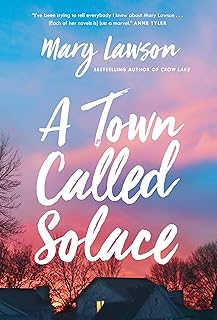
Review of A TOWN CALLED SOLACE by Mary Lawson (New Release)

4 Stars 

I loved Mary Lawson’s three previous novels (Crow Lake, The Other Side of the Bridge, and Road Ends) so was thrilled to see a new title.  A Town Called Solace does not disappoint.

Set in 1972 in northeastern Ontario, this book gives the perspectives of three people.  Seven-year-old Clara keeps a daily vigil at her front window hoping for the return of her sister Rose who has run away.  One day she notices a man moving into the house of the neighbor, Elizabeth Orchard.  Clara promised to take care of Mrs. Orchard’s cat while she was in hospital.  The man who moves in is Liam Cane who has been gifted the house by Mrs. Orchard whom he hasn’t seen in 30 years.

Each of the three main characters is facing a crisis.  Clara is missing her sister and believes her parents are lying to her, and then she has to contend with the man who has moved in.  Liam is recently divorced and unemployed and is trying to figure out what he should do with his life.  Elizabeth, in hospital, thinks back over her life and slowly remembers what happened between her and Liam so many years ago.

Characterization is outstanding.  Clara, for instance, is portrayed so realistically.  Because of her age, her understanding of events is limited.  She is anxious about her missing sister and believes her parents are lying to her when they are merely trying to protect her from some harsh realities.  Clara desperately wants some order in the chaos that is her world.  Liam and Elizabeth’s actions show them to be less than perfect.  Some of what Elizabeth did in the past is difficult to accept, but given her circumstances, the reader cannot but have some sympathy. 

All three of the main characters are dynamic.  Clara learns to trust as she struggles with understanding the consequences of keeping promises and secrets.  Liam has many regrets about his past but learns that second chances are possible.  Martha faces what she did in the past and tries to make amends as best she can at the end of her life.

There is considerable suspense.  Where is Rose and is she safe?  Concern increases as time passes and no one has heard from her.  Elizabeth has secrets which she admits having spent half her life trying to suppress and a past she fears her friends and neighbours might learn about.  These secrets have something to do with Liam but the exact nature of them is unclear at first.

There is also humour.  Liam, as the newcomer in town, receives the cold shoulder treatment from the waitress at the only café in town.  Clara’s activities in Liam’s house cannot but bring a smile.  Then there’s the comment by Martha who shares the hospital room with Elizabeth.  Martha objects to getting an injection by saying “’I hate having things stuck into me . . . I didn’t even like sex all that much.’” 

I lived in northeastern Ontario for 35 years, having moved there 7 years later than the novel’s setting, so I enjoyed the references to places like North Bay, Sudbury and New Liskeard.  Though Solace is a fictional town, the author clearly indicates where she imagines it is located.  Liam, for example, picks up the local newspaper:  “It was called the Temiskaming Speaker and was published in New Liskeard – he’d driven through New Liskeard on his way here, a small northern town, though a metropolis compared to Solace.”  The mention of “quart baskets of blueberries” brought back memories of berry picking in the region she describes.

One issue I had is the time frame.  When the narrative switches to another person, it is initially unclear whether the time continues.  Several times, Clara’s point of view is given over a period of several days; then when Liam’s perspective is given, it covers some of these same days.  This back and forth is confusing at times.  Elizabeth’s stay in the hospital does not occur during Clara and Liam’s sections, but that is not a problem.  (I must also mention the 31 references to cookies.  Did everyone in 1972 eat cookies so much?)

I very much enjoyed this book.  It is a beautifully written story with a strong plot and realistic characters.  It also develops themes clearly but not in a heavy-handed way.  I’m certain more than a few readers will find some solace in reading A Town Called Solace.

Note:  I received an eARC from the publisher via NetGalley.

Wednesday, February 10, 2021

Review of SUMMER BROTHER by Jaap Robben (New Release)

3.5 Stars 

The narrator is 13-year-old Brian Chevalier.  He lives with his father Maurice in a filthy, rundown trailer.  Maurice, a ne'er-do-well, learns that he can get money if he cares for his physically and mentally disabled son for the summer while his assisted-living residence is being renovated.  Of course Brian becomes Lucien’s primary care giver.  A strong bond develops between the brothers and Lucien even shows signs of physical improvement when he is not as sedated as he seems to be at the residence.  All is not well, however, as they are threatened with eviction.

The characterization of Brian is very realistic.  Appropriately for his age, he is naïve, impulsive, emotionally immature, and curious about sex.  Despite his flaws, like an occasional unthinking disregard for Lucien’s safety, there is no doubt that he loves his brother.  Unfortunately, Brian, not having any other role model, has picked up some of his father’s behaviours.  For instance, he knows how to pressure a person to get money.  Brian may not want to be like his father, but it seems almost inevitable that he will be like him.  His mother has moved on to another marriage and seems to have abandoned Brian to his life with his father.  Emile, a man who moves into another trailer, offers more of a positive example, but Brian’s time with him is limited for a number of reasons.  He is told that the trailer is not a good home for him, but he has no options.

Maurice is anything but admirable.  He leaves Brian in charge of his brother when giving Lucien proper care is not an easy task.  He is shiftless, leaving his sons every day with no explanation for his absences.  He is known to police.  He is not beyond using his son’s disability to get money and cover crimes.  Besides being neglectful, Maurice is also abusive.  It is clear that Brian fears his father who has violent outbursts.  The reader does get glimpses of positive traits, but there is little to like about the man.  What puzzled me is the choice of name for the father.  I know Maurice Chevalier as a French actor and singer and wondered if the author’s choice of name was intentional.  (And this raises another question:  why did the Dutch author choose to set his novel in France?)

Tension exists throughout the book.  Will Brian be able to care for his brother and keep him safe?  Will they be evicted by the landlords who are becoming more and more impatient with Maurice’s rent non-payment and lies?  Brian’s relationship with Selma, a 19-year-old resident at the home, is unsettling.  Maurice, though he can be funny and charming, is a threatening presence.  I kept waiting for something serious to happen. 

I also found myself feeling sad and angry.  Brian deserves a better life, but he just doesn’t have any opportunities.  He tells Lucien, “’When I’m old enough, you can come and live with me,’” but it’s a promise that will be difficult to keep.  Maurice is a dysfunctional person and that dysfunction may very well prove to be generational since Brian has been largely abandoned to a father who models inappropriate, if not dangerous, behaviour. 

Because of the subject matter, the book is not always an easy read, but it realistically and unsentimentally portrays life on the margins of society.  The novel is described as “an honest, tender account of brotherly love,” and that too is true.  That love is the one hopeful note.

Note:  I received an eARC from the publisher via NetGalley.

Saturday, February 6, 2021

Review of FERGUSON by Carl Johansen (New Release)

 2 Stars

What did I just read?  It certainly isn’t a book I can recommend.

Dennis Ferguson, recently widowed and recently retired, befriends Nasrin Kirmani, an Iranian refugee, and her husband and son.  Nasrin keeps challenging Dennis, asking what he will do about the injustices in the country:  “’We can all do something, Dennis. . . . What will you do?’”  When the family disappears, he decides to act.

This novel does not read like a novel.  It reads like a diatribe against President Trump and his supporters:  “’the president is a confirmed racist, and . . . the ruling party is systematically undermining the Constitution, the courts and the free media’” and “relations between leading countries within NATO were getting progressively worse, and the president threatened to use nuclear weapons against Iran” and “’The US is now ruled by an openly authoritarian president, backed by the majority in Congress.  The KKK and Neo-Nazis march with the president’s blessing’” and “’The greatest achievement of this presidency and the Republican Party has been to make truth irrelevant’” and “the president’s party had spent years dismantling laws and institutions, as well as the very political culture of tolerance and forbearance itself, so that it had now become impossible to exercise democratic, legal oversight over the escalating corruption and authoritarian execution of power under the current administration.”  Personally, I might agree with these observations and even enjoy the description of a senator from South Carolina as “roach-like,” but I expect a novel to show the president’s tyranny, not just have a character talk on and on about his shortcomings. 

Though clearly based on the current political situation in the United States, with a president “staging a number of these rallies . . . as part of the re-election campaign,” events then become part of a dystopian future where “clashes between various groups of protesters and the police had so far caused hundreds of deaths and thousands of injuries” and where “student activists [are] knifed in dark back alleys” and where “political murders were framed as the fight against terror” and where immigrants fall “’victim to one of the militias or White Power groups we suspect are behind a number of recent killings and disappearances.’”  The final scene is certainly downright dystopian.  Is the author speculating about the future should Trump have won re-election?

At the beginning, the protagonist spends time reading Plato’s The Republic.  Paragraphs and paragraphs are devoted to detailing what he reads.  Anyone expecting a novel will soon find him/herself reading a not-very-concise summary of Socrates’s views of justice.  Presumably this reading and Nasrin’s prodding influence Dennis to act, but I find it difficult to reconcile the passive, uninvolved citizen at the beginning and the man of extreme action at the end.  Dennis keeps repeating how he is experiencing only “less-than-obtrusive grief” after the death of his wife of forty years, yet he experiences such anger and grief when people he barely knows disappear?  His change is anything but convincing.

Style is a real problem.  The book is very dense with exposition.  A paragraph may go on for pages!  The constant use of questions becomes annoying:  “To what degree were one’s thoughts and the words used when thinking them shaped by one’s surroundings?” and “To what degree was it the music itself he’d craved, independent of the message it carried?  How much had the message conveyed by the music influenced his life and the person he had become?  And if it had, what form had this influence taken?” and “But where did all that leave the soul?  And how did such a system process feelings?  Where [sic] they purely impulses too, passed between electrified primates through coded messages?” and “What was life?  Was it inextricably linked to reproduction, or did it have an intrinsic value beyond bringing new life into the world?” and “Was there such a thing as a universal truth?  A deeper reality behind everything else?”

 I read a galley and this book is a translation from Norwegian so perhaps these account for some of the grammar issues where motive is used instead of motif and where verb tense is incorrectly used.  Some things just make no sense.  When paramedics arrive in his home, Dennis asks how they got in because the door was locked, and he is told, “’We have all sorts of keys, you know’”?!  Then when he refuses to go to the hospital, he imagines the paramedic’s concerns:  “He sensed that she was still weighing up the pros and cons.  The risks against the costs, the bonus from the insurance company versus the chance of being sued.  She would certainly be insured, you wouldn’t get a job as an authorized health worker without insurance, but you still had to pay the deductible.”  An EMT receives bonuses from insurance companies?  The white light in a mall is described as “a flat light, as flat as the floor he was walking on, and as square as the shop facades, the roof, the walls”?  A book store employee asks him to write down the name of the author and the book he wants?  And then when there is no available copy of The Republic, she offers him books by a famous crime writer?  Is this a comment on the stupidity of people who work in bookstores?  Jesus’s parables must be understood “’as divine inscrutability explained in words and images everyone can easily understand’”?  And what does inscrutable mean?!

This book needs major revision and editing.

Note:  I received an eARC from the publisher via NetGalley.

Tuesday, February 2, 2021

Review of THE HISTORIANS by Cecilia Ekbäck

 3.5 Stars

My husband and I had planned a trip to Scandinavia for the fall of 2020, a trip that never happened because of Covid-19, so the next best thing is reading a book set there.  Having enjoyed Cecilia Ekbäck’s previous novels (Wolf Winter and The Midnight Sun), I looked forward to this one.  The Historians is not the best of the three, but it is an entertaining read.

The novel is set in Sweden in 1943 when the country’s neutrality in the war is under pressure.  The story is narrated from three perspectives.  Laura, a young civil servant assisting a team overseeing trade negotiations with Nazi Germany, discovers the body of Britta, her best friend from university.  Britta had been tortured before being murdered.  Laura sets out to find Britta’s killer.  Meanwhile, Jens, the secretary to the Minister of Foreign Affairs, receives Britta’s PhD thesis but he dismisses it since there is no explanatory letter.  He is pre-occupied with concerns that his boss is secretly negotiating with the German Reich.  At the same time, in Lapland in northernmost Sweden, Taneli, a young Sami boy, is searching for his sister, one of several Sami who have mysteriously disappeared.  These three narratives gradually converge with the discovery of secrets which threaten the fabric of the entire country.

My knowledge about Scandinavia during World War II was scant so the preface at the beginning (“The Nordic Countries during World War II”) was very useful.  It provides a context for the events in the novel.  At the end of the book, the Author’s Note and Historical Background gives more information and explains which events are based on historical events and which characters are based on real individuals.  It is obvious that the author did considerable research.  At the beginning, there is also an extensive list of characters.  The length of that list had me concerned but I found that it was not especially difficult to keep track of who is who. 

The novel starts slowly but tension does gradually build.  The characters face increasing danger, especially after more deaths occur and more people disappear.  More than one person is keeping secrets and telling lies so there are many suspects.  Distrust seeps into relationships as it becomes difficult to determine who can be trusted.  Red herrings abound.  Just as one story reaches a crucial stage, the focus changes to another plot line so there are a number of cliffhangers.  I did guess the identity of one of the villains but was surprised at the identity of another one. 

I enjoyed learning more about Sami culture.  The racial bias against them has parallels to Canada’s treatment of its Indigenous peoples:  “authorities suppressed the Sami culture, dismissing it as backward. . . . the Sami were deemed racially ‘less’ than the rest of the population and not capable of managing their own destiny. . . . They were not allowed to hunt and fish where their ancestors had always lived.”

The one thing that is missing is the development of relationships, especially parent-child relationships.  One father calls his son “merciless” and another dismisses his daughter as “a tart”?  Another father is disgusted by his daughter’s behaviour?  There are backstories there that need to be developed; without them, actions are not totally credible and convincing. 

Blackåsen Mountain, a brooding and menacing presence, appears in all of Ekbäck’s novels; each of the books visits the mountain in a different time period (Wolf Winter:  1717; The Midnight Sun:  1856; and The Historians:  1943).  Though Blackåsen Mountain is not a real place, it is apparently based on places from Ekbäck’s childhood.  Perhaps I will eventually be able to visit northern Sweden; in the meantime, The Historians provided a vicarious visit which I really enjoyed.

Friday, January 29, 2021

Review of MY BRILLIANT LIFE by Ae-ran Kim (New Release)

 3.5 Stars

The narrator of this Korean novel in translation is Areum.  He suffers from progeria which causes him to age rapidly.  Though he is sixteen years old, he has the body of an eighty-year-old.  He decides to write his parents’ love story as a gift to them so the reader learns how they met, fell in love, and became parents at Areum’s age.  As his health deteriorates, Areum reflects on the lives of his parents and his own as well. 

This book may bring to mind other novels about teenagers with terminal illnesses like The Fault in our Stars by John Green or Five Feet Apart by Rachael Lippincott, but this one is better.  It is the characterization of Areum that is outstanding.  He is an intelligent and sensitive young man who possesses a maturity beyond his physical age.  For example, he has learned that “physical pain was a solitary endeavour” and that “when you love someone so much that it hurts, you have to run away.”   On the other hand, his behaviour can still show glimpses of adolescence appropriate to his actual age:  he would like to have a girlfriend and he is not always able to control his anger and resentment.  What stands out is his close relationship with his parents; rather than complain about his situation, he often focuses on trying to cheer them up.      

Areum’s life has major limitations, yet he tries to live fully despite them.  He finds enjoyment in his family, books, and the friendship with his neighbour.  When asked about what makes him want to live, he makes an extensive list:  “the faint sound of the lid of that jar [of uncooked rice] . . . clichéd trailers of a melodramatic movie . . . when celebrities I like joke on TV . . . when the gruff owner of the store in my neighborhood cries as he watches a drama on TV . . . when I see evening clouds that have all kinds of colors mixed together . . . When I see a nice word I didn’t know before . . . when I see prints of soccer cleats on the schoolyard, old underlined textbooks, soccer players who cry when they lose a game, girls talking loudly on the bus, hair in my mom’s comb. When I hear my father clipping his toenails, my upstairs neighbor flushing the toilet, the happy-new-years that people repeat year after year, a middle-aged man doing a terrible imitation of someone famous on an afternoon radio program.  When I see electronics that keep advancing beyond my imagination.  When I hear the languid gospel choir on the radio while doing physical therapy.  When I see the receipts piled up at home. . . . everything I see and hear around me is brilliant and gets me fired up.”

The ending is predictable, but the journey to that ending is engaging, made with an endearing protagonist, and eloquently described. 

Note:  I received an eARC from the publisher via NetGalley.

Monday, January 25, 2021

Review of BURNT SUGAR by Avni Doshi (New Release)

 3 Stars

This novel appeared on the shortlist for the 2020 Booker Prize for Fiction so I was anxious to read it and requested a digital galley before its North American release date of January 26.  Unfortunately, it was a disappointment.

The narrator is Antara, a woman in her mid-thirties living in Pune, India.  Her mother Tara seems to be in the early stages of dementia and Antara is left caring for a mother who didn’t take care of her daughter.  In sections set in the 1980s, we see Tara moving into an ashram to be the mistress of a guru; to do so she abandons her marriage and becomes estranged from her parents.  She takes Antara with her but neglects her:  “she would disappear every day, dripping with milk, leaving me unfed.”  For a time, the two live on the streets.  Though married and financially secure, Antara knows that her childhood continues to affect her life:  “my mother leaving my father, and my father letting us both go, has coloured my view of all relationships.”

Tara is an interesting, though unlikeable, character.  As a young woman, Tara is a free spirit obsessed with self-actualization, with pursuing her own dreams.  She lacks inhibition and lives her life free of guilt; she refuses the demands of motherhood and makes no apologies for her behaviour.  Though one might admire her desire for personal growth and happiness, there is no doubt that she is selfish.  Antara describes her mother as emotionally immature:  “emotionally, she has never progressed past being a teenager.  She is still at the mercy of hormones.  She still thinks in terms of freedom and passion.  And love.”  When angry or hurt, she lashes out at Antara, slapping her and calling her “’a fat little bitch.’”  Tara tends to compare herself to her daughter:  she would compare their bodies and comment that “her breasts were bigger than mine, but my waist was smaller.  She would comment on how my positive attributes were a symptom of age, declaring with certainty that my ugliness would surpass hers when I reached my forties. . . . she was pleased to tell me these things, to know that I would suffer as she had . . . did she ever see me as a child . . . [or] Did she always see me as a competitor, or, rather, an enemy?” 

Antara tends to receive sympathy from the reader as she details her childhood of abuse and neglect.  But then it becomes clear that Antara is not flawless.  Her behaviour towards her mother can be interpreted as self-preservation or as revenge.  She suffers from post-partum depression and her thoughts are distressing:  “I am tired of this baby.  She demands too much, always hungering for more. . . .  I’ve never been a stickler for manners, but this baby doesn’t stand on ceremony.  She’s a rude little bitch if I ever met one.” 

There is also some suggestion that Antara is not a reliable narrator.  Her memories of the past cannot be verified by Tara who is losing her memory but Antara’s grandmother questions the accuracy of some of her granddaughter’s memories.  Tara may be suffering from memory loss caused by dementia but perhaps Antara’s memory is selective.  One character says, “’We are all unreliable.  The past seems to have a vigour that the present does not.’”  It is interesting that Antara several times refers to madness (“This is madness.  I feel it – I inch towards it daily”) and at least two other people refer to her madness:  “’Hoarding this garbage will make you madder than you are’” and “’You should worry about your own madness instead of mine.’” 

This book can be commended for its depiction of the complicated emotions a caregiver can experience when trying to care for a person with whom she has had a difficult relationship.  However, it didn’t captivate me, and I found myself wanting to skim just to reach the end of the book.  The discussions of Antara’s art go on and on.  Some events, like the trip to Goa, seem irrelevant.  Perhaps I just wasn’t in the right frame of mind but trying to decipher the significance of some of the digressions just didn’t appeal. 

The winner of the 2020 Booker Prize, Shuggie Bain by Douglas Stuart, also deals with a complex parent-child relationship.  Its examination is so realistic, empathetic, and powerful that the book left me in awe. The depiction of the parent-child relationship in Burnt Sugar is less successful so I’m not surprised that it didn’t win the prestigious award.

Note:  I received an eARC from the publisher via NetGalley.