Ranked a Top Canadian Book Blog
Twitter: @DCYakabuski
Facebook: Doreen Yakabuski
Instagram: doreenyakabuski
Threads: doreenyakabuski
Substack: @doreenyakabuski
Bluesky: @dcyakabuski.bsky.social

Friday, May 21, 2021

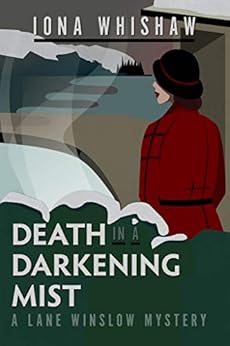
Review of DEATH IN A DARKENING MIST by Iona Whishaw

 3.5 Stars

Last year I read the first book in the Lane Winslow historical mystery series set in King’s Cove in interior British Columbia (https://schatjesshelves.blogspot.com/2020/03/review-of-killer-in-kings-cove-by-iona.html).  I had been meaning to get back to the series because the first book showed promise, so when I was contacted by the publishing company, I accepted the offer of the next two books in the series in return for honest reviews.  So here’s my review of the second installment; my review of the third book will be posted in four days. 

In December of 1946, Lane is at a local hot springs when the body of a murdered man is discovered.  The victim is a Russian who was living among the Doukhobors.  Lane’s assistance is required because, having grown up in Latvia, she speaks Russian and so can serve as a translator.  As the investigation is continued by Inspector Darling and Constable Ames, knowledge she acquired while working for British Secret Intelligence during the war provides valuable insight. 

There are two sub-plots.  One involves the embezzlement of money from accounts at the local bank.  The second is the developing relationship between Lane and Inspector Darling. 

As would be expected, there is further development of Lane.  She is intelligent, compassionate and possesses a good sense of humour.  She is also very independent and determined; these latter traits often lead her into difficulty and cause consternation in Darling because she dashes in heedlessly and then realizes she should have waited for the police.  She’d be a terrible police officer because she tends not to wait for backup. 

The characters introduced in the first novel, A Killer in King’s Cove, reappear.  The village is populated with interesting, quirky people and readers familiar with them from the first book will enjoy seeing them again.  The banter between Darling and Ames adds humour, and the conversations, often awkward, between Lane and Darling are always interesting. 

I appreciated the references to historical events like the internment of Japanese-Canadians and the government’s treatment of the Doukhobors.  I was inspired to do some additional research on the latter group about which I knew little.  Constable Ames decides that Lane Winslow is Wonder Woman and that had me doing fact checking; the fictional superhero would indeed have been known because she was created during World War II.

There is one chapter, Chapter 21, which has a problem with chronology.  In Chapter 17, Lane visits the bank and opens an account before she meets with Darling and Ames in Chapters 18, 19, and 20.  In Chapter 21, we learn “there had been withdrawals three different times, quite close together, starting the day after [Lane had] made the deposit” . . . though “The last time she’d been in was when she had deposited the money.”  Then, in Chapter 22, Darling speculates that Lane “should have gotten home by now” after opening the account and after meeting with them as described in Chapters 17 – 20.  This lapse is irksome; it should have been noticed in the editing process.

This can be classified as a cozy historical mystery but it does have some elements of a spy thriller.  I imagine these latter elements will continue as there is repeated reference to not being able to escape the past:  “It was not quite enough to imagine one could escape to the back of beyond . . . and live an idyllic life free of every connection with the past” and “It does not matter what we do, she thought.  What we wish for, what we believe.  Fate will try, willy-nilly, to draw us along some appointed road.”

I’m off to read the next book to see what next lies in wait for Lane Winslow.  (Just as I began reading this novel, an article written by Iona Whishaw came to my attention; it indicates that Lane was inspired by the author’s mother:  https://crimereads.com/a-family-of-spies/).

Monday, May 17, 2021

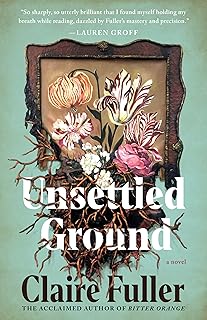
Review of UNSETTLED GROUND by Claire Fuller (New Release)

4 Stars 

This novel grabbed my interest from its first sentences, describing a snowfall in luminous prose, and wouldn’t let go. 

Jeanie and Julius Seeder are 51-year-old fraternal twins living with their mother Dot in a dilapidated cottage in rural England.  Though isolated and poor, they are content.  Then Dot dies suddenly, and the outside world intrudes and threatens their sanctuary.  They must learn to adapt and fend for themselves as they quickly learn that the world Dot had constructed for them was built on deception and manipulation.

Just as the ground unsettles beneath the twins’ lives, the reader will find the book unsettling.  The twins are hampered in their ability to deal with the outside world.  Julius suffers from travel sickness so being in a motorized vehicle is untenable; with limited education, he can take only menial jobs and only those which he can reach by bicycle.  Because of a heart condition which left her frail, Jeanie attended school only sporadically and is functionally illiterate.  They are vulnerable, and there are people who move in quickly to exploit their vulnerability.  As they are repeatedly victimized, I felt like I was reading a Thomas Hardy novel. 

This is very much a novel of character.  Though both Julius and Jeanie’s perspectives are included, Jeanie is more of a focus.  Because of her educational limitations and her lack of contact with the outside world, she lacks some basic life skills needed in the modern world and is uncomfortable outside her home:  Jeanie “craves home, quiet and security.”   Nonetheless, she engages with others as she must and fights to maintain her dignity and become more independent.  Though trapped by circumstances, she doesn’t let herself succumb to the increasingly hopeless situation in which she finds herself and shows herself to be both strong and brave.  The reader cannot but cheer for Jeanie even while sometimes being frustrated with her actions. 

Another character who is developed is Dot.  From the beginning it is made clear that she has secrets; as she suffers a stroke in the first chapter, she thinks about “that unmentionable-at-home man” who occasionally sleeps with her and her last thought is about “the biggest lie of all.”  The reader will certainly guess many of her secrets before her children learn them, but it’s not the nature of the secrets but her motivation that is of most interest.  I found myself increasingly angry with Dot for limiting her children’s opportunities.  Her conversation with Jeanie about the risks of pregnancy for someone with her heart condition and her casual mentioning to her son that she saw a friend of his kissing a man outside the pub do not portray Dot in a positive light.  A book club could have a great discussion about Dot’s choices:  Does her love for her children excuse her manipulation?  Does her pride keep her from taking actions that would have made her children’s lives easier?  What role do selfishness and a fear of loneliness play in her behaviour?  Was Dot the good woman everyone says she was?

Music is a very important source of comfort to both Julius and Jeanie and serves as a bond between them.  Dot also played an instrument and the twins fondly remember the home concerts with the three of them.  It becomes obvious that Jeanie is especially musically talented, and it is in this area that we see the harm that can be done by parents.

Suspense is built slowly but there is little doubt that something terrible is going to happen.  For example, the visitors to the cottage and spinney become more and more threatening, and Jeanie and Julius’ situation becomes more and more dire.  And then when a confrontation does happen, what will the long-term outcome be?

The book is slow-paced and generally bleak and oppressive, but the development of characters is exceptional and, fortunately, the ending offers some hope.  The novel certainly inspires one to think of the long-term impact of secrets and lies. 

Note:  I received a digital galley from the publisher via NetGalley.  The book will be released tomorrow, May 18.  

Thursday, May 13, 2021

Review of THREE-POINT TURN by Caitlin Dunseith

 3.5 Stars

The novel focuses on three characters who meet by chance in the restaurant of a cheap motel.  Tom is there to meet Claire with whom he’s hoping to reset an on-again, off-again relationship.  Jacqueline is celebrating her one-year anniversary with her boyfriend; she wants to break up, but she has just discovered that she’s pregnant.  Richard is attending his daughter’s university convocation, but he’s also pre-occupied with his disintegrating marriage. 

While these three strangers are having breakfast, Gus, another diner, engages them in conversation.  He asks a lot of questions but also talks about his life, especially his relationship with his wife Nellie.  Though she is deceased, Gus speaks fondly about their years together raising a family.  What he tells Tom, Jacqueline, and Richard has them reflecting on their pasts and pondering their futures. 

Chapters alternate among the three characters.  The book opens with three chapters, each introducing one of the protagonists.  Then, in the fourth chapter, Tom walks into the restaurant and the first part of the conversation with Gus is detailed.  The following chapter is a flashback to Tom’s childhood.  In the sixth chapter, Jacqueline arrives for breakfast and the first part of the conversation with Gus is repeated.  The subsequent chapter is a flashback to her childhood.  In Chapter 8, Richard enters and the conversation is again reported before Chapter 9 flashes back to Richard’s adolescence.  This format is repeated twice more.  The repetition of chunks of conversation becomes tedious.  The characters do react differently to what Gus says and the reader does become privy to their thoughts about the others, but the word-for-word reiteration is annoying. 

A strength of the novel is characterization.  Each of the main characters emerges as a complex person with a satisfactory backstory which explains their motivations.  All of them are flawed, but they also possess redeeming qualities.  Because of her childhood, Jacqueline, for example, is superficial, concerned with image and the opinions of others; she wants a boyfriend who is handsome and rich.  On the other hand, she loves her mother very much.  Sometimes, the characters behave in ways that make them unlikeable.  Tom, for instance, is shallow; he judges everyone, especially women, on their physical appearance.  Yet his desires to please his parents and to make his grandmother proud are admirable.  Richard’s treatment of Arnaud is difficult to accept but were he not guilty and conflicted, he would not have acted in a way that resulted in the fateful accident. 

Influenced by the conversation with Gus, the three protagonists experience epiphanies and make decisions that impact their futures.  My issue is that I’m not convinced that one conversation can be so impactful.  I did appreciate, however, that all three have reasons to change since they are at crucial points in their lives.  The changes are realistic in that not everything becomes perfect.  Not all issues in all relationships are resolved.  For instance, Richard admits that his marriage “still wasn’t perfect” and his “relationship with Luc remained strained.”

I appreciated some of the touches of humour.  Some of Gus’ stories are funny, but I appreciated the lighter touches of comedy:  When Tom first sees Jacqueline, he thinks, “The girl was a five or a six at best in the looks department.  While she was thin and well-dressed, her facial features were asymmetrical, and she was extremely pale. . . . Tom saw her glance at him out of the corner of his eye a few times, which wasn’t unusual.  Women tended to hit on him wherever he went.  Keep dreaming, he thought.  She definitely wasn’t his type.”  Jacqueline notices Tom “sneak a glance at her.  As if, she thought.  It wasn’t that he was unattractive.  He wore a leather jacket and fitted dark-wash jeans with what looked like an expensive haircut.  And he definitely works out, she noted.  But he was too old.”  Not only are their thoughts very revealing of their priorities, but the dramatic irony is perfect. 

There are a couple of style issues that irritated me.  It is accepted practice to write a character’s thoughts in italics.  It is aggravating, therefore, to read sentences like, “This might be it, he thought” and “Well not this time, Jacqueline thought” and “My daughter’s age, Richard thought.”  Italics indicate internal thought so adding “he thought” is redundant.  Secondly, the novel is set in southwestern Ontario so using “college” to mean “university,” as Americans do, is annoying.  Arnaud does “his college homework” but he attends university?

This book has some of the weaknesses found in debut novels, but it has its strengths, especially characterization.  I would certainly read another offering from this writer.

Note:  I received a copy of the book from the author in return for an honest review.

Sunday, May 9, 2021

Review of SUMMERWATER by Sarah Moss

 4 Stars

Sarah Moss’s Ghost Wall made a real impression on me (https://schatjesshelves.blogspot.com/2020/11/review-of-ghost-wall-by-sarah-moss.html) so I thought I’d read another of her novels.  This one also left me impressed.

The book is set on the shores of a Scottish loch where holiday-goers rent cabins.  The duration is only one day, but days of pouring rain mean that people are again cooped up inside.  Through twelve third person stream-of-consciousness chapters, the reader becomes intimately familiar with twelve characters, inhabitants of the holiday cabins.  Family dynamics are revealed through the perspective of different family members; for example, a chapter may be devoted to a wife/mother and later another chapter will present the point of view of the husband/father or that of the couple’s child. 

A portrait of life at different stages is presented.  Young children, teenagers, young adults, middle-aged parents, and retirees all make an appearance.  The inner lives of these characters are revealed:  their unfiltered thoughts and concerns.  A young woman, a feminist, is conflicted because of her sexual fantasies.  An elderly woman is suffering from memory loss.  Moody teenagers want privacy and time away from parents and siblings.  A child has to face nighttime fears.  Spouses want space from their partners.

What left me in awe is the authenticity of the various characters.  Each emerges as a distinct personality.  But what also becomes clear is that everyone is very self-absorbed, pre-occupied with his/her frustrations and worries.  There is often little connection among family members, but the inhabitants of each cabin are also isolated from people in the other cabins.  People observe their neighbours and pass judgment on their appearance or behaviour, but don’t interact with them.

Between the human chapters are brief interludes focused on nature, on what is happening around the humans.  There’s a doe with her fawn on the watch for wolves, birds and small creatures staying sheltered and hungry because of the unrelenting rain, and ants closing entrances to keep rain out of the anthill.  These sections emphasize that nature too has its concerns and evoke a feeling of timelessness.

Throughout the novel, there is a palpable sense of foreboding.  In the first nature interlude, there’s a comparison between the sounds of water and the sounds of blood and air in the human body and an ominous ending:  “You would notice soon enough, if it stopped.”   The first human chapter has a woman running a long distance alone despite her having been told by her doctor, “there’s to be no more running.  And if you really won’t take my advice at the very least don’t go far, don’t push yourself, don’t ever run alone.”  Something terrible will happen; the question is who will suffer.  Will it be the teenaged boy who goes kayaking and then realizes he might have gone too far as the wind and waves assault his craft? Will it be the teenaged girl who sneaks out to see a man illegally camping nearby?  Why is a man hiding in the woods and watching from the shadows every night at dusk?  And then one of the nature interludes ends with “There will be deaths by morning.” 

Despite the somber tone, there are touches of humour.  A woman’s thoughts wander during sex and she thinks, “you can’t expect a man to give you an orgasm if you keep thinking about particulates and genocides.”  A woman describes getting married “like voting in that whatever you choose the outcome will be at best mildly unsatisfactory four years down the line.”  A woman thinks she and her husband should have sex soon:  “even when she doesn’t feel like it, it seems to be good for them, like oiling your bike chain, doesn’t have to be fun but it stops things falling apart.” 

I know I’m not the first to compare this book to Reservoir 13 by Jon McGregor (https://schatjesshelves.blogspot.com/2018/03/review-of-reservoir-13-by-jon-mcgregor.html).  I found both novels totally immersive.  And the last chapter grabs the reader and won’t let go, even long after the book has been closed.

Wednesday, May 5, 2021

Review of SWIMMING BACK TO TROUT RIVER by Linda Rui Feng (New Release)

 4 Stars

This novel examines both how people are tethered by “the most ethereal of tendrils” to each other “in ways large or small, for a few minutes or for decades” and how individuals are insignificant in “the makings and transmutations of the world.”  Characters are brought together, tethered, at certain times, while also profoundly affected by social and political events “indifferent to human pain.”

Momo grows up in rural China in the village of Trout River.  He gains entrance to university where he meets Dawn, a budding violinist, who introduces him to classical music.  They lose touch after graduation when they are sent to work in different parts of the country.  Momo meets Cassia, a nurse, and the two marry and have a daughter Junie who is born without lower limbs.  Momo leaves for graduate school in the U.S., with plans that Cassia and Junie will eventually join him.  But Junie who has been raised by her paternal grandparents in Trout River doesn’t want to leave, and Cassia who has suffered several tragedies, does not see her future as Momo does.

The novel is narrated from the perspective of these four characters.  We see Momo’s life:  his university years, his marriage, and his adjustment to life in the U.S.  We see Dawn’s early years living with her grandfather, her love of music, and her pursuit of a career as a violinist.  We see Cassia’s meeting with Momo, her marriage, and her struggles with motherhood because of trauma from her past.  And we see Junie’s life with her grandparents who work to expand her world despite her physical limitations.

Momo, Dawn, and Cassia are all affected by China’s Cultural Revolution.  For years, Dawn cannot pursue a career as a violinist because even listening to Western music is a political crime:  “her ambition was the wrong tonality and color for the world.”  Both Momo and Cassia witness purges that affect them.    In essence, each of these must sacrifice dreams because of societal transformations happening around them. 

Each of the characters is well developed; their motivations are made clear so their actions are understandable.  What means the most to Momo is “to offer up his service to people ready to slaughter their donkey to send off a university student from their village.”  Dawn “’can’t bear to be alive without [music].’”  Cassia is emotionally scarred and is unable to move on; she knows that “Even a dull child . . . would have sensed her afflictions from the past and sussed out her ever-present presentiment of loss.”

The adults are all on journeys towards healing from loss and transforming into new lives.  Dawn takes drastic steps to pursue her career.  Cassia makes a momentous decision on her way to join her husband.  Momo works at bringing together his family which necessitates repairing his fractured relationship with Cassia.  The ending of the novel, though tinged with more tragedy, is hopeful as two people are tethered.

People may suffer in the face of a repressive regime indifferent to human suffering but people can also find what they need in a connection, however brief, with another person.  Just as Cassia as a child gives a stranger comfort without knowing it, Dawn meets people who made her career possible:  “’I washed up on these shores like a beached whale, and all of you . . . helped me grow my first pair of feet, and then helped me learn to stand on them.’”  Momo writes letters to a young violinist so two people meet “’By accident, or almost accident’” and “two commingled notes began to sound sweeter every second.”

I appreciated the author’s approach to explaining the Cultural Revolution.  She is not heavy-handed; instead, she inserts statements that say much in few words:  during this time, “gossip [led] to conjectures, which became accusations and verdicts over time; information that could be bartered for favors, exemptions, tokens of power.”  One man knows that “his own peasant pedigree was unassailable, and he knew that by marrying into his family, she’d be elevated from the class of intelligentsia suspected of unsavory, unrevolutionary activities.”  When a woman lowers her head to think, a young child interprets the gesture as sadness because “in a world where nothing was left standing, every gesture that involved turning the face away was interpreted as grief.”

As I was reading this book, I was often reminded of some similarities with Madeleine Thien’s novel Do Not Say We Have Nothing which focuses on a pianist, a composer, and a violinist studying music at the beginning of the Cultural Revolution (https://schatjesshelves.blogspot.com/2016/10/review-of-do-not-say-we-have-nothing-by.html).  

Swimming Back to Trout River is a beautifully written novel filled with tragedy, but it still manages to highlight human resilience. 

Note:  I received an eARC from the publisher via NetGalley.

Saturday, May 1, 2021

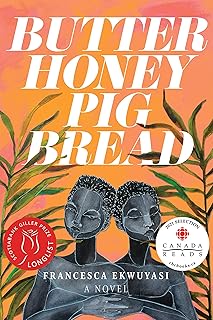
Review of BUTTER HONEY PIG BREAD by Francesca Ekwuyasi

 3.5 Stars

This book has been on my radar since it was longlisted for the 2020 Scotiabank Giller Prize.  Earlier this year, it was the runner-up in Canada Reads.  (I didn’t listen to the Canada Reads debate because I had not read any of the books and I was listening to this one at the time and wanted to form my own opinion.)

The book focuses on three Nigerian women.  Kambirinachi, who believes she is an ogbanje, gives birth to twin girls, Taiye and Kehinde.  The sisters have a very close bond but a traumatic event erodes that connection.  Much of the novel depicts how the estrangement affects them.  Years later, the two reunite in Lagos where they confront what caused their rift.

The narrative is non-linear, divided among the three characters and moving back and forth between past and present.  Taiye receives the most attention and so is most fully developed.  Her letters to her sister, letters which Kehinde has belatedly received, also show Taiye’s unhealthy habits and fragile emotional state.

The novel excels in its examination of the effects of trauma and perceived betrayal.  Kehinde is angry and resentful; she moves from Lagos to Montreal to start a new life though she suffers from poor self-esteem, especially as related to her body image.  Taiye is plagued by guilt and attempts to numb herself by self-medicating with drugs and alcohol.  Lonely without her sister, she becomes rather promiscuous.

The sisters live physically apart – Taiye moving between London and Montpellier and Halifax and Kehinde choosing Montreal – but they are brought together in Lagos because of their mother’s health.  Though the twins avoid opportunities to openly communicate, a confrontation is inevitable.  Unfortunately, when the climax does occur, it falls flat; the important scenes are handled very simplistically. Things have been left unsaid for so long that I think the two need to talk much more to recover from their emotional distance; I certainly expected more.

An element I did enjoy is the cultural explanation of mental illness.  Kambirinachi would probably be diagnosed as a schizophrenic, but she believes she is an ogbanje, in Igbo culture a spirit child who is repeatedly born just to die.  She makes the choice to remain with her human family, knowing that she will pay a heavy price.  The voices of her Kin constantly call her toward death so she can rejoin them. 

The novel is beautifully written so the narrative flows.  And the many descriptions of Nigerian food certainly had my mouth watering.  However, the story is one that has been told often; in fact, I just finished reading another novel by another Canadian (The Good Father by Wayne Grady) that examined the long journey to healing after a close relationship has been fractured.  Considering the accolades the book has received, I was expecting more.  Other than the cultural angle, there is not much new here.

Perhaps I’ll listen to the Canada Reads podcasts to discover more about the book.

Tuesday, April 27, 2021

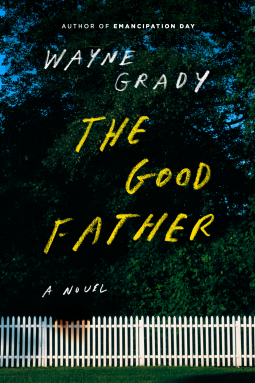
Review of THE GOOD FATHER by Wayne Grady (New Release)

4 Stars 

Having read and enjoyed Wayne Grady’s previous novels (Emancipation Day and Up From Freedom), I certainly wanted to read his latest.  It did not disappoint.

The book focuses on a father-daughter relationship.  Harry Bowes moves to Toronto from the small town of White Falls (“on the Madawaska River, between Ottawa and Peterborough”) to take a teaching job; he leaves behind his wife and ten-year-old daughter Daphne.  He never lives in White Falls again because his marriage ends in divorce and he eventually remarries.  He remains in contact with Daphne, visiting her and having her visit him, but their connection is eroded.

Daphne feels abandoned by her father, and the loving young girl is replaced by a hostile young woman who seems determined to totally destroy her relationship with Harry; she physically distances herself from him and limits contact with him.  Then she abandons her studies and begins self-medicating with drugs and alcohol.  A crisis brings them together physically, but will they be able to bridge the emotional distance?

I found myself frustrated with Harry.  He is supposed to be the adult, but he does not behave as one.  He doesn’t give much thought to how his move from home will affect his daughter.  He doesn’t even tell her that he’s leaving; he just assumes she will be alright:  “The relationship and trust and companionship he had built up with her over the years would ripen.”  Later, when it’s obvious that Daphne is not doing well, he has to be pushed to make more than a cursory effort to contact her.  Rather than reach out to find out exactly what Daphne is doing, he imagines best-case scenarios, “picturing her in a bright, cheerful apartment, with hardwood floors and tall windows that let in plenty of sunlight. . . . Food in the refrigerator, healthful food, smoked salmon, Boston lettuce, and a jar of real capers . . . and a small wine rack with bottles of a clear Okanagan sauvignon blanc.”  Harry is so right when he comments on his passivity:  “’I think I may just have been doing what was easiest for me.’” 

I sometimes found myself equally frustrated with Daphne.  Her behaviour as a child is understandable; she feels abandoned by her father with whom she had a close bond.  She looks for affection and attention elsewhere.  As a young adult, however, she makes choices that seem to be intended to punish her father because she cannot forgive him, even when those same choices destroy her own life.  She is so focused on what she sees as her father’s betrayal that she continues to blame him and wallow in self-pity when, in fact, she bears responsibility for her actions.  It takes a long time for her to admit that maybe her father’s leaving was “more a mistake than a premeditated desertion.”

The novel provides a dual perspective; the reader sees both Harry and Daphne’s points of view.  It is so realistic to read Harry saying, “’Daphne isn’t always there.  She’s always somewhere else’” and later, when he argues, “’I was always there for you’” have Daphne counter with “’Always there, never here.’”  In Daphne’s chapters, when she is facing a personal crisis and resorts to drugs again and again, she refers to herself in the second person.  This approach is somewhat disorienting but very effectively shows the chaos in her life. 

There are two aspects which I particularly enjoyed.  As a former English teacher, I loved the many literary allusions.  Shakespeare is quoted often, but W. B. Yeats and Walter Raleigh and Matt Cohen and Robertson Davies and Edna O’Brien and Siri Hustvedt and others are referenced.  Though White Falls is fictional, I grew up in the Madawaska Valley so references to “the Madawaska Valley accent” and “Madawaska Grunge” made me smile, as did mentions of Pembroke and Foymount.

The father-daughter relationship is portrayed so realistically that readers who are fathers or daughters will be inspired to examine their own relationships.  The novel reminds us that love requires “So much forgiveness . . . so much overlooking of hurt, so much emphasis on intentionality” and that love has many shapes.  Such a though-provoking book should be read.

Note:  I received a digital galley from the publisher via NetGalley.