Ranked a Top Canadian Book Blog
Twitter: @DCYakabuski
Facebook: Doreen Yakabuski
Instagram: doreenyakabuski
Threads: doreenyakabuski
Substack: @doreenyakabuski
Bluesky: @dcyakabuski.bsky.social

Friday, February 11, 2022

Review of FALL by West Camel

 5 Stars

I couldn’t help but fall for Fall.  There is so much to unravel in this multi-layered novel that I could write several critical analysis articles.

Aaron and Clive Goldsworthy are 62-year-old twins who have been estranged for over 40 years.  Aaron is the sole occupant of Marlowe Tower, part of a 1970s housing development designed by their mother Zöe on the banks of the Thames in southeast London.  Clive is a successful property developer who wants to turn the tower into luxury flats, but Aaron refuses to move.   When Annette and Christine Mayfield, a pair of black twins who lived in the tower in the 1970s, move back in, both Aaron and Clive must confront what happened the summer of 1976 and its aftermath. 

From the beginning, there are many unanswered questions:  Why are the twins estranged?  Flashbacks to 1976, when the two were 18, show them being so close that they have a psychic connection.  Now they live across the river from each other but haven’t communicated for four decades.  What happened?  Why do both of them fear the return of the two black women?  When Aaron and Clive first met this slightly older pair of twins, they were immediately drawn to them and spent a great deal of time in their company. 

Characterization is amazing.  All characters are complex and flawed; in other words, they are realistic.  At times I would feel compassion for someone and at another time, frustration with them.  What especially impressed me is the characterization of the twins.  Both direct and indirect characterization techniques are used.  We are told that “Clive dislikes – intensely dislikes – having his plans thwarted” and that Aaron is so “infuriatingly obdurate” that he “can never be persuaded of anything.”  Then we are shown these traits in their actions and thoughts.  I had no difficulty distinguishing Aaron and Clive.  Clive is the leader in that he is more forthright, whereas Aaron is rather diffident.  The same is true of the women:  Annette is more like Clive, while Christine is more similar to Aaron. 

I found Zöe such a fascinating character that I’ve added her to my list of fictional characters I’d love to meet in real life.  She is a strong, forceful person with a take-charge attitude.  As an architect, she is able to help dictate how people move around, and she tries to do this with her family as well.  It becomes obvious, however, that her sons do not know her as well as they think.  Aaron’s comment that Zöe is complicated is really an understatement.  As an architect, she struggled in a male-dominated field and had to make difficult choices between motherhood and professional advancement.  Though she tried to build a space where people from different walks of life would live together and even moved her family there, she continued to send her sons to schools outside the area.  Though supposedly concerned with egalitarianism, her including secret corridors and hidden doors in the building just for herself and her sons suggests a sense of ownership and superiority.  I found myself aghast at some of her choices and in awe of others, but always she behaves in keeping with her personality and priorities.

Though it is Zöe who is described as having a God complex, the narrator also behaves like a divine entity.  The omniscient point of view is carried to an extreme.  In the novel’s opening, for example, the reader is given a bird’s eye view of London before being invited to swoop down:  “We can drop even lower” and “And you might, if you trusted your wings enough to take you down even further, notice . . .”.   The narrator has unlimited access to all his characters and reveals their thoughts and gestures in minute detail, thereby developing character - though he also withholds information to create suspense.  It is the point of view that makes for such a satisfying closing in the last chapter. 

The book examines a number of issues; one of the major ones is racism.  Annette and Christine experience prejudice on a regular basis once they move into the housing complex.  As events unfold, it becomes clear that racism determines the fates of virtually everyone, not just those of the black characters.  Zöe’s options, for instance, are restricted not just because of gender discrimination but also because of society’s attitudes towards blacks.

The title is perfect because it works on so many levels.  There are physical falls, fallings-out, and lives falling apart.  The housing estate is falling apart.  Reading the novel is a process of slowly watching everything fall into place.  And how perfect is it that the last word in the book is fall!?

There is so much more I could discuss because there are so many admirable qualities:  the elegant prose, the symbolic use of architecture, and the subtly foreshadowed plot twists.  There is a great deal of tragedy because so much is lost by so many, but that does not mean there is no hope.  I could criticize the slow pace at the beginning and some coincidental meetings , but that would be caviling.  This is an extraordinary novel, both immersive and impactful. 

Tuesday, February 8, 2022

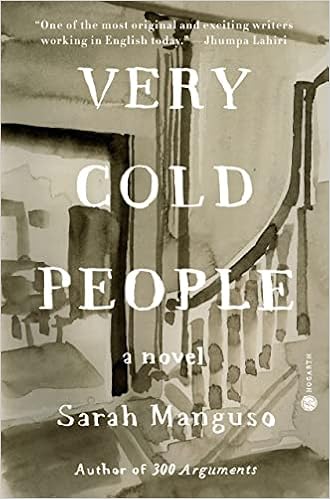
Review of VERY COLD PEOPLE by Sarah Manguso (New Release)

 3.5 Stars

This coming of age novel begins in the 1980s in Waitsfield, Massachusetts.  The narrator Ruth comes to see the town as a place to survive until she can leave.  She has to get away or she won’t be “any better than anyone else in that shit-frozen town.”

Ruth grows up in a town once home to America’s oldest and most illustrious families.  She begins by stating, “My parents didn’t belong in Waitsfield”:  her father is Italian, her mother is Jewish, and the family struggles financially.  Slowly, Ruth realizes that the town’s façade conceals dark secrets, and silence has allowed the perpetuation of violence and abuse. 

The book does not have a traditionally structured plot.  In short paragraphs, Ruth recounts different events as they come to mind.  The result is a string of fragmented, stream-of-consciousness vignettes suggesting a series of snapshots organized in random order, though there is a general sense of chronology.  There is little dialogue. 

There is a focus on showing, not telling.  Ruth describes events but doesn’t explain their significance because she often does not understand their importance.  The reader is left to determine the implications of what she describes.  She often senses something is wrong but cannot articulate it.  When a girl introduces herself in a way that is revelatory to the reader, Ruth only comments, “I remember there were so many horse chestnuts on the ground.”  One time, Ruth goes to a movie with her mother who “put the popcorn cup on the floor between her feet and leaned back in her chair and held on to the insides of her ripply thighs, her fingers reaching down and around them.  Every few moments, one of her hands twitched.  She closed her eyes halfway and rubbed her tongue all around her teeth.”  Yikes!  Yet Ruth’s comment is “I don’t remember anything about the movie.”

At one point, Ruth is told by an aunt that “you are very cold, cold people” and Ruth says, “I know.” Ruth’s parents, especially her mother, are indeed cold and distant.  Her mother is narcissistic:  “She was the protagonist of everything.”   She goes to a school reunion and “thought everyone had come to the reunion to watch her attend the reunion.”  There’s a bizarre episode that stands out:  “One day my mother asked me what color my eyes were. . . . She had no idea that a normal person would find it insane for a mother to ask her only child what color her eyes were.”  When Ruth shows promise in some activity, her parents mock her; for instance, Ruth seems to have some musical talent but she is not encouraged to pursue her interests:  “I listened to music through headphones.  I couldn’t let my mother find out what I liked because she would jeer at me for liking something, and then she would take it away.”  Ruth’s father is not much better:  “You must be the only person in the world whose hair looks dirtier after you wash it, my father crowed, my mother watching him approvingly.”

The neglect and emotional abuse she suffers has an effect on Ruth.  She has virtually no self-esteem and confidence.  She is fearful, “fearful of finding myself somewhere I didn’t have the skills or character or constitution to endure.”  She constantly feels shame:  “I took the shame and packed it into my body along with all the shame that had come before.  It was my birthright.”  She engages in self-harm:  she pulls out her eyebrows and eyelashes though she allows herself “only five lashes per day, since more than that would leave gaps that made people ask questions.”  When someone treats her kindly, she cries:  when a father’s friend helps her with her bike, she comments, “His kindness was so potent, I could hardly breathe.”

This is not a hopeful book.  Abuse is piled on top of abuse.  Ruth is mentally and emotionally scarred and several of her friends cannot escape abusive situations except through drastic means.  The point seems to be to emphasize that abuse has multi-generational effects and it is very difficult to escape.  Readers need to be forewarned that they may reach the end of the book feeling scarred.  Personally, I can’t say that I enjoyed reading it. 

Note:  I received a digital galley from the publisher via NetGalley,  Quotations may be slightly different in the final copy.

Friday, February 4, 2022

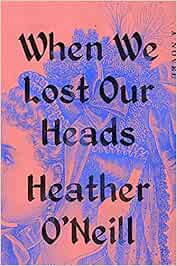
Review of WHEN WE LOST OUR HEADS by Heather O'Neill (New Release)

 4.5 Stars

I found this novel both entertaining and thought-provoking.  In some ways, it reminded me of a Victorian novel.

The book opens with the friendship between two girls.  Marie Antoine is the spoiled daughter of the owner of a sugar factory.  She lives on the Golden Mile, home to the wealthiest and most powerful families in late 19th-century Montreal.  In 1873, Marie meets Sadie Arnett when her status-conscious family moves into the neighbourhood.  Though opposites in appearance, the two girls immediately form such a passionate, intense friendship that they become obsessed with each other.  They engage in daring behaviour often instigated by Sadie who is fascinated with death and the darker aspects of life and is introduced as “strange” and “different” and “devilish.”  A tragic event leads to their being separated during most of their teenage years, but it is inevitable that they will be reunited.  It is also inevitable that their reunion will be consequential. 

The friendship between the girls is complicated.  An observation is made that “Every decent friendship comes with a drop of hatred.  But that hatred is like honey in the tea.  It makes it addictive.”  This seems to be true because though the two love each other, as soon as they met, they experience jealousy.  Sadie comments, “It was a strange feeling, jealousy.  When she saw the way her parents treated Marie, she was jealous.  Once this feeling had been awoken in her, it was impossible to make it dormant again.”  When Marie meets Sadie who is as intelligent and talented as she, “It planted the seed of jealousy in her.  And that seed began to grow and it bore thoughts that were like tendrils.”  When the two are reunited, Sadie believes, “Their characters were both too strong.  There was just no way they would ever be able to coexist peacefully.  They could either resume their explosive love affair that would somehow bring down everyone around them or they ought to be on opposite sides of the Atlantic.”  There is suspense as the reader wonders what mayhem the two will cause. 

The reader will definitely have an emotional reaction to Marie and Sadie.  They possess lavish personalities:  they are intelligent, ambitious, determined, and manipulative.  I was fascinated, just as I was also often repelled.  I certainly don’t agree with all their decisions and actions, but their motivations are always clear and understandable.   This is also true for secondary characters like Mary, George, and Jeanne-Pauline. 

I couldn’t help but notice the parallels between the names of characters in the book and important figures in the French Revolution:  Louis Antoine (Louis XVI); Marie Antoine (Marie Antoinette); Sadie (Marquis de Sade); Mary Robespierre (Maximilien Robespierre); Jeanne-Pauline Marat (Jean-Paul Marat); and George Danton (Georges Danton).  Since the novel includes more than one type of revolution and an uprising of the lower classes, these parallels are appropriate. 

A major focus is gender roles.  Again and again, statements about the expectations of female behaviour are mentioned:  “Ladies were supposed to moderate their physical behavior.  They were supposed to speak in an articulate and reserved fashion.  They were not supposed to act as though they were transported by their emotions.”  And “There was a pervasive idea that girls were all on the brink of madness.  It took much less than anyone previously believed to push a girl over the edge.  A single novel could do it.  A complicated idea could do it.  Having ambition and wanting to have an occupation could definitely do it.  It was too taxing on the female brain.  They had to be monitored carefully to make sure they stuck to exclusively feminine subjects.  It was disturbing and unnatural for women to engage in male endeavors.”  And women had to learn the basics of history “so they could follow men’s conversation.  They were not, however, to form an opinion on anything.  It was up to men to do that.  Women would simply marvel at their ideas.”  And “A woman ought to be pleasing to others, even when they were at their most miserable.” 

Women were expected to marry because “being aligned with a real man brought a woman so much social standing in the world.”  Of course, once married, they were expected to live in “a state of humbled servility,” and to be subjected to abuse:  “It was usual for women to suffer abuse at home.  There were no laws against it.  It wasn’t exactly socially acceptable, but everybody did it.”  Women were not allowed to be idle:  “Women never got to be alone.  That was too much of a luxury.  Women always had someone to take care of.”

Particular attention is given to women and sexual desire.  The Madonna-whore dichotomy is mentioned:  “Women are either one thing or the other . . . indisputably wicked and terrifying, [or] . . . sheltered and pure.”  If a woman were the former, “they would have her committed.  The most socially approved way of ruining a girl.  She would never be heard from again.”  Women’s sexual pleasure was secondary to a man’s:  “There were no guidebooks for women’s pleasures.  There were only guidebooks that instructed a woman on how to give other people pleasure.”  But since the female orgasm has no reproductive function and no other purpose other than enjoyment, “All the strict matrimonial laws were put in place because men didn’t want to have to stake their future on female desire.”  In fact, a man could use a woman’s orgasm against her:  “It could never be considered rape if the girls had an orgasm.  He turned their orgasms against them.  He considered their orgasm to be a form of consent.”  If raped, a woman “was not allowed to talk about what had happened to her.”  If an unmarried woman became pregnant, “what had happened to her was her own fault.  She had spoiled herself.  She was a whore.”  One of the most crushing statements is, “[Women] were so surprised by their own ruin, as though it had hit them like lightning and not through an inevitable path the world had set out for them.”

Another focus is the radical disparity between the upper and lower classes, the rich and the poor, those who live on the Golden Mile and those who shelter on the Squalid Mile.  Sometimes the disparity is mentioned in statements like, “When you were that rich, you didn’t have to be angry with your child.  You hired a governess to do it.”  But then there are detailed descriptions of conditions for workers.  Marie thinks “’Working at a sugar factory is quite wonderful.  We have the world’s most splendid machines.  And what’s more, you inhale and sugar gets in your lungs and stays there.  And when you cough, you cough sugar,’” but in reality accidents and mutilations occur on a regular basis.  Children are hired because they can be paid less, and women are “underpaid, overworked, sexually vulnerable.” 

The lyrical language is noteworthy.  There are many poetic descriptions of writing:  “The tip of her pen made the flight pattern of neurotic birds mating.  The looping words on the page were like knots in a girl’s hair that had formed after she’s been standing in the wind.  They were like the tendrils of a plant if spring happened all in one moment.”  And “Sadie moved the tip of her pen like a sailboat over the waves on a most perfectly windy day.  Her editing pen was making notes and slashes like a seabird dipping for fish.”  And “the ink words turned into black goldfish, and swam off the page.” 

There is so much in this novel that a second reading would be useful.  O’Neill has written a raw and gritty novel about women who behave boldly and unapologetically; it reminded me of Everyone Knows Your Mother is a Witch by Rivka Galchen in which a woman who does not conform to societal norms is branded a witch.  I think this book will cause a real stir – and deservedly so.

Note:  I received a digital galley from the publisher via NetGalley.  Quotations may not be exactly as they appear in the final copy.

Tuesday, February 1, 2022

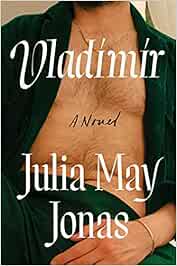
Review of VLADIMIR by Julia May Jonas (New Release)

 2.5 Stars  

I found this novel a tiresome read.

The unnamed narrator is a 58-year-old college professor at a small liberal arts school in upstate New York.  Her husband John, also an English professor there, is being investigated for his past affairs with students.  Although she and John have had an open marriage and she has found his affairs neither disruptive nor painful, she finds her relationships with students and colleagues changing as his sexual exploits become public knowledge.  At the same time, she becomes infatuated with Vladimir Vladinski, a handsome (and married) new professor who has recently arrived on campus. 

The title suggests that the novel will focus on the narrator’s relationship with Vladimir, but that is not the case.  She claims to be fixated on him, but it is only in the latter part of the book that her attention really zeroes in on him.  And then there’s a plot twist that, though it is foreshadowed in the prologue, is just bizarre. 

Though I am an older woman, I found it difficult to relate to the narrator.  Except in her role as a mother, she is selfish, even admitting “I am the most selfish human being I know.”  She is supposedly intelligent, but sometimes behaves so stupidly.  She is insecure, constantly worrying about her writing and her aging body.  Though I can understand her concerns about growing older (“Older women with lust are always the butt of the joke in comedy, horny sagging birds with dripping skin”), her vanity and constant whining become annoying. 

Other characters are no more likeable or sympathetic.  John is just a cad who used his prestige and power to bed young women.  Vladimir is supposedly a talented writer, but comes across as needy.  Sid is the lesbian daughter of John and the narrator; she has an argument with her lover and so she has sex with a man in the bathroom of a train?!  I found it difficult to care about these people.

An action-packed plot is not a necessity for my enjoyment, but the pace is almost glacial.  For much of the novel I wondered where exactly it was going.  The narrator goes on and on in long, meandering paragraphs expressing her opinions about sundry topics.  Then she acts decisively but in a way that is unrealistic. 

The aspect that most interested me is that this could be classified as a #MeToo novel, but it doesn’t offer the perspective one might expect, especially from a woman.  The narrator takes exception with charges that John was abusing his power when “that power is the reason they desired him in the first place.”  She believes the women accusing her husband were not traumatized:  “’He didn’t drug them or coerce them . . . None of these women suffered professionally or academically . . . They came to him.  He didn’t pursue.’”  She argues that the women accusers have adopted a victim mentality and are “’reacting to a moment.’”  She believes that academia creates a discriminatory environment because some students are selected for honours while others are dismissed or ignored:  “those selections caused more pain, at least in my opinion, than the amorous fixations of an over-the-hill professor.”

This just wasn’t my cup of tea.  As I read, I kept checking to see how many more pages were left.  I’m sure it will appeal to some readers, but the behaviour of narcissistic characters with opinions about random topics left me totally indifferent.

Note:  I received an eARC from the publisher via NetGalley.

Saturday, January 29, 2022

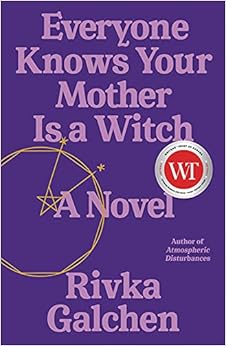
Review of EVERYONE KNOWS YOUR MOTHER IS A WITCH by Rivka Galchen

 4.5 Stars

In the early 17th century in the German town of Leonberg, a woman was accused of being a witch.  That woman was Katharina Kepler, the mother of the famed German astronomer, Johannes Kepler.  This is a fictionalized account of her story. 

Katharina Kepler is accused of poisoning the wine of Ursula Reinhold and thereby causing her chronic pain.  As the accusation becomes public knowledge, more and more people come forward arguing that they too have seen evidence of her sorcery.  Katharina’s only allies are her three children, Johannes (Hans), Christoph, and Greta, and her neighbour, Simon Satler, who becomes her legal guardian. 

Three perspectives are given.  Katharina tells her version of events to Simon who writes down her story:  “This manuscript is for after my case has ended, whatever the outcome.”  Then Simon explains his relationship with Katharina and finishes her story after the trial.  And the testimony of various townspeople is presented; these are presented as court transcriptions. 

Katharina does not conform to societal norms.  Though widowed and illiterate, she is wealthy (having inherited her father’s house) and has three successful children, including a son who is the Imperial Mathematician.  She is intelligent, stubborn, and independent.  One man criticizes her behaviour:  “Widows generally keep to themselves and don’t go here and there all over town like a whirligig.  Frau Kepler has been more like a man in her out-and-aboutness.”  She is outspoken and offers her opinion and advice even if not asked.  Simon notes her “intrusive nature” when he mentions that “Katharina was decisive as a ship captain:  calling out plans in what I now recognize as her usual off-putting way.”  Katharina lives with Johannes for a while; at the end of her stay, he says, “’How could this happen to Mama, who works so hard, who is kind even to animals, who never complains, who never uses foul language, who has no troubles with drink? . . . But how has Mama, who has been a hardworking widow for so many years, who has been so generous to so many – how has she been so viciously turned on?  . . . But living again with you here, I remember.  I understand.  I’m not surprised.’”  And Katharina herself sees her tendency to speak in such a forthright manner “like a child who doesn’t understand the intersection of tactics and truth.”

Katharina’s bold and meddlesome ways make her a perfect scapegoat since it is easy to demonize someone, especially a woman, who does not behave as expected.  The evidence against her is hearsay which sees to grow more and more outlandish.  Many of the accusers are jealous or greedy.  For instance, the schoolmaster attended school with Johannes and he interprets Katharina’s behaviour as wanting “to make me feel [Johannes’] success over my own.  . . .  Here I have worked so hard in my life, and faced so much adversity.”  Ursula’s motivation is financial compensation:  While in prison, Katharina must pay her two guards, and Ursula’s husband writes to the governor asking that she be given only one guard so “this draining of funds more properly destined to victims be halted.”   

The novel emphasizes the powerlessness of women.  Though Katharina is a mature woman who has successfully raised a family on her own, she has to have a man serve as her legal guardian in all official proceedings.  In a man like her son Johannes, intelligence and determination are seen as signs of genius; because she is a woman, those traits make her a witch.  Intelligent, independent women were perceived as dangerous and needed to be silenced.

The book also examines “the destructive power of rumor.”  Simon describes Katharina’s accusers as “the guild of rumormongers.  The society of theft-by-accusation.  People are stupid, sure, they’re ignorant, yes, they’re greedy, okay – but these people are fine with basically murdering her if it suits them.”  People who are resentful, jealous and/or greedy start false rumors and make unfounded accusations.  These rumors spread quickly, “You rarely see a spider spinning a web, you more often see webs already spun.”  Then others looking to find an explanation for their own suffering or misfortune join the bandwagon.  Simon concludes, “If you see someone as a monster, it is as good as attaching a real horn to them and poking them with a hot metal poker. . . . In order to avoid turning people into monsters by suspecting them of being monsters, I do my best to keep myself mostly to myself.”

There are numerous parallels between this story of 400 years ago and today.  In the novel people believe the strangest stories about Katharina with no evidence whatsoever.  Today people scorn science by disavowing the safety of vaccines, accept ridiculous QAnon conspiracies, and believe that the 2020 American presidential election was stolen, despite all evidence to the contrary.  We, like the characters in the novel, live in a culture of fear and misinformation and scaremongering. 

Despite the novel’s serious themes, there are some wonderful humourous moments.  Katharina’s observations about others are wonderful.  She notices that the governor has a lot of silver and she comments, “I doubt all the silver objects were gifts from his mother.”  She gives people descriptive titles:  “the Werewolf Ursula, her horrible forest administrator brother the Cabbage, the dog-killing False Unicorn ducal governor.”  Then there’s the more subtle humour:  a woman making a false accusation against Katharina doesn’t see the irony of saying “Many false charges are made” when it is mentioned that her husband is being charged with theft.  I loved Simon’s comment that “a note had been nailed to [Katharina’s] door, complaining of the weeds traveling.  Everyone thinks himself a Luther.”

This book is highly recommended.   It is entertaining and thought-provoking; though set in the 17th century, it has relevance to the 21st

Wednesday, January 26, 2022

Review of AN ISLAND by Karen Jennings

 4 Stars

I came across this title on the 2021 Booker Prize longlist.  It’s a short novel but packs a punch.

The protagonist is Samuel, a septuagenarian who has spent the last 23 years as a lighthouse keeper on an island of an unnamed African country.  Though bodies have washed up on shore in the past, one day a survivor arrives.  Because of the language barrier, Samuel and the man can communicate only through facial expressions and gestures, so he knows nothing about his visitor.  When the man begs not to be removed by the supply boat that comes every two weeks, Samuel begins to wonder whether the man is a refugee or a fugitive.  Samuel often retreats to memories of his traumatic past and these, along with his years of isolation, make him fearful and distrustful so he tends to interpret the man’s actions as threatening. 

Though the duration of the novel is a short four days, it actually covers most of Samuel’s life against the backdrop of the country’s turbulent history.  The country experienced colonial rule, political independence, and a military dictatorship.  Samuel was affected by all of this political history:  because of colonialism, his family was forcibly removed from their home; because of his involvement in the independence movement, Samuel’s father was disabled; and because of his role in an uprising against the dictator, Samuel served a 23-year prison term.  There is no doubt that his experiences have shaped him. 

Only in his years as a lighthouse keeper has Samuel found peace.  After his years in prison, he was unable to adjust to life in the outside world: “Freedom came to Samuel as something he feared.”  The island with its solitude has been his haven.  He resents that solitude being disturbed when the man washes up on shore and initially hopes the man will just die.  Having lost his home more than once in the past, he is terrified that the man will take the island from him:  “The island.  The island.  The island belonged to Samuel.  It was his and his alone.” 

The novel is narrated in third person limited omniscient point of view.  We see things only from Samuel’s perspective, so we too know nothing about the man, and this creates suspense.  Is Samuel in danger?  We see how memories of being helped by others influence him to have some sympathy for the man, and we also see how past humiliations and his anger and guilt over his cowardice haunt him. 

Samuel is an Everyman.  He is not exceptional in any way:  he is not educated or wealthy, and he has not behaved heroically.  Violence has dominated his life; sometimes he has been the victim; sometimes, a witness; and sometimes, the perpetrator.  So the book shows the effects of political events on the ordinary person.  Certainly, Samuel’s behaviour is totally understandable given his traumatic past. 

It is suggested that the history of Samuel’s country is typical of that of most African countries:  colonialism, revolution, failed self-governance, military dictatorship, uprisings, and fragile parliamentary democracy fraught with corruption scandals, perhaps because of foreign investments.  No country is named but readers can surely identify African countries with similar political histories.  Samuel’s neighbours in the slum disagreed with Samuel’s father that independence would solve the country’s problems; having fled because of a post-independence civil war, they argued, “’It was like this for us too . . . We were exactly like you. . . . You will see.’” 

Xenophobia, racism, and the plight of the displaced are examined.  Samuel’s family is forced off their land; the arable land becomes the property of the colonists while those evicted are told, “’You are to return to the mountains where monkeys belong.’”  The family ends up living in a city’s slums where their neighbours are also displaced, a couple who fled their own country’s civil war.  Years later, to gain popularity with the masses, a general proclaims, “’Why are we still sharing our country with foreigners . . . Let them go back to their own homes . . . We don’t want them here, taking from us, stealing what we fought so hard for.  This country is ours, no one else has a right to claim it.  No one else has a right to be here.  This country is ours alone, only ours.’”  This general instigates a “’culling’” of foreigners like Samuel’s neighbours. 

Even later, not much has changed.  When Samuel reports bodies washing up on the island, he is asked, “’What colour are they?  . . . Are they darker than you or me?  . . . We cannot come out to the island every time another country’s refugees flee and drown.  It’s not our problem.’”  And the man who comes with provisions for Samuel, says, “’They deserve it, don’t they?  . . . Anyone stupid enough to pack themselves in a rotting boat like that and try to enter another country illegally is asking to die.’”

Though short, this novel is thought-provoking.  The legacy of colonialism, xenophobia, the migrant crisis, the long-lasting effects of violence, and even climate change are examined.  Be forewarned:  there is little optimism.   

Sunday, January 23, 2022

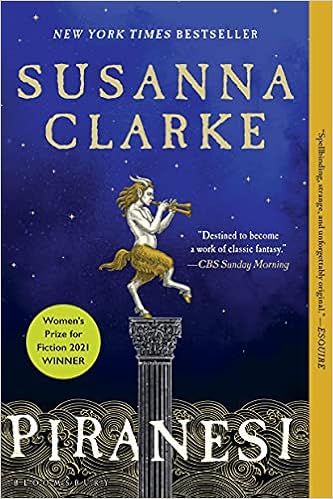
Review of PIRANESI by Susanna Clarke

4.5 Stars

Though Piranesi won the 2021 Women’s Prize for Fiction and was shortlisted for the 2020 Costa Novel Award, two book awards which I respect, I hesitated to read it because it is classified as fantasy, a genre I seldom read.  I’m so glad I finally decided to give it a chance.

The eponymous narrator’s entire world is the House which consists of countless halls and passageways filled with statues.  Above is a limitless sky and below is an ocean.  Piranesi believes he and the man whom he calls the Other are the sole inhabitants, though he has found the skeletal remains of thirteen people.  He spends his days exploring his world, studying the tides, fishing for food, and writing detailed entries in his journal.  He has an intimate knowledge of the various halls and statues, believing it is his duty “to bear witness to the Splendours of the World.”  For an hour every Tuesday and Friday, he meets with the Other who often asks Piranesi to bring him information about a particular part of the House. 

Piranesi and the Other have different attitudes to the House.  The Other, who refers to the House as a labyrinth, sees only “endless dreary rooms all the same, full of decaying figures covered in bird shit.”  He does, however, think that the House hides some ancient and secret knowledge which he enlists Piranesi to help him find.  On the other hand, Piranesi does not see the House as a place to be exploited:  “The House is valuable because it is the House.  It is enough in and of itself.  It is not the means to an end.”  He sees the House as a sacred place; he repeats, “The Beauty of the House is immeasurable; its kindness infinite.”

The book is structured as a series of journal entries written by Piranesi.  Readers soon realize that he knows almost everything about the House but he knows nothing else.  Gradually we come to suspect there’s much more going on than Piranesi knows.  A concern about losing his memory has Piranesi re-reading his old journals and making some surprising discoveries.  The novel then unfolds like a puzzle with new revelations arriving at a steady pace until we and he are able to piece together the truth of his past. 

Piranesi is an innocent, gentle soul.  He sees the world as one “before the iron hand of modern rationality gripped one’s mind.”  He is surprisingly incurious about himself.  The Other addresses him as Piranesi; though he knows this is not his real name, he is not curious to find it out.  He does occasionally wonder how he has knowledge of things that do not exist in his world, but he doesn’t obsess about that.  The Other has many more possessions but, instead of questioning where he got them, Piranesi just assumes the House is more generous with the Other because he is less skilled at taking care of himself.  When the Other gives him things, he doesn’t ask about where he got them; instead, he lists them so he will remember to be grateful to the House for giving him such a good friend.

Though Piranesi is naïvely oblivious, there is much to admire about him.  He is so kind, taking loving care of birds and the human remains.  He is so empathetic that he shows concern for others, even those who might mean him ill.  Because he is guileless, he is an easy target for manipulation, and from the beginning, a reader will suspect that the Other is taking advantage of Piranesi.  Even his naming Piranesi after an Italian artist known for his etchings of imaginary prisons suggests an ulterior meaning. 

It is Piranesi’s sense of innocent wonder that suggests a major theme:  there is a magical beauty in the world which people can find if they slow down and observe life around them.  Even if a person’s world is narrow and confined, it need not be a prison.  Even if a person is isolated from others, s/he need not be bored or lonely.  Everyone can achieve a state of joyful mindfulness.  

For this reason, though it was not intended as such, the novel is a perfect read in pandemic times when we are being confined and forced into isolation.  I am so happy that I disregarded my misgivings about the book’s genre because the novel, like Piranesi’s House, possesses a beauty that can be transformative.