Ranked a Top Canadian Book Blog
Twitter: @DCYakabuski
Facebook: Doreen Yakabuski
Instagram: doreenyakabuski
Threads: doreenyakabuski
Substack: @doreenyakabuski
Bluesky: @dcyakabuski.bsky.social

Monday, March 17, 2025

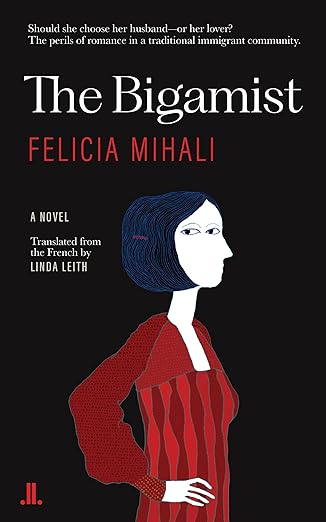
Review of THE BIGAMIST by Felicia Mihali (New Release)

 2 Stars

I’m not sure whether this book is intended to be an allegory, but I am certain that I didn’t enjoy reading it.

The narrator of this novella is an unnamed immigrant woman from Romania. She comes with her husband Aron to Canada where she tries to adapt to life in Montreal. She meets Roman, another Romanian immigrant, and begins an affair with him, eventually leaving Aron to live with Roman. That’s it in terms of plot.

It’s not difficult to determine that Aron represents the past, the life left behind in Bucharest, whereas Roman represents the present, where she’s trying to integrate into Canadian culture and society. Life with Aron becomes unbearable because of his unwillingness to adapt to their new country but life with Roman, who is “perfectly in tune with the North American lifestyle,” also presents challenges because they clash over things like her thriftiness.

The narrator is the bigamist in that she lives in both the past and present; she keeps house for Roman, but she regularly returns to Aron’s apartment to clean for him too. Aron even comments that she will always have a key for the apartment. The message is that for an immigrant, finding a balance is the key to happiness: “Isn’t that what happiness is? What could be more joyful than being married to both past and present, till death us do part?”

As expected, there are observations about the immigrant experience in Canada. The narrator complains that “The Department of Immigration lumped us all together in the same category” though there are many differences among immigrants from different parts of the world. She also observes how in Romania, “each individual lived within his family and his clan, remaining faithful to their age-old ideas and beliefs” whereas in Canada, “boundaries and class distinctions were fading, and your place in this heterogeneous society was now measured by your occupation” and “The smaller the jar in your [shopping] basket, the more rights you have in this country.”

One issue I had was with the personality of the narrator. Besides being dull, she is not likeable. I understand that her wavering and uncertainty are meant to emphasize her desire to retain things from the past and her desire to find her place in her new country with its different values, but her vacillating becomes annoying and suggests a lack of introspection. Her actions towards Émilie may be symbolic of the narrator’s unwillingness to cut ties with the past, but they are despicable.

There is no doubt that the narrator is to be seen as well-read; the book is peppered with allusions to writers such as Dzevad Karahasan, Edith Wharton, Salman Rushdie, Hanif Kureishi, Kazuo Ishiguro, and Herta Müller. I did find, however, that after a while these literary references come across as a form of name-dropping to impress. On the other hand, though the woman is supposed to be a writer, there is little mention of her actually writing.

What makes this book so tedious is that there is really no tension. I don’t enjoy books that focus only on plot, but in this case there’s the opposite problem: absolutely everything is intended to be symbolic of the immigrant’s conflict between past and present. Rather than a narrative diagram, I imagine the writer created a chart of symbols. Surely this conflict could be developed in a more interesting way. The total lack of dialogue is, for me, a real issue since dialogue is so useful for any number of dramatic purposes. I can appreciate the idea behind the book, but the execution does not impress though, admittedly, it would probably work well for a university course focused on extended metaphor and symbolism.

A writer wanting to convey a theme needs to do so in an interesting and emotionally impactful way or there will be no audience for that message. Unfortunately, I was neither entertained nor emotionally captivated by this book. If I did not feel obligated to write a review for it, I would have stopped reading after a few pages.

Note: I received an eARC from the publisher via NetGalley.

Friday, March 14, 2025

Review of SON by Johana Gustawsson and Thomas Enger (New Release)

 4.5 Stars

I’ve not read any books by Thomas Enger, but I really loved two of Johana Gustawsson’s novels, The Bleeding and Yule Island, so I was anxious to read Son, the first Kari Voss Mystery.

Kari, a psychologist and expert on body language and memory, is also a consultant for the Oslo Police. She is asked by her friend, Chief Constable Ramona Norum, to assist in the investigation of the brutal murder of two teenage girls, Eva and Hedda, in the small Norwegian town of Son. Jesper, a friend of the girls, is arrested and charged after he confesses, but Kari is not convinced of his guilt and continues to investigate on her own. She uncovers several secrets and multiple suspects.

As expected with the first of a series, there is considerable character development. Kari emerges as an interesting character with a traumatic background. She lost her husband in an accident and then her nine-year-old son Vetle went missing. It’s been seven years since Vetle’s disappearance, but Kari has not accepted that he could be dead and when stressed, she experiences episodes of transient global amnesia. The killings of Eva and Hedda and the arrest of Jesper hit close to home because the three were Vetle’s best friends. Besides her intelligence and intuitiveness, what I especially appreciated about Kari is that, though she does not back down easily, she keeps an open mind and questions her assertions.

I’ve always been interested in body language, the process of communicating non-verbally through conscious or unconscious gestures. As a consequence, I enjoyed Kari’s explanations of character’s movements and what they reveal. Of course there’s always the element of nervousness in people talking to a woman known as a human lie detector.

I found the book a compelling read from beginning to end. It opens very strongly and continues at a relentless pace with several twists and turns. As secrets are uncovered, more suspects emerge. The reader feels like Kari does when she’s “left with a whirlwind of new information. The complexity of it all bears down on me, covering everything in a cloak of suspicion and uncertainty.”

I'd be remiss if I didn’t comment on the title. It’s perfect because it works on so many levels. There’s Vetle, a missing son; the town of Son where the murders occur; and various sons like Jesper, Samuel, Erik, and Petter whose relationships with their parents receive considerable attention.

The final sentence in the novel had me screaming, “When will the next book in the series be released?” I will definitely be looking for it. I also intend to read Gustawsson’s three books in her Roy & Castells series and Thomas Enger’s five books in his Henning Juul series. In the meantime, I will definitely be recommending this totally immersive collaboration.


Here are links to my reviews of the two Johana Gustawsson novels I have read:

The Bleeding - https://schatjesshelves.blogspot.com/2022/09/review-of-bleeding-by-johana-gustawsson.html

Yule Island - https://schatjesshelves.blogspot.com/2024/02/review-of-yule-island-by-johana.html

Monday, March 10, 2025

Review of A MOTHER'S LOVE by Sara Blædel (New Release)

 3 Stars

When I requested an advance reading copy of this book, I was unaware that it is in fact the eleventh book in the Louise Rick / Camilla Lind series. Fortunately, though I was obviously missing information about previous events in the characters’ personal lives, there is sufficient explanation that the novel can be read as a standalone.

Dorthe, a widowed innkeeper, is found murdered. In the course of the investigation into her death, a search of the inn reveals a concealed nursery in which a child obviously lived. Since Dorthe was childless, who is the child and where is s/he? The search for a murderer also becomes a search for a child whose identity is unknown.

The investigation is lead by Detective Louise Rick, head of the recently created Mobile Task Unit charged with assisting with difficult cases across Denmark. Besides having to work with a hastily cobbled together team of officers she has never met, Louise finds herself having to work with Eik, her ex-fiancé. Louise does receive help from her friend, crime reporter Camilla Lind.

I had difficulty understanding the relationship between Louise and Camilla, though the suggestion is that they are best friends. In this novel, they have little interaction other than phone calls and texts. When they do communicate, Louise is brusque and churlish. Though Camilla repeats that she is taking a break from work, Louise insists she do some research for her. After demanding her help, Louise later rudely snaps at Camilla, accusing her of pumping her for information about the investigation.

There are a lot of twists in the plot to keep the reader entertained. I did find, however, that the events in the church at the end seem to have been included just to add suspense by prolonging the conclusion. Those events are not only unnecessary but also far-fetched. The suicide of a troubled individual is understandable but the other actions taken by that person make little sense.

There are other things that make no sense. How can two people (a killer and a victim) leave the same location at the same time and both arrive at a second location at the same time when the killer stops en route to pick up the murder weapon? How can someone who is hiding a young child in his/her house be absent for extended periods from home? There is no suggestion of that child being drugged. At one point Louise “went to join [Melvin and Jonas] in the living room” though Melvin had left for his own apartment and Jonas “disappeared into his room”? Then there’s the fact that the investigation is in a small town where it’s usual for people to know a lot about each others’ activities, yet there are so many secrets and secret locations? The number of evil characters totally lacking in humanity also requires some suspension of disbelief.

Despite the twists, I identified the murderer early on. There’s the title, of course, and then a definite focus on a subplot – both clues that a regular reader of crime fiction cannot miss.

This is an entertaining though not exceptional book because of the plot holes. Readers who have followed the series from the beginning may be interested in the developments in Louise and Camilla’s personal lives.

Note: I received an eARC from the publisher via NetGalley.

Friday, March 7, 2025

Review of 33 PLACE BRUGMANN by Alice Austen (New Release)

 3.5 Stars

This novel, set during World War II, focuses on the residents of an apartment building in Brussels. They are a diverse group of people of different ages and from different backgrounds. There’s a Jewish family, the Raphaëls, who disappear one night, leaving everything behind but their valuable art collection. There’s a Russian immigrant and a widowed war veteran. There are a number of students, including Charlotte, a colour-blind art student. There are professionals: an architect, an art dealer, an attorney, and a notary. There’s a nosy busybody. Once the Nazis occupy the city and life becomes more difficult with restrictions on movement and food rationing, each resident must choose whether to submit to the regime or resist. Some people make sacrifices and endanger themselves to save others and some people betray others to save themselves.

There are multiple points of view. At least one person from each apartment provides his/her perspective. This narrative technique provides an opportunity for the reader to encounter the thoughts of the best and worst of people, both heroes and cowards. Though they are not narrators, the Nazis are also represented, and even there, we see differences – a Nazi officer who shows compassion more than once and a collaborator who shows none to either human or animal.

There’s a disjointed feeling to the novel because of the constant shifts between so many narrators. What also affects the narrative flow is the insertion of dreams and visions, sometimes in stream-of-consciousness passages. Charlotte, for instance, at the beginning of the novel sees that “blood is seeping out under [the massive church doors], too, flowing from the church and flooding the square. Blood is everywhere. The passersby wade through blood, and it spatters their pant legs and skirts, but they take no notice.” This vision obviously symbolically foreshadows what is to come, but others are less clear.

What is also less clear is the philosophical musings. There are repeated references to Wittgenstein and I found these less than interesting. Charlotte dislikes Wittgenstein’s writings and comments, “I’d rather read a magical book with the illusion of a beginning and an end. Not pithy little bursts that force me to consider every damn sentence.” When encountering another discussion of Wittgenstein’s philosophy, I found myself agreeing with Charlotte.

Charlotte is a central figure in the novel. Her point of view is included several times, and it is her life that provides considerable action to the plot; she’s involved in the romance story and the most suspenseful scenes. Unfortunately, I found it difficult to relate to her. Others speak so highly of her, but I found it difficult to grasp her personality. For me, she remains an indistinct character, always hazy and lacking definition.

There are quite a few coincidences which troubled me. Julian’s arrival at Herman’s apartment stretches credibility. And then there are the connections among Dirk and Putzeis and the Gorilla and Masha.

I have read quite a bit of historical fiction set during World War II, but I believe this is the first set in Brussels, so I learned a great deal from this book. I learned about the VNV, the Flemish nationalist party which became the leading force of political collaboration in Flanders during the German occupation of Belgium. I also learned about the 1943 solo bombing of the Nazi headquarters in Brussels by Jean de Selys Longchamps.

Though there are elements of the book I did not enjoy, it does offer a look at how Nazi occupation affected ordinary people whose survival was threatened in many different ways. It also inspires the reader to consider how s/he would react in similar circumstances. Would one choose submission or resistance? Some statements certainly made me draw parallels with current events in the US: “When we stop trying to understand how others see the world, when we lose our compassion, our empathy, we become animals. Worse than animals” and “Elected. The meaning of the word has changed for me since [the election of Hitler]. Or else my understanding of my fellow humans’ basic intelligence has changed. I don’t know if it will come to shooting, but I know it might.”

Note: I received an eARC from the publisher via NetGalley.

Monday, March 3, 2025

Review of THE IMMORTAL WOMAN by Su Chang (New Release)

 4 Stars

This multi-generational story weaves the personal stories of women with historical events and emphasizes the power of “the ghosts of the past.”

In 1960s Shanghai, Lemai reluctantly becomes a student Red Guard leader and eventually a journalist with a state newspaper. Events during the Tiananmen Square protests cause her to lose faith in her country so she raises her daughter Lin to aim for a life in the West. Years later, Lin arrives in North America but struggles with identity and finding her place in the world.

Mother-daughter relationships are a focus. The one between Lemai and Lin is certainly complicated. Because Lemai’s experiences as a young woman are detailed, we understand her motivations, especially in raising Lin to aspire for a life in the West. Because Lin’s experiences in the West are detailed, we understand her struggles: she wants to fulfill her mother’s dream but she has her own ambitions. What is impressive is that the author manages to elicit in the reader both sympathy for and frustration with both women.

It is Lin’s experiences with which I most identified. She identifies herself as “the executor of Ma’s Grand Plan” and “thanks to [her mother’s] years of gospel-like teaching,” Lin “spent her entire formative years admiring, romanticizing, worshipping those [white] faces.” In the West, however, she ends up unhappy and suffering from the equivalent of a colonial mentality with “a bruising inferiority complex, a decimated self.”

Lemai imagines a perfect life for her daughter, like the one she imagines for her friend Wei who left for the West years earlier: “She had imagined her lifestyle: lunches with American co-workers, shopping sprees at luxury brands, vacations on white-sand beaches by the undulating sea. . . . Lemai was sure her friend could switch between cultures effortlessly, like slipping in and out of different outfits.” Lemai believes the propagandizing about “the Melting Pot in action; ah, the harmonious coexistence; ah, the nation unparalleled in its embrace of immigrants.” Lin discovers the falsity of the American dream: because her appearance differentiates her, she cannot totally assimilate into Western society and encounters both overt and subtle racism.

I appreciated the balanced portrayal of both China and the West. We see the extreme nationalism in China where the government controls the media as a propaganda weapon, and closely monitors and oppresses its people. Though Lemai thinks of the West as a paradise, she is ill-informed. Wei’s life proves to be nothing like what Lemai imagined. A classmate of Lin’s comments, “’You turn on the TV every morning and see the clowns talking, the cults and fake gods, the obscene rich and abject poor, the school carnage . . . this is supposed to be the pinnacle of human civilization?’”

The novel focuses on women’s experiences. Men in both parts of the world do not emerge as admirable characters. Men in both China and the West abandon their wives and children. And they enjoy wielding power over women, some physically but many psychologically. Men are either cowardly or manipulative while women may be quieter but are definitely stronger.

Parts of the novel are dense with politics. My lack of knowledge about Chinese history meant that some sections were tedious and I struggled to understand. Fortunately, there is sufficient explanation that I didn’t get totally lost. There are also cultural references which I had to research: I was not familiar with terms like hukou, baijiu, iron rice bowl, and hanfu. On the other hand, I completely understood the commentary about American society, comments which I found particularly relevant because of current events.

This is a worthwhile read although readers should be forewarned about the novel’s serious tone. There are few light-hearted moments, though the ending, with its emphasis on proudly embracing one’s heritage, is satisfying. Su Chang is definitely a Canadian writer to follow.

Note: I received an eARC from the publisher via NetGalley.

Friday, February 28, 2025

Review of SMALL FIRES by Ronnie Turner (New Release)

 4 Stars

Though gothic fiction is not my genre of choice, I really enjoyed Ronnie Turner’s So Pretty (https://schatjesshelves.blogspot.com/2023/01/review-of-so-pretty-by-ronnie-turner.html) so was excited to read her next offering. Small Fires I would classify as folklore gothic, combining elements of traditional folklore with classic gothic tropes.

Della and Lily Pedley, suspected of murdering their parents, flee Cornwall in southern England to an island in Scotland known only as The God-Forgotten. Strange events occur on the isolated island and people avoid travelling to it because “bitterness runs through the land like poison in blood.” The Folk on the island seem drawn to Della whereas Lily becomes friends with Silas, the publican, and Kit, a visiting geologist. Silas and Kit are different from the rest of the islanders; they don’t seem to live with the same fear that permeates every aspect of the lives of the Folk. Lily is curious and becomes interested in the local stories, especially those about the Warden that the Folk always try to appease. It is soon obvious that “’stories are never simply stories.’”

The island is very much a character in the novel. The opening sentence is “They say the Devil came here.” When the sisters arrive, Lily comments on the silence over the land and the dark mountain casting shadows; she even thinks “This land smells of death.” Kit speaks of the island having “’So much history. All of it bad.’” What is emphasized is that the island is full of legends; Silas, who was born on the island and has lived there all his life, thinks of it as a godless place “Where nothing but stories grow.”

And the inhabitants are a strange lot; they have a religion about the Devil whom they call the Warden; they are variously described as mad and deluded but what stands out is their fear. Kit comments that they live in constant fear because of their beliefs about the Warden which are passed down via their old, ominous legends: “’I’m not saying I don’t think there is something rotten here. There is. But it’s something these people have grown themselves.’” Later, she states, “’There is no illness like the illness of the mind. They think they have a devil. I think they have groomed themselves into a delusion.’” Is Kit correct or is there evil on the island?

The narrative alternates between two perspectives – that of Lily in first person and that of Silas in third person. Whenever there’s a reliance on first person narration, I always question whether the narrator is reliable. For instance, because Lily definitely portrays her sister in a negative light, I kept wanting Della’s point of view. Can Lily be trusted if children react to her with “such fear in their unblemished faces” and her own mother called her Little Wolf? Can Lily be innocent if she admits “We murdered our parents”? Yet Silas’s opinion of Della confirms Lily’s; when he sees Della for the first time, he describes her: “The tall one has long fingers, a thick neck inches wider than his own. A beast among men” and from Lily’s behaviour, he concludes she is frightened of Della. Certainly point of view was carefully chosen to keep the reader uncertain.

Imagery is used very purposefully and effectively. There are frequent references to bones, blood, shadows, ghosts, and animals. For instance, “The sun has not yet risen, so the bonfire is their sun, and it puts violence in the shadows and makes them all look like they have beasts inside their skins” and “the clouds are dark like blood when it dries” and “She is outside somewhere, picking through the darkness like a tick on a body” and “He has ghosts inside his eyes. Such hungry ghosts.”

I had difficulty imagining the time period of the novel. It is not until reference is made to an online article, that it’s clear this is a contemporary story. Regardless, I often pictured an earlier time. Rituals like the Tithing made me think of the short story “The Lottery” by Shirley Jackson. Perhaps the vagueness of time is intentionally used to emphasize timeless themes.

The themes are about generational trauma, the power of stories, and identity. The first two are developed from the beginning. The theme of identity appears later with statements like “’Identity is a powerful thing’” and “’I don’t think you can ever know someone. We are all wearing faces to get through the world. We are all pretending, slipping on new identities’” and “’I have a different skin for every pair of eyes. Sometimes even I am confused.’”

With its constant sense of foreboding, this book is an unsettling read. As I mentioned at the beginning, gothic fiction is not a favourite for me, but this book offers more than an eerie atmosphere. It is well-written and its themes are thought-provoking.

Thursday, February 27, 2025

Review of PRECIOUS CARGO by Craig Davidson

3 Stars 

Memoirs are not my genre of choice but this was a book club selection. Given its appearance on the shortlist for Canada Reads in 2018, with its theme of One Book to Open Your Eyes, I was expecting more.

Depressed and broke, Davidson took a job as a school bus driver and spent one school year driving five special-needs students. We meet Nadja, Oliver, Gavin, Vincent, and Jake and see snippets of their time on the bus during which they tell stories and jokes, tease each other, laugh together, and bond. As a result of getting to know these teenagers and seeing how society treats people viewed as disabled, he re-evaluates his life: “The physical truth is that I drove you. The deeper truth is that you drove me. Drove me to step out of my own sickened skin, to stop feeling sorry for myself and to see the world for its beauties more than its agonies.”

As I’ve already mentioned, I was wanting more from this book. In particular, I wanted more of the five students and less of the bus driver. I wanted more stories of the interactions between the driver and his passengers. Except for Jake with whom Davidson had a relationship outside his job, it is difficult to remember who is who; there is insufficient differentiation.

There is more telling than showing. Not everything has to be explained. Do we need over a page about how chemically we are all the same because every living thing starts out as carbon, nitrogen, and oxygen? And the life lessons he learns are not exactly profound: we’re all people deserving of respect despite our differences; we need to make the best of what life gives us; and life is sometimes unfair. Basically he learns to have empathy for others and to appreciate his own life.

I didn’t dislike the author, but I wasn’t overly impressed with him either. At first he was whiny and full of self-pity; I expect a writer to understand human nature and be capable of self-reflection, but that’s certainly not the case at the beginning. Then, though he did try to make the times on the school bus pleasant for all and his actions show acceptance of and respect for everyone, I detected a self-congratulatory tone for being such a good driver to these students and then expecting praise for learning rather obvious lessons about life.

What really bothered me is Davidson’s dropping out of Jake’s life. He speaks of the relationship he developed with Jake, but once the school year is over, he never sees him again? Surely both Jake and Calvin would have appreciated Davidson’s further involvement in Jake’s life. This behaviour made me question Davidson’s sincerity. Did he use the five passengers as fodder for his writing and then just abandon them once they had served their purpose?

The inclusion of excerpts from “The Seekers” serves little purpose. Yes, the unpublished novel does include the five as lead characters/heroes in a narrative, but these sections interrupt the flow of the narrative. Were it the writing of one of the gang I’d have been more interested. Davidson does say that both Vincent and Jake “could end up as writers.”

In the end, I have greater respect for school bus drivers. Given the level of their responsibilities, I think they are underpaid. Not only must they keep their passengers safe, they’re expected to understand their personalities and needs. I understand why there’s a shortage of people for those positions.

This is not a bad book, but I wanted more depth, not just surface-level life lessons, and I’d have enjoyed learning more about the precious cargo.