Ranked a Top Canadian Book Blog
Twitter: @DCYakabuski
Facebook: Doreen Yakabuski
Instagram: doreenyakabuski
Threads: doreenyakabuski
Substack: @doreenyakabuski
Bluesky: @dcyakabuski.bsky.social

Friday, April 11, 2025

Review of THE CURE by Eve Smith (New Release)

 4 Stars

This dystopian thriller is narrated from the perspectives of two women: Ruth and Mara.

Ruth, years earlier, while searching for a cure for the disease that led to her daughter’s premature death, accidentally discovered a vaccine against age-related diseases. Erik Grundleger, a colleague, hijacked this vaccine known as ReJuve and, with the help of a billionaire obsessed with immortality, created an upgrade, SuperJuve, which extends human life span. There were disastrous consequences so laws were passed to limit life to 120 years. Supers who took SuperJuve are tracked down by Omnicide investigators and executed. One of these investigators is Mara who hesitantly teams up with Ruth to find Grundleger.

The reader comes to understand the two women and what drives them. Ruth is easy to like from the beginning. Her intention was always to help people like her daughter, and she even tried to insure that her discovery would not be misused. Mara, known as The Blade, is more difficult to like. She’s a relentless, merciless hunter of Supers but the reason for her obsession becomes clear; like Ruth, she experienced a trauma that profoundly affected her.

The novel is very thought-provoking. It forces us to consider what might happen if people lived longer. The novel suggests that if the population of the planet increased, there could be housing and food shortages. Natural environments are devastated leading to extinction of animals as land is needed to build homes: “open grasslands no longer exist. They were razed for food production and housing.” The old outnumber the young who become resentful: “crime is rising amongst the younger generations who are out of work, out of an inheritance, and out of patience.” Amongst the many centenarians, there’s an emotional toll of living longer. Loneliness and depression are major concerns: “there’s an increasingly anxious and disconnected generation of elders who lack purpose and fulfilment.”

What the novel also emphasizes is the extreme disparity between the ultra-wealthy and the rest of the world. To receive ReJuve, citizens must meet criteria, one of which stipulates that they must pay into an accredited pension scheme for a minimum of sixty years. Not everyone qualifies for ReJuve so the lives of the disadvantaged have not improved. As for SuperJuve, it can only be afforded by the ultra-rich who obviously will do whatever is necessary to access it. And what if SuperJuve had side-effects which were dangerous for everyone?

The name of the SuperJuve investor is Jeff Busk who has a “net worth of over three hundred billion dollars.” Is the name an amalgam of Jeff Bezos and Elon Musk, two people with unlimited wealth and power? I can imagine these two men would concur with the choices made by Grundleger and Supers. Channeling the names of two of the richest men in the world just adds to the realism of the novel. We are already seeing extreme financial inequality in the world and the devastation of ecosystems so what the author is suggesting is certainly not far-fetched.

In the latter part of the novel, the thriller elements come to the fore. Ruth and Mara find themselves in increasing danger so tension also increases. And, as expected in thrillers, there are some plot twists. There are a couple of instances where there was reliance on coincidence but it was not enough to affect my enjoyment of the novel.

Because what is described is plausible, this is a terrifying cautionary tale. The book entertains and informs – a perfect combination for me.

Monday, April 7, 2025

Review of THE GRANDDAUGHTER by Bernhard Schlink

 4 Stars

Bernhard Schlink is best known for his 1997 novel The Reader, but I’ve enjoyed other of his books and so picked up The Granddaughter, his most recent offering.

Seventy-one-year-old Kaspar Wettner is a bookseller in Berlin grieving the death of his wife Birgit. When going through her papers, he discovers she had left behind a baby in East Berlin when she fled to West Germany. He decides to search for his stepdaughter Svenja and eventually finds her living in a rural community of Völkisch people – far-right, white supremacist nationalists. Svenja and her husband Björn have a daughter, 14-year-old Sigrun, who is an enthusiastic believer in far-right ideology. Kaspar manipulates her parents into allowing Sigrun to spend time with him, time he hopes he can use to broaden Sigrun’s worldview.

Kaspar is the grandfather most people would like to have. He is patient and tolerant. When he learns about Brigit’s daughter, he is determined to find her, and when he meets Sigrun, he is determined to establish a relationship with her. Liberal and progressive in his views, he finds Sigrun’s anti-Semitic, xenophobic, Holocaust denying comments offensive, but he admires her curiosity, strength, and loyalty. A cultured man, he takes her to concerts and introduces her to books she would not encounter in her insular world. When he discovers she has a talent for the piano, he pays for lessons. He takes her on a trip to broaden her horizons.

Of course, Kaspar has to tread carefully as he tries to correct Sigrun’s understanding of German history. Her parents certainly fear Kaspar’s influence because they insist on strict rules while she visits Kaspar: for example, she cannot wear jeans, use the internet, or go to the cinema. He doesn’t want to alienate them because they might deny him visitations. He is also afraid to contradict Sigrun too forcefully for fear that she herself might choose to end their relationship. This leaves him wondering if/how he can challenge her radical opinions.

It is not just Sigrun’s views which are challenged. Kaspar is forced to confront his prejudices. For instance, Sigrun draws attention to his attitude of superiority. He does not agree with how Sigrun has been parented, but he comes to understand the reasons for Svenja and Björn’s decisions regarding their daughter. Kaspar also has to acknowledge the complexities of German reunification which has not solved all the problems. Even Kaspar’s understanding of Birgit increases.

I enjoyed the book and recommend it. Readers who do not like ambiguous endings may not be satisfied by the novel’s partial resolution, but given the book’s subject matter, the ending is appropriate. Though the focus is political radicalization in Germany, I found the book timely: it made me consider the political radicalization so obvious in the U.S., especially following the most recent presidential election.

Friday, April 4, 2025

Review of THE RESISTANCE PAINTER by Kath Jonathan (New Release)

 3 Stars

This is a dual timeline novel.

Irena Marianowska is an art student living in Warsaw with her mother and sister when the Nazis invade Poland. She immediately joins the Home Army and remains involved in the resistance movement throughout the war, becoming an expert in navigating the sewer system of the city to transport people and goods.

In Toronto, 2010, Jo Blum looks after her grandmother Irena, a decorated war hero and renowned painter. An artist herself, Jo creates sculptures for grave sites based on the lives of her clients. She is hired to do one for Stefan Cegielski. When Jo comes to interview him, she discovers parallels between his wartime past and that of her grandmother. Intrigued, she starts investigating further and uncovers some surprising family secrets.

One issue with the novel is the number of names one character can have. It’s easy to remember that Jo is Josephine and Mati is Mateusz, but things become more confusing: Irena Marianowska, Irena Iwanowska, Renka, Ala, and Wit are the same person; Alexandra, Ola, Olenka, and Zofia are the same person; and Szarlota, Lotka, and Charlotte are the same person. I’m not sure there’s a need for so much obfuscation.

I enjoyed learning about the Armia Krajowa, the Home Army, which was the dominant resistance movement in German-occupied Poland during World War II. Though my ancestors come from Poland, I knew little about his period in the country’s history. I had never heard about how the sewer system allowed the Polish Home Army to move supplies and people between isolated districts. The descriptions of the smells and rats emphasize the horrors of navigating these underground routes.

I found it difficult to believe that Jo knows so little about her grandmother. Jo, her mother, and her grandparents lived together yet Jo asks, “How is it that I know so little about my grandmother’s life?” Then as she becomes more curious, she avoids asking, more than once using the weak excuse “Now is not the time to ask.”

There are other issues with Jo’s behaviour. Despite her Polish heritage, she can’t differentiate German and Polish when spoken? She has a confidentiality agreement with her client Stefan but she breaks it so unthinkingly, telling what she’s learned not only to Irena but also to Irena’s art dealer? She looks after Irena as her health fails, yet only at the very end does she notice “for the first time a small, deep scar on her left leg above her ankle”? She struggles to make doctor’s appointments for her grandmother, but then she doesn’t insist on Irena going?

There are a lot of coincidences that had me shaking my head in disbelief. How many times does Ala encounter Davey just by chance? Irena doesn’t figure out the clue about meeting at the bakery, but she manages to arrive just at the right time?

To add local colour, the author added some Polish words, but I found the repetition of cholera (23 times) tedious after a while. Some terms like łapanka and Hitlerow are not explained.

The book is unnecessarily long. It drags at time; for instance, Jo’s avoidance of questioning her grandmother feels like plot manipulation. There’s interesting information, but there’s also some unnecessary repetition.

Note: I received an eARC from the publisher via NetGalley.

Monday, March 31, 2025

Review of THE CASE OF THE LONELY ACCOUNTANT by Simon Mason

 3 Stars

This is the second of the Finder Mysteries which focuses on Talib, a specialist in finding people. Having enjoyed the first book in the series, Missing Person: Alice, I decided to listen to the second one.

In 2008, Don Bayliss, a well-respected accountant, vanished in Bournemouth. His clothes discarded by the harbour led police to presume death by suicide. Fifteen years later, the discovery of a possible connection to a convicted criminal results in the case being re-opened. The Finder is hired to determine exactly what happened to the quiet accountant.

Talib re-interviews everyone associated with Don at the time of his disappearance: his wife, colleagues, neighbours, acquaintances, etc. His slow and methodical approach results in uncovering clues that were missed in the initial investigation. As expected in the investigation of a cold case, this is not an action-packed book.

As in the first novel, literature is used to suggest parallels to the case. Talib is reading Dr. Jekyll and Mr Hyde and with its theme of dualities, it is soon obvious that part of solving the mystery of Don’s disappearance is determining who the real Don Bayliss was. Was he the hardworking and scrupulously honest colleague or an embezzler? Was he a dull and dutiful husband or a sexual predator?

I liked learning more about Talib’s past which explains his choice of career. He remains the intelligent, thorough, and compassionate man we met in the first book but discovering more events in his past helps the reader to understand him better.

I didn’t enjoy this second book as much because it seems formulaic in that it has so many similarities with the first. In my review of that book, I referred to a character mentioning that people often present contradictory versions of themselves to different people. That is very much a theme in this novel as well, as is the examination of the impact of the missing person on those left behind.

A third book is scheduled for release later this year, but I’m not certain I’ll add it to my audiobook collection. Will it just follow the same formula and repeat the same themes?

Thursday, March 27, 2025

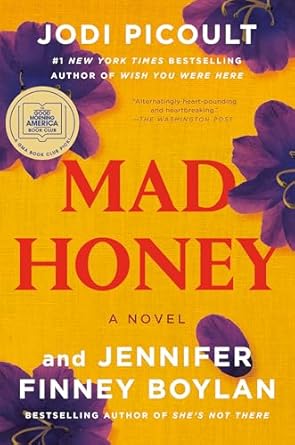
Review of MAD HONEY by Jodi Picoult and Jennifer Finney Boylan

 3 Stars

This novel has many of the hallmarks of a Jodi Picoult novel: more than one narrator, a focus on family, an exploration of contemporary social issues, and surprise twists and revelations. Unfortunately, as I’ve found with her other books, her desire to educate readers overshadows the need to entertain via a plausible plot.

Eighteen-year-old Asher Fields is charged with the murder of his girlfriend Lily Campanello. The trial reveals that both kept secrets and told lies so even Olivia, Asher’s mother, starts to doubt her son’s innocence.

There are two narrators who appear in alternating chapters. One narrator is Olivia; she narrates in the present tense, moving forward from the day of Lily’s death. The other narrator is Lily; she also narrates in the present tense but her chapters move backwards from the day of her death. Lily’s sections, a type of internal monologue, bothered me. She has a closely guarded secret, but she never reveals what it is – even to herself? Is it necessary to have the first 200 pages, half of the book, hide the main topic? Also, the reverse time of Lily’s chapters means that she vaguely refers to something that happened earlier and then in her next chapter will actually describe what happened; this narrative approach means that there is a lot of repetition. By the time we reach the end of the novel, we already know her story because of what Olivia relates about the trial, so Lily has little new information to add.

There are issues with the courtroom scenes. Olivia details the testimony of others and then testifies herself. Perhaps I’m wrong, but my understanding is that witnesses are usually not allowed to hear other witnesses' testimony. Then the great reveal happens during the trial and comes as a total shock to everyone except Ava, Lily’s mother? If Ava believes the motive for her daughter’s murder is connected to Lily’s secret, wouldn’t she have told the prosecutor? Her statement that “’Is there a reason I had to?’” is unconvincing. Then the reason Lily dies has nothing to do with this secret, the novel’s raison d'être?

Once the main subject is finally introduced, the novel becomes didactic. I certainly understand the need to inform people and I agree with the author’s opinion, but there are information dumps that impede narrative flow. Though she has never mentioned it specifically for half the novel, Lily suddenly writes about nothing but the nature of her secret and goes on and on. At times the tone becomes didactic and so many topics are touched on: bullying, physical and psychological abuse, transphobia, homophobia, racism, and domestic violence. There’s an abortion, suicide attempts, and even police brutality. Is it necessary to have both a same sex couple and an interracial couple? It’s as if the authors feel they must mention every serious issue found in contemporary society.

Then there’s the information about bees and honey. I can see parallels between the experiences of the bees and those of the characters: a hive is virtually destroyed and a home no longer feels safe either. Olivia’s attempts to save a hive indicate her personality and parallel her attempts to save her son. And the reference to mad honey can’t be missed; certainly, more than one relationship in the book seems sweet but proves to be damaging. But I did find some of the information about honeybees to be superfluous and, again, it impedes narrative flow.

The ending of the trial is not a surprise and subsequent revelations confirm what I suspected. Much of the plot is a teenage love story so the development at the end can hardly be shocking. Unfortunately, there are unanswered questions at the end: at least two people never have to answer for their actions? Domestic violence and obstruction of justice go unpunished?

The book is entertaining, but there are weaknesses I found difficult to ignore.

Monday, March 24, 2025

Review of A LESSON IN DYING by Ann Cleeves (New Release)

 3 Stars

This is the first in the Inspector Stephen Ramsay series, written before the Vera, Shetland, and Two Rivers series for which Cleeves is best known. This book was originally published in 1990 but is being re-released.

The events are set in Heppleburn, a pit village in Northumberland. Harold Medburn, the much-disliked headmaster of the local school, is murdered on Hallowe’en night. Many people disliked him so there are several suspects with possible motives but Medburn’s wife Kitty is soon arrested. However, Jack Robson, a retired miner and the school caretaker, is determined to prove her innocence. He enlists the help of his daughter Patty; the two uncover several instances of adultery and blackmail and eventually the identity of the murderer, though not before other deaths occur.

In a note to the reader at the beginning of the book, the author states that Ramsay “is on the periphery” and this is certainly the case. At the end, he still feels vague. There is some information about his personal life – his wife left him. Otherwise he is described as “the aloof, rather arrogant policeman” whose colleagues think “he’d lost his sense of proportion” because for him “there was little more to life than work.” He acknowledges that he is not sociable and “had never been particularly liked.”

The one trait expected of a detective is intelligence, but Ramsay doesn’t strike me as particularly intelligent. His investigative skills are not impressive; he carries out a less than comprehensive investigation and jumps to conclusions. Twice he is convinced he has identified the killer and twice proves to be wrong. It is Jack and Patty who really do the legwork and uncover the truth. As the investigation proceeds, Ramsay admits to “making up his own rules” and uses both Jack and Patty to estions for him. This appproah is not only unconventional but can also be viewed as unprofessional.

Patty’s reaction to Ramsay is interesting though perplexing: “From the beginning she had been attracted to him” and though she feels he is manipulating her, she agrees to do whatever he asks. She follows him around like a puppy dog and seeks opportunities to spend time with him, so much so that her husband is jealous. At one point Ramsay dismisses Jack as “an infatuated old fool” but I think Patty is as infatuated with the good-looking police detective. Cleeves mentions that Ramsay’s “character develops more in subsequent novels” so perhaps Patty’s positive feelings towards him will become more understandable.

In comparison to Cleeves’ other series, this one pales. Her storytelling has definitely improved with her later novels. For instance, there are unanswered questions. A woman married a man because she wanted privacy? A suicide occurs, but an explanation for the motive behind that choice is given as a fear of being released? Why?

This book will appeal to readers who enjoy a slow-paced novel. There are six books in the series so I may check out one more to see if Ramsay has a chance of becoming a detective like Vera Stanhope, Jimmy Perez or Matthew Venn, all of whose company I’ve come to enjoy.

Note: I received an eARC from the publisher via NetGalley.

Friday, March 21, 2025

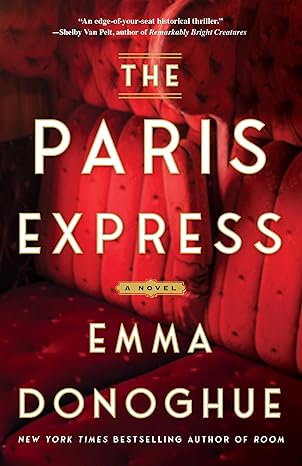
Review of THE PARIS EXPRESS by Emma Donoghue (New Release)

 4 Stars

The events in this novel take place in a single day (October 22, 1895) on an express train from Granville on the Normandy coast to the Montparnasse station in Paris.

The author populates the train with actual people who were part of the crew or on the passenger list, real people who could plausibly have been on the train, and fictional characters. The passengers include people from various classes of society: government officials, a priest, a female scientist, a cabaret performer, an Irish playwright, a black American artist, a Russian immigrant, a coffee seller, a pregnant woman, a young boy travelling alone, a young anarchist, a fisherwoman, etc.

The novel begins at a leisurely pace as the various crew members and passengers are introduced, but then we learn that a young woman named Mado Pelletier, an anarchist, has fatal plans for the train. As the journey progresses, because the engineer tries to make up time to keep the train on schedule, the train’s speed towards disaster increases and tension builds. Will Mado change her mind when she considers the collateral death of innocent people? Will a fellow passenger who guesses Mado’s intention be able to stop her? The writer effectively adds suspense by shortening the scenes devoted to characters: at the beginning several pages focus on each person but as the train gains momentum, the scenes become shorter and shorter and there are constant shifts among characters, thereby adding to the impression of speed and impending doom.

And then there’s the ending. Yes, a disaster does occur, though there is a twist. I knew nothing about the historical event and I would advise readers to go in blind. At the end of the book, there is a lengthy explanation about the train and the fate of her crew and passengers. Knowing beforehand what actually happened would, I think, lessen the novel’s impact.

The book provides a snapshot of the times. Political and social conditions and technological advances are described. For instance, classism, racism, and misogyny are evident. And references are made to typewriters, automobiles, the development of films, and the building of a subway.

The book also provides a snapshot of the intimate lives of people. There is a large cast of characters, but I found it not too difficult to differentiate among them. Everyone has a pre-occupation or secret or regret or hope unique to him/her.

The plot could be summarized as a train journey, but there are mini-plots. For example, there’s a sexual encounter, a possible romance, Mado’s internal conflict, friction between a boss and his ambitious female secretary, and a quarrel over a young woman’s health.

I found I learned a great deal from reading this book. Donoghue clearly did considerable research. I also appreciate when a book adds to my vocabulary: glacis, dynamitard, bourdalou, demimondaine, and dandling are words with which I was not familiar.

When travelling, I like to imagine the intimate lives of my fellow travellers, and this book is a writer’s imaginative creation of the interior lives of travellers, albeit those on a specific historical train journey. I enjoyed the novel and definitely recommend it, though some readers might find the sheer number of characters daunting.

Note: I received an eARC from the publisher via NetGalley.