Ranked a Top Canadian Book Blog
Twitter: @DCYakabuski
Facebook: Doreen Yakabuski
Instagram: doreenyakabuski
Threads: doreenyakabuski
Substack: @doreenyakabuski
Bluesky: @dcyakabuski.bsky.social

Tuesday, June 14, 2016

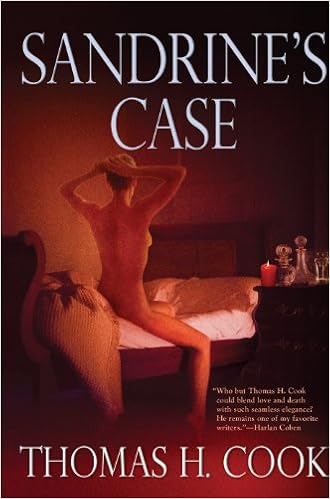
Review of SANDRINE'S CASE by Thomas H. Cook

4 Stars
This is my first Thomas H. Cook novel; it will not be my last since this is among the best mysteries I have ever read.

The narrator is Samuel Madison, an English literature professor, whose wife Sandrine dies from an overdose.  Sam is arrested on suspicion of murder and his trial forms the structure of the narrative.  As the trial proceeds and witnesses testify, Sam begins a journey of self-discovery as he relives his life, especially relationship with his wife.  “I’d come to feel that my thinking was growing deeper and more curiously seeded with poignant memories.  One thing was certain, thing that once mattered no longer did and in their vanishing they’d created more space in my mind.  It was strange that by radically confining my life, Sandrine’s death, along with its dire consequences, had in some way expanded my consideration of it.”

Sam’s flashbacks reveal the disintegration of his marriage.  We learn that “’the core reason [Sandrine’d] loved her husband [was] . . . His kindness. . . . His goodness.  His capacity to feel sympathy.’”  Lately, however, Sandrine had become increasingly withdrawn and angry and frustrated with Sam:  “she moved away from me, moved away from my trumpeted opinions, my sharpened sensibilities, my resentment of all that struck me as puerile.”   In fact, the evening of her death, she called him a sociopath.

The book is a psychological character study.  Sam emerges as not a particularly likeable character.  It is difficult to see the man with whom Sandrine fell in love, the young man who was “without bitterness, harboring no resentments, working on a novel . . . about ‘the tenderness of things’.”   When the novel opens, Sam is an arrogant intellectual snob.  He shows little emotion except contempt; he makes sarcastic, judgmental comments about the people of the town in which he lives and the students at the college where he teaches.  At different points he is described as “aloof” and “soulless” and incapable of sympathy.  Sam even admits that he seems to be missing something in his character, and this observation reminds us of a conversation he’d had with Sandrine in which she wondered if an essential element of character “’could be gotten back’” if it went missing. 

As a former teacher of English literature, I loved the many literary references in the book.  For instance, allusions to Robert Frost’s poetry are made:  Sam describes the college president as “young, with miles to go before he slept” and his own life as being numbed because of “the road not taken”.  Sam’s thoughts and speech are full of literary references appropriate to a pedantic English professor. 

Interest never lags.  There is the mystery:  Did Sandrine commit suicide or did Sam kill her?  There is also the interest in learning how/why Sam changed so much.  The reader’s emotions are engaged as his/her feelings for Sam change:  just as some sympathy is felt for him, some ugly thought or action of his is revealed. 

I highly recommend this book to people who enjoy mysteries but who want more than just suspense.  The flyleaf describes the novel as a “literary mystery” and it is indeed that – in every sense of the word.

Monday, June 13, 2016

Book-to-Television Adaptations

My husband and I have been watching Outlander, the British-American television drama series based on the historical series of novels by Diana Gabaldon.  That got me to thinking about other tv adaptations of books, and I came across this list of 15 compiled by publicbooks.org: 

For a British perspective, see the list of 22 book-to-television adaptations ranked by the British newspaper The Telegraphhttp://www.telegraph.co.uk/culture/tvandradio/11359903/greatest-TV-adaptations.html?frame=3171662.

Why not read a book and then check out its television version?

Sunday, June 12, 2016

Stephen Leacock Medal for Humour Winner

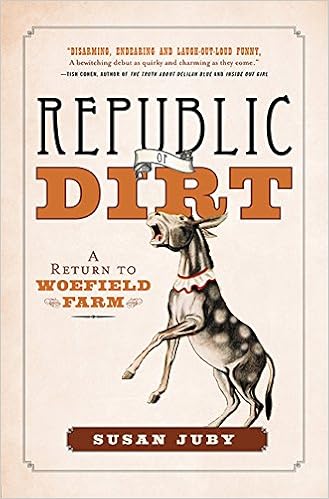
Last night, it was announced that Susan Juby is the winner of the 2016 Stephen Leacock Medal for Humour for her book Republic of Dirt: A Return to Woefield Farm.

Prudence Burns is an overly idealistic Brooklyn girl who has inherited a derelict plot of land named Woefield Farm. Her motley crew of farm hands consists of Earl, an elderly, reclusive bluegrass legend; Seth, an agoraphobic heavy-metal blogger in early recovery from alcoholism; and Sara, an 11-year-old girl with a flock of elite show poultry.  When Prudence is felled by a thyroid condition, things on the farm begin to fall apart, resulting in valiant and sometimes ill-advised attempts to restore domestic bliss. Efforts are complicated by a renegade mule, attempts to turn a hideously ugly child’s playhouse into a high-yield roadside farm stand, and an electrical station’s worth of crossed wires. Will Prudence get well? Will Seth finally get rid of his pesky virginity? Will Earl rescue Sara? And will anyone, ever, admit they might be wrong? (https://www.amazon.ca/Republic-Dirt-Susan-Juby/dp/1443423955/ref=sr_1_1?ie=UTF8&qid=1462561244&sr=8-1&keywords=republic+of+dirt).

This annual literary award, one of the oldest literary prizes in Canada, is presented for the best book of humour written in English by a Canadian writer. The medal is a tribute to well-known Canadian humourist Stephen Leacock (1869–1944) and is accompanied by a cash prize of $15,000(CAD).

Saturday, June 11, 2016

Read a Short Story by an Emerging Canadian Writer

Earlier this week, the winner of the RBC Bronwen Wallace Award for Emerging Writers was announced: Brendan Bowles for his short story entitled “Wyatt Thurst”.

This annual award, alternating between poetry and short fiction,  is given to a writer below the age of 35 who has published in literary magazines, journals, or anthologies, but has not yet been published in book form.

For more information about the winner and the other finalists, go to http://www.writerstrust.com/Awards/RBC-Bronwen-Wallace-Award-for-Emerging-Writers.aspx.

The winning story can be downloaded for free at iTunes.com/BronwenWallace.

Friday, June 10, 2016

Review of ORPHAN TRAIN by Christina Baker Kline

3 Stars
Molly, a troubled teen, meets a 91-year-old wealthy widow, Vivian Daly.  Though seemingly very different, it turns out that Molly and Vivian (as a young girl) lead almost parallel lives:  semi-orphaned, they are shuttled from one foster home to another; both belong to marginalized groups; both lose almost everything important in their lives except for a totem piece of jewelry; both are “broken inside”; a book about an orphan is a favourite for each girl.

I enjoyed the historical aspect of the book.  I had not known about the orphan trains which brought orphaned, homeless and destitute children, mostly immigrants, to American Midwest families.  This child migration scheme reminded me of the British Home Children who were sent to Canada and other settler countries

Unfortunately, there are other aspects of the book which I enjoyed less.  The plotting is formulaic.  Niamh’s experiences with the foster families are predictable as are events like her reunion with a fellow orphan.  The ending is very rushed; so much happens so easily and quickly.  It’s just too neat and feels contrived.  Readers who want a happy, feel-good ending will find just that.

There are weaknesses in characterization.  Vivian, a nonagenarian, picks up computer skills so easily!  An orphan, who wants a family more than anything and who never throws anything away, gives up a child for adoption?   There are several stereotypes, the most obvious being Molly’s most recent foster mother, Dina.  She is the epitome of the evil stepmother with no redeeming qualities. 

The epiphanies that Vivian and Molly experience are identical?  They would even use the same words to describe how their personalities were formed by their experiences?   For instance, Vivian says, “I know too much; I have seen people at their worst, at their most desperate and selfish, and this knowledge makes me wary.  So I am learning to pretend, to smile and nod, to display empathy I do not feel.  I am learning to pass, to look like everyone else, even though I feel broken inside.”  Molly says, “More often than not, you see the worst of people.  You learn that most adults lie.  That most people only look out for themselves.  . . . You know too much, and this knowledge makes you wary.  You grow fearful and mistrustful.  The expression of emotion does not come naturally, so you learn to fake it.  To pretend.  To display an empathy you don’t actually feel.  And so it is that you learn how to pass, if you’re lucky, to look like everyone else, even though you’re broken inside.”

This book has received rave reviews from some people and negative reviews from others.  I am tending to agree with the latter more than the former.  The book is an easy read with simple symbolism and a simple message, characteristics often found in young adult fiction.  That is the group to which I would recommend this novel.  Anyone looking for literary fiction with more depth should look elsewhere.

Thursday, June 9, 2016

Dublin Literary Award Winner

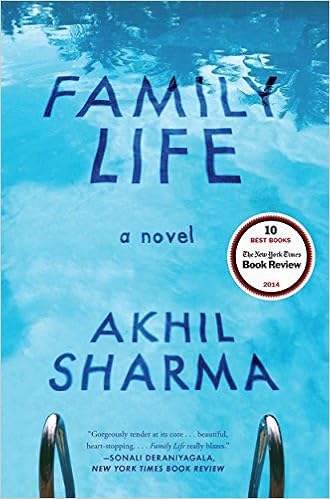
Today the winner of the Dublin Literary Award was announced:  Akhil Sharma for Family Life

We meet the Mishra family in Delhi in 1978, where eight-year-old Ajay and his older brother Birju play cricket in the streets, waiting for the day when their plane tickets will arrive and they and their mother can fly across the world and join their father in America. America to the Mishras is, indeed, everything they could have imagined and more: when automatic glass doors open before them, they feel that surely they must have been mistaken for somebody important. Pressing an elevator button and the elevator closing its doors and rising, they have a feeling of power at the fact that the elevator is obeying them. Life is extraordinary until tragedy strikes, leaving one brother severely brain-damaged and the other lost and virtually orphaned in a strange land. Ajay, the family’s younger son, prays to a God he envisions as Superman, longing to find his place amid the ruins of his family’s new life. Heart-wrenching and darkly funny, Family Life is a universal story of a boy torn between duty and his own survival (https://www.amazon.ca/Family-Life-Novel-Akhil-Sharma-ebook/dp/B00FQUDT66/ref=sr_1_1?ie=UTF8&qid=1465524496&sr=8-1&keywords=family+life).

The Award, presented annually for a novel written in English or translated into English, aims to promote excellence in world literature.  Nominations are submitted by library systems in major cities throughout the world; to be eligible for the 2016 prize, books must be of high literary merit and must have been first published in English or in English translation in 2014. At €100,000, this is the world’s most valuable annual literary prize.

The longlist of 160 books was released on November 13; there were 10 Canadian novels on that list:  http://schatjesshelves.blogspot.ca/2015/11/2016-international-dublin-literary.html.

Wednesday, June 8, 2016

Baileys Women's Prize for Fiction Winner Announced

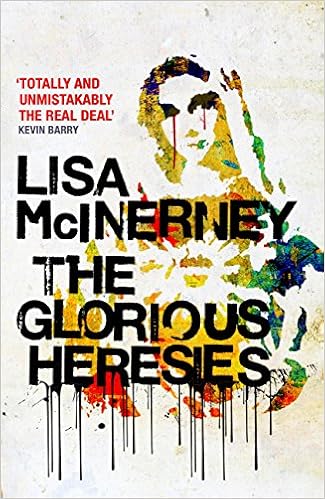
Today the winner of the Baileys Prize for Fiction was announced:  Lisa McInerney for The Glorious Heresies.

One messy murder affects the lives of five misfits who exist on the fringes of Ireland's post-crash society. Ryan is a fifteen-year-old drug dealer desperate not to turn out like his alcoholic father Tony, whose obsession with his unhinged next-door neighbour threatens to ruin him and his family. Georgie is a prostitute whose willingness to feign a religious conversion has dangerous repercussions, while Maureen, the accidental murderer, has returned to Cork after forty years in exile to discover that Jimmy, the son she was forced to give up years before, has grown into the most fearsome gangster in the city. In seeking atonement for the murder and a multitude of other perceived sins, Maureen threatens to destroy everything her son has worked so hard for, while her actions risk bringing the intertwined lives of the Irish underworld into the spotlight.  (https://www.amazon.ca/Glorious-Heresies-Longlisted-Baileys-Fiction-ebook/dp/B00NLJKMX2/ref=sr_1_1?s=books&ie=UTF8&qid=1460401419&sr=1-1&keywords=the+glorious+heresies).

The prize was established to recognize the literary achievement of female writers.  One of the United Kingdom's most prestigious literary prizes, it is awarded annually to a female author of any nationality for the best original full-length novel written in English and published in the United Kingdom in the preceding year.