Ranked a Top Canadian Book Blog
Twitter: @DCYakabuski
Facebook: Doreen Yakabuski
Instagram: doreenyakabuski
Threads: doreenyakabuski
Substack: @doreenyakabuski
Bluesky: @dcyakabuski.bsky.social

Tuesday, October 10, 2017

Best and Worst Sex Scenes in Literature

The Telegraph newspaper has compiled lists of the best and worst literary scenes.

The Best list of 14 titles includes books by D. H. Lawrence (no surprise) and also Margaret Atwood’s The Robber Bride, Arundhati Roy’s The God of Small Things and Ian McEwan’s Atonement.  See the complete list and read the relevant scenes at http://www.telegraph.co.uk/books/what-to-read/erotic-literature-best-sex-scenes-novels/.

The newspaper’s list of worst sex scenes has 13 titles.  These books are much less known; the only one I have read is Ed King by David Guterson.  The full list and excerpts can be read at http://www.telegraph.co.uk/books/what-to-read/top-10-worst-sex-scenes-in-modern-literature/.

Later this fall, look for the nominees for the Literary Review’s Bad Sex in Fiction Award.  This year will be the award’s 25th anniversary.  The award honours “an author who has produced an outstandingly bad scene of sexual description in an otherwise good novel. The purpose of the prize is to draw attention to poorly written, perfunctory or redundant passages of sexual description in modern fiction.”  Go to https://literaryreview.co.uk/bad-sex-in-fiction-award for information about previous winners. 

Monday, October 9, 2017

A Booklover's Thanksgiving

I've posted this on previous Thanksgivings, but I think it deserves being repeated.

Today is Thanksgiving Day in Canada.  Especially as a Canadian, I have so much for which to be thankful, but since this is a book blog, I thought I’d focus on what I as a booklover have to be grateful for. 
I am grateful for books which provide me with so much pleasure.
I am grateful for authors who, using their imaginations and talent, write those books.
I am grateful for the trees which provide the paper on which books are printed.  (Although I read ebooks and listen to audiobooks too, print books are still my favourite.)
I am grateful for all the people who work in the physical production of paper and books (e.g. forestry workers, pulp and paper mill workers, binders, printers).
I am grateful for publishers, especially those who take chances with new authors.
I am grateful for editors and copy-editors who ensure that an author’s work is the best it can be.
I am grateful for translators whose work allows me to read literature written in many different languages.
I am grateful for booksellers, especially the small, independent booksellers who persevere despite all odds.
I am grateful for my teachers:  my elementary school teachers (especially Zita Bloski) who taught me to read; my high school teachers (especially Sylvia Post) who challenged me to read widely; and my university professors (especially Professor Jean Moreau) who expanded my understanding of literature.
I am grateful for libraries which provide everyone with free access to books, those politicians who support them, and the librarians who staff them and are always willing to make book recommendations.
I am grateful for reviewers, both professional and amateur, whose comments often guide me to books.
I am grateful to the media that feature book-related articles giving me better understanding of books and authors and making me aware of books I might not otherwise have encountered.
I am grateful for friends who lend books and discuss them.  Among those friends are book club members, especially those in THE Timmins Book Club, the 80+-year-old book club of which I was privileged to be a member when I lived in Timmins.
I am grateful for time to read books.
I am grateful for my husband who gave me the library of my dreams.

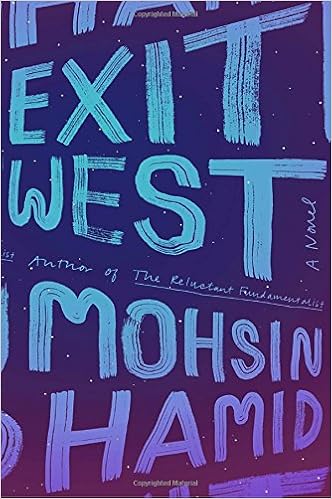
Review of EXIT WEST by Mohsin Hamid

3.5 Stars
Saeed and Nadia are young people embarking on a romantic relationship as civil war breaks out in their unnamed country.  When their lives in a war zone become untenable, they decide to flee through magical doors that serve as portals to other countries.  They end up in a migrant camp in Greece and then travel further to the West.  As they deal with exile, their relationship changes.   

The country of their origin is never specifically named because the author wanted to emphasize that Saeed and Nadia’s situation is almost universal; the focus of the book is on the dilemma of refugees world-wide.  There is also no description of harrowing or life-and-death journeys; the writer was not interested in portraying the physical hardships endured by migrants but wanted to focus on the psychological impact of migration.

Hamid certainly wants to draw attention to the various reasons for mass migration:  “All over the world people were slipping away from where they had been, from once fertile plains cracking with dryness, from seaside villages gasping beneath tidal surges, from overcrowded cities and murderous battlefields . . . ”  He also wants to emphasize what it really  means to leave one’s life behind:  “when we migrate, we murder from our lives those we leave behind.”  And there are no promises for refugees:  will they be met with acceptance or will they feel “unmoored, adrift in a world where one could go anywhere but still find nothing”? 

Hamid wants to emphasize that we are all migrants; an old woman who has lived in one house her entire life realizes that her neighbourhood has changed:  “every year someone was moving out and someone was moving in . . . and all sorts of strange people were around, people who looked more at home than she was, . . . more at home  maybe because they were younger, and when she went out it seemed to her that she too had migrated, that everyone migrates, even if we stay in the same houses our whole lives, because we can’t help it.  We are all migrants through time.”

In fact, Hamid wants to draw attention to what all people have in common:  “loss unites humanity, unites every human being, the temporary nature of our being-ness, and our shared sorrow, the heartache we each carry and yet too often refuse to acknowledge in one another.”  The glimpses into other lives interspersed throughout the narrative serve to show similarities in our experiences:  everyone wants sanctuary and acceptance.  Perhaps, instead of “building walls and fences and strengthening their borders,” and wishing “people would go back to where they came from,” it would be better to live in a world without borders. 

Change is one constant throughout the book.  Saeed and Nadia change locations several times; the dynamics of their relationship keep shifting; periodically, the narrative moves away from the main story to brief vignettes involving other people in other parts of the world; and the book could even be labelled as genre-shifting.  The point is that everything is transient:  “that is the way of things, with cities as with life, for one moment we are pottering about our errands as usual and the next we are dying, and our eternally impending ending does not put a stop to our transient beginnings and middles until the instant when it does.”

Characterization is used to challenge our pre-conceptions.  Saeed, the male, is quiet and pious while Nadia, the female, is independent and sexually assertive.  Though Nadia is not religious, rides a motor bike, and uses drugs, she wears a black robe associated with conservatives.   Saeed prays regularly but he prays “fundamentally as a gesture of love” and because prayer allows him “to believe in humanity’s potential for building a better world.”  Hamid wants to shake up gender and religious stereotypes. 

I cannot say that I always enjoyed reading the book.  I disliked the paucity of dialogue and the distancing third person omniscient point of view.  Nonetheless, it is a very timely novel which explores the impact of migration.  It asks the reader to consider thoughtfully the plight of refugees regardless of where they came from and where they find themselves. 

Sunday, October 8, 2017

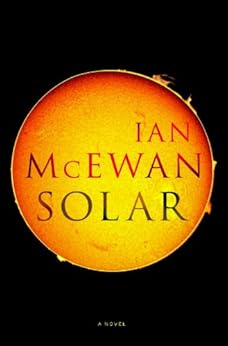
Archival Review of SOLAR by Ian McEwan

Yesterday, I blogged about climate change fiction.  One of the titles that inevitably appears on lists of cli-fi is Solar by Ian McEwan, a satire about a jaded Nobel-winning physicist whose dysfunctional personal life and cynical ambition see him pursuing a solar-energy-based solution for climate change.  I read the book back in 2010; here is my review.

Review of Solar by Ian McEwan
3 Stars 
The protagonist is Michael Beard, a Noble Laureate physicist, who at 53 is coasting on his laurels.  He hasn’t done any cutting-edge thinking since his youthful breakthrough in quantum physics. 

He is a serial philanderer so it is not surprising that his fifth marriage is breaking up as the novel opens.  Then he pilfers ideas from a young scientist (also his wife’s lover who dies accidentally) and becomes a proponent of technology which will tap solar energy through artificial photosynthesis.

Michael is a totally unlikeable character:  he’s a slob, glutton, adulterer, alcoholic egomaniac.  He lacks any humility or self-reproach.  He’s an opportunist who lives only for the present with little regard for consequences.  In his consumption of food, women and drink, he becomes a symbol of humans who are devouring the planet’s resources. 

There are many comic episodes.  The book even won the Bollinger Everyman Wodehouse Prize, a British literary award for comic writing.   For example, Beard’s misadventures in the Arctic are very humourous, almost slapstick. 

The reader knows that events are inevitably sliding toward disaster as all parts of Michael’s life converge.  There is no doubt that Nemesis is approaching.  The problem is that the end comes too suddenly.

Saturday, October 7, 2017

Climate Change Literature

Donald Trump doesn’t believe in climate change.  On November 6, 2012, he tweeted, "The concept of global warming was created by and for the Chinese in order to make U.S. manufacturing non-competitive."  In June of this year, he announced that the United States would withdraw from the Paris climate agreement unless there are major changes made to the carbon emissions pact.

I think Trump is in the minority in his skepticism.  Certainly, fiction writers have tackled this subject for a number of years.  Climate fiction, popularly abbreviated as cli-fi, is literature that deals with climate change and global warming. Not necessarily speculative in nature, works of cli-fi may take place in the world as we know it or in the near future.

Although the term "cli-fi" came into use in the late 2000s to describe novels and movies that deal with man-made climate change, historically, there have been any number of literary works that dealt with climate change as a natural disaster. One example is Jules Verne's 1889 novel The Purchase of the North Pole, which imagines a climate change due to tilting of Earth's axis. In his posthumous Paris in the Twentieth Century, written in 1883 and set during the 1960s, the titular city experiences a sudden drop in temperature, which lasts for three years.  Wikipedia has a list of cli-fi titles (https://en.wikipedia.org/wiki/Climate_change_in_popular_culture#Literature) as does Goodreads (https://www.goodreads.com/shelf/show/climate-change).  

 Last month, The New York Times highlighted some climate-themed fiction: https://www.nytimes.com/interactive/2017/09/26/climate/climate-books-fiction-scifi-novels.htmlEarlier in the year, The Guardian focused on five climate change novels: https://www.theguardian.com/books/booksblog/2017/jan/19/five-of-the-best-climate-change-novels-cormac-mccarthy-margaret-atwood. And on Earth Day, The Verge outlined eight works of fiction that explore climate science and what the future could hold: https://www.theverge.com/2017/4/22/15386776/earth-day-best-sci-fi-books-bacigalupi-atwood-ballard.

A novel that stands out in my mind is Barbara Kingsolver’s Flight Behaviour.  When this novel’s protagonist, Dellarobia, witnesses a striking vision of orange in the mountains, like fire with no smoke, she is convinced it is a sign from God. The vision makes her a quasi-celebrity, drawing journalists, religious leaders and a climate scientist into her small town. The various reactions and interpretations of the phenomenon — later discovered to be a colony of Monarch butterflies displaced by a flood in their usual home in Mexico — reflect contemporary conversations on climate change and open up Dellarobia’s world.  See my review at https://schatjesshelves.blogspot.ca/2015/12/book-advent-calendar-day-11-flight.html. 

Friday, October 6, 2017

Fun with Book Titles

It’s time to have some fun with book titles.

First, try this quiz which has one word missing in the title:  http://mentalfloss.com/article/67035/name-missing-word-each-book-title.  How many of the books can you correctly identify?

Then, take a look at two Twitter sites.  Check out #RuinaBookinOneLetter and #RuinaBookTitleinOneLetter to see how book titles can be changed with hilarious results by changing only one letter.  The suggestions with photos are the best.

Thursday, October 5, 2017

2017 Nobel Prize for Literature

The English author Kazuo Ishiguro has been named winner of the 2017 Nobel prize in literature, praised by the Swedish Academy for his “novels of great emotional force”, which it said had “uncovered the abyss beneath our illusory sense of connection with the world”.

I believe he has written 7 novels:
A Pale View of Hills
An Artist of the Floating World
The Remains of the Day
The Unconsoled
When We Were Orphans
Never Let Me Go
The Buried Giant 
The one for which he is probably best known is The Remains of the Day for which he won the 1989 Booker Prize.

The Guardian has a good article about the win:   https://www.theguardian.com/books/2017/oct/05/kazuo-ishiguro-wins-the-nobel-prize-in-literature

To celebrate Ishiguro’s win, Book Marks looked through the archives for some of the first reviews for every one of his novels:  http://lithub.com/the-first-reviews-of-every-ishiguro-novel/.