Ranked a Top Canadian Book Blog
Twitter: @DCYakabuski
Facebook: Doreen Yakabuski
Instagram: doreenyakabuski
Threads: doreenyakabuski
Substack: @doreenyakabuski
Bluesky: @dcyakabuski.bsky.social

Friday, November 10, 2017

Book Photography

I love books.   I even love photographs of books.  I own a copy of A Book about Books with photographs by Abelardo Morell.  It has 52 black-and-white photographs of unusual books.  For once, I agree with a book jacket blurb:  “A visual tribute to the printed word, this sumptuous ode to books will be irresistible to anyone who treasures the touch of fine paper.”

Now there’s another book I’d like to add to my collection:  Expired by Kerry Mansfield.  According to Hyperallergic, this book from the San Francisco-based photographer features over 70 images of discarded library books, each posed against a black background for a post-withdrawal portrait.

“’Each picture serves as an homage calling out palpable echoes etched into the pages by a margin-scrawled note, a yellowed coffee splatter or sticky peanut butter and jelly fingerprints,’ writes Mansfield in a book essay. ‘It’s easy to feel a sense of abuse and loss, but they say much more. They show the evidence of everyone that has touched them, because they were well read, and often well-loved. They were not left on shelves, untouched.’
“The dog-eared pages of To Kill a Mockingbird, a copy of Lad: A Dog that has a chunk missing from its cover (perhaps taken by canine teeth?), crayon scribbles on The Velveteen Rabbit, the broken spine of Treasure Island, and The Hunchback of Notre-Dame braced by tape, all recall the shared experience of library literature. Mansfield’s photographs give these imperfections a quiet dignity” (https://hyperallergic.com/403659/loved-to-death-a-photographers-tribute-to-discarded-library-books/).   

The Hyperallergic article has some photographs; the book itself can be purchased from the photographer:  http://www.kerrymansfield.com/expiredthebook/.   Apparently, she plans to do a second volume as well. 

Thursday, November 9, 2017

280-Character Microfiction

Twitter’s defining attribute has long been its brevity: 140 characters in a post and no more.  Now Twitter has doubled its tweet length limit to 280 characters.  In honour of this change, Electric Literature ran a 280-character story contest with the proviso that ““the story must be about something getting magically, randomly, inexplicably, or mysteriously bigger, longer, or just… more.”

The top five submissions have been chosen and illustrated by a cartoonist.  See the winners at https://electricliterature.com/behold-the-winners-of-the-280-character-story-contest-17532fb1ab9e. 

Tuesday, November 7, 2017

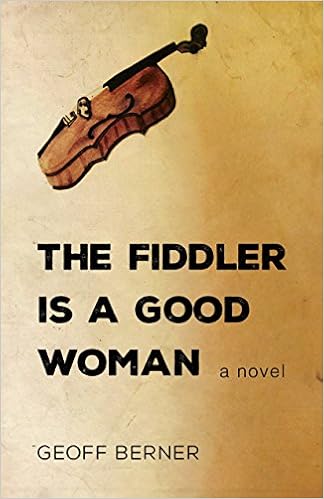
Review of THE FIDDLER IS A GOOD WOMAN by Geoff Berner (New Release)

3 Stars
DD is an elusive Canadian folk musician who has disappeared.  The author, in an attempt to find her, interviews people who knew her, mostly fellow musicians, and asks them to divulge their most important memories of DD.  What emerges is a character portrait.

Every one of the narrators seems to have been mesmerized by DD.  There are some conflicting accounts but it seems clear that DD is a troubled woman who has been wounded by life.  Though she is predictable and unreliable, these flaws seem not to matter.  Everyone seems mesmerized by her prodigious talent and her charisma; both men and women find her sexually irresistible even though she is serially unfaithful. 

Of course, the narrators also reveal themselves as they present their versions of DD.  Some of her bandmates are jealous of her musical gift and resent how she attracts others to her.  Everyone seems to want something from her, use of her body or talent being foremost.  Several people have a love/hate relationship with the quirky fiddler.  One lover admits, “There was something about her that . . . I couldn’t figure out . . . I was trying to get DD somehow,” but really no one person has a complete understanding of her. 

There is nothing like a traditional plot structure.  The narrative shifts among narrators and moves back and forth in time.  There are many narrators so it is sometimes difficult to keep track of who is who.  I kept wishing there were a list of all the speakers and their relationship to DD; I almost resorted to making notes to help me remember the salient points about each narrator.

What is missing is tension.  At the beginning, confusion is dominant; later, interest grows but there is no great suspense.  The reader knows from the beginning that DD will not be found; in the introductory note, Berner admits, “I failed to find DD.”  Anyone who needs suspense to motivate his/her reading will not enjoy this book.

Even though the book is a novel, a work of fiction, the author does succeed at making the reader think of DD as a real person.  That is a commendable literary accomplishment.  The insights into the Canadian music scene are intriguing; it is obvious that Berner writes from first-hand experience.  DD is an Indigenous woman so I found the references to missing Indigenous women appropriate:  DD’s disappearance is dismissed because she is “a woman, a musician, and of Indigenous heritage.  Those kinds of people disappear all the time, after all.” DD’s admonition to a friend, “’Just promise me you won’t hitchhike around here,’” refers, I think, to the Highway of Tears.

This is not a book I would recommend to everyone.  The subject matter with its proliferation of drugs, sex and profane language will repel some readers; the non-traditional structure along with shifting time periods and multiple narrators will not appeal to others.  Anyone wanting a quirky read focusing on quirky characters will enjoy this novel.

Note:  I received an eARC of this book from the publisher via NetGalley.

Monday, November 6, 2017

2018 International Dublin Literary Award Longlist

The 2018 longlist for the International Dublin Literary Award has been announced:  150 novels from 40 countries in 18 languages.  At €100,000, the award is the world’s most valuable annual literary prize for a single work of fiction published in English.

There have been two Canadian winners of the Award to date.  Alistair MacLeod was awarded the prize in 2001 for his novel No Great Mischief, and Rawi Hage received the prize for De Niro’s Game in 2008.  This year there are 14 Canadian nominees, of which I have read only 5:

Rachel Cust - Transit
Dominique Fortier - The Island of Books
Michelle Butler Hallett - This Marlowe
Jen Sookfong Lee - The Conjoined
Catherine Leroux - The Party Wall 
Ashley Little - Niagara Motel
Lisa Moore - Flannery
Edward Riche - Today I Learned It Was You
Paul Rowe - The Last Half of the Year

Perhaps we can also claim Emma Donoghue (who was born in Ireland but is now a Canadian citizen living in Canada) who is nominated for The Wonder (http://schatjesshelves.blogspot.ca/2016/11/review-of-wonder-by-emma-donoghue.html).   And what about David Szalay (who was born in Canada though the UK has been his home for most of his life) who is nominated for All That Man Is?

Here are the other nominees which I have read:

The full list of 150 titles is available at http://www.dublinliteraryaward.ie/nominees/. The shortlist will be published in April 2018 and the winner will be announced on June 13, 2018.  I have only 131 books to read in about 7 months!

Sunday, November 5, 2017

Difficult Novels

When researching yesterday’s topic on novels that influenced other novels, I came across a BuzzFeed list of 25 challenging novels:  https://www.buzzfeed.com/louispeitzman/the-25-most-challenging-books-you-will-ever-read?utm_term=.qrqXw2nVJ6#.pnvMxPEb61.  What is interesting is that at least 8 of those titles appear on the list I mentioned yesterday of novels that changed subsequent novel writing:  https://www.barnesandnoble.com/blog/50-novels-changed-novels/

If you’re interested in a more extensive list, check out this list of 50 novels, “some absurdly long, some notoriously difficult, some with intense or upsetting subject matter but blindingly brilliant prose, some packed into formations that require extra effort or mind expansion, and some that fit into none of those categories, but are definitely for tough girls (or guys) only” (http://flavorwire.com/423424/50-incredibly-tough-books-for-extreme-readers) or this list of 200 titles:  http://www.listchallenges.com/goodreads-200-most-difficult-novels.

Saturday, November 4, 2017

Novels That Influenced Novel Writing

Yesterday, I wrote about plotless novels; that got me thinking about how certain, often experimental and plotless, novels have changed how subsequent novels were written.  On this topic, I found a relevant Barnes and Noble blog which lists 50 game-changing novels:  “The novel has been the dominant form of literature for centuries, evolving and changing in exciting, unexpected ways over the years. Just when you think we know what a novel can do, a book comes along that does something no one ever thought of before. Every now and then that innovation is so powerful, it changes the way subsequent novels are conceived” (https://www.barnesandnoble.com/blog/50-novels-changed-novels/).  I like that there is a brief explanation as to the influence of each book and that modern books, not just classics, are mentioned. 

The only author that has two books on that list is James Joyce; both Finnegans Wake and Ulysses are considered very influential.  Ulysses is probably more approachable than Finnegans Wake, but even it is not an easy book to read.  It contains 30,030 different words, and endless puns, allusions, and stylistic curiosities.  For that reason, I was interested in a TED-ED video entitled “Why Should You Read James Joyce’s Ulysses?” (https://www.facebook.com/TEDEducation/videos/1788814741131724/).

Friday, November 3, 2017

Plotless Novels

I am currently reading a book which could be described as plotless.  (See my review of it on Tuesday, November 7.)  Actually, I don’t think that any novel is really plotless; as long as there’s a character who performs actions, then there’s a plot.  Of course there are novels that are more character-driven than plot-driven and that’s really what I mean by plotless.

BookRiot recently published a list of six plotless novels:  https://bookriot.com/2017/10/28/praise-plotless-books/?utm_source=Sailthru&utm_medium=email&utm_campaign=The%20Riot%20Rundown&utm_term=BookRiot_TheRiotRundown_Sun.  It includes the first novel I ever read that could be called plotless:  The Life and Opinions of Tristram Shandy, Gentleman by Laurence Sterne. 

List Challenges has a list of 28 “Novels with No Plot Whatsoever”:  “These books not only have no story arc, but there is little character progression or change within the characters.  Instead, these books explore life through anecdotes, analysis, opinion, interjection, and a lack of concrete structure” (http://www.listchallenges.com/plotless-novels).