Ranked a Top Canadian Book Blog
Twitter: @DCYakabuski
Facebook: Doreen Yakabuski
Instagram: doreenyakabuski
Threads: doreenyakabuski
Substack: @doreenyakabuski
Bluesky: @dcyakabuski.bsky.social

Tuesday, April 3, 2018

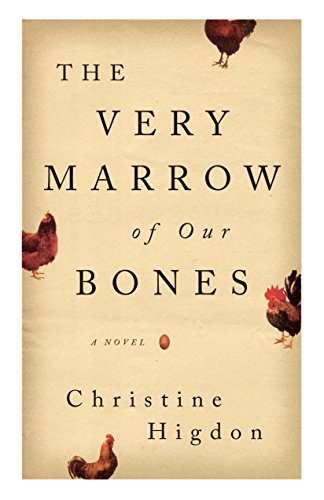
Review of THE VERY MARROW OF OUR BONES by Christine Higdon (New Release)

4 Stars 
On the same November day in 1967, two women disappear from Fraser Arm, B.C. One of them, Bette Parsons, leaves behind her husband Wally and their five children:  Geordie, Alan, Ambrose, Trevor, and Lulu.  Lulu, the youngest child and only daughter, discovers a note written by her mother but she tells no one about it.  Lacking her mother’s supervision, Lulu is befriended by Aloysius McFee, the husband of the other woman who disappeared.  At the age of 18, Lulu leaves her hometown and distances herself from her family.  Forty years after her mother’s disappearance, she learns that someone else in her family has kept a secret, one for which “some serious atoning” is required. 

This book has several memorable characters.  One is the eldest Parson child, Geordie, who is 20 when his mother disappears.  He has an intellectual disability but he knows what is most important in life.  His loving and cheerful nature inspires the reader to hope that Geordie’s optimism will be rewarded.  Another unforgettable character is Doris Tenpenny whose perspective, along with Lulu’s, is given throughout.  She is a mute who communicates only through written notes.  She closely observes the human and natural world around her and becomes a wise woman. 

The book is about secrets and their consequences; because of secrets, people are hurt “to the very marrow of our bones.”  In the novel’s opening, we learn one of Lulu’s secrets:  the content of a note from her mother.  Lulu mentions that until her mother left, “None of us knew about pain.  Not the kind that leaves you shattered and speechless.”  Though that is not her intention, Lulu’s keeping the note a secret just increases the pain.  And that is not the only secret she keeps throughout much of her life.  And she is not the only one who has secrets which impact the lives of many others.  Because people know Doris cannot easily tell others their secrets, they confide in her; she does indeed keep their secrets, but she also keeps one of her own which she realizes could have saved others from suffering.  The conclusion is that “Secrets weigh” and leave people with “too much baggage on the flight [through life].”  So much is lost because of secrets.  In one case, Lulu suspects a secret “ruined” a person:  “In the end, I thought, it had killed him.”

The reader will not leave the book unscathed.  At times I was incredibly angry at people’s behaviour and choices though I could also empathize because their choices were made for very understandable reasons; people who are hurt or angry or ashamed or truly desperate do not always make the best decisions.   (There is only one character whose behaviour I could not excuse, though that individual does perhaps try to atone in the end.)  As expected, sections of the novel are incredibly sad, though there are also comic scenes.  And some sections left me squirming in discomfort. 

Not all of the reader’s questions are answered by the end.  There are some things that one can only speculate about.  Though some may disagree, I think the ending is perfect, though it does leave room for a sequel.  At times, I wished the point of view of another character were given.  A companion novel giving the viewpoint of Wally or Aloysius would be interesting. 

Should the author choose to write a sequel or parallel novel, I would definitely read it.  On an emotional level, this one got into the very marrow of my bones. 

Note:  I received an eARC of this book from the publisher via NetGalley.

Sunday, April 1, 2018

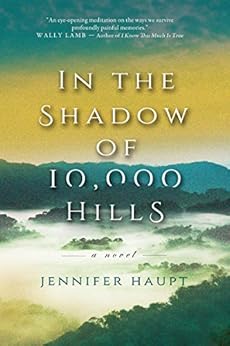
Review of IN THE SHADOW OF 10,000 HILLS by Jennifer Haupt (New Release)

3 Stars
Rachel Shepherd decides to try and find her father, Henry Shepherd, who abandoned her when she was eight years old.  Her quest brings her to Rwanda to meet Lillian, a woman who looks after orphans on her farm.  Lillian also had a long-term relationship with Henry, and Rachel hopes Lillian can answer her questions about Henry.  While in Rwanda, Rachel learns some things about her father but also learns about the Rwandan Genocide, especially as it affected Nadine, Lillian’s adopted daughter. 

Multiple points of view are given; those of Rachel and Lillian predominate but those of Nadine and Tucker, a doctor who lives on Lillian’s farm, and even Henry are also included at times.  Each of them is living with intense grief; all have, in some way, lost loved ones.  They are all trying to find amahoro, the Kinyarwanda word for “peace.”  To find this inner peace, they must learn to forgive; only by doing so can they find hope and learn to truly love.

It is Nadine’s story which is most compelling.  Though she survived the genocide, she cannot forget it.  Like all Rwandans, she must live next to those who participated in the killings and rapes.  Lillian mentions, “’Most of us don’t expect justice, not really. . . . The goal of the gacaca [trials] is reconciliation and forgiveness. . . . Not so much letting go [of the past] as finding a way to live with it.’”  Providing a personal, individual perspective on the genocide is the novel’s most noteworthy element. 

I cannot say that I really enjoyed the book.  There are many things about it that annoyed me.  First of all, Rachel is so self-centred and whiny at the beginning that it is difficult to connect with her.  She wants her husband to say “I don’t blame you” and she needs to know that her father loved her and she needs her husband to tell her he needs her.  Everything is about her!  Then her approach to finding her father makes no sense.  I understand that getting her to Rwanda is crucial for her transformation and for the novel’s thematic development, but if she can use the internet to find Lillian’s email address, why doesn’t she use it to try and locate her father?  Only much latter does she say, “I’ve been thinking, I’ll go look for him.’”  Lillian responds to Rachel’s first email by saying she wishes she could help Rachel.  Why, then, doesn’t she give the information she does have about Henry’s last whereabouts?   

There are other things that bothered me.  Caribou are North American reindeer but they are also found in Africa?  What’s the deal with the stolen laptop?  It is never mentioned again.  Why does Christian keep Rachel’s passport?  A man who was abandoned as a child would abandon his own child?  One moment Rachel “jackknifes the bike into the grassy ditch and jumps off” and the next minute she claims that someone “’drove right over it’”?  Rachel is Jewish (claiming “Her mother insisted that they attend services for the high holidays every year to ask for absolution for their sins and then start fresh again on Rosh Hashanah”), yet she “misses waking up early on Christmas morning, as excited as a kid”?  Rachel brings a snow globe with her to Africa and her father travels around the continent with “several jars of peanut butter”?   Henry goes to Africa because Lillian writes to him and because “The Life photo editor said he would be interested in seeing some follow-up shots of the girl [who] . . . devoted her life to caring for orphans in Africa,” but later he has “only a vague notion of finding Lillian and photographing her farm.” Yet even later, he decides “It’s time to go find Lillian’s farm, take the photos he came for.”  How can Rachel claim “Her father told her stories about Kwizera [Lillian’s farm]” when he had not yet been there and received only one letter from Lillian?  A student would be expelled from university for failing a midterm exam?  Rachel’s mother “didn’t want their daughter to be alone in the world, without a family” and asks Henry to come see Rachel but then tells him to leave almost as soon as he arrives?  I read an eARC so perhaps some of these problems will be rectified, but these types of discrepancies (and there are many others I didn’t mention) affected my enjoyment of and appreciation for the book.

Rachel’s development and the insight into the Rwandan Genocide make this book a worthwhile read.  However, it needs considerable editing and is unduly lengthy.  Parts of it are also predictable, the romance being a prime example.  

Note:  I received an eARC of this book from the publisher via NetGalley.

Thursday, March 29, 2018

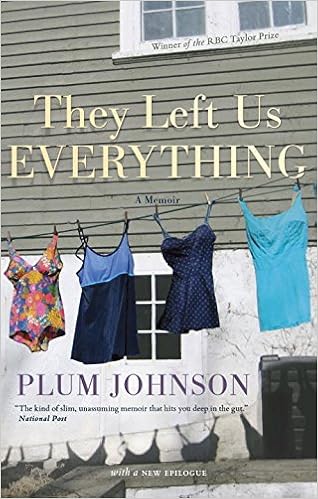
Review of THEY LEFT US EVERYTHING by Plum Johnson

3.5 Stars
In this memoir, Plum Johnson recounts how after the deaths of her parents, she spent 16 months sorting through their belongings and preparing the house for sale.  Her parents, Alex and Anne, had lived for over half a century in the sprawling, 23-room house in Oakville on the shores of Lake Ontario, so the amount of accumulation was massive. 

In that time in her childhood home, she not only decluttered the house.  She examined her difficult relationship with her mother whom she saw as “intrusive, demanding, and possessive” (252), a relationship that was exacerbated by years of elder care.  She realized she had to find what she missed, ignored or forgot about her mother.  After her mother’s death, people “didn’t describe the forceful mother I had been experiencing for the past twenty years – the one who invaded my privacy, demanded I call her every few hours, who seemed judgmental and disapproving of my choices – they described an Other Mother who was loving and wise, confident and charming, admirable and true.  They described a woman I wished I had known.  Or perhaps a mother I had pushed away.  A mother I just needed to remember – someone who had been there all along” (88).  In the end, Plum admits that “most of the clutter was in my head” (279).  And I love the irony of Plum saying about her daughter, “I can’t believe she doesn’t see herself the way I do” (213). 

Many books, both fiction and non-fiction, have been written about mother-daughter relationships, and I didn’t find that this one added anything new.   Of course, this means that readers will find much that is relatable in the book.  Plum Johnson wonders what all daughters have probably asked:  “Are all our unfulfilled dreams unconsciously passed down from mother to daughter for generations?” (217) and “Was I afraid to see that [my mother] looks like me?” (263).  With age, most daughters have more empathy:  “I’m experiencing some aches and pains myself, and I see now that old people are simply young people locked into aging bodies.  No wonder she was cranky” (263).  The author confirms what most people come to understand:  we don’t fully appreciate things and people until they’re gone. 

I did appreciate the discussion of Other Mothers, other women who can serve as mentors:  “we can all use more than one mother . . . It keeps us sane” (91).  It’s true that “It’s hard to accept guidance when you’re trying to break away” (91) so it’s easier to accept guidance from others with whom relationships are less fraught with emotions and so are less complicated.  I’ve treasured close friendships with older women who have, like Plum’s friend Pat, shared “hard-won insights” (93). 

Plum’s difficult relationship with her mother is understandable.  Anne was definitely a strong personality:  “a ‘life force’ who . . . always stole the show . . . it was more like Mum was the limelight . . . [that required] constant attention” (83-84).  It’s interesting that the author admits to replacing “the lens through which I view her” (263), and accepting that “’Mothers are always “The Nurturer” and “The Witch,” whether we like it or not . . . We have to accept both in the same package’” (264). 

In the Acknowledgments, Johnson states, “I just wish the last twenty years hadn’t been so thorny.  Because then I wouldn’t have felt the need to put [my mother] back up on a pedestal – which is where she sits now” (279 – 280).   It seems that she has done the same thing with her father.  Her mother may have been insensitive to her children’s feelings, but her father was overbearing and abusive.  She describes his behaviour towards her and her brothers but she seems to refuse to see it for what it is.  Though he was a man of a different time, his treatment of his wife also seems harsh.  And the author doesn’t examine the impact of her parents’ tumultuous relationship on her and her siblings.  (I found myself wanting to learn more about her parents’ fascinating histories and adventurous, book-worthy lives.)

The sibling relationships do not ring true.  The division of family assets is often a competitive exercise, yet these four siblings seemed to have no conflicts and remained unfailingly supportive of each other.  Perhaps the sympathetic portrayals were influenced by the fact that her brothers were alive when she wrote this memoir? 

Though not ground-breaking, the book will appeal to readers of a certain age, especially baby boomers caring for elderly parents and having to dispose of decades of accumulation.  And it did get me thinking about what I should do with my lifetime collection of journals:  “Earlier I’d resolved to clear out my own mess, too, so my children wouldn’t have to face it, but since then I’ve had a change of heart.  Now I believe this clearing out is a valuable process – best left to our children.  It’s the only way they’ll ever truly come to know us, discovering things we never wanted them to find” (219).

Monday, March 26, 2018

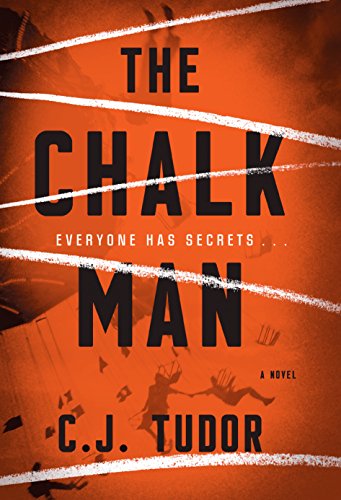
Review of THE CHALK MAN by C. J. Tudor

2.5 Stars
Once again, I seem to be in the minority because my review of a book will not be like the many, many glowing reviews it has received.  The Chalk Man is mediocre at best, just a diluted version of Stephen King’s novella, The Body. 

In The Body, a group of boys finds a dead body and one of them, now an adult, narrates a retrospective of what happened; chapters concerning the present are interspersed throughout.  One boy struggles with the death of a brother; one has older parents; one boy is abused by a father; one is overweight; and the brother of one of the boys is the leader of a gang of bullies.    

In The Chalk Man, twelve-year-old Eddie Adams and three of his friends (Metal Mickey, Fat Gav, and Hoppo) find a body.  Ed, thirty years later, narrates the story of what happened; that story alternates between chapters set in 1986 and those set in 2016. The friends are forced to re-examine the murder and other crimes that were committed around that time.  One boy changes after the death of his brother; Eddie has parents that “were older than other parents”; Nicky, also a member of the group, always has bruises and is never seen “without a brown or purple mark somewhere; Fat Gav is overweight; and Sean, the leader of an older group of bullies, is Metal Mickey’s brother.  And these are just some of the similarities; if I were still a high school English teacher, I might encourage a student to write an essay comparing the two books!

The Chalk Man is full of plot weaknesses.  There are so many coincidences; for example, the many connections among various characters are incredible.  In both the past and the present, characters appear and take up residence in the town at the most opportune time.  No one, not even an adult who should be well aware of medical confidentiality, thinks about the possible serious consequences of actions.  The climax is over-the-top and outlandish; it requires much too much suspension of disbelief.  And then there’s the last box that Ed takes with him at the end!  Despite the book’s warnings about “assuming”, any astute reader will know the contents of that box.  But is the reader really supposed to believe that Ed kept such a “treasure” and convinced himself he did it “To hold on to something.  To keep it safe”?!

The author tried to create suspense but did so in amateurish ways, using certain techniques over and over.  For instance, chapters often end with cliffhanger statements like “’I know who really killed her’” and “The worst had finally come” and “Chloe was gone.”  Ed often has nightmarish dreams (which he calls “lucid dreaming”) that are supposed to add to the creepiness factor; their repeated occurrence just becomes annoying.  Some scenes which are supposed to be horrific just don’t work.  The fight at a funeral ends up being unintentionally funny.  And didn’t Stephen King have exactly the same thing happen in Pet Sematary?

What also becomes tedious is the many clichés that Ed spouts as wisdom.  Are readers supposed to be amazed at the profundity of statements like “Often, what comes with age is not wisdom but intolerance” and “We’re all just pretending to be civilized, when, deep down, we’re not” and “We all make mistakes.  We all have good and bad in us” and “We ask questions that we hope will give us the truth we want to hear”? 

Like chalk drawings exposed to the elements, this book’s fame will not be long-lasting.  Read Stephen King’s The Body or watch Stand by Me, the film adaptation, instead.

Thursday, March 22, 2018

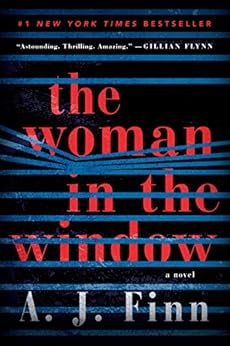
Review of THE WOMAN IN THE WINDOW by A. J. Finn

3 Stars
On July 30, 2017, I blogged about how the practice of adopting a female or gender-neutral nom de plume is prevalent in the psychological thriller genre (https://schatjesshelves.blogspot.ca/2017/07/male-writers-using-gender-neutral.html).  Apparently, there is market demand for psychological thrillers written mostly by women for female audiences and featuring a female narrator.  Some fans might doubt the authenticity of the female narrator’s voice when it is delivered by a male author, so male writers are adopting gender ambiguous pseudonyms in order to attract more female readers.  Hence, Daniel Mallory has become A. J. Finn, author of The Woman in the Window. This marketing ploy strikes me as manipulative, so I hesitated to read this book.  I wish I had resisted because it is very derivative and does not live up to its hype.

Anna Fox, 38, is a child psychologist who because of some initially unidentified traumatic event has become an agoraphobic.  She has not left her home for almost a year; she spends her time drinking and spying on her neighbours.  Virtually her only other activity is daily chats with Ed, her husband from whom she is separated, and her 8-year-old daughter Olivia who is with her father.  One day Anna witnesses the murder of a neighbour, but no one believes her since she is definitely not a reliable witness.  She herself begins to doubt the veracity of her recollections.  Did her mixture of potent prescription drugs and alcohol, aided by her obsession with classic thriller movies, cause her to hallucinate? 

The plot is just so familiar.  An unreliable narrator who believes she has seen a crime being committed is dismissed because of her drinking and erratic behaviour.  This certainly sounds like The Girl on the Train by Paula Hawkins.  Having recently read Eleanor Oliphant is Completely Fine by Gail Honeyman, I found several major parallels:  Eleanor Oliphant experienced an unidentified trauma which left her emotionally and physically scarred and she has reacted by self-medicating with alcohol and socially isolating herself, except from an absent family member with whom she regularly communicates by telephone.

There are virtually no surprises.  The clues to all mysteries are many and very obvious.  A reviewer in The Washington Post writes that the story “ends with a series of mind-boggling surprises” and that  the book is “a riveting thriller that will keep you guessing to the very last sentence” (https://www.washingtonpost.com/entertainment/books/next-years-gone-girl-perhaps-the-woman-in-the-window-lives-up-to-the-hype/2017/12/15/588b91ca-dec0-11e7-bbd0-9dfb2e37492a_story.html?utm_term=.42613aff4d44), but that reviewer has obviously not read many books of the psychological suspense genre.  Any perceptive reader will find the book very predictable.

The one positive element is the characterization of Anna.  Her sleeping and drinking indicate that she is severely depressed, and her thoughts and behaviour realistically portray those of a depressed person.  The problem, however, is that there is much that is unrealistic.  A psychiatrist visits her in her home and despite all the evidence of Anna’s excessive drinking and impaired judgement, prescribes increasingly potent medications?  The many allusions to black-and-white classic suspense films which emphasize the parallels between the plots and Alma’s circumstances will appeal to cinephiles but eventually just become annoying. 

The book’s short chapters make for a fast read, but anyone wanting an original, challenging sample of psychological suspense, should look elsewhere.    

Saturday, March 17, 2018

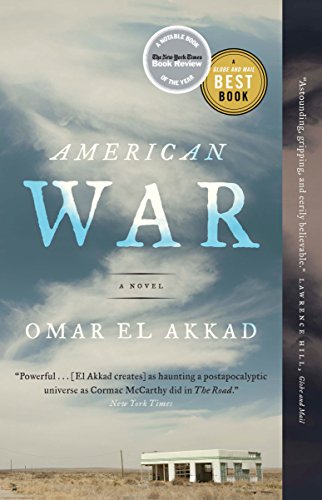
Review of AMERICAN WAR by Omar El Akkad

4 Stars
An elderly man with terminal cancer tells the story of his aunt, Sarat Chestnut, and her involvement in the Second American Civil War (2074 – 2095).  We see how she, a young girl with a relatively happy childhood, is radicalized and becomes a terrorist fighting Northerners after her family ends up in a camp for Southern refugees.  Interspersed with her narrative are primary sources (academic studies, government reports, military documents) that flesh out the background.

By the time the war begins, the United States has experienced an environmental catastrophe.  Because of global warming, the oceans have risen dramatically and forced people to move inland.  A man-made plague has quarantined South Carolina.  The civil war erupts because the government has passed a Sustainable Futures Act which prohibits the extraction and use of fossil fuels.  Longstanding political divisions worsen, and Southerners in Mississippi, Alabama and Georgia rebel against this law and secede.  The fighting, with each side making incursions, makes refugees of even more people.  On Reunification Day, a day to mark the end of the war, a biological agent is released which results in a plague that takes over 100 million lives. 

These events are the background because the novel focuses on Sarat:  “This isn’t a story about war.  It’s about ruin.”  She is an intelligent and independent child, but family tragedies, violent reprisals, and even the boredom of the camp make her ripe for recruitment.  Provided with training and weapons, she is changed into a terrorist:  “For Sarat Chestnut, the calculus was simple:  the enemy had violated her people, and for that she would violate the enemy.  There could be no other way, she knew it.  Blood can never be unspilled.”  Her anger is emphasized again and again:  “Rage wrapped itself around her like a tourniquet, keeping her alive even as it condemned a part of her to atrophy.”  By the end, though the reader will not condone her activities, he/she will certainly understand how she became an angry young woman full of hatred and capable of violence. 

The book asks readers to put themselves in the position of displaced persons:  “the misery of war represented the world’s only truly universal language.  Its native speakers occupied different ends of the world, and the prayers they recited were not the same and the empty superstitions to which they clung so dearly were not the same – and yet they were.  War broke them the same way, made them scared and angry and vengeful the same way.  In times of peace and good fortune they were nothing alike, but stripped of these things they were kin.  The universal slogan of war, she’d learned, was simple:  If it had been you, you’d have done no different.”

The book is not flawless.  The premise for the civil war is weak:  would a war break out because of a dispute over the use of fossil fuels?  (Though there is a nod to a contemporary nation divided by ideology:  the word Red is shorthand for the South, a term that has “something to do with who voted for the old Republican Party back when it was all still one country.”)  The science is questionable:  would all of Florida be inundated by rising ocean levels?  Would drones go rogue because a server farm is destroyed?  There are coincidences that do not ring true:  Sarat’s repeated meetings with a friend are very improbable.  There are the things that don’t change:  one hundred years in the future, people will still watch television?   And there are things that aren’t mentioned:  in fifty years, race issues have been resolved? 

To increase the book’s plausibility, the author makes reference to issues which have parallels in our world.  The U.S. is currently involved in foreign conflicts; in the novel, foreign powers become involved in the American civil war because of their own agendas.  A representative of a pan-Arab empire, which has emerged and wants to become the new superpower, admits that Americans cannot be allowed to kill themselves in peace: “’we intend  . . . to be the most powerful empire in the world.  For that to happen, other empires must fail. . . . Everyone fights an American war.’”  Refugees are often unwelcome in parts of our world; in the next century of the novel, refugees are often disliked.  One man who was a refugee years earlier protests the arrival of newer refugees:  “Nativism being a pyramid scheme, I found myself contemptuous of the refugees’ presence in a city already overwhelmed.   At the foot of the docks, we yelled at them to go home, even though we knew home to be a pestilence field.  We carried signs calling them terrorists and criminals and we vandalized the homes that would take them in.  It made me feel good to do it, it made me feel rooted:  their unbelonging was proof of my belonging.”  (I love the twist to the refugee crisis:  “’If you ever stand anywhere on this shore, say in New Algiers, you’ll see fleets of ragged little boats headed southward from the European shore . . .  Boats full of migrants from the old Union countries, looking for better lives.’”)  Certainly, the climate change deniers of today are like the people in the novel who refuse to give up their vehicles powered by the remains of “ancient lizards.”  There are power struggles among various rebel groups, the types of struggles that can be found in the Middle East today.  There is even passing reference to antibiotic drug resistance:  “’there used to be drugs that could have fixed her right up, but everybody used them too much and they didn’t work anymore.’”

Though not without its faults, this book is worth reading.  It is thought-provoking, providing a new perspective on refugees, and emphasizes the need to take care of these people.  If we do nothing, we had best hope that “even someone hell-bent on revenge might find a temporary capacity for kindness.”  The book will leave you thinking, “There but for the grace of God, go I.” 

Monday, March 12, 2018

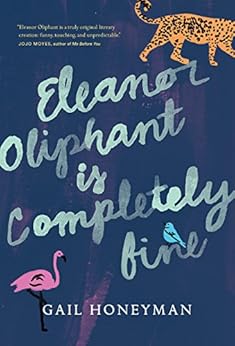
Review of ELEANOR OLIPHANT IS COMPLETELY FINE by Gail Honeyman

4 Stars
Thirty-year-old Eleanor Oliphant lives a strictly regimented and isolated life.  During the week she works as an accounting clerk; on weekends, she drinks two bottles of vodka and speaks to no one.  She has had the same job for nine years, since she graduated from university, and in the dozen years she has lived in her apartment, she has not had any real guests:  “It often feels as if I’m not here, that I’m a figment of my own imagination.”  In fact, her only interaction outside of work is a weekly conversation with her mother:  “When the silence and the aloneness press down and around me, crushing me, carving through me like ice, I need to speak aloud sometimes [to my plant], if only for proof of life.”  Things change when she and Raymond, a new colleague, help an elderly man; slowly, she gets drawn into the wider world.  As her external world opens up, so does her inner world; she slowly decides to confront the childhood trauma that left her emotionally and physically scarred.

Eleanor stands out as odd.  She dresses unfashionably (“flat, black, comfortable [shoes] with the Velcro fastenings”) and speaks very formally, without colloquialisms.  Her extensive vocabulary is impressive but her forthrightness can give offense.  Though intelligent, she cannot read social cues.  For example, she learns that she needs to bring a gift when invited to a party; not knowing what to give a man for his birthday, she gives him a half bottle of vodka and a packet of cheese slices since “All men like cheese.”  When the man opens his present, “He looked at each item in turn with an expression that I found hard to read, but I quickly eliminated ‘boredom’ and ‘indifference.’  I felt happy; it was a nice feeling, giving someone a gift, the kind of unique, thoughtful present that he wouldn’t have received from anyone else.”

Eleanor tends to be very judgmental, not realizing that she has the very traits she criticizes in others.  For instance, she “unraveled the string on my mittens from my sleeve” yet sneers at Raymond for wearing a duffle coat:  “A duffle coat!  Surely they were the preserve of children and small bears?”  She bluntly tells a woman, “’You don’t look like a social worker’” but when the woman doesn’t know how to respond, Eleanor says, “In every walk of life, I encounter people with underdeveloped social skills with alarming frequency.  Why is it that client-facing jobs hold such allure for misanthropes?”  She spends twenty minutes explaining the benefits of a travel pass to Raymond but when he shows lack of interest, she concludes, “He is a spectacularly unsophisticated conversationalist.” 

There is so much humour in Eleanor’s lack of knowledge about social conventions.  I loved her reaction to singing and dancing to the Y.M.C.A. song:  “Arms in the air, mimicking the letters – what a marvelous idea!  Who knew that dancing could be so logical?  During the next free-form jiggling section, I started to wonder why the band was singing about . . . a gender- and faith-based youth organization.” 

But there is also truth to her observations.  Once she starts taking pains with her appearance, she observes, “Being feminine apparently meant taking an eternity to do anything, and involved quite a bit of advanced planning.  I couldn’t imagine how it would be possible to hike to the source of the Nile, or to climb up a ladder to investigate a malfunction inside a particle accelerator, wearing kitten heels and ten denier tights.”  She also wonders, “Did men ever look in the mirror, I wondered, and find themselves wanting in deeply fundamental ways?  When they opened a newspaper or watched a film, were they presented with nothing but exceptionally handsome young men, and did this make them feel intimidated, inferior, because they were not as young, not as handsome?  Did they then read newspaper articles ridiculing those same handsome men if they gained weight or wore something unflattering?” 

There is also a great deal of sadness in the book.  Eleanor was raised in foster care and describes her experience as fine:  “’Being fostered was . . . fine.  Being in residential care was . . . fine.  No one abused me, I had food and drink, clean clothes and a roof over my head.’”  When asked if her emotional needs had been met, Eleanor is “completely taken aback” and says, “’But I don’t have any emotional needs.’”  Another time, she admits, “There are scars on my heart, just as thick, as disfiguring as those on my face.  I know they’re there.  I hope some undamaged tissue remains, a patch through which love can come in and flow out.  I hope.”  Having a mother who can only be described as abusive, Eleanor is astounded to hear a man say he hopes his children find happiness:  “Was that what people wanted for their children, for them to be happy?  It certainly sounded plausible.”  Throughout, we are reminded that she is like the donated furniture in her apartment:  “unloved, unwanted, irreparably damaged.”

The book emphasizes the human need for contact.  When Eleanor makes a friend, “a genuine, caring friend,” she feels she has been saved.  The importance of kindness is also stressed.  When Eleanor does a kind deed, she is amazed:  “I would never have suspected that small deeds could elicit such genuine, generous responses.”  Her kindness to a stranger is in fact what begins her own transformation.

I understand why this book won the Costa Debut Novel Award.  It will leave you cheering for Eleanor as she finds herself.  At the beginning she has a “tiny voice” but she learns that her own voice “was actually quite sensible and rational” and decides, “I was getting to quite like my own voice, my own thoughts.  I wanted more of them.  They made me feel good, calm even.  They made me feel like me.”   The book will also leave you wanting a sequel.