Ranked a Top Canadian Book Blog
Twitter: @DCYakabuski
Facebook: Doreen Yakabuski
Instagram: doreenyakabuski
Threads: doreenyakabuski
Substack: @doreenyakabuski
Bluesky: @dcyakabuski.bsky.social

Tuesday, March 5, 2019

Review of THE PERFECT ALIBI by Phillip Margolin (New Release)


3 Stars 
 
Robin Lockwood is a lawyer in Portland, Oregon.  She is representing Randi Stark, a rape victim who is bringing a lawsuit against her rapist, Blaine Hastings.  Blaine maintains he is innocent but DNA evidence leads to his conviction.  He threatens a number of people when his guilty verdict is announced.  Things get muddled when Blaine’s DNA is also found in another woman raped while he is in jail and when his attorney, Doug Armstrong, disappears and his law partner is murdered.  Are all these events connected?

The plot can best be described as cluttered.  At least 8 lawyers and 2 district attorneys make an appearance, and there are at least 5 cases and multiple crimes (murders, rapes, physical and verbal threats, corruption, prosecutorial misconduct, obstruction of justice).  And then there are the infidelity and everyday deceptions.

Robin is the strong female protagonist.  She is intelligent, confident and tough.  Her mixed martial arts experience is an asset since she does put herself in potentially dangerous situations.  She is a principled person who gives careful consideration to ethical dilemmas and tries to see that justice is done.   The problem is that she is often absent in the narrative because some of the many short chapters focus on the viewpoints of secondary characters. 

And these secondary characters are not fully developed.  Because of the numerous characters, it is not surprising that most of them lack depth.  There are also stereotypes such as the arrogant rich family and the unscrupulous prosecutor who will do anything to win a case.  The inevitable physical descriptions that accompany the introduction of each character become annoying.  Mark Berman, Robin’s law partner, is described even though he plays no role whatsoever in the novel:  “Mark was thirty-two with long brown hair, brown eyes, and the rock-hard body he had developed while competing on the University of Washington’s nationally ranked crew.”  One inconsistency stands out:  two different people describe a man as an “unspectacular litigator” and “second-rate” yet his work helps his firm “gain recognition as one of the best small firms in the state”? 

The book is described as a legal thriller but there are few thrills.  It is more of a legal procedural.  There is not a great deal of suspense, certainly none of the “gripping the edge of your seat” suspense.  Any scenes in which Robin might be in danger are quickly resolved because there is always a knight conveniently nearby to rescue her.  Because multiple points of view are given, there is a lack of cohesion which also contributes to the lack of suspense.

I understand that this is the second book featuring Robin Lockwood; the first is entitled The Third Victim.  It might be best to read this latter book first because the relationship between Robin and Jeff Hodges, the firm’s in-house investigator, lacks background which I assume is explained in the first novel in the series.  Out of nowhere, one of them admits to being in love with the other. 

It is occasionally difficult to keep track of the many characters and the various plot threads but, otherwise, this is an easy read.  It often feels scattered and disjointed but is fast-paced with a few twists.  It is sufficiently interesting but certainly not memorable. 

Note:  I received a digital galley from the publisher via NetGalley. 

Review of BABY OF THE FAMILY by Maura Roosevelt (New Release)


2.5 Stars
This novel’s epigraph includes a quote from George W. Bush:  “When I was young and irresponsible, I was young and irresponsible.”  That is a perfect summary of the book; it is about three young people acting irresponsibly.

Roger Whitby, the patriarch of a once enormously wealthy family, dies and leaves his diminished fortune to his 21-year-old son.  Nick is his youngest son, actually a stepson; Roger’s fourth wife was a single mother when she met Roger.  Though Roger has several other children from his previous three marriages, Nick inherits everything, including houses currently occupied by these other children. 

The book focuses on three siblings from three of Roger’s marriages.  Nick is unaware of his father’s death because he is a member of an eco-terrorist group and has to go into hiding after an attack on a biotech lab.  Shelley drops out of college and gets a job as an amanuensis for a blind architect with whom she develops an unhealthy relationship.  Brooke is a nurse who becomes pregnant but is really in love with a woman.  Shelley and Brooke could both lose their homes to Nick and so are anxious to find him. 

None of the three is likeable.  The reader is supposed to feel sympathy for the three because each was abandoned by Roger; flashbacks are used to emphasize their feelings of abandonment when Roger left their mothers and thereafter gave them only sporadic attention:  “But every time he’d shown up had also corresponded with a minor breakdown in his daily life.”  As a consequence, they are looking for the affection and stability they didn’t have as children.  They also feel burdened by the expectations placed on them because of their family name:  “The Whitbys of the last few generations were rather afflicted with the sincere and problematic issue of not knowing what the hell to do.”

Actually, however, the Whitby name means less and less; in fact, the book opens commenting on this:  “There was a time when the death of a Whitby would have made the evening post.  Two generations earlier, flags would have been flown at half-mast and taps played in town squares at dusk. . . . But when Roger Whitby Jr. died half a century later, there was no such hubbub.”  The name does, however, still carry enough cachet that it gives people a sense of superiority; one outsider comments on the greatest benefit of being a Whitby:  “you were born knowing you had worth.  This entitlement, randomly assigned by the universe, was simply not fair.”  Nick, Shelley and Brooke need to overcome any feelings of being extraordinary and get on with “the beastly process of becoming” their own persons. 

The three are spoiled rich kids.  The author takes pains to point out that “The rich are no different from the rest; different only, perhaps, in the inclination to be more outrageous.”  However, it seems that the rich take longer to grow up.  (Maybe the title has more than one meaning.)  Only at 21 years of age does Nick realize he must accept responsibility for his decisions and their consequences:  “As he owned up to it all, he realized that every single action was a result of his own choices.  He was responsible for it all”?!  They also seem to have little self-control; all three have anger issues:  Nick “was filled with an anger that teetered on uncontrollable” and “A sense of injustice began to fill [Shelley] with anger. . . . It simply wasn’t fair” and “Overcome with anger, [Brooke] dropped to her knees on the wet sand too, exasperated.”  Brooke calls Shelley “young and self-absorbed” but 37-year-old Brooke is not much better.   She is in a panic because she might actually have to pay rent for the first time in her life?!  The truth is that the three have endless opportunities yet all they do is whine.

I really struggled to get through the book.  It goes on and on (450+ pages) and I cared less and less about the three protagonists, three poor rich kids who keep acting irresponsibly and making stupid decisions.   The author is the great-granddaughter of Eleanor Roosevelt and President Franklin Delano Roosevelt; her 2014 marriage received mention in The New York Times.  She could very well be writing about her family, but the portrait of her generation is not flattering. 

Note:  I received a digital galley of this book from the publisher via NetGalley.

Thursday, February 28, 2019

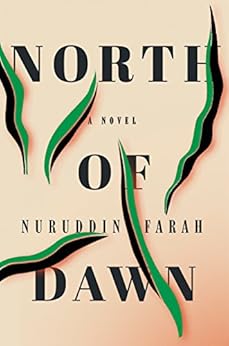
Review of NORTH OF DAWN by Nuruddin Farah

3 Stars
The author of this book is a celebrated Somali novelist who apparently has been a frequent contender for the Nobel Prize in Literature.  I was unfamiliar with him until I came across a brief plot outline of this book in The New Yorker and the premise sounded interesting.

Mugdi, a former Somali diplomat, and his wife Gacalo have lived in Oslo for two decades.  Their son Dhaqaneh, raised in a secular, upper-middle-class home in Norway, was radicalized and joined Al-Shabaab, a terrorist group in Mogadiscio.  He died in a suicide bombing.  Though Mugdi disowned his son because of his jihadist activities, Gacalo maintained contact and promised to look after his wife Waliya and his two stepchildren.  Gacalo convinces her husband to sponsor the family and bring them to Norway.  

Events take place over a five-year period.  Waliya makes no effort to integrate and keeps company with members of a radical mosque.  The children, 12-year-old Naciim and 14-year-old Saafi, are torn between their mother’s ultra-conservativism and the freedoms offered by Norwegian society.   Mugdi and Gacalo’s lives suffer upheaval as they contend with their daughter-in-law’s hostility and try to do what they think is best for their grandchildren.  

This novel often reads more like non-fiction with long passages extoling a point of view:  “As his eyes move from the face of a Caucasian woman to a man with Middle Eastern features, and from a woman in a sari to an African man in an agbada, Mugdi is sad that scenes such as this, where a variety of races congregate at a public arena, are unavailable in Mogadiscio.  As he watches the expressions of the faces of some of the Norwegians, he can spot some whose gentle features stiffen, turning ugly when they come face-to-face with a Muslim woman in full Islamic gear.  Maybe a woman with a Muslim headscarf is seen as a threat, whereas a sari-wearing woman is viewed as unusual and fascinating in this part of the world.  Mugdi remembers reading about a judge in the state of Georgia in the US who barred a woman with a headscarf from entering his court.  Would the same judge turn away a Jewish man with a yarmulke or a nun in her habit?”  Conversations often become mini-lectures:  “’here in Norway, the Somalis are very much unwelcome, being black Muslim refugees at a time when migration is now viewed both as a political problem and as a threat to the Norwegians’ continued existence as a “pure race.”  Right-wing groups see the Somalis as real pests, worse than bubonic plagues.’”  

The reader learns a lot about changes in religious attitudes in Somalia:  women dressing “in the ‘Saudi’ way . . . has lately become fashionable among Somalis” and “’Lately, many Muslims are practicing a different Islam . . . Whereas in former times, Somalis were relaxed about the genders mingling and spaces were not necessarily allotted to specific genders, our people have recently adopted the more conservative, stricter Wahhabi tradition which stipulates that different entrances are assigned to the two genders’” and “’Besides, in much of Somalia, old men your father’s age have lately been marrying girls even younger than Saafi’” and “lately Somalis have developed the bizarre habit of making little tykes don veils” and “traditional clothes the religionists have lately described as un-Islamic and therefore forbidden” and “Recently he has had the displeasure of extending his hand to shake that of a woman whom he has known for years, only for her to say, ‘I’m sorry, no handshakes’”  and “the new social convention prevailing among Islamists in Somalia nowadays discourages men from speaking directly to women except via a Mahram.”

Dialogue is particularly problematic.  Everyone speaks in a stiltedly formal way.  Would one teenager say to another, “’Nothing would give me more joy than to come with you and to make their acquaintance’”?  Would a 17-year-old tell a parent, “’How can you expect me to be good when a great number of our people kill, when the weak are massacred with impunity?  We Somalis pay lip service to the faith while we live a life of lies.  This is why the dissonance in our hearts continues to flourish, why there is no letup in the usual struggles within our minds, why the strife in our land rages on unabated’”?  Conversation is awkward and artificial because often its primary purpose is to convey information to the reader:  “’Incense burning is traditional in our culture and it lends an odiferous liveliness to the burial process.’”

Extraneous details are included.  Do we need to have the Norwegian flag described:  “flags bearing blue crosses outlined in white on a red background, the colors borrowed from the French tricolor, seen as a symbol of liberty”?  Do we need to be taught how to make an omelet:  “Mugdi brings out a skillet and some butter, cracks two eggs, which he beats together in a bowl, adds a drop of water, and then seasons the mix with black pepper and salt.  When the butter has melted, he pours the mix into the frying pan and waits until it is fully cooked on all sides and ready to serve”?   Do we need to know what people order to eat in a restaurant:  “He orders sautéed scaloppini, Timiro all’arrabbiata, and Eugenia sole in white wine”? 

The plotting is uneven.  There are instances when there is a build-up of suspense but then nothing happens.  This is definitely the case with Arla.  She is Waliya’s best friend but she isn’t mentioned until late in the first half of the book.  Later, she seems to pose a threat but that peters out to virtually nothing.  And the purpose of her first encounter with Mugdi is never explained!  And why is she always described as wearing something “see-through”?!  Other aspects of the book that should have been developed aren’t.  For example, Saafi’s trauma because of what happened in the refugee camp is not sufficiently explored.  Saafi receives short shrift throughout.  One minute she loses a job and the next, she “is setting up her seamstress business after obtaining her qualifications.”  The passage of time is often unclear.  We are told that a widower still misses his wife “almost a year and a half after her passing” but he tells a friend there have been several interruptions in his life and some “’more recently, because of my wife’s passing’”? 

The book often gives the impression that it was translated rather than written in English.  Mugdi and Gacalo rent an apartment for Waliya and the children but a police officer identifies the former “’as the apartment tenants’”?  A mother and daughter, distraught at being separated, would cry and weep and sob but calling their emotional outpouring as “ceaseless sniveling” seems a poor choice of words.  Some of the diction is complex and then there are clichés like “she has cased the joint” and “He moves like greased lightning”!  Clearly, editing was cursory.  Naciim buys several Norwegian flags and he lets his mother see only “one of them” but somehow she cuts up several flags, though he has successfully hidden the rest?  A man accused of sexual assault must give “blood and urine samples” when earlier he is told “to give samples of blood and semen”?  We are told that “Dhaqaneh accorded [Naciim] a greater preference, inducting him into the position of a Mahram, the male head of the household” but later we are told “The initial mistake was Waliya’s, when she singled Naciim out for his maleness in a household of females and assigned him the role of Mahram”!

Mugdi is translating Ole Edvart Rølvaag’s novel Giants in the Earth into Somali, and comparisons are constantly made between the Norwegian immigrants in the Dakotas and Somali immigrants in Norway:  “Beret, in her fear of the prairie, covers the windows of her sod house and bars the door at the slightest worry whenever her husband is away.  And the Somalis conceal their bodies with all-enveloping tents when they are outside the house, afraid of whom they may run into” and “Just like Beret, Waliya is forever creating havoc, unable to come to terms with her new country’s climate, culture, or faith, nor able to tear herself loose from all that defined her back in the land where she was raised.”  These comparisons serve to remind the reader that immigrants regardless of country of origin have struggled, but would a man in the midst of grief really think about the death of a character in a novel?

The book touches on important topics.  It examines the impact of religious radicalization.  It explores the struggles immigrants face in integrating into a different culture.  It points out that Somali immigrants in Norway are really “’caught between a small group of Nazi-inspired vigilantes and a small group of radical jihadis claiming to belong to a purer strain of Islam.’”  The problem is that the book is clunky with numerous issues that need to be addressed.  The impact of its important message is greatly lessened by the book’s lack of literary quality. 

Sunday, February 24, 2019

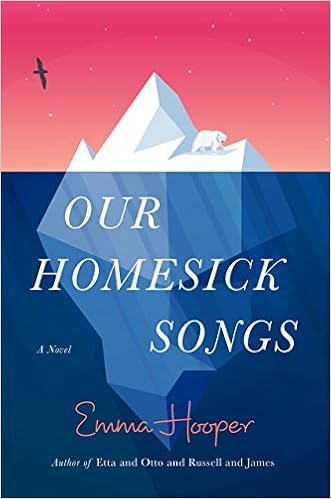
Review of OUR HOMESICK SONGS by Emma Hooper

4 Stars
Because Newfoundland is my favourite Canadian province, I love reading novels set there and was thrilled to come across this book. 

The setting is the outport of Big Running in the early 1990s.  The cod have disappeared and so people are leaving the community to make lives elsewhere.  The Connors are the last family to remain, though Aiden and Martha take turns working in the oil fields of Alberta.  Each leaves the family in the care of the other parent for a month.  Meanwhile 14-year-old Cora transforms abandoned houses into countries she dreams of visiting.  And 10-year-old Finn makes it his mission to lure back the fish, using a folk tale for inspiration. 

Sadness permeates the narrative.  Finn witnesses the disappearance of fish and boats and people, including members of his family.  The government has told the family they have only months to leave so they mourn the loss of the only home they’ve known as well as their way of life.  Clenched hands become symbols of the tension everyone feels and the desire to hang on to the life they love.  When Aiden and Martha were courting, “In clenched fists, Martha would bring Aiden sea glass, round and smooth and blue and green and clear as sky.  Mermaid’s tears, they called them, in the Runnings.  Cried for people left back onshore, hardened by distance.”  Throughout her absences from home, Martha keeps a clenched fist:  “Her left hand, the one with the ring . . . in a tight fist.  A hard, safe ball.”   

Music is also ever present.  Aiden sang when he went fishing and that singing, which Martha interpreted as coming from mermaids, brought them together.  Cora plays the fiddle and Finn, the accordion.  Whenever members of the community gather, they bring music.  At a funeral, “there were two fiddles, three guitars, one banjo, one bodhran, three whistles, two accordions, and almost everyone singing”; at a community meeting, “there were three fiddles and three guitars and two bodhrans and four whistles and two accordions and one flute and one set of pipes.”  Mrs. Callaghan, Finn’s music teacher, tells him that “singing together makes you allies.  Automatically.  Always.” and “Even when you don’t have anything, you can always sing.” 

In particular, Mrs. Callaghan talks about the power of music to help remember a place.  She speaks of sailors coming from Europe to fish and “the only, the best, way for them to remember home was through singing, through the songs and tunes they knew from home.  When they were homesick, when they needed to remember where they were from, they could sing to see, to remember.  They could close their eyes to block out where they were, and sing and remember where they used to be.”  And singing together is even better:  “Every new voice would make a bigger, better picture of home, filling in some gaps, bits they might forget alone.”  Though Big Running will be a deserted place, its former residents can remember it through song. 

The style is spare but lyrical.  Some passages, like the description of a storm, are almost stream-of-consciousness:  “First the lightning, then the thunder, then the wind and the waves, the waves and the wind and the night-white water, all of which were the same, all one, pushing and reaching and pulling and pressing in on them, on every side, wind, waves, water, everything wet and loud and black and white, deep night, then light, then night, then light, and everyone was awake now, Aidan’s mouth moving like talking but just the sound of the wind and the waves and the water, just a moving mouth, only visible when the light hit, then gone again, his arms up and grabbing things, something, a snake, a rope, just a rope, Martha stepping out, toward him, black-white, the wind grabbing her hair, punching her back, deep, heavy against her gut, and something, something else, on her arm, pulling her back, a hand in unison with the wind, pulling her, sudden, and she fell back, away from Aidan and back inside and the hatch banged shut.”

This is a haunting, moving novel that will linger in my memory.  I recommend it being read while listening to some Newfoundland folk songs by Great Big Sea or The Fables or Simani or The Punters.  Or listen to “Grey Foggy Day” by Eddie Coffey (https://www.youtube.com/watch?v=uY2nVUXeXzY) or “Saltwater Joys” by Buddy Wasisname and the Other Fellers (https://www.youtube.com/watch?v=LZmQj5rRULU).  

Wednesday, February 20, 2019

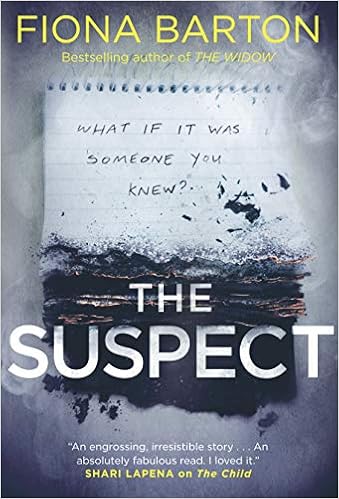
Review of THE SUSPECT by Fiona Barton

3 Stars
Two English 18-year-old girls, Alexandra O’Connor and Rosie Shaw, go missing while backpacking in Thailand.  A veteran reporter, Kate Waters, becomes interested in their story and gets to know the parents.  When bodies are discovered after a fire in a guesthouse, Kate flies to Thailand to get the full story while at the same time looking for her son Jake who went to Thailand two years earlier and has had only sporadic contact with his family since.  She discovers that Jake lived in that same guesthouse and may know something about the fire. 

The novel is narrated from alternating points of view; most often, it is Kate and Alex’s mother Lesley who are the focus, but the viewpoint of DI Bob Sparkes, a police officer facing the impending death of his wife, is also given as he takes charge of the investigation on the British end.  Alex’s voice is also heard in the emails she writes to her best friend.

The book touches on several topics.  For instance, it addresses the way people edit their public lives on social media.  Alex’s postings suggest that she is having a wonderful time but her private emails to her friend tell the truth:  things are not going well between her and Rosie who is not really interested in exploring the country.  It also examines what it is like to be on the receiving end of media attention; when Kate’s son becomes a person of interest, Kate, the newspaper reporter, says, “We’re taught that the truth is all that matters. . . . Everyone wants to know the truth.  Except those who don’t.  Those who stand to lose by it.  I know that now.”  The question of how well parents know their children is also asked; Kate starts to wonder about how well she knows Jake, and Rosie’s mother seems very much unaware of her daughter’s behaviour. 

Alex and Rosie are foil characters; the former is the good girl and the latter is the bad girl.  Alex is the responsible one who is interested in seeing Thailand while Rose is the partier who is really interested only in boys.  There are other stereotypes too.  There’s one young man who feels his parents have pressured him too much and another who is the product of the foster care system.  The incompetence of the Thai police is unbelievable. 

There are subplots that are unnecessary.  For example, the terminal illness of Sparkes’ wife serves little purpose except to arouse sympathy for the policeman.  The tensions between Rosie’s divorced parents are irrelevant. 

Some elements leave the reader mystified.  What parents would let their young daughters go unsupervised to Thailand?  Alex is supposedly the mature girl who is aware of possible dangers for young travelers yet she is so naïve?  Why do the girls continue to stay in a rooming house which is certainly substandard? 

This is an easy, undemanding read.  The chapters are short and the clues so obvious that the villains are easily identifiable.  It might be a good book to take on a plane, though perhaps not on a flight headed to Thailand.