Ranked a Top Canadian Book Blog
Twitter: @DCYakabuski
Facebook: Doreen Yakabuski
Instagram: doreenyakabuski
Threads: doreenyakabuski
Substack: @doreenyakabuski
Bluesky: @dcyakabuski.bsky.social

Tuesday, November 10, 2020

Review of LITTLE CRUELTIES by Liz Nugent (New Release)

 4 Stars

At the centre of this dysfunctional family drama are three Irish brothers:  William, Brian, and Luke Drumm.  The novel opens with one of the three dead, but the reader does not know which one.  Each of the three tells his story, but it becomes clear that they all acquired resentments and jealousies in childhood and carried them into adulthood:  “Three is an odd number, so there had always been two against one, although we all switched sides regularly.  Nobody would ever have described us as close.”  The narrative focuses on their rivalries and betrayals. 

In the prologue, the reader is told that one brother died suddenly and horrifically; his body was “smashed and broken.”  Both survivors may have been involved in the death because both seem to think “this outcome was all for the best.”  The mystery as to the identity of the dead man is complicated by the fact that all three are flawed and have done things which could lead to a violent death.  And each has a motive to want the other brothers out of the picture. 

None of the three is particularly likeable.  William, the eldest, becomes a film producer, but he is more memorable as a philanderer and misogynist.  Brian, the middle brother, has difficulty finding his niche but gradually becomes a master manipulator who is pre-occupied with the acquisition of money.  Luke, the youngest, is the most sympathetic of the three; he becomes a pop star but struggles with mental illness and addiction. 

Each of the three is affected by their upbringing, specifically the treatment received from their mother Melissa.  A singer and actress, she is a vain narcissist who sees everyone as inferior to her.  William’s arrogance can be seen as stemming from the fact that Melissa makes it abundantly clear he is her favourite son.  Brian is treated indifferently and perhaps sees financial success as a way of gaining more of Melissa’s attention.  Luke is sensitive and his mother’s obvious lack of love for him leaves him fragile.

Since each brother narrates his own story, some events are seen from more than one perspective.  Since William tells his story first, the reader may sympathize with him; however, once the perspective of another brother is given, the reader’s feelings may change.  Some readers might complain about repetitiveness, but I enjoyed the additional insight into behaviour and the depth of character development. 

The one complaint I have about the individual stories is that they all have unique, non-linear timelines (e.g. William:  1994, 1985, 1992, 1978 . . . ; Brian:  1978, 1993, 1979, 1976 . . . ; Luke:  1977, 1989, 1984, 1995 . . .).  I could find little reason for this rather chaotic arrangement. 

Liz Nugent is known for her crime fiction, but this book does not have the amount of suspense found in that genre.  This novel touches on a variety of topics:  dysfunctional families, mental illness, addiction, sexuality, #MeToo.  I particularly liked how it demonstrated the effects of upbringing and traumatic events on personality and behaviour. 

Note:  I received an eARC from the publisher via NetGalley.

Friday, November 6, 2020

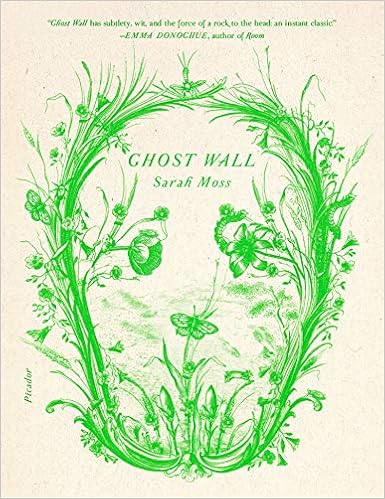
Review of GHOST WALL by Sarah Moss

 4.5 Stars

The book begins with a scene reminiscent of "The Lottery" by Shirley Jackson.  It’s a powerful opening to a short, suspenseful novel that packs a punch. 

The protagonist is 17-year-old Sulevia (Silvie) Hampton.  Her father Bill, an amateur historian, insisted that Silvie and her mother join him in rural Northumberland to re-enact the life of Iron Age Britons.   Bill is especially fascinated with the bog people.  Because of his “self-taught expertise in outdoor survival, foraging, and mountaincraft,” he was invited to join a professor and three of his students in an experimental archaeology program for two weeks.  Dressing in tunics, the participants forage for food and even build a ghost wall, a defensive palisade crowned by animal skulls. 

Bill is obsessed with authenticity so, for example, he wants everyone to sleep in the roundhouse “on the splintery bunks . . . padded with three deerskins.”  The professor is less concerned:  “Professor Slade said, ah well, after all, authenticity was impossible and not really the goal anyway, the point was to have a flavour of Iron Age life.”  The students are even less committed and not above bringing in contraband food.  Molly, the one female student, is most lackadaisical; she even refuses to take part in certain activities like butchering rabbits.  When the others are not enthusiastic about authenticity or the professor disagrees with him, Bill is not happy and his typical reaction is noteworthy:  “Dad didn’t say anything.  He lifted his chin, locked eyes with the fire.  Mum hunched on her rock, touched her arm where I’d seen the bruise earlier.”

Bill’s attitudes are relics of the past.  He expresses racist and xenophobic views.  He is also a misogynist:  he tends to be almost totally dismissive of women and their views.  Even menstruation he sees as a failing:  “in the old days women weren’t going around forever bleeding all over the place anyway, all those doings started later in life when there was less to eat and everyone better for it.”  He doesn’t like his wife or daughter buying tampons because “Women managed well enough, he said, back in the day, without spending money on all that, ends up on the beaches in the end, right mucky.”  He constantly scolds his wife for being late with meals she is expected to make on an open fire.  He criticizes her for being fat but doesn’t like her exercising; she enjoyed swimming and attending a fitness class but “Dad hadn’t liked her doing either.  Surprised you’d want people seeing you in your swimming costume, shape you’re in, he’d said.” 

Molly doesn’t behave submissively.  For instance, Molly refuses to eat the rabbit stew.  In response, Bill mutters, “You’ll eat what you’re given, girl. . . . picky lasses went hungry, back then, . . . it weren’t for the likes of you to say who gets what.”  Silvie hates when Molly challenges Bill:  “My stomach clenched.  Stop it, you don’t know what you’re stirring up, you have no idea how this goes, you can’t speak to him like that.”  Since he cannot punish Molly, Silvie and her mother become the targets of his violence. 

Silvie is a well-developed character.  She is very knowledgeable about the natural world so she can identify plants and knows their uses.  She is proud of her outdoor skills.  She is also spirited and has some rebellious tendencies which antagonize her father.  As is often the case with victims of abuse, she defends her abuser.  She does have happy memories of good times with her father when she was younger.  Seeing his daughter growing up obviously upsets Bill.  He often accuses her of behaving inappropriately in front of the male students.  When she innocently asks if she can sleep in a tent like the students, Bill’s response is telling:  “Don’t be daft, he said, of course you can’t sleep wi’ the lads, shame on you. . . . I did not know what my father thought I might want to do, but he devoted considerable attention to making sure I couldn’t do it.”  Interestingly, it seems that Silvie’s nascent sexual interest lies elsewhere. 

Silvie is really trapped.  Does her father see the ghost wall as a way of keeping her trapped?  When the group discusses what they would sacrifice to the bog “if you were really scared or really desperate for something,” Bill looks at his daughter:  “I felt Dad’s gaze on me and knew with a shiver what he was thinking.  My daughter.  Break her and stake her to the bog, stop her before she gets away.”  Silvie’s encounters with the students, especially Molly, show her a way out.  She admits, “University would have been a way of escaping” but she doesn’t know how to ask the questions she really wants to voice:  “How do you leave home, how do you get away, how do you not go back?”

One of the major themes is expressed by the professor:  “there’s no steady increase in rationalism over the centuries, it’s a mistake to think that they had primitive minds and we don’t.”  Like so many of the boys in Lord of the Flies, the men become infused with tribal passions:  “the Prof drumming with his head thrown back to the moon, at Dad himself sitting straight as if in church and joining a wordless chant, the two sceptical boys in the end not exchanging glances but intent on the bone-faces on high and swaying to rough music.”  They also become transfixed by a desire to “kill things and talk about fighting.”  The women usually do the foraging while the men set off “on some mission of violence against the local fauna.”  Certainly, the author suggests a connection between ancient sacrificing rituals and present-day abuse.

The style of the book is not traditional.  Speech indicators like paragraphing and quotation marks are not used.  As a result there are some confusing passages:  “Come on, she said, come and talk.  Mum needs these, I said, Dad said.  Yes, well, she said, I say.  Come on.  Tell me what they said.”  Comma splices and sentence fragments abound:  “Haven’t you been listening, people don’t bother to hurt what they don’t love.  To sacrifice it.”  Dialect is also employed:  “I’ve some kecks you can take while you’re about it.  But give us dinner first, we’re all clemmed.” 

Though a quick read, this book has a lasting impact because it is so thought-provoking.  It is a coming-of-age tale but so much more; it challenges the reader to think about domestic abuse, toxic patriarchy, class prejudices, connections between ancient and modern societies, and the various meanings of walls.

Monday, November 2, 2020

Review of MISS BENSON'S BEETLE by Rachel Joyce (New Release)

 3.5 Stars

Most of the novel is set in 1950.  Margery Benson, a 46-year-old spinster schoolteacher, abandons her job in a dramatic way after a humiliating experience.  On a whim, she decides to travel to New Caledonia to find the legendary golden beetle her father had told her about just before his sudden death.  When left with no other option, Margery hires Enid Pretty as her assistant.  Enid has none of the qualifications Margery wanted but in the course of their adventures, the two unlikely companions forge a strong friendship.

Some of the interest in the novel is that the two women are foil characters.  Margery is plain, frumpish, introverted, and judgmental whereas Enid is attractive, flamboyant, extroverted, and undiscriminating.  At the beginning, Margery hates Enid’s company; on the 5-week, transoceanic voyage, Margery feels “stuck in a very small space with the world’s most talkative woman.”  It takes a while for Margery to realize that there is more to Enid than appearances suggest; she proves to have skills that the ill-prepared Margery needs and even if Enid is chatty, she has secrets. 

Though the purpose of the journey is to find a (perhaps mythical) gold flower beetle, it is really a journey of self-discovery.  Margery feels like a misfit in society:  “She would always be on the outside.”  Her life is dull and boring because “It was so easy to find yourself doing the things in life you weren’t passionate about, to stick with them even when you didn’t want them and they hurt.”  Enid tells her, “’Just because you’ve never done  something doesn’t mean you can’t start’” and Margery comes to realize that it’s not too late for a second chance:  she had “the strangest sense that everything she wanted was ahead and available, so long as she was brave enough to claim it.”  She finds unknown reserves of endurance and courage.  She sees the wisdom of Enid’s comment that “’We are not the things that happened to us.  We can be what we like.’”

In many ways, the novel is about female empowerment.  Margery finds happiness when she realizes, “I’m not here because I am someone’s wife or sister.  I am here because this is what I want, and now I have a place for my work.”  In fact, Margery and Enid become objects of resentment for one woman because “they had found a way to be themselves.”  And the novel ends with a final comment that “the real failure as a woman was not even to try.”

This is an adventure story; the women face many obstacles:  some like passport photos and lost luggage are minor, but others like cyclones and illnesses are life-threatening.  Some of the adventures are improbable and almost slapstick, requiring some suspension of disbelief. 

On the other hand, serious topics are addressed:  homosexuality, suicide, and sexual abuse.  Certainly the lasting effects of war are highlighted.  Margery is haunted by what happened to her family during World War I.  Another character was a prisoner of war in Burma during World War II; suffering with PTSD, he thinks, “war was not over just because someone signed a truce.  It was inside him.  And when a thing like war was inside you, it never left.” 

This book would make an entertaining movie.  It has some wonderful touches of humour (Enid calling Margery “Marge as if she was a highly processed alternative to butter”) and farcical adventures (setting up a tent for the first time) but also a heart-warming message about friendship and second chances.  Though not perfect, with some pacing issues in the middle, the book is a good read for pandemic times when we need “moments of joy.  [Fortunately] even at its worst, life will offer such moments,” and this book provides some of these. 

Note:  I received a digital galley from the publisher via NetGalley.  This book will be published tomorrow.

Thursday, October 29, 2020

Review of REPRODUCTION by Ian Williams

 3 Stars

I finally got around to reading this 2019 Giller Prize winner; actually, I listened to it as an audiobook, and that may not have been the best idea because of the experimental style.

In the late-1970s, nineteen-year-old Felicia Shaw, a black immigrant from a “small unrecognized island,” meets Edgar Gross, a much older and affluent white man of German background.  Their first encounter is in a Toronto hospital room where their mothers are patients.  Felicia’s mother dies and Edgar convinces Felicia to take care of his mother once she is discharged.  Their short-lived relationship results in Felicia becoming pregnant.  The novel then jumps fifteen years into the future.  Felicia and her teenaged son Army rent part of a house from Oliver, a bitterly divorced man.  In the latter part, Army is 36 but still living in the house shared by Oliver, Felicia, and Riot, a college-aged young man whom they have raised since his birth. 

The novel examines relationships and unconventional family structures and how they are formed.  Often relationships are established only because of proximity.  That is certainly the case with Felicia and Edgar and Felicia and Oliver.  When Felicia and Army move into part of a house owned by Oliver, they form a sort of family with him and his children.  Later Oliver and Felicia adopt Riot, even though they are not a couple.  Army tries to form a relationship with his father and even forces others to accept him as part of their already unorthodox family.  On the other hand, some characters use distance to separate themselves from relationships.  This is certainly the case with Riot’s mother and father. 

The structure is unusual.  Williams explained it in an article in Quill and Quire:  “it’s in four parts and each part approaches reproduction differently.  In part one it’s biological.  It’s in 23 paired chapters so it’s chromosomal.  Part two has four characters, so we go from those two characters to four characters and 16 chapters.  And part three [grows] exponentially, from 16 to 256 small sections [16 x 16].  At the end of part three the book gets cancer and you see those tumours growing in the superscript and the subscript [rendered by the text flowing intermittently above, below, and along the sentence lines]. That is the final form of reproduction beyond human control” (https://quillandquire.com/authors/poet-ian-williams-experiments-with-structure-to-tell-a-classic-love-story/). 

The style is also irregular.  For instance, song lyrics, German words, and Caribbean patois are included.  Some sections are like stream-of-consciousness.  My issue with the style is that, especially in the later sections, it becomes more of a focus than the content.  What’s with the many different spellings of Edgar’s names?

The characters are certainly distinct, but the men are all unlikeable.  Edgar’s surname is so appropriate for a self-absorbed, arrogant manipulator who treats women abhorrently.  Oliver is a wanna-be rock star who frequents strip clubs and constantly mocks his ex-wife’s appearance.  Army is full of get-rich-quick schemes even as an adolescent; in his mid-30s, he remains a hustler, even in his romantic relationships.  Riot is another man-child who expects others to support him while he makes art films which include recording a man’s death.  And don’t get me started on Skinnyboy!

Women are forced to shoulder more responsibilities than men.  Edgar has no qualms about leaving his mother without a caregiver, knowing that Felicia will feel a moral responsibility to step in.  Felicia raises Army as a single mother without any financial support from the wealthy Edgar; in fact, he blames her for getting pregnant, even though he had lied to her about having a vasectomy.  When Army brings a terminally-ill man into the home, his care falls mostly to Felicia.  I kept wishing Felicia would develop a backbone and stand up to the men; if she had been more forceful with Army and Riot, they might have become more mature.  I can understand a 19-year-old being manipulated, but it is more difficult to understand in a 55-year-old. 

I’ve read two other titles that were on the 2019 Giller Prize shortlist:  The Innocents by Michael Crummey (https://schatjesshelves.blogspot.com/2019/10/review-of-innocents-by-michael-crummey.html) and Small Game Hunting at the Local Coward Gun Club by Megan Gail Coles (https://schatjesshelves.blogspot.com/2020/03/review-of-small-game-hunting-at-local.html).  I think both of these are of better quality.  When compared to these two novels, Reproduction suffers because of more focus on style than substance. 

Sunday, October 25, 2020

Review of TROUBLED BLOOD by Robert Galbraith

 3 Stars

This is the fifth Cormoran Strike novel.  The investigation, this time, is a 40-year-old cold case.

In 1974, Dr. Margot Bamborough left her clinic and was never seen again.  The initial police investigation was led by a man who was shortly thereafter hospitalized because of mental illness; his successor had no success in determining what happened to the doctor.  In 2014, the doctor’s daughter hires Strike and his partner, Robin Ellacott, to find out what happened to her mother.

The police had focused on Dennis Creed, a notorious serial killer who had been abducting, torturing and killing his female victims in the vicinity of Bamborough’s disappearance.  In the course of the investigation, other suspects emerge:  among others, there’s a vicious gangster and a patient whose girlfriends tended to end up dead. 

Besides the cold case, the novel also focuses on Strike’s relationship with his father and his visits to his aunt/surrogate mother who has been diagnosed with cancer, Robin’s divorce, and the mutual attraction between Robin and Strike. 

At over 900 pages, this book is a doorstopper.  I found it becoming tedious for a number of reasons.  The interrogation scenes with witnesses or children of witnesses went on and on.  Of course, some witnesses are missing and memories are faulty.  Then there are the lies and misdirections.  The reader is given so much information with so many red herrings that it is virtually impossible to solve the case.  Astrology was an obsession of the lead police investigator, and Robin and Strike’s discussions of the subject also go on and on.  In addition, each chapter begins with a quotation, sometimes fairly long, from Edmund Spenser’s The Faerie Queen; after a while I just gave up trying to figure out the relevance to each chapter.  It is difficult to maintain suspense in a lengthy tome, so some judicious editing would have been appropriate. 

I re-read my review of Lethal White, the previous book in the series, and found that many of my comments could be applied to Troubled Blood:  “This is a lengthy book with lots of twists and turns and red herrings.  The plot is so complex with so many details that the reader will be at a loss to tie together all the information into a coherent whole” and “There are some predictable elements.  . . .  the women with whom Strike has liaisons cause problems for Strike and confusion for Robin.  And there are the inevitable conversations where Strike and Robin talk at cross purposes and fail to understand each other” and “Though this can be read as a standalone novel, it is best read as part of the series since the Strike and Robin relationship has developed over time.  This book, more than the others, focuses on the unacknowledged romantic tension between the two.”

I would not call this a page-turner.  To the first three books in the series (The Cuckoo’s Calling, The Silkworm, and Career of Evil) I awarded 4 Stars; the fourth book Lethal White received 3.5 Stars; and this one gets only 3 Stars.  There’s an unfortunate trend here.

Here are links to my reviews of the other books in the series:

https://schatjesshelves.blogspot.com/2015/10/reviews-of-cuckoos-calling-and-silkworm.html

https://schatjesshelves.blogspot.com/2015/10/review-of-career-of-evil-by-robert.html

https://schatjesshelves.blogspot.com/2018/10/review-of-lethal-white-by-robert.html

Wednesday, October 21, 2020

Review of MISS ICELAND by Auður Ava Ólafsdóttir

 3.5 Stars

When my husband and I toured Iceland in 2017, we were in a progressive country with a reputation for gender equality and for being one of the most LGBT-friendly countries in the world.  It had already had a female president and a prime minister who was the world’s first openly lesbian head of government.  This novel, however, takes the reader back to the early 1960s when Icelandic society was much more conservative.

Hekla is a young woman who aspires to be a writer.  She leaves home for Reykjavík, but she encounters obstacles to the fulfillment of her dreams.  The male-dominated community wants its women in beauty contests or in domestic roles. 

Writing is Hekla’s obsession.  When her friend Isey asks her whether she wants a boyfriend or to write books, Hekla answers, “In my dream world the most important things would be:  a sheet of paper, fountain pen and a male body.  When we’ve finished making love, he’s welcome to ask if he can refill the fountain pen with ink for me.”  Later, she tells Isey, “’Writing.  It’s my lifeline.’”  Whereas male writers gather in cafes to discuss writing, she devotes every free moment to actually writing.  She starts a relationship with Starkadur, one of these men, and for the longest time doesn’t share that she writes, knowing that he wouldn’t understand that a woman could have a passion for writing.  His Christmas gift  to her is a cookery book.  When she does eventually reveal her secret, he acknowledges her devotion:  “’If you’re not working, you’re writing.  If you’re not writing, you’re reading.  You’d drain your own veins if you ran out of ink.’”  She persists even when she is told, “’The world isn’t the way you want it to be . . . You’re a woman.  Come to terms with that.’” 

Hekla is published but used a male pseudonym.  When she sends a manuscript to a publisher, he comments, “’There’s certainly a daring and fearless element in the prose, to be honest I would have thought it had been written by a man . . .’”  He declines to publish and makes pointed reference to having heard that she declined to compete for the Miss Iceland title.

Men, on the other hand, “’are born poets.  By the time of their confirmation, they’ve taken on the inescapable role of being geniuses.  It doesn’t matter whether they write books or not.’”  There are some wonderful jabs at these men who think of themselves as poets. Starkadur who claims, “’there are so few female novelists in Iceland and they’re all bad,’” has a poem accepted for publication despite the fact that it has a “line that starts with ‘assuage the wound’ and ends with ‘crepuscular gasping of mantled hopes’.”  He quits his job at a library because he wants an “environment for inspiration”! Hekla’s father writes that “It’s actually quite amazing how so many poets lack physical stamina.  If they’re not blind like Homer, Milton and Borges, they’re lame and can’t do any sort of labour.”

Hekla’s only real friends in the city are also trapped by societal expectations.  Isey dreams of being a writer too but finds herself as a housewife married to a barely literate man who is “good at sleeping through the children crying at night”; she resorts to writing in a diary but the busy life of housewife and mother leaves her with few options; she has an opportunity to read only if “the fishmonger packs the haddock in a poem or a serialized story.”  Eventually she writes to Hekla that she has “packed away my wings.”  Isey serves to show what Hekla’s life could be like if she gives up pursuing her goal. 

Jon John is a gay man who wants to be a fashion designer but has to take jobs on ships where he is routinely humiliated and brutalized.  He compares the treatment he receives to the oppression of blacks in the United States at the time.  Jon John mentions that “’The Icelandic government negotiated a deal to make sure there would be no blacks at the [Keflavík Air] base.’”  Iceland also wants no homosexuals.  Jon John’s  is a sad story:  “Men only want to sleep with me when they’re drunk, they don’t want to talk afterwards and be friends.  While they’re pulling on their trousers, they make you swear three times that you won’t tell anyone.  They take you to the outskirts of Heidmörk and you’re lucky if they drive you back into town.’”  Society sees him as a freak:  “’They consider us the same as paedophiles.  Mothers call in their children when a queer approaches.  Queers’ homes are broken into and completely trashed.  They’re spat on.  If they have phones, they’re called in the middle of the night with death threats. . . . It’s so difficult not to be scared. . . . I wish I weren’t the way I am, but I can’t change that.’”

For anyone who has visited Reykjavík, reading this novel will undoubtedly bring back memories.  I loved reading the street names in the city, streets like Laugavegur and Bankastræti down which we strolled.  I was reminded of the Mál og Menning bookstore in which I browsed.  Visitors to the city cannot escape noticing Hallgrímskirkja, and Hekla makes reference to its being built.  Mention is made to historic events like the assassination of JFK, the awarding the Nobel Peace Prize to MLK, and the Beatles’ concert in Copenhagen; these will resonate with older readers. 

The style of the book can best be described as sparse and restrained.  It consists of short passages which resemble vignettes.  These sometimes give an impression of disjointedness.  Hekla is the narrator, but the first-person narration does not include any of her thoughts.  Her voice is unemotional and often feels impersonal so it is difficult for the reader to connect with her. 

The ending bothered me.  It is very abrupt.  The entire last section entitled “The Body of the Earth” left me wondering about exactly what happened.  The flashback strikes me as strange, and the last letter left me questioning Hekla’s motives.  Did she really make that request?   

My only experience with Icelandic literature has been crime fiction from writers such as Arnaldur Indriðason, Ragnar Jónasson, and Yrsa Sigurðardóttir, so it is great to read another genre.  Auður Ava Ólafsdóttir has apparently written other novels and the quality of Miss Iceland has me convinced that I should check them out as well. 

Note:  I received a digital galley from the publisher via NetGalley.

Saturday, October 17, 2020

Review of SHUGGIE BAIN by Douglas Stuart

 4.5 Stars

This novel has been shortlisted for the 2020 Booker Prize, and I will be disappointed if it does not win.   What James Joyce did for Dublin, Douglas Stuart has done for 1980s (Thatcher-era) Glasgow.  (I would suggest that readers look at the photos of 1980s Glasgow taken by Raymond Depardon; some are available for viewing online.)

The novel, beginning in 1981 and ending in 1992, covers Shuggie from the age of five to sixteen.  A sensitive, lonely child, he endures regular physical and psychological abuse because of his effeminate mannerisms and interests.  Besides bullying, he has to contend with having an absent father and an alcoholic mother.

The focus is on Shuggie’s relationship with his mother Agnes.  Unhappy with her life, Agnes takes solace in alcohol.  Her self-destructive journey leaves her family even more impoverished.  Her two older children, Catherine and Leek, look for ways to escape so Shuggie is left to care for her.  Much as he tries, Shuggie is not able to help his mother, and despite periods of sobriety, her addiction continues to spiral out of control.

This is very much a novel of character.  When she was a child, Agnes’ father treated her like a princess, and she believes that her life should be so much more than it is.  Though she is beautiful, her father speaks of her having a “selfish devil” inside her.  In her pursuit of happiness, she leaves a stable husband and takes up with a man who promises her a more exciting life but ends up being a philanderer who has no difficulty abandoning more than one family.  Angry and sad, she resorts to drinking which makes her vulnerable to predatory men.  Regardless of her situation, she is a proud person:  “Everyday with the make-up on and her hair done, she climbed out of her grave and held her head high.  When she had disgraced herself with drink, she got up the next day, put on her best coat, and faced the world.  When her belly was empty and her weans were hungry, she did her hair and let the world think otherwise.”  When sober, she shows herself to be full of love, but when drunk, she manipulates those she loves.  In the reader, Agnes arouses complicated emotions.

Of course, Agnes’ actions have an effect on her children.  Leek, for instance, walks with “hunched shoulders . . . around his ears.  . . . It was getting harder to get up in the mornings, to let the day in, to come back to his body and stop floating around behind his eyelids, where he was free.”  Shuggie loves his mother unconditionally and cares for her as best he can.  Before he goes to school, Shuggie leaves a bucket beside her bed should Agnes vomit; he also “arranged three tea mugs:  one with tap water to dry the cracks in her throat, one with milk to line her sour stomach, and the third with a mixture of the flat leftovers of Special Brew and stout that he had gathered from around the house and frothed together with a fork.”  He hides pills, razors, and knives so she cannot harm herself.  He helps her maintain her dignity in public and tries to protect her from “uncles” who come to take advantage of her.  He lives in a perpetual state of anxiety; returning home from school, he listens at the door to determine his mother’s mood.  Leek tells him, “’She’s never going to get better.  . . . The only thing you can save is yourself.’”  Despite his brother’s warning and Agnes’ many broken promises to give up drink, Shuggie never gives up hope that his mother will get better. 

The bleakness is almost unrelenting.  The description of Glasgow, for instance, is depressing:  “Glasgow was losing its purpose . . . Thatcher didn’t want honest workers anymore; her future was technology and nuclear power and private health.  Industrial days were over, and the bones of the Clyde Shipworks and the Springburn Railworks lay about the city like rotted dinosaurs.  Whole housing estates of young men who were promised the working trades of their fathers had no future now.”  Agnes and her children live in a housing scheme at the edge of a shuttered colliery:  “In the distance lay a sea of huge black mounds, hills that looked as if they had been burnt free of all life.  . . .  The burnt hills glinted when they were struck with sunlight, and the wind blew black wispy puffs from the tops like they were giant piles of unhoovered stour.  Soon the greenish, brownish air filled with a dark tangy smell, metallic and sharp, like licking the end of a spent battery.”

There are touches of humour, albeit rather black humour.  One woman’s child is away from home in a special school which allows her “to dedicate more time to raising her favourite child, Stella Artois.”  When a friend tells Shuggie he should fight for his mother, he retorts, “’I do fight for her!  . . .  Mostly with herself, but it’s still a fight.’”  At the end, he tells another friend, “’My mammy had a good year once.  It was lovely.’” 

The book includes a lot of working-class Scottish slang so readers will encounter words like dreich, girning, sleekit, boak, skelfy, papped, and gallus.  A glossary would have helped because the dictionary on my Kindle didn’t have definitions for a lot of the argot. 

This novel is not for the faint of heart; it is a gritty, harrowing, heart-breaking read.  Its examination of the complex relationship between an alcoholic parent and a child is realistic, empathetic, and powerful.  It will leave the reader drained and numb, but in awe at the author’s accomplishment, especially considering that this is a debut novel. 

Note:  I received a digital galley from the publisher via NetGalley.