Ranked a Top Canadian Book Blog
Twitter: @DCYakabuski
Facebook: Doreen Yakabuski
Instagram: doreenyakabuski
Threads: doreenyakabuski
Substack: @doreenyakabuski
Bluesky: @dcyakabuski.bsky.social

Monday, February 28, 2022

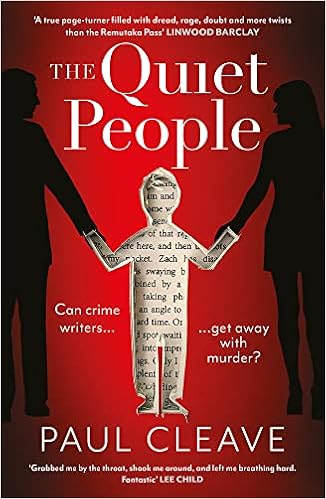
Review of THE QUIET PEOPLE by Paul Cleave

 4 Stars

This is the first book I’ve read by this author; it will definitely not be my last.

Cameron and Lisa Murdoch are successful writers of crime fiction living in Christchurch, New Zealand.  One morning, after threatening to run away, their 7-year-old son Zach goes missing.  The police soon determine that Zach’s disappearance may actually have been an abduction.  In the past, Cameron and Lisa have joked that, because of their careers, they would probably be able to get away with murder.  That boastfulness is used against them.  Because Zach is a challenging and demanding child prone to tantrums, did his parents kill their son who is both a financial and emotional burden?  As the police turn their attentions to them, the couple also find themselves hounded by media.  The community quickly turns against them, especially when Dallas Lockwood, a man with a personal vendetta, uses social media to circulate misinformation and incite hysteria.  Will the Murdochs be able to prove their innocence?  Will Zach be found alive?

There are two alternating points of view.  One is that of Cameron; his sections are narrated in first person.  The second perspective, in third person, is that of Rebecca Kent, the detective in charge of the investigation.  This narrative technique allows the reader to understand the motivations of both Cameron and the police. 

The characterization of Cameron is certainly a strong element.  I often did not agree with his choices but my heart broke for him as he made those choices.  Because of his quick temper, he is a man prone to volatile reactions.  He has some very public meltdowns and those do not serve him well.  I couldn’t help but notice the similarities between him and Zach who also easily loses control of his emotions and behaviour.  Cameron has regular exchanges with Mr. What If, whom Cameron describes as “the voice of my imagination who comes out to play when I’m working.”  Unfortunately, when Cameron lets Mr. What If have the upper hand when he makes decisions, chaos usually follows. 

Cameron undergoes a sudden change after which he reacts extremely.  This metamorphosis may seem unrealistic, but if one considers the extreme situation he faces, it is not possible to just dismiss Cameron’s behaviour as unbelievable.  He is afraid about what has happened to Zach; he is angry at the police and others who seem to be focusing on him rather than looking for his son; and he feels guilty because he dismissed Zach’s threat to run away.  He starts to feel totally isolated because everyone seems to be turning away from him; even his wife pulls away from him.  Obviously, one of the themes is an examination of what a person is capable of doing when placed under unimaginable pressure.

The novel also explores how people jump to conclusions, how easily public opinion can be swayed, and how mob mentality takes over.  Lockwood, for example, is able to turn the community into a frenzied mob just by making sly innuendos.  Though there is no solid evidence, public opinion quickly turns against the Murdochs; “’the media and the public think for a crime writer to write dark and twisted material, you must be dark and twisted.’”  The police also make assumptions which cause them to make mistakes in the investigation.  I disliked the portrayal of the police as inept but the ending does explain how they are manipulated to follow red herrings. 

Anyone who enjoys action-packed thrillers should read this book.  The suspense begins in the prologue and there’s no abatement.  Astute readers who stop to question statements or behaviour will pick up clues, but it’s so difficult to slow down on the twisty roller coaster ride that is this book. 

Thursday, February 24, 2022

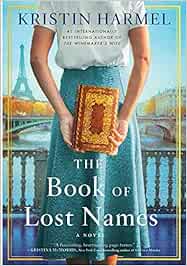
Review of THE BOOK OF LOST NAMES by Kristin Harmel

 2 Stars

This book has such a promising premise, but it fails in execution.   

The novel opens in 2005.  Eighty-six-year-old Eva Traube Adams is a semi-retired librarian living in Florida.  When she sees the photo of a rare book in a New York Times article, she flies to Berlin to claim it.  The majority of the novel, however, flashes back to Paris during the Nazi occupation.  We learn that Eva is the French-born daughter of Jewish immigrants from Poland.  When her father (Tatuś) is taken away in one of the roundups of Jews in 1942, Eva and her mother (Mamusia) escape the city.  Eva then becomes a forger, making false documents to help smuggle Jewish children into Switzerland.  Knowing that some of the children are so young that they will not remember their real names, she and Rémy, a fellow forger, come up with a scheme to record their true identities. 

The plot is implausible.  For instance, Eva has no artistic training; all she does is doodle in a notebook, “a nervous habit that dated back to her childhood.”  Nonetheless, on her first attempt she makes documents that are good enough to pass inspection and get her and her mother to safety, and in virtually no time, she is a master forger.  If Tatuś wants Eva to have false papers and he has already paid for them with his life savings, why wait until the last minute to get those papers?  Conveniently the forger reneges on his promise so that Eva has to forge her own papers!  Merely to deliver some paper that can be used for false documents, a man insists on meeting Eva in person and alone?  This meeting is just plot manipulation to bring together two characters.  In the middle of a war at a particularly dangerous time, a man is able to find an English copy of The Adventures of Tom Sawyer and place it in a specific spot?

Then there’s the book in which Eva and Rémy record children’s real names along with their new identities.  They construct a code that they share with no one.   What value does the book have if only three people know about it and only two can decode it?  In the end it becomes a cheap device to add a romantic element. 

Characters are unconvincing.  Eva, for example, comes across as naïve and stupid.  She has kept a pair of leather boots beside her bed “for the past year in case she needed to flee” but she has made no other preparations?  The questions she asks Rémy when she first meets him are intended to give the reader information, but they make her seem stupid.  When she finally understands where Rémy finds names for his documents, he says, “’You are bright’” but his earlier comment that her intelligence has been oversold is much more accurate.  On the train trip to Paris with Rémy, she doesn’t seem to understand that they have to pretend to be a couple?  She is told, “’Eva, you can’t tell anyone my real identity,” yet she immediately tells her mother?  For everyone’s safety, personal details should not be shared but she divulges those to several people? 

Eva is also very shallow.  We get no sense of the depth of her faith.  She identifies as a Jew, but her observance is inconsistent.  Mamusia is very bothered by Eva’s possible relationship with a Catholic but Eva seems concerned only because of her mother’s reaction.  Her interior monologues consist of little real reflection other than questions:  “But how could that be when he wasn’t Jewish?  Her mother would never forgive her, and what if Tatuś wouldn’t, either?  How could she betray them now? . . . Would it be braver to follow her heart at the risk of failing her parents?  Or braver to turn her back on a person she was forbidden to love so she could preserve the history being stripped from her people?”  And, “Why had Eva let that define her life?  Her future?  And what if [he] never returned?  What if he didn’t survive the coming months?  What if Eva herself perished?” 

To be perfectly honest, Eva is annoying.  First, she is always blaming herself, even for things over which she had no control.  This tendency to self-blame may be because of the belittling comments made by Mamusia, but her willingness to accept that everything is her fault suggests immaturity.  Then there’s her constant fretting about whether Rémy knows she loves him.  The repetition becomes tedious.  He’d have to have no intelligence whatsoever to not know!

Mamusia is another character who is unbelievable.  Not to mention unlikeable.  She is constantly complaining and blaming her daughter.  Eva tried to warn her parents about a possible roundup but she dismisses the warning as ridiculous.  Later, she tells Eva, “’You let them take him!  You knew they were coming and you just stood there and did nothing.’”    And “’I’m disappointed in you, Eva, more disappointed than I’ve ever been.’”  She doesn’t worry about Eva’s safety; instead, she just insists Eva go find Tatuś.  She has no gratitude to those who have helped:  “’So the priest gave you a bit of information.  And Madame Barbier prepared us some food.  So what?’”  Much of the time, she sounds like a whiny child:  “’You are in your own world, Eva, and there’s no room for me in it. . . . An apology won’t return your father to me.’”  She does nothing to help the Jewish children who need to be sheltered, just spends her time – years – feeling sorry for herself.

Characters change, but those changes are not realistic.  Mamusia goes from constantly denigrating her daughter to defending her?  A man goes from speaking about a woman “’with a special kind of warmth’” to calling her “’pathetic cow’” and threatening her with torture and an excruciating death?  Extreme circumstances do cause behaviour changes but, again, the author is manipulating readers’ emotions.

Given the events of the Holocaust, word choice seems poor.  Eva thinks, “There was nothing to do but walk into the fire and hope she wasn’t burned alive”?  Then there’s a description:  “Loss would forever be etched on the child like a tattoo.” 

The author can be commended for her extensive historical research, but to promote the book as based on a true story is deceptive.  And there is so much wrong with this book, besides those elements I’ve already mentioned:  the many plot holes, the contrived, unnatural dialogue, the predictable plot, the coincidences, and the unnecessary drama.   This book will appeal to those who like sentimental books and Hallmark movies.   

Monday, February 21, 2022

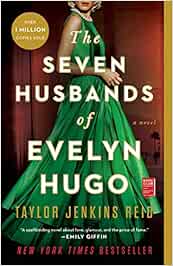
Review of THE SEVEN HUSBANDS OF EVELYN HUGO by Taylor Jenkins Reid

 3.5 Stars

This historical fiction book was an excellent choice for an audiobook.

In 2017 at 79 years of age, Evelyn Hugo, a Hollywood legendary star, approaches a magazine about giving an interview.  Her condition is that it be conducted by Monique Grant, a young and inexperienced journalist.  When Monique arrives, she discovers that Evelyn actually wants Monique to write her biography to be published only after Evelyn dies.  Of course, Monique agrees, and what follows is Evelyn’s describing, in chronological order, her marriages to seven different men. 

Though the novel is divided into parts named after each husband, Evelyn’s story actually focuses more on her experiences navigating Hollywood from the 1950s to the 1980s to achieve stardom.  Not only must she contend with a male-dominated film industry, but she also has to cope with celebrity gossip magazines whose sensationalistic stories could destroy an acting career. 

Evelyn is an interesting, complicated, flawed character who lives on her own terms.  She is unapologetically ambitious and has no qualms about manipulating people to get what she wants.  As she admits, she is very selfish, though she can also be very generous.  Her courage, determination, and loyalty towards those she loves are admirable, yet her actions have consequences, sometimes tragic, for others.  She emerges as a character the reader will both admire and despise. 

A mystery throughout is why Evelyn choose Monique, a largely unknown journalist, to write her biography.  She could have chosen anyone she wanted to write a book that would undoubtedly be a best seller.  It is only at the end that Evelyn’s motivation is revealed.  This revelation is the only truly shocking twist; most of the rest of the novel is predictable.  That revelation is also emotionally devastating for Monique and leaves the reader reassessing his/her opinion of Evelyn. 

The book does address some serious issues like race, sexuality, misogyny, and homophobia so it is not pure fluff.  The style, however, makes it an effortless read which didn’t require me to analyze too much.  I prefer lighter fare for audiobooks, and this one certainly kept me entertained on morning walks. 

Thursday, February 17, 2022

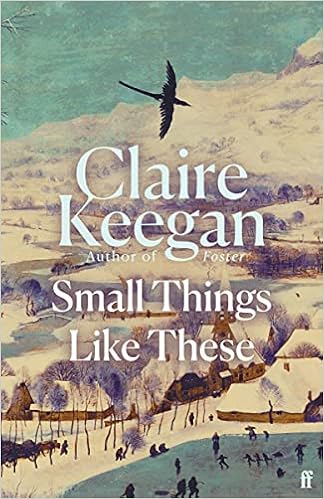
Review of SMALL THINGS LIKE THESE by Claire Keegan

 4.5 Stars

This novella, which says a great deal in a few words, will not leave you unaffected.

Bill Furlong is a 39-year-old fuel merchant in New Ross, County Wexford, Ireland.  He is also a family man with a wife and five daughters.  Making Christmas deliveries, he finds a young woman locked in the coal shed of the Catholic convent.  The nuns operate St. Margaret’s “the only good school for girls in the town” but also a training school where “girls of low character . . . spent their days being reformed, doing penance by washing stains out of the dirty linen, that they worked from dawn til night.” 

Seeing what he does, Bill faces an internal conflict:  “he felt his self-preservation and courage battling against each other.”  He needs to provide for his family and his wife Eileen warns him about the importance of staying “’on the right side of people’” and that may mean turning a blind eye:  “’If you want to get on in life, there’s things you have to ignore, so you can keep on.’”  Rumours spread quickly and Bill notices that a store clerk “the well-dressed woman behind the counter, the wife of one of his good customers, didn’t seem overly eager to serve him.”  Bill knows full well that “It would be the easiest thing in the world to lose everything.”

On the other hand, Bill remembers that his mother could have faced a similar fate to the girls in the training school/commercial laundry.  She was only sixteen when she was pregnant with Bill but fortunately had the help of her employer who also became a protector for Bill.  He can also not but ask, “’But what if it was one of ours?’”  And he can’t help but ask, “was there any point in being alive without helping another?  Was it possible to carry on along through all the years, the decades, through an entire life, without once being brave enough to go against what was there and yet call yourself a Christian, and face yourself in the mirror?” 

The power of the nuns is emphasized.  The convent “was a powerful-looking place on the hill at the far side of the river with black, wide-open gates and a host of tall, shining windows, facing the town.”  A businesswoman also advises Bill:  “’surely you must know these nuns have a finger in every pie.’”  The Mother Superior warns Bill that his interference could have consequences; knowing that Bill wants his daughters to attend St. Margaret’s, she says, “’It’s no easy task to find a place for everyone.’” 

The wealth of the convent is also mentioned:  it is, for example, heated with “Furlong’s best coal.”  Financial gain seems to be a priority; at a social function, “the nuns walked around, supervising and talking to some of the more well-off parents.”  Mother Superior can give Bill a fifty-pound note, really as a bribe, and the nuns “always pay what was owing and on time unlike so many who would put everything on the slate.”  The nuns are able to spend money on their garden (“Year round, the front garden was kept in order with shaved lawns, ornamental shrubs growing neatly in rows, the tall hedges cut square”) but meanwhile “The dole queues were getting longer.”  Bill, on the other hand, is so generous that Eileen comments on his being “soft-hearted.”   “More than a few times, Furlong stopped to leave a bag of logs at the doors of those who had given him the business, when they could afford it.”  Christian charity seems not to be found amongst the Good Shepherd nuns.

The cruelty of the nuns is in no doubt, but the Catholic Church at large is not blameless:  Bill thinks about speaking to the parish priest about his suspicions about the convent but concludes “the priests already knew.”  The community is also responsible for enabling the nuns:  Bill mentions that “’they’ve only as much power as we give them.’”  And by disregarding what is going on, they perpetuate the suffering of the young women.  Eileen is typical of those who are fearful and selfish:  she is concerned about her daughters but argues “’what do such things [as are going on at the convent] have to do with us?’” 

At the end of the novel, there’s a note about the number of girls and women who “suffered time in Ireland’s mother and baby homes and Magdalen laundries.”  It is horrifying to read that “Most of the records from the Magdalen laundries were destroyed, lost, or made inaccessible. . . Many girls and women lost their babies.  Some lost their lives.  Some or most lost the lives they could have had.  It is not known how many thousands of infants died . . . These institutions were run and financed by the Catholic Church in concert with the Irish State.”  As a Canadian, I couldn’t but notice the parallels with Canada’s residential schools and the recent discovery of unmarked graves at those institutions.    

This book wastes no words.  Every word seems to have been carefully chosen.  For instance, lengthy academic essays could be written about the author’s use of imagery (crows, blackness) and allusions to Nativity scenes and the novels of Charles Dickens.  But even without detailed analysis, the novella’s emotional impact is undeniable. 

And why not listen to “The Magdalene Laundries” by Joni Mitchell for another artistic retelling of the horrific story of these institutions?

Monday, February 14, 2022

Review of THE FINAL CASE by David Guterson

 3.5 Stars

I loved Guterson’s Snow Falling on Cedars but was unimpressed by his Ed King (https://schatjesshelves.blogspot.com/2017/10/archival-review-of-ed-king-by-david.html).  Because it’s been a decade since I last read this author, I decided to give him another try when I discovered a new novel had been released.  This one left me puzzled at times.

The narrator is a successful novelist who has given up writing.  His father Royal, 83, is a criminal lawyer reaching the end of his career.  In what he knows may be his last case, Royal agrees to defend Betsy Harvey, a Christian fundamentalist who, along with her husband Delvin, is accused of murdering her foster daughter Abeba .  Almost immediately after her arrival from Ethiopia, Abeba was abused; Betsy and Delvin are charged with homicide by abuse.  Royal is unable to drive so his son becomes his driver and attends the trial.  The book, however, is not really a courtroom drama.  When the trial comes to a precipitous end, the focus switches to the narrator’s personal and family concerns. 

The book examines the justice system.  Royal’s life has been devoted to the law and justice, often taking pro bono cases.  He believes everyone deserves a defender no matter what he/she has done; he argues that a criminal attorney must put aside his/her personal feelings and force the state to provide a solid case and accurately apply the law:  “’They might have done the most evil things you can imagine, and you can abhor them for it, but if what they did doesn’t conform to what they’re charged with, then they’re innocent.  And that’s important.  If you convict someone because they’re abhorrent, and not because they broke the law, you might as well live in a dictatorship.  And who wants that?  I don’t.  And another thing.  I play a role according to my lights and I’m at peace with myself.’”

In many ways, Royal sounds like Atticus Finch in To Kill a Mockingbird.  For instance, Royal says that trials are not like those shown on television where a last-minute discovery proves the defendant’s innocence.  He thinks he will lose this case:  “’So you end up doing the best you can while knowing, from experience, that it’s useless, it’s hopeless, and that if you’re going to take any satisfaction from your work, it’s going to have to come with losing.’”  Atticus says much the same to his children:  “’[Courage] is when you know you’re licked before you begin but you begin anyway and you see it through no matter what.  You rarely win, but sometimes you do.’” 

The reader will feel disoriented when the trial ends abruptly and the novel is no longer a courtroom drama.  The last one-third of the novel meanders.  It covers a lot of topics like the craft of writing, the predicament of being a white male in contemporary society, and the misrepresentation of tea drinking by Russian writers of the 18th and 19th centuries.  I could find little connection among these digressions and I haven’t been able to determine their purpose.  In some of these disjointed passages are rambling sentences of 240+ words which, though grammatically correct, leave the reader gasping.

What does stand out for me is the contrast between the Harvey family and the narrator’s.  In the course of the novel, the reader meets Betsy, her parents, and several of her children.  What emerges is a family where discipline is the focus.  Betsy’s mother, for example, goes on a pages-long angry and hate-filled rant:  “’The world’s a terrible place in her head, filled with terrible, horrible people who are one hundred percent wrong about absolutely everything.”  The judge perfectly describes the family in her summation.  On the other hand, the narrator’s family (wife, parents, and sister) are decent, dutiful, supportive, and loving – ordinary people trying to do the best they can.  Even when faced with a death, they accept death as “an eternal human norm” from which they are not exempt and they acknowledge there are things to be grateful for in the manner of that death.

The overwhelming feeling is of one of sadness:  Royal repeats, “’Sad case,’ he said.  ‘Very sad.’”  and “’Well, first, the main thing is how completely sad it is.’” and “’The whole thing was sad.  To tell you the truth, a lot of things in my work are sad.  It’s sort of a sad world to have to move around in.’”  The narrator agrees:  “everything about this case was sad, and that without much effort you could make the leap from the facts of this case to a very sad portrait of the human race.”  Abeba, before she leaves Ethiopia, is given a book with the warning that “it had been written for adults and was sad.”  A friend tells her to still read it:  “if it’s sad, so what, too, you already know about sadness, there can’t be anything in the book sadder than what you already know.”  The dramatic irony cannot be missed. 

Despite this sadness, the message of the book, as stated in the last sentences, seems to be to love people:  “’We can love people . . . What else is there?’”  Loving people does not mean “’disciplining out of love’” like the Harveys.  Unlike Abeba’s adoptive family who could not accept her, the narrator’s mother speaks of her admiration for someone “’who understood what it meant to respect somebody and love them for who they are and not wish for them to be different, or need them to be different.’”  And because we are, like the song the narrator plays in a jukebox,  just dust in the wind and “we’re all just passing through,” perhaps we should try to find beauty where we can:  “’dream of evanescence, and linger in the beautiful foolishness of things.’”

A re-reading of this book would probably be useful and revelatory, but it didn’t hold my interest sufficiently to entice me to read it again, at least not yet. 

Friday, February 11, 2022

Review of FALL by West Camel

 5 Stars

I couldn’t help but fall for Fall.  There is so much to unravel in this multi-layered novel that I could write several critical analysis articles.

Aaron and Clive Goldsworthy are 62-year-old twins who have been estranged for over 40 years.  Aaron is the sole occupant of Marlowe Tower, part of a 1970s housing development designed by their mother Zöe on the banks of the Thames in southeast London.  Clive is a successful property developer who wants to turn the tower into luxury flats, but Aaron refuses to move.   When Annette and Christine Mayfield, a pair of black twins who lived in the tower in the 1970s, move back in, both Aaron and Clive must confront what happened the summer of 1976 and its aftermath. 

From the beginning, there are many unanswered questions:  Why are the twins estranged?  Flashbacks to 1976, when the two were 18, show them being so close that they have a psychic connection.  Now they live across the river from each other but haven’t communicated for four decades.  What happened?  Why do both of them fear the return of the two black women?  When Aaron and Clive first met this slightly older pair of twins, they were immediately drawn to them and spent a great deal of time in their company. 

Characterization is amazing.  All characters are complex and flawed; in other words, they are realistic.  At times I would feel compassion for someone and at another time, frustration with them.  What especially impressed me is the characterization of the twins.  Both direct and indirect characterization techniques are used.  We are told that “Clive dislikes – intensely dislikes – having his plans thwarted” and that Aaron is so “infuriatingly obdurate” that he “can never be persuaded of anything.”  Then we are shown these traits in their actions and thoughts.  I had no difficulty distinguishing Aaron and Clive.  Clive is the leader in that he is more forthright, whereas Aaron is rather diffident.  The same is true of the women:  Annette is more like Clive, while Christine is more similar to Aaron. 

I found Zöe such a fascinating character that I’ve added her to my list of fictional characters I’d love to meet in real life.  She is a strong, forceful person with a take-charge attitude.  As an architect, she is able to help dictate how people move around, and she tries to do this with her family as well.  It becomes obvious, however, that her sons do not know her as well as they think.  Aaron’s comment that Zöe is complicated is really an understatement.  As an architect, she struggled in a male-dominated field and had to make difficult choices between motherhood and professional advancement.  Though she tried to build a space where people from different walks of life would live together and even moved her family there, she continued to send her sons to schools outside the area.  Though supposedly concerned with egalitarianism, her including secret corridors and hidden doors in the building just for herself and her sons suggests a sense of ownership and superiority.  I found myself aghast at some of her choices and in awe of others, but always she behaves in keeping with her personality and priorities.

Though it is Zöe who is described as having a God complex, the narrator also behaves like a divine entity.  The omniscient point of view is carried to an extreme.  In the novel’s opening, for example, the reader is given a bird’s eye view of London before being invited to swoop down:  “We can drop even lower” and “And you might, if you trusted your wings enough to take you down even further, notice . . .”.   The narrator has unlimited access to all his characters and reveals their thoughts and gestures in minute detail, thereby developing character - though he also withholds information to create suspense.  It is the point of view that makes for such a satisfying closing in the last chapter. 

The book examines a number of issues; one of the major ones is racism.  Annette and Christine experience prejudice on a regular basis once they move into the housing complex.  As events unfold, it becomes clear that racism determines the fates of virtually everyone, not just those of the black characters.  Zöe’s options, for instance, are restricted not just because of gender discrimination but also because of society’s attitudes towards blacks.

The title is perfect because it works on so many levels.  There are physical falls, fallings-out, and lives falling apart.  The housing estate is falling apart.  Reading the novel is a process of slowly watching everything fall into place.  And how perfect is it that the last word in the book is fall!?

There is so much more I could discuss because there are so many admirable qualities:  the elegant prose, the symbolic use of architecture, and the subtly foreshadowed plot twists.  There is a great deal of tragedy because so much is lost by so many, but that does not mean there is no hope.  I could criticize the slow pace at the beginning and some coincidental meetings , but that would be caviling.  This is an extraordinary novel, both immersive and impactful. 

Tuesday, February 8, 2022

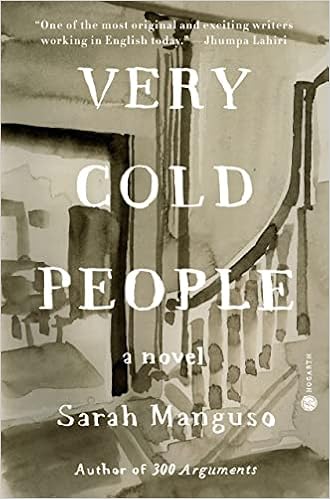
Review of VERY COLD PEOPLE by Sarah Manguso (New Release)

 3.5 Stars

This coming of age novel begins in the 1980s in Waitsfield, Massachusetts.  The narrator Ruth comes to see the town as a place to survive until she can leave.  She has to get away or she won’t be “any better than anyone else in that shit-frozen town.”

Ruth grows up in a town once home to America’s oldest and most illustrious families.  She begins by stating, “My parents didn’t belong in Waitsfield”:  her father is Italian, her mother is Jewish, and the family struggles financially.  Slowly, Ruth realizes that the town’s façade conceals dark secrets, and silence has allowed the perpetuation of violence and abuse. 

The book does not have a traditionally structured plot.  In short paragraphs, Ruth recounts different events as they come to mind.  The result is a string of fragmented, stream-of-consciousness vignettes suggesting a series of snapshots organized in random order, though there is a general sense of chronology.  There is little dialogue. 

There is a focus on showing, not telling.  Ruth describes events but doesn’t explain their significance because she often does not understand their importance.  The reader is left to determine the implications of what she describes.  She often senses something is wrong but cannot articulate it.  When a girl introduces herself in a way that is revelatory to the reader, Ruth only comments, “I remember there were so many horse chestnuts on the ground.”  One time, Ruth goes to a movie with her mother who “put the popcorn cup on the floor between her feet and leaned back in her chair and held on to the insides of her ripply thighs, her fingers reaching down and around them.  Every few moments, one of her hands twitched.  She closed her eyes halfway and rubbed her tongue all around her teeth.”  Yikes!  Yet Ruth’s comment is “I don’t remember anything about the movie.”

At one point, Ruth is told by an aunt that “you are very cold, cold people” and Ruth says, “I know.” Ruth’s parents, especially her mother, are indeed cold and distant.  Her mother is narcissistic:  “She was the protagonist of everything.”   She goes to a school reunion and “thought everyone had come to the reunion to watch her attend the reunion.”  There’s a bizarre episode that stands out:  “One day my mother asked me what color my eyes were. . . . She had no idea that a normal person would find it insane for a mother to ask her only child what color her eyes were.”  When Ruth shows promise in some activity, her parents mock her; for instance, Ruth seems to have some musical talent but she is not encouraged to pursue her interests:  “I listened to music through headphones.  I couldn’t let my mother find out what I liked because she would jeer at me for liking something, and then she would take it away.”  Ruth’s father is not much better:  “You must be the only person in the world whose hair looks dirtier after you wash it, my father crowed, my mother watching him approvingly.”

The neglect and emotional abuse she suffers has an effect on Ruth.  She has virtually no self-esteem and confidence.  She is fearful, “fearful of finding myself somewhere I didn’t have the skills or character or constitution to endure.”  She constantly feels shame:  “I took the shame and packed it into my body along with all the shame that had come before.  It was my birthright.”  She engages in self-harm:  she pulls out her eyebrows and eyelashes though she allows herself “only five lashes per day, since more than that would leave gaps that made people ask questions.”  When someone treats her kindly, she cries:  when a father’s friend helps her with her bike, she comments, “His kindness was so potent, I could hardly breathe.”

This is not a hopeful book.  Abuse is piled on top of abuse.  Ruth is mentally and emotionally scarred and several of her friends cannot escape abusive situations except through drastic means.  The point seems to be to emphasize that abuse has multi-generational effects and it is very difficult to escape.  Readers need to be forewarned that they may reach the end of the book feeling scarred.  Personally, I can’t say that I enjoyed reading it. 

Note:  I received a digital galley from the publisher via NetGalley,  Quotations may be slightly different in the final copy.