Ranked a Top Canadian Book Blog
Twitter: @DCYakabuski
Facebook: Doreen Yakabuski
Instagram: doreenyakabuski
Threads: doreenyakabuski
Substack: @doreenyakabuski
Bluesky: @dcyakabuski.bsky.social

Sunday, December 31, 2023

SCHATJE'S FAVOURITE BOOKS OF 2023


Schatje's Favourite Books of 2023

Of the 110 novels I read this year, here are my favourites.  The vast majority were published in 2023.  It’s been a great year of reading!


Fiction by Canadians

Since I’m Canadian, I read a lot of novels written by Canadians.  Here’s my baker’s dozen of favourites.

The Adversary by Michael Crummey https://schatjesshelves.blogspot.com/2023/09/review-of-adversary-by-michael-crummey.html

The Observer by Marina Endicott https://schatjesshelves.blogspot.com/2023/11/review-of-observer-by-marina-endicott.html

The Good Women of Safe Harbour by Bobbi French https://schatjesshelves.blogspot.com/2023/04/review-of-good-women-of-safe-harbour-by.html

The Forcing by Paul E. Hardisty https://schatjesshelves.blogspot.com/2023/02/review-of-forcing-by-paul-e-hardisty.html

Snow Road Station by Elizabeth Hay https://schatjesshelves.blogspot.com/2023/04/review-of-snow-road-station-by.html

The Story of Us by Catherine Hernandez https://schatjesshelves.blogspot.com/2023/03/review-of-story-of-us-by-catherine.html

Gin, Turpentine, Pennyroyal, Rue by Christine Higdon https://schatjesshelves.blogspot.com/2023/09/review-of-gin-turpentine-pennyroyal-rue.html

Rage the Night by Donna Morrissey https://schatjesshelves.blogspot.com/2023/09/review-of-rage-night-by-donna-morrissey.html

The Berry Pickers by Amanda Peters https://schatjesshelves.blogspot.com/2023/06/review-of-berry-pickers-by-amanda-peters.html

The Imposters by Tom Rachman https://schatjesshelves.blogspot.com/2023/06/revie-of-imposters-by-tom-rachman.html

All the Colour in the World by C S Richardson https://schatjesshelves.blogspot.com/2023/01/review-of-all-colour-in-world-by-cs.html

Everything There Is by M. G. Vassanji https://schatjesshelves.blogspot.com/2023/09/review-of-everything-there-is-by-m-g.html

Far Cry by Alissa York https://schatjesshelves.blogspot.com/2023/02/review-of-far-cry-by-alissa-york-new.html


American Fiction

Here are my “top 5” American novels read in 2023.

Baumgartner by Paul Auster https://schatjesshelves.blogspot.com/2023/11/review-of-baumgartner-by-paul-auster.html

48 Clues into the Disappearance of My Sister by Joyce Carol Oates https://schatjesshelves.blogspot.com/2023/03/review-of-48-clues-into-disappearance.html

Tom Lake by Ann Patchett https://schatjesshelves.blogspot.com/2023/11/review-of-tom-lake-by-ann-patchett.html

The End of Drum-Time by Hanna Pylväinen https://schatjesshelves.blogspot.com/2023/08/review-of-end-of-drum-time-by-hanna.html

Stealing by Margaret Verble https://schatjesshelves.blogspot.com/2023/02/review-of-stealing-by-margaret-verble.html


Fiction from United Kingdom

These are my “top 10” 2023 books written by authors from either England or Ireland.

All the Little Bird-Hearts by Viktoria Lloyd-Barlow https://schatjesshelves.blogspot.com/2023/12/review-of-all-little-bird-hearts-by.html

Old God’s Time by Sebastian Barry https://schatjesshelves.blogspot.com/2023/04/review-of-old-gods-time-by-sebastian.html

eden by Jim Crace https://schatjesshelves.blogspot.com/2023/08/review-of-eden-by-jim-crace-new-release.html

The Wren, The Wren by Anne Enright https://schatjesshelves.blogspot.com/2023/11/review-of-wren-wren-by-anne-enright-new.html

The Fascination by Essie Fox https://schatjesshelves.blogspot.com/2023/07/review-of-fascination-by-essie-fox.html

Trespasses by Louise Kennedy https://schatjesshelves.blogspot.com/2023/05/review-of-trespasses-by-louise-kennedy.html

Strange Sally Diamond by Liz Nugent https://schatjesshelves.blogspot.com/2023/07/review-of-strange-sally-diamond-by-liz.html

The Queen of Dirt Island by Donal Ryan https://schatjesshelves.blogspot.com/2023/02/review-of-queen-of-dirt-island-by-donal.html

ONE by Eve Smith https://schatjesshelves.blogspot.com/2023/09/review-of-one-by-eve-smith.html

So Pretty by Ronnie Turner https://schatjesshelves.blogspot.com/2023/01/review-of-so-pretty-by-ronnie-turner.html


International Fiction

These are my “top 5” 2023 books by authors from countries other than Canada, U.S., England or Ireland.

His Favourite Graves by Paul Cleave (New Zealand) https://schatjesshelves.blogspot.com/2023/11/review-of-his-favourite-graves-by-paul.html

Magma by Thóra Hjōrleifsdóttir (Iceland) https://schatjesshelves.blogspot.com/2023/05/review-of-magma-by-thora-hjorleifsdottir.html

Someone Like Her by Awais Khan (Pakistan) https://schatjesshelves.blogspot.com/2023/10/review-of-someone-like-her-by-awais-khan.html

Stolen by Ann-Helén Laestadius (Sweden) https://schatjesshelves.blogspot.com/2023/02/review-of-stolen-by-ann-helen.html

Return to Valetto by Dominic Smith (Australia) https://schatjesshelves.blogspot.com/2023/06/review-of-return-to-valetto-by-dominic.html


Favourite Crime Series

I read the latest instalments in some favourite crime series.  Here are my top five.

You Can’t See Me by Eva Björg Ægisdóttir https://schatjesshelves.blogspot.com/2023/07/review-of-you-cant-see-me-by-eva-bjorg.html - the 4th in the Forbidden Iceland series

The Opposite of Lonely by Doug Johnstone https://schatjesshelves.blogspot.com/2023/10/review-of-opposite-of-lonely-by-doug.html - the 5th book in the Skelfs series

Killing Moon by Jo Nesbø https://schatjesshelves.blogspot.com/2023/06/review-of-killing-moon-by-jo-nesb-new.html - the 13th in the Harry Hole series

Dead and Gone by Joanna Schaffhausen https://schatjesshelves.blogspot.com/2023/08/review-of-dead-and-gone-by-joanna.html - the 3rd in the Detective Annalisa Vega series

White as Snow by Lilja Sigurðardóttir https://schatjesshelves.blogspot.com/2023/10/review-of-white-as-snow-by-lilja.html - the 3rd in the Árora Investigation series

Thursday, December 28, 2023

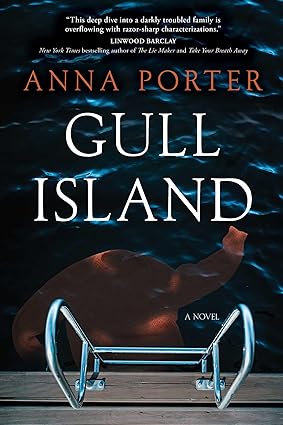
Review of GULL ISLAND by Anna Porter

 2.5 Stars

This book was a major disappointment.

Jude Bogdan returns to her family’s cottage on a private island in Georgian Bay.  Her mother, who is dealing with encroaching dementia, wants Jude to look for her father’s will after his mysterious disappearance a month earlier.  Besides searching for the will, Jude also scours her memories and looks through old photos for evidence that she was loved.  But all she finds and remembers is a dysfunctional family with a distant mother, a cruel father, a jealous sister, and her mother’s mysterious friend Eve. 

It becomes clear early on that Jude is an unreliable narrator.  She spends most of her time operating in a fog of alcohol so her memories are clouded.  She drinks so much she doesn’t remember how much she drinks and even experiences blackouts.  While at the cottage, she has to contend with solitude, darkness, and wildlife.  The crows and gulls seem hostile, and she keeps hearing strange noises and encountering foul odours.  The reader cannot but wonder what is real and what are just overwrought imaginings or inebriated hallucinations.  Jude even questions her own sanity.

And things are complicated by the fact that we are given only Jude’s point of view:  we are privy only to her version of events and her perception of what is happening.  In the present, she never interacts with anyone; only in flashbacks is there any direct dialogue.  Since no one else is present, the reader has no way of gauging the accuracy of Jude’s reactions to what she sees and hears.  Jude’s narration often goes in circles as she returns to objects or events, but the reader is left to try and determine if these repetitions have deeper meaning or implications. 

I found it difficult to connect with any of the characters.  They are all unlikeable.  Mother never hugged Jude; her sister Gina saw her son William only as a burden; and Father can only be described as a monster.  Actually Murray Bogdan is almost a cartoon villain; he’s unfeeling, self-centred, and emotionally and physically abusive.  He’s involved in unsavoury business dealings and enjoys killing animals.  Of course, everything we learn about him is through Jude so the reader must be cautious of her vilifications.

Jude discovers some facts about her past and her family members while she is at the cottage.  I don’t know whether these discoveries were intended to be shocking, but they’re not.  What she learns about her birth, Scoop’s death, William’s death, and her father’s illegal business transactions are obvious almost from the beginning.

The one surprise is the ending.  It is abrupt and will undoubtedly leave the reader confused.  I understand what Jude did and why, but . . . there are many unanswered questions.  Normally, I’d go back and re-read the book to see what clues I’d missed, but I was so bored while reading it that I am not going to repeat the drudgery.

I cannot recommend this book.  It’s very slow.  Jude is frightened by noises she hears, and I assume these are supposed to create suspense.  I found, however, that because they are mentioned so often, they just become annoying.  Maybe if I were to read it while alone on a remote island I might have a different reaction. 

Tuesday, December 26, 2023

Review of COLD SNAP by Maureen Jennings

 2 Stars

I decided to read this third installment of the Paradise Café Mysteries.  I know a fourth book is planned for next year, but this will be the last one I read.

It is December 1936.  As foreshadowed in November Rain, Charlotte Frayne’s boss, has brought a Jewish refugee from Germany to Canada.  Charlotte has been asked to help protect that man, Stephen Lucas, who has documents that could supposedly change the government’s attitude to Nazi Germany.  There are people who are trying to prevent that information from being passed on. 

As in the previous books, there is a second case.  Charlotte’s estranged mother Moira reappears; she asks her daughter to find a son, Charlotte’s half-brother, whom she gave up for adoption two decades earlier.  Of course the two cases converge, again in a very contrived way.  What are the chances that for the third time in months, Charlotte is tasked with two cases simultaneously and they connect as in the previous two instances?!

This book is repetitious in other ways as well.  There are several meetings held at the Paradise café where a pattern emerges:  Cal’s daily menu is described; Pearl, the waitress, makes some caustic comments; and there is a disagreement between Hilliard and Wilf as to the entertainment being planned.  Again, Charlotte is co-opted by the police to take notes at interviews.  Then Detective-Inspector Jack Murdoch shares significant findings with her and even asks her to accompany the police to a potentially dangerous arrest.  Police would never involve civilians like this. 

I was really irked by the repeated delays.  Characters don’t share information, stating that they will do so at a later time.  Then Charlotte wants to share with others, but always seems to be out of time.  People whom Charlotte interviews, like Sister Ambrose and Mrs. Stafford, have only a few minutes to spare so Charlotte has to return a second time. 

And then there are the inconsistencies.  On page 258, Charlotte makes notes of a conversation and lists the four people in attendance.  Then, on page 266, Pearl bursts into the room calling for Hilliard, yet he is not one of the four present and there’s no indication he came in at any point.  On page 144, Mrs. Stafford states unequivocally that she would never show anyone the content of a resident’s box without his consent, but then, on page 295, she does exactly that?  Where was the editor? 

This series has deteriorated.  The first book, Heat Wave, offered some interesting historical information, but this one contains nothing new.  The plots in the second and third books follow the pattern established in the first.  Such formulaic plotting with unrealistic events has little interest for me.

Friday, December 22, 2023

Review of STILL LIFE by Louise Penny

 3 Stars

This is the first in the Chief Inspector Armand Gamache series.  It seemed time to get to this series after my husband and I watched Three Pines on Netflix and recently visited Knowlton, the town in the Eastern Townships in Quebec where the author lives.

Jane Neal, a well-respected, retired teacher and artist, is found dead, killed by an arrow.  Was it a hunting accident?  Or is there some connection to the fact that her first submitted painting was accepted for a local exhibition?  The impossibly charming village of Three Pines doesn’t have a police force so Gamache from the Sûreté du Québec is sent to investigate. 

Much of the book focuses on introducing the villagers:  artists Clara and Peter Morrow; poet Ruth Zardo; therapist/bookshop owner Myrna Landers; and Olivier Brulé and Gabri Dubeau, a gay couple who own a bistro and bed-and-breakfast.  They seem a cosmopolitan group.  I assume these characters will be regulars in successive books.  Of course, we also become acquainted with Gamache’s team, especially his second-in-command Jean-Guy Beauvoir and rookie Yvette Nichol. 

Armand is definitely likeable.  My problem is that he is almost flawless.  A soft-spoken mentor, he’s well-read, wise and introspective.  He has keen powers of observation and a gift for listening.  He is deeply empathetic and has a vast reserve of patience.  He is so principled that he’ll accept a suspension rather than arrest someone he believes is innocent.  What makes him less than perfect is that he does make errors but, of course, he acknowledges his mistakes and tries to learn from them. 

The characterization of some characters is problematic in that they’re almost cardboard characters.  Yolande, the self-absorbed social climber, has no redeeming qualities.  The other character who is unbelievable is Yvette Nichol.  I understand that as the daughter of immigrants she feels a lot of pressure to succeed, but she is so incompetent it is difficult to believe she ever received any training.  In addition, she is rude, self-absorbed, arrogant, and petulant.  And she’s so dense and oblivious that she doesn’t understand the message in the mirror about looking at the problem?!

The mystery itself is fairly simple and predictable.  Clues are sprinkled throughout, the biggest being the title.  The author obviously has an interest in human nature and psychology, though I found the murderer’s motive is rather weak.  The pace is slow; only one scene towards the end has any real action.  There is also a paucity of suspense.

Some plot elements are weak.  Characters who are suspects are allowed to uncover potential evidence and aren’t even supervised while doing so?  The explanation for how the murderer lured Jane makes little sense.  We are told she trusted him completely, but this can’t be true given what impels him to kill Jane. 

There are some awkward stylistic elements.  The perspective jumps among characters within scenes; this approach feels clunky.  I also dislike the evasive tactic of being told that something has been found or realized but not being told what that is until later.  I guess this is intended to create suspense but I just find it annoying. 

Despite its flaws, I found the book a pleasant companion on morning walks.  Anyone looking forward to a comfortable, unchallenging book set in a charming village full of quirky residents would enjoy it.  I have been told by several people who have devoured the entire series that the books improve in quality so I’ve already downloaded the next novel in the series. 

Monday, December 18, 2023

Review of A PECULIAR CASE by Ginette Guy Mayer

 2 Stars

I’ve been reading the Paradise Café mystery series because Maureen Jennings was the featured author of SD&G Reads, a library program in my area which encourages all residents across Stormont, Dundas, and Glengarry counties to read the same title before coming together for an evening with the author.  This series, set in the 1930s in Toronto, features a female private investigator.  Then I learned that there is a local author, Ginette Guy Mayer, who has also written a series of mysteries featuring a female investigator; the three books are also set in the 1930s but in Cornwall, Ontario.

Elizabeth Grant is a middle-aged widow who has opened a private investigations firm using a male persona, François Lefebvre.  She is hired by Albert Drew, a customs officer from Morrisburg, to find Josephine Smith, an antiquarian.  Drew gave her a rare book, a 1548 prayer book which purportedly belonged to Mary Queen of Scots, to determine its value.  Smith has been making excuses for not returning the book and Drew fears she has absconded with it.  Elizabeth agrees to take the case which ends up having links to the Fenians, a secret society of Irish patriots. 

From the beginning, I had difficulty with the premise.  In the prologue, the reader learns that Drew basically stole the book; he tells his friend Ernest Lawson that, “’I am cooked if caught.’”  A private investigator would be hired by a thief to track down an item he stole?  Lawson is a lawyer who is supposedly helping Drew, though the nature of his help is never clarified.  He, also in danger of being found out, agrees to the hiring of a P.I.? 

There are other events that have scant regard for credibility.  Smith is missing and then just appears so Elizabeth can follow her?  Elizabeth conveniently finds a bill of lading in a wastebasket when that piece of paper would have been needed by the owner?  Sometimes things are mentioned that are irrelevant but seem thrown in to confuse.  For instance, what is the purpose of the “discarded draft of a letter . . . asking for boxes to be shipped back to Cornwall’?  Other cases are added to the narrative for little apparent reason; these are left to Elizabeth’s nephew to investigate.  But it’s annoying when these cases are just dropped:  a question asked about a case on page 47 is never answered, even when the case is closed on page 51. 

I found myself confused more than once.  One minute Elizabeth works in a typing pool and the next she is working directly with a lawyer.  Instead of taking orders from his secretary, she has lunch with the lawyer himself “to go over what needed to be done”?  This lawyer doesn’t even know what his job is.  He tells Elizabeth, “’Canada is ideally positioned to provide intelligence to the British.  And that . . . is our role.’”  Then, one page later, the reader is told the lawyer’s job “was to see if any dealings and intelligence findings broke any laws of the country.”  Then, sentences later, he receives a telegram from an operative in Omaha, Nebraska, and decides the Department of Justice must “’move our contact out of the States’”? This lawyer is conducting intelligence operations?  And he shares sensitive information with Elizabeth at the end of her temporary placement in his office?

The book needs major editing.  There are comma splices on almost every page.  Verb tense is frequently misused.  Question marks are used when a statement is not actually interrogatory.  Paragraphs are indented, so why are there extra spaces between them?  Dialogue is very confusing:  it is often difficult to determine who is speaking because of unnecessary spacing and indentations.  There are some phrases which appear to be anachronisms.  (Chapter 17 with its switch to Josephine Smith’s point of view is also jarring.)

There is no doubt that the author is a history buff.  People interested in local history will find a great deal of it in the novel.  The problem is that there are several instances of information dumps.  Much of the first chapter is historical information about Cornwall.  There are even pages of photos included at the end of the book.

This book, at 121 pages, is short.  Even that length is more than necessary because there are irrelevant scenes.  For example, what is the purpose of the meeting at The Cornwall Club?  The community’s response to the downtown fire has no connection to the plot.  Is it really necessary to detail Elizabeth’s shopping for a car?  There is an obvious attempt to emphasize the perception of women’s roles in the 1930s, but the conversations on the topic could be more subtle and nuanced.

There are two other novels in the Elizabeth Grant series:  The Gale and The Literary Thread.  I will not be reading them.  This book lacks the suspense and intrigue I expect in a mystery, and the need for judicious revising and editing makes reading it a chore. 

Thursday, December 14, 2023

Review of ALL THE LITTLE BIRD-HEARTS by Viktoria Lloyd-Barlow (New Release)

 4 Stars

This book came to my attention when it was longlisted for the 2023 Booker Prize.  With its unique perspective, it made for a good read.

It is 1988 in England’s Lake District.  Sunday Forrester is a neurodivergent single mother living with her 16-year-old daughter Dolly.  She works in the plant nursery owned by her former in-laws.  Sunday and Dolly’s lives are upturned when Vita and Rollo rent the house next door.  Sunday has difficulty with social interactions but is happy in her encounters with Vita because she seems to accept Sunday as she is.  And Dolly, an impressionable teenager, is attracted to the excitement and glamour of Vita and Rollo’s lives, qualities not found in her staid life with her mother.  But all is not as it seems.

Though an official diagnosis is not given, Sunday, the narrator, seems to be on the autism spectrum.  She is a creature of habit; change really disturbs her so she strives for a life of consistent routine.  I loved her comment that “[Dolly] is all that I have loved more than adherence to my routines.”  She also tries to avoid sensory overload:  “I was born with this intolerance of noise and light, and an accompanying greed for touch and smell” so “I want my choices narrowed so that they do not become overwhelming.”

Sunday is very self-aware.  She knows how her behaviour is different and considered odd:  “Facial expressions typically tell me nothing more than what is said” and “it takes time and considerable effort for me to adjust my conversation or focus” and “I naturally speak in a monotone.”  To help herself in social situations, Sunday has virtually memorized an etiquette book from the 1950s. 

With her exuberant personality, the exotic, free-spirited Vita is Sunday’s foil.  Vita is glamourous, confident, and unpredictable, all things that Sunday is not.  Like almost everyone, Sunday is dazzled and captivated by Vita.  But Vita, lacking the ability to understand people’s motives and intentions, is an unreliable narrator, as she admits:  “the details I am drawn to are often secondary, and these often mislead.”  As a result, Sunday’s descriptions of Vita mean something different to the reader.  Statements like “[Vita] seemed entirely without curiosity or concern” and her having “a profound lack of interest in pleasing people” though she “had an unimaginable desire for company” and “needed constant attention” suggest that Vita is a narcissist.  And only later does Sunday see that Vita is manipulative:  “I had not properly understood, then, that people could be played like instruments to produce whatever sound you demanded of them.” 

As soon as Vita appears, I experienced a sense of unease which grew into a sense of foreboding.  Vita is so self-absorbed and has such a sense of entitlement that it seems she must have a hidden agenda, especially once she starts paying particular attention to Dolly.  Knowing that her daughter is so important in Sunday’s life, I could only fear Vita’s intentions.  I suspected she would have no difficulty blithely taking anything belonging to someone else if she wanted it.

This growing menace is emphasized by Sunday’s foreshadowing.  She is narrating her story from the future looking back at the summer of 1988 so she often makes comments like she would still like to hear Vita’s posh accent, “even at the very end” and “Vita was extravagant and theatrical in all her expressions, and I appreciated that then.”  Sunday hints that she came to realize that Vita’s “appearance of naturalness was, in fact, a construct.”   Even Rollo is described as “solid and sweet as he seemed then.”

I loved seeing Sunday’s growth.  She comes to see Vita as shallow and self-centred.  For so much of her life, Sunday has suppressed her natural reactions to appear more “normal” but at the end she no longer holds on “to the compulsions and tics inside; these must be expressed to become feelings. . . . I no longer resist the urges to tap, to touch, or to wave my hands, . . . but allow them instead to travel through me uninterrupted.”  And she knows that though she may have difficulty expressing her feelings, she feels more deeply than those with little bird-hearts (like Vita, Sunday’s ex-husband, and Dolly’s paternal grandparents) who are capable of only a “superficiality of feeling.”  Her love for Dolly is a “solitary devotion without asking for reciprocation.”  She concludes, “my love for her remains constant; it is as fat as a beloved pet and receives the same frequent attention.  It is more, certainly, than conjuring polite and pleasing lies for onlookers.”  Vita is all artifice but Sunday is a genuinely loving person. 

One element that bothered me is the repetition.  The weekly dinners with Vita and Rollo follow a pattern.  Sunday’s repeated references to Sicilian folk tales and constant phonetic pronunciations mimicking Vita’s accent become tedious.  Yet this repetition is appropriate to the narrator who finds comfort in it.  The reader’s impatience actually reflects the impatience Sunday would see regularly in people who thought her strange. 

The book is not action-packed or fast paced.  But I found it engaging.  And it feels authentic in its depiction of the thought processes of someone on the autism spectrum.  For me, the novel was a quiet but compelling read.

Note:  I received an eARC from the publisher.

Monday, December 11, 2023

Review of NOVEMBER RAIN by Maureen Jennings

 3 Stars

This is the second Paradise Café Mystery, after Heat Wave (https://schatjesshelves.blogspot.com/2023/09/review-of-heat-wave-by-maureen-jennings.html).  I needed a quick read so I decided to check in on Charlotte Frayne.

It is November of 1936 in Toronto.  Charlotte, a private investigator, is hired by Mrs. Jessop to determine if her son Gerald really did commit suicide.  A badly disfigured World War I vet, he is found dead and with a suicide note, but his mother refuses to believe he would have killed himself.  On the same day, Charlotte is hired by Saul Rosenthal to infiltrate his garment factory because he suspects communist agitators are fomenting labour unrest at his company.  The murder of the supervisor on Charlotte’s first day at the factory gets her seconded by the police into their investigation. 

As in the first book in the series, the plot is slow with little suspense and intrigue.  The novel covers only a few days and everything gets nicely wrapped up in the end.  The two cases end up being connected and that really irked me.  It’s one of so many coincidences.  In fact, it’s Charlotte’s happening to see people together that helps her make connections between the cases.  It’s not great sleuthing that solves the cases – just luck. 

As in the previous book, the plotting is so obvious.  Characters that are not needed, like Mr. Gilmore and Hilliard, are given an excuse to travel.  Why, for instance, does Charlotte go the café just after being hired on the two cases?  The visit serves no purpose except to have her witness two women arguing, two women she will encounter again, of course.  What is also problematic is how the police treat her as a colleague.  Because various police officers conveniently have the flu, she is co-opted to attend questionings?  She admits to “a rather ambiguous position in terms of officialdom.”  No kidding!  And what’s with all the obviously Jewish names like Klein and Cohen?  Mr. Rosenthal is identified as Jewish, yet Mr. Klein is a Methodist?

In Heat Wave, I appreciated the historical aspects.  In a second book, however, it just seems repetitious.  Nothing new is added, except the reference to blue park benches which were reserved for veterans, a warning to passersby that a veteran sitting on the bench might be disfigured.

There is currently one more book in the series, Cold Snap, and a fourth one, March Roars, is set to be released in 2024.  I might turn to the next installment when I need another unchallenging read.  Maybe I keep hoping the books will get better, or maybe I just enjoy being critical and picking out the flaws.