Ranked a Top Canadian Book Blog
Twitter: @DCYakabuski
Facebook: Doreen Yakabuski
Instagram: doreenyakabuski
Threads: doreenyakabuski
Substack: @doreenyakabuski
Bluesky: @dcyakabuski.bsky.social

Friday, January 31, 2025

Review of MISSING PERSON: ALICE by Simon Mason

 4 Stars

For my listening during morning walks, I thought I’d try a new series. This is the first of the Finder Mysteries focused on Talib, a specialist in finding people.

In 2015, 12-year-old Alice Johnson went missing from Sevenoaks, southeast of London, and was never found. Nine years later the body of another girl is found and a man named Vince Burns is charged. Police also suspect him in Alice’s disappearance so they hire the Finder to find anything that may have been missed in the initial investigation. He interviews those who knew Alice and learns about a girl who seems an enigma. Witness statements often paint contradictory impressions of the young girl. Which was the real Alice and what happened to her?

Talib remains much of a mystery since little is learned about him. He was born in Iraq and his parents were killed in a bomb attack. Perhaps more of his backstory will be revealed in later installments in the series. What does emerge is his personality: he is intelligent, determined, thorough, and compassionate. He is also self-controlled so not easily ruffled.

This is not an action-packed book since the focus is the investigation of a cold case. The Finder interviews people and decides on a course of action based on what he discovers after each conversation. This is a quiet, measured detective story which is cleverly plotted. It works well as an audiobook.

I liked that there are lots of clues throughout. Even the book Talib is reading provides insight into Alice and suggests possible motivations. I appreciated one character’s comment that people sometimes present contradictory versions of themselves to different people. And there is some thematic depth in this short novel; it examines the impact of a missing person on those left behind – family, acquaintances, and the community as a whole.

I really enjoyed this unassuming book so I’ve already downloaded the second book in the series, The Case of the Lonely Accountant. A third book, The Woman Who Laughed, is scheduled for release in 2025.

Monday, January 27, 2025

Review of GOOD DIRT by Charmaine Wilkerson (New Release)

 3 Stars

Ten-year-old Ebby Freeman hears the gunshot that kills her older brother Baz and shatters a family heirloom known as Old Mo, an old stoneware jug handcrafted by an enslaved ancestor. The Freeman family, one of the only Black families in an affluent New England enclave, faces a media frenzy. This is repeated eighteen years later when Ebby’s fiance, Henry Pepper, doesn’t show up on their wedding day. Ebby flees to France where she spends time reflecting on what she and her family have lost and how to move ahead.

A major theme is how the past informs the present. It’s certainly obvious that trauma has shaped the lives of many. Ebby has never recovered from the death of Baz as her relationship difficulties indicate. Ebby’s parents, Ed and Soh, also have never recovered; Soh, for instance, has become overly protective of her daughter.

But another theme is one that is also found in the author’s previous book, Black Cake: how poor communication causes relationship problems. This is not just the case between Ebby and Henry, but also between Ed and Soh and between Ebby and her parents. So many times, I wanted to scream at the characters, “Just talk to each other openly and honestly.”

The book has multiple points of view. I usually enjoy this narrative technique, but this novel includes the perspectives of secondary characters which add little to the story. For instance, what’s the purpose of including the point of view of the two robbers? We already know how Baz dies, so why do we have to have his viewpoint? Because there are multiple timelines and the novel jumps amongst characters and time frames, the result is a disjointed novel.

The book is much longer than it needs to be. The story tends to be repetitive. Over and over again, we have Ebby’s interior monologue always focused on the same thoughts about her brother’s death, the media focus on her family, and Henry’s disappearing on their wedding day. How many times must there be teasing reference to the secret message of hope inscribed on Old Mo? Repeatedly withholding information doesn’t create suspense; it just becomes annoying. Then there are the events that serve no purpose. What, for example, is the purpose of Henry’s injury? Yes, Avery and Ebby connect as a result, but are their interactions really necessary? The many extraneous scenes add quantity but not quality. The reliance on coincidences also weakens the narrative. The section in France is particularly full of chance events.

Good Dirt suffers from another weakness also found in Black Cake: the impression of a checklist of issues that the author wants to mention. So many problems faced by Blacks are covered: their history not being seen as part of American history because Blacks are still perceived as being worth less; the difficulty of their being accepted as capable, successful and affluent; the dangers faced by young Black men; the tendency to blame Black families that have encountered misfortune; and the disapproval of mixed-race marriages. And of course there’s the horrible treatment Blacks suffered from the beginning of their being brought to the country. All of these certainly deserve attention, but trying to address all of them in one book may not be the best approach.

The book needs tightening. It meanders all over the place and touches on so many characters and so many issues that it lacks focus. It would be a more powerful book were unnecessary repetition and elements omitted.

Note: In return for an honest review, I received an eARC from the publisher via NetGalley.

Friday, January 24, 2025

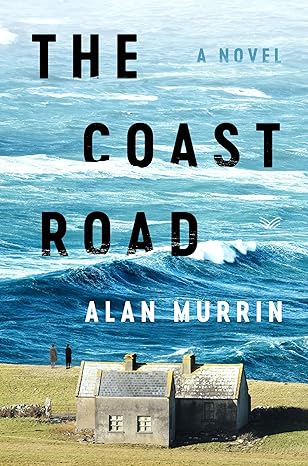
Review of THE COAST ROAD by Alan Murrin

 4 Stars

This book examines marital constraints women faced when divorce was not an option in a religious and patriarchal society. The plot is set in 1994 in the fictional Irish town of Ardglas in County Donegal and focuses on three women trapped in unhappy marriages.

Colette Crowley, a published poet, left her husband Shaun and three sons for an affair with a married man in Dublin. The relationship over, she returns to Ardglas, wanting to have contact with her sons, but Shaun denies her visits. She rents a cottage and tries to earn money by holding creative writing workshops.

Izzy Keaveney is married to James, an elected member of the government, who controls her life by denying her any attempts at independence. She often sinks into deep depression. Her only friend is Father Brian Dempsey, the parish priest. She attends Colette’s workshops and eventually sets up clandestine meetings between Colette and her youngest son.

Dolores Mullen is pregnant with her fourth child. She too is unhappy in her marriage because her husband Donal is a philanderer who constantly criticizes her. She suspects that he is having an affair with Colette who has rented their cottage next door.

The women are fully developed, complex characters; they are flawed but vulnerable so it’s impossible not to have empathy for them since they are trapped by circumstances and their lack of free agency. Colette may have left her husband, but she wants to remain a part of her children’s lives, especially her youngest son. Though she has some money, she relies on Shaun for financial support until he cuts her off completely. She becomes the target of the town’s gossip. Izzy wants to open up a business as a florist, but James refuses. James’ concern is always what the public will think. Dolores can’t escape: she’s pregnant, with abortion not an option, and married to a serial adulterer.

The men in the novel are bullies who manipulate others but suffer less from the townspeople’s intolerance. Whereas Colette is viewed as a sexually promiscuous woman, her husband Shaun dates another woman without being censored. James uses his powerful position to punish Izzy but remains viewed as an upstanding man in the community. Donal is a womanizer who psychologically abuses his own wife but still manages to find clients for his business. Women have much more to fear from scandal than the men.

One of the few likeable male characters is Father Brian. Though a Catholic priest, he is the most open-minded. He allows Colette to read in church and befriends Izzy. He also tries to counsel Dolores, though he obviously can’t advise her to leave her husband. He becomes a victim of James’ machinations and small-town rumours.

With its focus on characters and their circumstances, the novel is slow-paced. The perspective of several characters is included. Only the last part of the novel, after a tragic event, is more action-packed. This last section also shows women being stronger than the reader might initially think. Though accepting of their situations, they are not resigned.

I very much enjoyed the book and its examination of Irish women’s lives and how they were controlled by men and the Catholic Church before the legalization of divorce in 1996. I was impressed by the male author’s ability to convey the inner lives of women.

I will end on a personal note. There are so many excellent Irish novels, but I’ve been hindered by my lack of knowledge of Irish geography. Happily, my husband and I toured Ireland this past fall so I have a better understanding of the setting of Irish books I now know exactly where the various counties and towns are located and what their physical features are.

Monday, January 20, 2025

Review of WE DO NOT PART by Han Kang (New Release)

4 Stars

This is my first novel by Han Kang, the winner of the 2024 Nobel Prize in Literature.

Kyungha, a writer suffering from migraines and abdominal spasms, receives a message from Inseon, a friend who left her career as photographer/film documentarian to become a woodworker. Inseon has been hospitalized because of an injury and asks Kyungha to travel to her house on Jeju Island to save her pet bird. A snowstorm impedes Kyungha’s travel, but her eventual arrival at her friend’s home brings her face to face with a dark, forgotten chapter in Korean history.

For me this was a challenging read both because of its style and its subject matter. The experimental style, often bordering on stream-of-consciousness, with its ambiguity I sometimes found confusing. The narrative switches frequently and suddenly between past and present and between perspectives so I struggled with orienting myself. Then there are sequences, especially in the second half of the novel, which blur the boundaries between dream and reality so it is difficult to determine what is real and what is imagined. Of course, this blurring is appropriate given that the content emphasizes the difficulties of penetrating a history kept hidden.

I’d be remiss if I didn’t comment on the beautiful, poetic prose with its vivid metaphors. The descriptions of snow are gorgeous: “white thread-like flakes draw empty paths through the air” and “snowflakes swirl wildly as if inside a giant popcorn machine” and “Snowflakes resembling a flock of tens of thousands of birds appear like a mirage” and “Each snowflake made its endlessly slow descent, seeming to thread together in mid-air like giant motifs in a lace curtain” and “a flurry of snow coruscating like fine grains of salt” and “the flakes were floating down like feathers now, and I could see their crystalline shapes” and “As the snow lands on the wet asphalt, each flake seems to falter for a moment. Then, like a trailing sentence at the close of a conversation, like the dying fall of a final cadence, like fingertips cautiously retreating before ever landing on a shoulder, the flakes sink into the slick blackness and are soon gone.”

Of course, the snow, like so much other imagery, is symbolic. Kyungha finds herself almost buried in snow, just as the past has been buried. Her struggle parallels the difficulty of re-visiting the past. The ferocity of the snowstorm mirrors the brutality of the events that occurred on Jeju Island. What cannot but strike the reader is the contrast between the beautiful language and the horrific content.

My lack of knowledge about Korean history was definitely a factor in my understanding of events being described. I might recommend that readers familiarize themselves with the events in South Korea between 1948 and 1954, but that would undoubtedly lessen the emotional impact of what is revealed. Nonetheless the reader must be prepared to read about torture, ethnic cleansing, and genocide so that, like Inseon, the reader might find that “nothing one human being did to another could ever shock. . . again.” I imagine that most readers will be motivated to do some research after finishing the novel.

The message of the book, as its title clearly suggests, is that we cannot and should not be separated from our pasts and each other. Trauma lingers long after the violence ends, even for generations, but healing can be found in remembrance and human connection.

This poignant and powerful novel demands much of readers. Not only is it challenging in terms of style, but it also asks readers to bear witness to traumatic events and to remember. It’s a book worth not just reading but re-reading because it’s so masterfully written that it is impossible for a reader to grasp all its artistry and nuances in one read.

Note: In return for an honest review, I received a digital galley from the publisher via NetGalley.

Friday, January 17, 2025

Review of LOCKED IN by Jussi Adler-Olsen

3.5 Stars 

This is the tenth and last installment in the Department Q series; this book brings everything full circle to the first book.

This book begins where The Shadow Murders, the ninth book, ends. Detective Carl Mørck, charged with aiding and abetting a murder, corruption, theft, and drug dealing, is arrested and incarcerated. He knows he has been framed but he doesn’t know by whom or how to prove his innocence. In prison he is in danger from incarcerated criminals and corrupt guards; he learns that there is a bounty on his head. The media is having a heyday, and few in the Copenhagen police department support him. The exceptions are Assad, Rose, and Gordon of Department Q, but they have been given strict orders not to investigate Carl’s case in any way. Fortunately, help does come from unexpected people who feel they owe Carl.

There are lots of connections to previous cases, especially the one central to the first book, The Keeper of Lost Causes. I had forgotten quite a bit but the author provides sufficient information to remind readers of the essential details. Then there’s the case that is mentioned in each of the books, the one which resulted in Hardy’s catastrophic injury and the death of his colleague Anker Høyer. That case is the one that is finally solved.

The novel covers a fairly short time span (Dec. 26, 2020 to Jan. 11, 2021) but several points of view are provided.  Included are the perspectives of various bad guys; tension increases as the reader knows the personalities, motivations, and plans of those interested in guaranteeing Carl’s demise. Carl is in danger from both inside and outside the prison.

The novel is like the previous Department Q books. There are the quirky Department Q staffers; touches of humour, usually via Assad’s misunderstanding of idiomatic expressions; graphic violence; and the untangling of “labyrinthine mysteries.” Though the case that lead to the creation of Department Q is resolved, I did find that some of the secondary characters are abandoned. What happened to “the invisible power behind it all” or Pelle? Their subplots, given more than cursory attention, are not completely resolved.

This book is recommended to those who have followed and read the entire series. I’m actually tempted to re-read the books to see if there are any subtle clues as to the villain’s identity which I missed in my initial readings.  

Monday, January 13, 2025

Review of THE LOST HOUSE by Melissa Larsen (New Release)

 3 Stars

Agnes Glin travels from California to Iceland to investigate the gruesome murders of her grandmother Marie and her infant daughter 40 years earlier. The case was never solved, but most people suspect that Einar, Agnes’ grandfather, killed his wife and daughter. Agnes’ beloved grandfather has died but she wants to clear his name so connects with Nora Carver, a true crime podcaster who has helped solve another case. Will Agnes be able to prove her grandfather’s innocence or will she only confirm what virtually everyone in the town of Bifröst already believes?

There are a couple of complications. Agnes has a dependence on pain medication after a major injury to her leg. Then, just as Agnes arrives in Iceland, a university student named Ása has gone missing in Bifröst after a party at Agnes’ ancestral home. Are the cases connected?

I found Agnes an unlikeable character and so had difficulty caring about what happens to her. She’s 26 years of age, but she seems very immature. Before arriving in Iceland and despite warnings from her father, it never occurred to her that her grandfather might be guilty? She’s in Iceland for two weeks in February, but doesn’t buy gloves to protect her hands from the cold? She is very self-centred, showing little consideration for other people’s struggles or emotions. She stays with Nora but not once offers to help with things like meals? Despite her life-altering injury, she doesn’t take care of herself; over and over again, she pushes her body beyond its limits and then seems shocked by the pain she experiences. She makes rash decisions without considering possible consequences; these seem choices more appropriate to a teenager. Though we are to believe she undergoes some character growth at the end of the novel, I wasn’t convinced.

The male characters feel underdeveloped, more like flat characters with one dominant trait: Óskar is hostile, Ingvar is sweet, Thor Senior is antagonistic, etc. And what’s with Óskar’s belief in a murder gene; he’s a university student so supposedly intelligent but thinks Agnes needs to be watched and calls her “’murderer’s child’”!

Pacing is an issue. Not much happens, especially in the middle of the plot. There are just a lot of conversations which are repetitive and reveal little new information. And so much else is repetitive; since so much of the narrative is Agnes’ interior monologue, there are repeated references to her injury, her struggles with opiate addiction, her fractured relationship with her father, and her feelings for Lilja. There is action at the end of the book, but readers might be tempted to stop reading before reaching the action-packed section.

There are plot issues. The author seems not to have researched Iceland’s weather very carefully because blizzards are not likely to happen so often and so conveniently in a two-week span. And where’s the reference to the Northern Lights since February is the best month to see them there? The search for Ása is so uncoordinated and no one thinks of a cellar in a farmhouse? Agnes, not once but twice, somehow finds herself at the back of houses? And what’s with the unnecessary romantic relationship, especially one which relies on the love-at-first-sight trope? Finally and most importantly, there is no great reveal because the plot is predictable. The repeated references to people’s ages give any astute reader the answer very early on.

I understand this is not the author’s first novel, but with its plot weaknesses it feels very much like a debut book.

Note: I received an eARC from the publisher via NetGalley.

Friday, January 10, 2025

Review of STONE YARD DEVOTIONAL by Charlotte Wood

 3.5 Stars

Slow, meditative novels dominated the 2024 Booker Prize for Fiction. This title was on the shortlist.

The narrator is an unnamed woman who worked in a Threatened Species Rescue Centre. She leaves her job and her marriage in Sydney and joins a convent in her childhood town in New South Wales. She doesn’t convert; she becomes an oblate, not a member of the religious order but offering herself in service to it. She despairs about the state of the world and wants to withdraw and reflect on her life. She believes the routine, solitude, and quiet of the convent will allow her to contemplate grief, forgiveness, and atonement.

There is minimal plot. Only three events occur: the remains of Sister Jenny, a nun murdered years ago in Thailand, are repatriated; Helen Parry, an activist nun working on environmental and human rights issues, arrives and brings the noise of the world with her; and the region suffers a plague of mice which swarm the convent after a drought in the north.

The description of the mice is visceral. The narrator admits to hating them: “Their stink, their rapaciousness and skittering feet. . . . At night . . . No birds, no psalm practice, no miscellaneous noises . . . Only mice feet overhead, pattering across the ceiling and inside the walls.” The narrator wakes up to “see that the flyscreen over my closed window is crawling with leaping, climbing mice.” At one point the mice begin to feed on their own dead. The scene where the woman opens the car door and feels “a squirming sensation” at her back only to discover a dozen mice will not leave me.

It is the flashbacks to the narrator’s childhood that were most interesting to me. Her relationship with her mother receives most attention. It’s obvious that she was deeply influenced by her mother: “I never knew anyone else who had her reverence for the earth itself.” A major regret is her not having understood her mother better and therefore not helping her more as her death approached. The woman realizes her inability to recover from her parents’ death; she describes this as “a source of lifelong shame to me.”

For me, it is not the narrator who is most memorable; it is Helen Parry who steals the show. Helen and the narrator were classmates and she remembers Helen as a vulnerable, needy child with a negligent mother; Helen was treated as an outcast and terribly bullied. Now she seems invulnerable and so confident that she requires no affirmation from anyone. Her comment at the end shows wisdom: “’I loved my mother, and she – tried, as much as she was able, to love me.’” I’d love to read a book focusing on Helen and her development into “the radical environmentalist nun.”

The novel asks what is the appropriate response when there are so many problems that require our attention. Sister Jenny insisted “on the immorality of staying” but her friend who stayed at the convent has difficulty forgiving Jenny for leaving. The narrator admits that she can accurately be described as “Choosing disappearance, while Helen has chosen the opposite.” Is retreat or escape an ethical choice when problems like climate change need action?

As I read, I found myself identifying with a comment made by the narrator: “It feels always that I am on the edge of some comprehension here but never breaking through to the other side.” I still feel that I’ve missed a lot in this novel, as if I’m the stone yard, arid ground, which has not absorbed much.