4.5 Stars
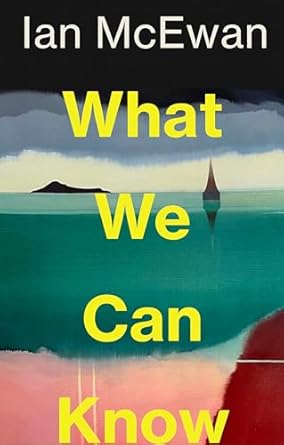
This book has been described as speculative fiction, social commentary, and a literary detective story. Regardless of how it’s classified, if it’s written by Ian McEwan, I know it’ll be worth reading.
There are dual timelines just over a century apart. In 2014 at his wife Vivian’s birthday dinner attended by a few friends, renowned poet Francis Blundy reads aloud a sequence of 15 sonnets, a corona, he wrote for her. The poem is never published; Vivian is given the only copy. For generations people have speculated about this corona, a copy of which has never been found, but it is generally regarded as the great lost poem of the climate crisis.
In 2119, in the aftermath of a hydrogen bomb disaster in 2042, much of the western world has been submerged by rising seas and Britain is now an archipelago. In the south of what used to be England, Thomas Metcalfe, a humanities scholar, has dedicated himself to finding “A Corona for Vivian.” He pores over print and digital archives and considers himself an expert on the lives of Francis and Vivian Blundy: “I know all that they knew – and more, for I know some of their secrets and their futures, and the dates of their deaths.” When led to a site which he believes is the hiding spot for the corona, he uncovers a truth he had not expected.
This first part of the novel is narrated by Thomas in the first person. He makes clear that he is captivated by Vivian, so much so that his relationship with his partner Rose is affected. Besides his obsession with the poem, he has an almost obsessive nostalgia for Francis and Vivian’s time period which is, of course, our era: “The Blundys and their guests lived in what we would regard as a paradise. There were more flowers, trees, insects, birds and mammals in the wild . . . The wines . . . were superior to ours, their food was certainly more delicious and varied and came from all over the world. The air they breathed was purer and less radioactive. Their medical services . . . were better resourced and organized.”
It is this re-creation of our era as seen from a dystopian future which I found very interesting. Thomas summarizes our time: “What brilliant invention and bone-headed greed. . . . people flying 2,000 miles for a one-week vacation . . . razing ancient forests to make paper to wipe their backsides . . . they watched amazed as the decades sped by and . . . the weapons proliferated and they did little, even as they knew what was coming and what was needed.” The term Derangement is used, “a shorthand for the usual list of global heating’s consequences . . . [but the term also hints] at collective responsibility for our innate cognitive bias in favour of short-term comfort over long-term benefits. Humanity itself was deranged.” Thomas also comments that in that past, “many of humanity’s problems would have been solved. When too few understood how sublime their natural and man-made worlds were.” Rose argues that Thomas ignores the past’s “squalor and cruelty and morbid greed” and lists a litany of problems with our behaviour: “The stupidity and waste . . . the nastiness of social media, then run for profit rather than as a public service . . . the self-serving short-sightedness or plain folly or mendacity or viciousness of political leaders . . . the quiescence or craven idiocy or terror of their populations . . . people’s careless love of autocrats . . . the poisons they left in the oceans, the forests they stole, the soils and rivers they ruined and the Derangement they acknowledged but would not prevent.” The message for us is abundantly clear.
As the title suggests, the novel asks what we can really know. Thomas is convinced of his knowledge based on his perusal of journals and letters and the digital data such as emails and texts. In fact, he feels burdened by the amount of research material at his disposal: “three million internet mentions of Francis Blundy in his lifetime, the 219,000 messages that were written to him and by him and the near-infinite references since.” When writing about the Blundys and the corona, especially the birthday dinner, Thomas decides it is acceptable “where the source material did not exist . . . to make educated guesses about the subjective states and lines of thought of people who had died a hundred years ago. . . . When faced with the essential but undisclosed inner life, invent within the confines of the probable.” He regards it “an essential freedom to speculate, infer, make educated guesses and animate circumstances and states of mind with the reasonable projection of a common humanity unchanged across the intervening century” because his duty “is to vitality, to convey the experience of lived and felt life.” Rose, on the other hand, disagrees and argues that Thomas’ “only duty is to the truth . . . whereof you do not know, therof you must be silent.”
Vivian is the narrator in the second part and what she reveals suggests that there are boundaries to our understanding; in fact, we can know very little. Random details and records, even personal ones, may not tell the entire story. I keep a journal but can I really say that it’s unbiased or that I haven’t lied by omission? Trying to extrapolate motives, feelings, the full truth, from a series of disparate sources may mean that we are like Francis: our certitude may suggest brilliance but actually indicates our foolishness. The next time I read a biography, I will remember McEwan’s caveat.
There is so much in this book, so much I could parse. There’s the complex characterization where everyone has both positive and negative traits, and there’s more nuance to characters than initially shown. In the end I found no one really likeable, but that’s okay. There’s humour: “inter-racial marriage increased to the extent that within a mere three or four generations, the descendants of many whites have realised the old sunbathers’ dream.” And there are more ideas explored that I haven’t even touched on. In other words, this is another Ian McEwan masterpiece.
Note: I received an eARC from the publisher via NetGalley.

No comments:
Post a Comment