4 Stars
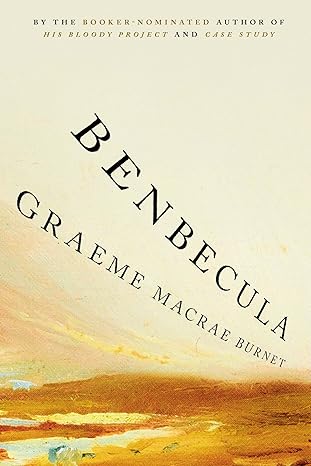
This historical novel, based on an actual crime committed in 1857, is set on Benbecula, an island of the Outer Hebrides. The narrator, Malcolm MacPhee, is living in the family home where a few years earlier, his younger brother Angus killed their father, mother and aunt. A recluse ostracized by his community, he seems to be slowly losing his grip on sanity.
Malcolm suggests that Angus was always unstable, though just prior to the murders, his fits of madness become more frequent and more violent. Young women feel unsafe in his presence: he “had a shameless fascination for those parts of his body and their functions that decency normally dictates are kept private.” Angus’ family, because they do not have the funds to have him placed in an asylum, are told to keep him under control. There is little doubt that he is suffering from a mental illness.
As Malcolm continues his story, it becomes increasingly obvious that he too may be suffering from a similar illness. From the beginning, he confesses to wanting to differentiate himself from his brother, “yet I was haunted by the sense that I was not his opposite but his mirror image” and adds, “He sometimes even came to me in my dreams so that I felt that Angus penetrated my whole being.” After the murders, Malcolm has become a recluse and has given up working, though earlier he was outraged that “there was not a fellow in the entirety of Benbecula more dedicated to the practice of Sloth than Angus.” He fantasies about rape. Even his youngest sibling tells him, “You’re a tyrant and a bully, Malcolm.” He also admits to seeing phantoms.
Malcolm starts questioning his own sanity. He talks about his mind being “a devious thing” and admits to hearing voices: “And I find myself wondering, when these dialogues run in my mind, whether I am the mind that goads me or I am the mind that reasons with the other mind. And I feel that I am not one man but two men. If I am the brain contained within my skullhouse, then there is another self contained within my skull. Were I to give him a name, I would call him Angus. It is Angus that goads me. It is Angus . . . that gives me no peace. There are times I confess when I have been driven to beat my head against the walls of the house to drive him out but that does no good.” But he clings to being normal: “I have heard other men say, I’m in two minds about such and such a thing. It is quite commonplace this being in two minds. I am a man just like other men and they are men just like me.”
What is most telling is Malcolm’s use of words. For example, he states, “I am still capable – through the careful weighing of evidence – of distinguishing between reality and illusion. The certainty that the tormented voices I hear are only inside my head convinces me that I remain in possession of my reason. A madman could surely not achieve such clarity of thought.” Words like still and surely undermine his certainty. He comments, “I am careful to behave like other men. To speak the way they speak and act the way they act for I am still capable of doing so.” The repetition of “am still capable” is telling.
All of this leaves the reader wondering about the origins of insanity. Is it a hereditary trait? (More than once, Malcolm speculates about how those possessed of fine features marry others with similar traits while “The less fortunate are left with what scraps they can find – the disfigured or feeble-minded – and through procreation combine the worst characteristics of each parent . . . [so] the rest of us become more degraded with each passing generation.” This almost implies inbreeding, and Malcolm’s relationship with his sister Marion left me wondering about the possibility of incest.) Or is Malcolm’s descent into madness a reaction to the killing of his family?
I found this novella thoroughly absorbing, especially the gradual revelation of Malcolm’s troubled state of mind. I suspected him of being an unreliable narrator from the beginning, but his last sentence still caught me by surprise. And the extended Afterword provides even more information for the reader to consider.
When a book lingers in my mind after I finish reading it and when I’m considering re-reading it, I have no hesitation in recommending it to others.
Note: I received an eARC from the publisher via Edelweiss.

From the author: "Thanks for such a thoughtful review!" (https://x.com/GMacraeBurnet/status/1990097364208562502)
ReplyDelete