3 Stars
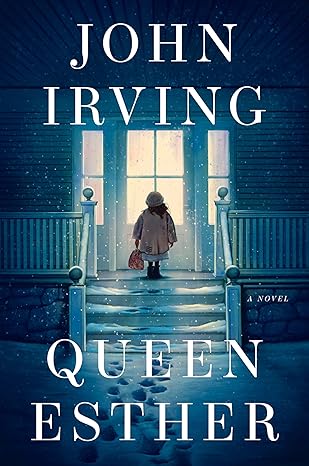
Some of my favourite novels have been written by John Irving, but this is not one of them.
Esther Nacht, born in 1905, becomes an orphan after her mother is killed by anti-Semites in Portland, Maine. When she is fourteen, Esther is adopted by Constance and Thomas Winslow, a couple living in New Hampshire. Though they are not Jewish, they despise anti-Semitism and are the only people open to adopting a Jewish child. Esther helps care for Honor, the youngest of four daughters, but becomes very much a part of the family. Despite its title however, the novel focuses on Jimmy Winslow, Esther’s biological child born in 1941 but raised by Honor. It is very much his coming-of-age story. Though it covers 40 years of his life, a large portion of the book details Jimmy’s study year in Vienna where he works on writing a novel and makes life-long friends.
One of the themes is that of identity. Jimmy questions his identity from an early age. He believes in his “intrinsic foreignness” because “Jimmy was a nobody’s boy. This much was understood: his mother had adopted him; his father was an unknown. As for the boy’s birth mother . . . she was an orphan.” He’s not considered “a real Winslow” so who is he? His biological mother is Jewish so is he Jewish? He thinks of himself as “just a New Hampshire boy” but travels to Vienna, Esther’s birthplace, in hopes of connecting with her. The last paragraph begins with “At last, James Winslow knew who he was” and outlines what he has realized.
Irving’s novels often center on non-traditional families, with strong but sometimes profane mothers, absent fathers, and unconventional sexual dynamics. This is certainly the case here. Constance and Thomas have four daughters, but also adopt four more. Jimmy has two mothers and he creates a type of family with Claude and Yolanda, his roommates in Vienna. Then there’s Jimmy’s daughter who also has two mothers. There’s an asexual mother and a lesbian one.
Of course it is not just the theme of identity and the unconventional families that signpost an Irving novel. Readers of his books will see many familiar motifs: the New England and Vienna settings, wrestling, the presence of at least one writer, a prominent animal role, sex workers, and quirky characters in absurd circumstances. And there are frequent digressions often found in his books; in this one, the reader is given histories of abortion and circumcision and analyses of Dickens’ novels.
Though engaging in parts, I found some sections too long and drawn out. Jimmy’s year in Vienna (1963-64) goes on and on, with constant reference to Honor’s scheme to keep her son from being drafted and sent to Vietnam. The subplot with the dishwasher and her thugs is also excessive and left me wondering what the point is. Needless repetition is a problem. Is it really necessary to have Thomas say, “’Right you are, Connie’” two dozen times? This wordiness, rambling, and lack of cohesion left me struggling to maintain interest.
Esther, though the title bears her name, remains a secondary character. We see little of her and learn most about her from others. She keeps a distance from her family and she is kept at a distance from the reader. She becomes a larger-than-life, mythical character and I guess that’s the point. However, her perspective would have added to the themes of Jewish identity, anti-Semitism, and the historical Israel/Palestine conflict, “this eternal conflict, this everlasting hatred.”
I was disappointed with this book; it did not resonate with me as Irving’s other novels have. My 3-star rating may seem insulting but is actually generous.
Note: I received an eARC from the publisher via Edelweiss.

regarding repetition- many of the characters don't merely "say" something, they "cry" it over and over , and not necessarily in an exclamatory context. distracting and puzzling…
ReplyDeleteI Think it's quirky and funny , which I believe is the point of the repetition , especially from thomas. I'm not fond of wrestling so i'm a bit bored with that. It's not clear what happened to Hildegarde and her thugs after the russians beat them up. They keep referring to them going down the river and i'm not sure if they're dead or alive. I still have a few more chapters to go, in the midst of it now.
ReplyDeleteI agree with you, the repetitions are quirky and funny and meant to be that way. The wrestling bits in all of irving's novels don't interest me because I couldn't be less interested in wrestling, buddy , still , one of my favorite american authors based on his imagination and sense of place. My favorite novels by him are garp , of course, and until I found you. Also cider house rules.
Delete