3 Stars
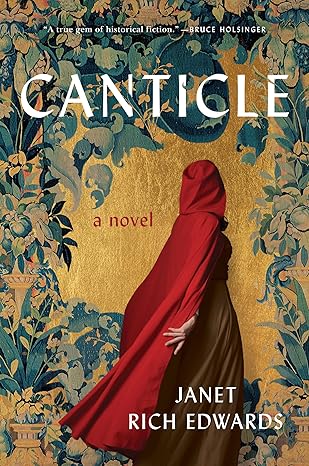
Aleys is an unusual child. From early childhood, she is fascinated by her mother’s psalter and the stories of saints and martyrs. She learns to read and later learns Latin as well. When her father promises her in marriage to a merchant, she runs away. She wants to join the Franciscan friars but because of her gender is given shelter by the beguines, a community of religious laywomen focused on religious devotion and charity. While working in a hospital, Aleys seems to perform miracles so she comes to the attention of the ambitious bishop. She chooses to become an anchorite, living a solitary life of prayer. However, agreeing to be walled into a small cell from which she is forbidden to ever leave does not end her spiritual journey or her sacrifices.
I did not find Aleys relatable or particularly likeable. As a child, she has a spark: she is intelligent, spirited, and stubborn. Despite visions, she has a sense of humour. For instance, when she has a vision, “She hopes the angel will return. Just so long as he doesn’t announce she’s pregnant.” Once she chooses a religious life, she loses this spark and becomes just bland. The Magistra, the leader of the beguines, describes Aleys very aptly: “’She has a calling, . . . I can see that. It doesn’t mean she has charisma.’” At times she is the opposite of what would be expected. For instance, she comes across as conceited: she doesn’t want to be an ordinary beguine but “wants to be more than another thread in the cloth.” She wants ecstasy: “Aleys left home to fly.” Her attitude does change somewhat, but she certainly seems to be full of herself, in love with the idea that God has chosen her. To say she is obsessed is not an overstatement. Sometimes there seems little difference between Aleys and Lukas, her confessor, who ends up suffering what I can only think of as a form of insanity.
I found the book slow. From the beginning, we know Aleys’ fate so all that remains is how she gets to that end. For long periods of time, nothing happens. Her time as an anchorite is just pages of her praying, listening to petitions, experiencing visions, and then despairing when her visions cease. The descriptions of visions are problematic; they’re largely undecipherable. This obscurity is obviously intentional, but paragraphs of unintelligible prose do not make for interesting reading.
There are elements I liked. For example, there are some wonderful turns of phrase: “Eventually, her siblings leave her alone with her saints. Griete discovers the looking glass, Claus deserts martyrs for marbles, and Henryk, growing firm of jaw, decides that virgins are, in fact, interesting.” The book clearly shows the views of women at the time: a friar thinks “Women are easily tempted, prone to deception by demons. It’s hardly their fault. They’re daughters of Eve.” I loved the version of the Sodom and Gomorrah story from the perspective of Lot’s wife and the conclusion, from a woman’s perspective, that Abraham failed God’s test. I appreciated the message that “’heaven is on earth, before us, if only we can see it’” and “everyone [speaks with God]. It’s just so hard to hear.”
The Church’s control over the populace is emphasized. When the bishop finds translations of the Bible into Dutch, the common language, he declares them a heresy. Ecclesiastical power is diminished if “people are asking why they can’t speak directly with God” without the intercession of clergy. In particular, “’The Church wants to silence difficult women.’” Corruption in the Church, as in the sale of indulgences and relics, is emphasized, so much so that the bishop wonders, “Why would God get involved in the affairs of his own church? He’s turned a blind eye to the corruption for centuries.”
The book offers insight into Christianity in medieval times: mysticism, beguines, and anchorites. Unfortunately, the pace is slow so it is sometimes difficult to maintain interest.
Note: I received an eARC from the publisher via NetGalley.

No comments:
Post a Comment