3.5 Stars
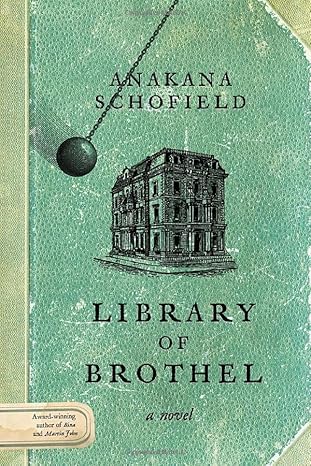
Let me begin by stating that I have read two of Schofield’s previous novels (Martin John and Bina) and both of them left me highly impressed with the author’s bravery and creativity. Her latest, Library of Brothel, often left me more confused than enlightened.
The setting is a crumbling building housing a worker’s co-operative, “the only remaining analog, offline operation in Vancouver.” The Library of Brothel consists of a variety of rooms with workers who are tasked with helping people recover from the internet and “reacquainting the human with the human.” The rooms focus on exploring a specific theme but, more importantly, provide clients with “the opportunity to converse and practise interacting with another human.”
There is little in terms of a traditional plot. The workers do have conflicts with each other, but their major concern is the possibility that the library may close. Fewer clients are using their services. Developers are buying up properties all around and there is fear that their building will be next to be demolished and replaced. Workers are already struggling because of the high cost of housing; many need multiple jobs to survive.
Except for a few characters like Scrabble Woman and Security, there is little differentiation. The narrator, one of the workers presumably, states, “We are a conglomerate of eccentrics” who like “wholesome weirdness.” Characters have no names other than the themes of the rooms. And to call the themes esoteric seems almost an understatement! Some examples are History of Outrageous Political Excuses in the Last Century; Evolution and Influence of Irish Butter; History of Early Urologic Inventions: Forgotten Poets Called John; Decoding Ancient Computers and Bonding with the Antikythera Mechanism; Bayesian Analysis of Phylogenetic Trees; and Great Moments in Belly Dancing.
One theme is the value of human connection. The narrator argues that “We are necessary because humans no longer look at each other. They are ghosting in stasis. On the phones.” There is repeated reference to an “epidemic of avoidance” and the crisis of “the human retreat from the human.” The library serves to address “the great reluctance of humans to be in a room with their eyes open (and not staring at a phone) and to tolerate the prospect of each other socially, romantically, or even generally. We need to convey an urgent requirement to return to interaction or risk social extinction.” The workers want “to keep all our clients sustained intellectually while we attempt, unofficially, to reintroduce them to the concept of each other.”
There are wonderful touches of humour. There are the themes of the various rooms like Influence of the Outdoor Ukulele on Yukon Carpenters circa 1896. The library’s has no WiFi: “We remain aged cheddar to the slippy-slappy slice.” There are comments like “It’s hard to absolutely vaccinate against assholes.” And there’s the totally ridiculous: who could be shaking a fridge so violently that a jar stowed on its side would spill its contents?
And there is social commentary. The narrator comments that in Vancouver “we erase the past swifter than we can construct the present”; it’s the “microfibre cloth swipe of capital.” It’s impossible not to think of current events with statements like “Diversion is a ruse Noble Leader and other global dictators have often used” and workers being warned “not to use the word ‘socialist’ because these days it can get you deported to places you’ve never been.” The razing of neighbourhoods is bemoaned so an “established community of low-income renters and new immigrants” has made way for houses for “financially rising or arisen folks with pre-approved mortgages and an abundance of pedigree dogs and electric blinds.” People are less likely to see “volleyball playing Tamils” but more likely to see new stock in the grocery store: “adding words like organic and no cholesterol to products that had never held any cholesterol, such as a bottle of water.”
The book is written in an absurdist style. It focuses on characters trapped in absurd situations, rejects a realistic, traditional plot, and uses dark humor. This style is not my favourite so I found the book a challenging read. I know I missed much of its message. At the beginning, the reader is told that one of the library’s rules is not to anticipate anything “except intellectual stimulation” and in many ways the book does feel like an intellectual exercise, much like analyzing “The Waste Land” or “Jabberwocky.” I’m certain that if I had the time to re-read the book, I’d appreciate it more.
I recommend Library of Brothel to readers who enjoy unconventional books and love to analyze but are also able to embrace uncertainty.
See my reviews of other Anakana Schofield books.
Martin John: https://schatjesshelves.blogspot.com/2016/07/review-of-martin-john-by-anakana.html
Bina: https://schatjesshelves.blogspot.com/2019/05/review-of-bina-by-anakana-schofield-new.html
Note: I received an eARC from the publisher via NetGalley.

No comments:
Post a Comment