Ranked a Top Canadian Book Blog
Twitter: @DCYakabuski
Facebook: Doreen Yakabuski
Instagram: doreenyakabuski
Threads: doreenyakabuski
Substack: @doreenyakabuski
Bluesky: @dcyakabuski.bsky.social

Thursday, October 22, 2015

Reviews Archive: Ami McKay and "The Virgin Cure"


In today’s blog, I want to focus on another great Canadian author, Ami McKay.  She has had two novels published so far:  The Birth House and The Virgin Cure.  A third book, The Witches of New York, is scheduled to be released in October of next year.

Brief Description of The Birth House:
 “The Birth House is the story of Dora Rare, the first daughter to be born in five generations of Rares.  As a child in an isolated village in Nova Scotia, she is drawn to Miss Babineau, an outspoken Acadian midwife with a gift for healing.  Dora becomes Miss B.’s apprentice, and together they help the women of Scots Bay through infertility, difficult labours, breech births, unwanted pregnancies and even unfulfilling sex lives.  Filled with details as compelling as they are surprising, The Birth House is an unforgettable tale of the struggles women have faced to have control of their own bodies and to keep the best parts of tradition alive in the world of modern medicine” (http://www.amazon.ca/Birth-House-Ami-McKay/dp/0676977731/ref=sr_1_3?ie=UTF8&qid=1445520045&sr=8-3&keywords=ami+mckay).
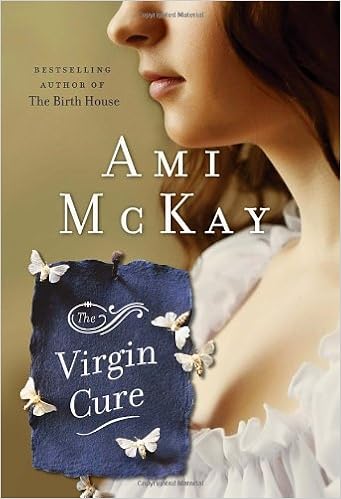

 Review of The Virgin Cure
4 Stars

The protagonist is 12-year-old Moth who lives in the tenement slums of Manhattan's Lower East Side in the early 1870s. Moth's mother, a gypsy fortune-teller, sells her as a servant to Mrs. Wentworth, a wealthy but abusive woman. Because of her mistreatment, Moth runs away and soon finds herself under the tutelage of Miss Everett, the owner of an upscale brothel specializing in prostitutes-in-training. Here Moth meets Dr. Sadie, an idealistic physician who tends to prostitutes and the poor and tries to entice Moth away from Miss Everett before her imminent, premature and possibly life-threatening deflowering.

This book includes vivid historical realism, especially in its depiction of misery and poverty. There are several examples of Dickensian cruelty. Sidebars (e.g. Dr. Sadie's notations, newspaper stories) are inserted throughout and they add to the historical authenticity of the novel.

The book is a powerful exploration of the issues facing women in that time period, including the lack of options for women, especially poor women. The power imbalance between the sexes is certainly emphasized. Unfortunately, the myth of the virgin cure for syphilis endures in some parts of Africa as the virgin cure for AIDS.

The one weakness is that Moth seems rather innocent at times. She is streetwise but given her hardscrabble existence, one would expect her to be more worldly. In her training to be a prostitute, she isn't given any instructions about sexual relations?

Readers who enjoyed McKay's first novel will undoubtedly enjoy this book.

                                                                                                                                                              Preview of The Witches of New York:
“To those who say the world holds no more magic, are you certain of this? For this night, within the candlelit walls of a room near Madison Square, three witches are alive and well - one born of cunning, one born of ghosts, one born of wishes yet to be fulfilled.
“Eleanor St. Clair, Adelaide Thom and Beatrice Dunn have gathered to prepare for an evening among Manhattan's elite. By divination, enchantment, spellcraft and seduction, they'll carry out their work in the drawing room of a grand mansion on Fifth Avenue. Without the aid of a medium's cabinet or false knocks on table or wall, they'll peer into the future and call upon the dead. They have no need for the trappings of Spiritualism. 'Ready or not, it's begun...'
“Compelling, enchanting and utterly unique, The Witches of New York invites you on a journey ranging from high society Manhattan to the hidden voices of the budding suffragette movement, and on to the web of secrets that connects them all” (http://www.amazon.ca/Witches-New-York-Ami-Mckay-ebook/dp/B00S3QAM06/ref=sr_1_1?s=books&ie=UTF8&qid=1445520805&sr=1-1&keywords=the+witches+of+new+york).

Tuesday, October 20, 2015

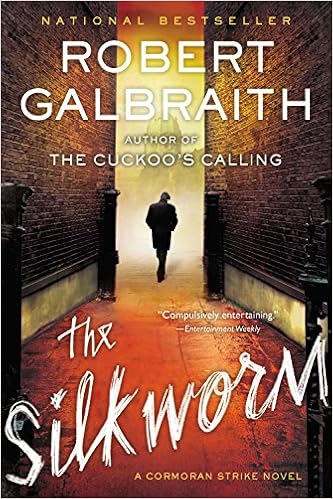
Reviews of "The Cuckoo's Calling" and "The Silkworm" by Robert Galbraith (J. K. Rowling)


My e-copy of Career of Evil was delivered this morning; it’s the third Cormoran Strike novel written by Robert Galbraith (a.k.a.  J. K. Rowling).  To celebrate its arrival, I thought I’d post my reviews of the first two books in the series – I am a firm believer in reading mysteries featuring the same detective in the order in which they are written.

Review of The Cuckoo’s Calling (Cormoran Strike #1)
4 Stars
 
Having read the other J. K. Rowling foray into adult fiction, I decided to give her detective mystery novel a try. Cormoran Strike is a private detective hired by John Bristow to investigate the death of his supermodel sister, Lula Landry. Police have ruled Lula’s death a suicide, but John does not believe this version of events. Cormoran and his temporary assistant, Robin Ellacott, eventually uncover the truth.


This is a slow but steady novel. There are no on-the-edge-of-your-seat action sequences or dramatic revelations or unexpected plot twists. There is more focus on characters than plot. Cormoran conducts his investigation methodically, gradually interviewing everyone involved in Lula’s life. Each interviewee gives his/her version of significant events, often inadvertently revealing something important about him/herself. Many have motives for wanting Lula dead, so there are enough possible suspects to muddy the investigation.

The mystery follows the traditional formula with the typical elements: a quirky private detective, a competent sidekick, a high profile crime, obstructionist police, and numerous suspects, red herrings and clues. Information is not withheld from the reader, so he/she is able to solve the case. In the end, there is a confrontation with the guilty party where all the threads of the investigation are connected.

Cormoran and his aptly-named assistant make a good pair. As would be expected, he is intelligent and determined. Not what would normally be considered handsome, he could best be described as a lumbering bear. Life has left him wounded both physically and emotionally, but he has retained an innate decency. Glimpses are given of his past which will undoubtedly be fleshed out in future books. Robin proves to be meticulous and resourceful. The two have an awkward relationship that has its humourous moments.

What is also appealing about Cormoran is his self-reflection. He does not just reflect on that which pertains directly to the case; he makes connections to his own life as well. This particular case makes him realize something about the early death of his mother, “1970s supergroupie Leda Strike”(80): “he could not help seeing his mother as a spiritual sister to [Lula] . . . they had not tethered themselves to life with mortgages and voluntary work, safe husbands and clean-faced dependents: their deaths, therefore, were not classed as ‘tragic,’ in the same way as those of staid and respectable housewives. How easy it was to capitalize on a person’s own bent for self-destruction; how simple to nudge them into non-being, then to stand back and shrug and agree that it had been the inevitable result of a chaotic, catastrophic life” (374-375).

Though a mystery, the book does tackle the issue of fame and its effects. Prying paparazzi followed Lula’s every move and her phones were hacked by the media. Cormorant is the illegitimate son of a rock star, and that tangential connection to fame does come in useful when trying to get people to talk to him. This focus on fame is rather ironic considering Rowling’s wish to remain anonymous by writing under a pseudonym.

This is a good mystery. It is not for those who want their thrillers to be in the vein of Dan Brown, but anyone looking for a well-written mystery with a carefully constructed plot and well-developed characters would be advised to read this one. Though slow-paced, it remains entertaining throughout.


Review of The Silkworm (Cormoran Strike #2)
4 Stars
I really enjoyed J. K. Rowling’s first mystery, The Cuckoo’s Calling, and The Silkworm is as entertaining. This time Cormoran Strike is hired by Leonora Quine to find her wayward husband, a writer of sexually explicit novels with Gothic overtones. Not surprisingly, the missing person’s case soon becomes a murder investigation when Owen Quine’s body is discovered. What is unusual is that his gruesome murder copies the description of the protagonist’s death in the manuscript of his latest novel.

Because Quine’s novel skewers virtually everyone in his life, there are many suspects with motive. Most also have opportunity. In an Agatha Christie-type ending, Cormoran gathers all the suspects together to reveal the identity of the murderer. The resolution will probably come as a surprise to readers, but everything fits perfectly. Even seemingly innocuous details of the killer’s life mentioned early on prove to be crucial clues.

Characterization is a strong element. All of the suspects are developed as round characters. Cormoran’s back story is developed further as is that of Robin, his assistant. Their relationship is also fleshed out; interesting possibilities exist. Many of the suspects are involved in publishing, so insight is given into the behind-the-scenes machinations of that industry. Two writers, Owen Quine, and his archenemy, Michael Fancourt, are described with wonderful touches of humour: Quine is described as “’a monumentally arrogant, deluded bastard’” and Fancourt’s female characters are “’all temper, tits and tampons.’”

The one aspect of the novel that bothered me is the technique of deliberately withholding Cormoran’s thoughts towards the end when he develops a theory as to the killer. Even his conversations with Robin are censored. I understand the desire to create suspense, but since Cormoran’s thoughts and conversations are given in great detail throughout, the sudden shift away from omniscience jars. It seems that Rowling is aware of this problem because she even has Cormoran address the issue: “He knew that he was acting as though he were held to a professional standard that had ceased to apply when he had left the Special Investigation Branch. Though legally free to gossip to whomever he pleased about his suspicions, he continued to treat them as confidential. . . . the safest way of ensuring that secret information did not leak was not to tell anybody about it.” The problem is, of course, that the reader is hardly going to gossip or divulge secret information!

This is a good mystery with a carefully constructed plot and well-developed characters. Like its predecessor, it is not fast-paced but certainly maintains the reader’s interest throughout. Even after only two installments in the series, Cormoran and Robin are a duo whom the reader feels he/she knows but wants to meet again.

Monday, October 19, 2015

Some Comic Relief/Political Satire for Election Day?

Today is Election Day in Canada.  Canadians have endured a very long, 78-day campaign, and most of us are suffering from election campaign fatigue.  To help alleviate that fatigue, I thought I’d suggest two humourous books about Canadian politics.  (I am not a reader of comedy, preferring mine to be of the stand-up kind or in the form of television shows or film, but members of my book club have enjoyed both of these books and highly recommend them.)

The Best Laid Plans by Terry Fallis

This political satire won the Stephen Leacock Medal for Humour and CBC Canada Reads.

“A burnt-out political aide quits just before an election--but is forced to run a hopeless campaign on the way out.  He makes a deal with a crusty old Scot, Angus McLintock--an engineering professor who will do anything, anything, to avoid teaching English to engineers--to let his name stand in the election.  No need to campaign, certain to lose, and so on.
“Then a great scandal blows away his opponent, and to their horror, Angus is elected.  He decides to see what good an honest M.P. who doesn’t care about being re-elected can do in Parliament.  The results are hilarious--and with chess, a hovercraft, and the love of a good woman thrown in, this very funny book has something for everyone” (http://www.amazon.ca/Best-Laid-Plans-Terry-Fallis-ebook/dp/B003F3FJV4/ref=sr_1_10?s=books&ie=UTF8&qid=1445260060&sr=1-10&keywords=canadian+politics+fiction).


The High Road by Terry Fallis

This book, the sequel to The Best Laid Plans, continues the story of Angus McLintock, an amateur politician who dares to tell the truth.

“Just when Daniel Addison thinks he can escape his job as a political aide, Angus McLintock, the no-hope candidate he helped into Parliament, throws icy cold water over his plans.  Angus has just brought down the government with a deciding vote.  Now the crusty Scot wants Daniel to manage his next campaign.
"Soon Daniel is helping Angus fight an uphill battle against "Flamethrower" Fox, a Conservative notorious for his dirty tactics.  Together they decide to take "The High Road" and--against all odds--turn the race into a nail-biter with hilarious ups and downs, cookie-throwing seniors, and even a Watergate-style break-in.  But that's only the beginning.  Add a political storm in the capital and a side-splitting visit from the U.S. President and his alcoholic wife, and Terry Fallis's second novel is a wildly entertaining read full of deft political satire and laugh-out-loud comedy” (http://www.amazon.ca/The-High-Road-Terry-Fallis/dp/0771047878/ref=tmm_pap_title_0).

So . . . go and vote.  And then check out one of these books so, whether the results are the ones you wanted or disappoint you, at least you can have a few laughs.  

Sunday, October 18, 2015

Review of "The Heart Goes Last" by Margaret Atwood

   3 Stars

I purchased Atwood’s latest novel as soon as it was released, though I wasn’t able to read it for a few weeks.  Unfortunately, I didn’t find it as engrossing as I had hoped.

The novel is set in the near future when the world has suffered a catastrophic economic collapse leaving many people unemployed in a society verging on total chaos.  Stan and Charmaine are destitute and living in their car.  In desperation, they apply to be participants in a socioeconomic experiment promising full employment and a house.  One month they are inmates in a prison and the next month they work as civilians outside its walls to sustain it before repeating the cycle.  At first, Stan and Charmaine don’t dwell on the downsides of their lives in the oppressive, tightly-monitored community ruled by a Big Brother figure named Ed – a community which they cannot leave.  Eventually, however, their lives become less placid as they become involved in or aware of various activities:  extra-marital affairs, human-organ trafficking, bestiality, blackmail, identity theft, customizable sex-bot manufacturing, medically-induced neurological imprinting for sexual enslavement, Elvis  and Marilyn Munroe impersonations, Teddy Bear carnality.

The novel addresses several issues:  sexism, greed, economic and sexual exploitation, and the (im)morality of technological progress – themes explored in other of Atwood’s novels.  She also asks how much freedom to make choices people would be willing to sacrifice in return for stability and security and whether sexual desire can triumph over the desire for stability.  Stan and Charmaine stay together during very difficult times, but when their lives become stable, their relationship suffers.  At the very end, a character asks, “’Isn’t it better to do something because you’ve decided to?  Rather than because you have to’” (306)?  Another replies, “’No, it isn’t . . . Love isn’t like that.  With love, you can’t stop yourself’” (306).

As Stan and Charmaine’s lives spin out of control because they let their erotic impulses control them, I felt the novel spins out of control as well.  The betrayals and counter-betrayals and focus on lust turn the book into an absurdist sex romp.  The plot becomes just too bizarre and over-the-top, and there is a comic tone which distances the reader from the characters. 

It is not just the tone, however, that separates the reader and characters.  I found both Stan and Charmaine to be unlikeable.  Charmaine, for example, is so naïve.  She immediately falls for the sales pitch given by Ed and persuades Stan that they must apply to join the Positron Project.  And she barely thinks about the consequences of her duties as Chief Medications Administrator!  It is difficult to have sympathy for people who are so impulse-driven and whose relationship lacks honesty.  They each vacillate so frequently between loving and loathing their partner so the reader finds them just whiny and annoying.

Even the novel’s style is problematic.  A review in the British newspaper Independent noted the food similes:  “And for a writer justly celebrated for her precision, there is some loose stuff here.  In the space of a couple of paragraphs, Charmaine is “like a stepped-on blueberry muffin… like toffee in the sun… like a super-strong mint… like cinnamon” (http://www.independent.co.uk/arts-entertainment/books/the-heart-goes-last-by-margaret-atwood-book-review-a6667016.html).  I noticed the many references to teachers; one character has “a severe stare, like a gym teacher’s” (211), another character speaks “in the stern, slightly accusing voice of a high school teacher” (268), and a third refers to a sex-bot being made to resemble a “high school English teacher” (185). 

At one point in the novel, I was reminded strongly of A Cure for Suicide by Jesse Bell which I read recently – another example of speculative fiction set in the near future.  In Atwood’s book, a character says, “’Killing is harsh. . . It was positioned as the alleviation of excessive pain.  And happily there are now more ways than one of doing that!  Alleviating the excessive pain. . . . The thing is, people get lonely; they want someone to love them.  That can be arranged for anyone now . . . Why should anyone have to endure that kind of emotional damage’” (255)?  This is certainly similar to the injection given to people in A Cure for Suicide to help them with life’s difficulties.

The title refers to biological death but also to the human heart’s ability to love.  Unfortunately, I was not able to fall in love with this book.  It starts strongly with an interesting premise but then loses its focus.  Black humour does not appeal to me, and neither did the unlikeable characters and absurd plot.

Saturday, October 17, 2015

The 2015 International IMPAC Dublin Literary Award

In this brief pause in the midst of literary awards season, I thought I'd focus on another annual literary award that announced its winner before I began my blog:  the International IMPAC Dublin Literary Award.  At €100,000, it is the world’s largest prize for a single novel published in English. 


This year’s winner was Harvest by Jim Crace which details the unraveling of bucolic life in the face of economic progress.

“A remote English village wakes on the morning after harvest, looking forward to enjoying a hard-earned day of rest and feasting.  But two mysterious columns of smoke mar the sky, raising alarm and suspicion.
The first column of smoke comes from the edge of the village land, sent as a signal by newcomers to announce their presence as per regional custom.  The second smoke column is even more troubling: it comes from a blaze set in Master Kent's stables.  Walter Thirsk, a relative outsider in the village, casts his eye on three local boys and blames their careless tomfoolery.  The rest of the villagers, though, close ranks against the strangers rather than accuse one of their own.  Two men and a woman are apprehended; their heads are shaved to mark their criminality; and the men are thrown into the stocks for a week. Justice has been served. Or has it?
Meanwhile, another newcomer has been spotted in the village sporting the finer clothes and fashionable beard of a townsman.  Mr. Quill, as the villagers name him, observes them closely and takes careful notes about their land, apparently at Master Kent's behest.  It is his presence more than any other that will threaten the village's entire way of life” (http://www.amazon.ca/Harvest-Jim-Crace-ebook/dp/B00AW0DM94/ref=sr_1_1?ie=UTF8&qid=1444094990&sr=8-1&keywords=Harvest).

There were ten books on the shortlist.  Besides the winner, the following books were finalists:
Americanah by Chimamanda Ngozi Adichie (Nigeria)
Horses of God by Mahi Binebine (Morocco)
The Narrow Road to the Deep North by Richard Flanagan (Australia)  See my blog entry of October 9 for  my review.
Burial Rites by Hannah Kent (Australia)  See my blog entry of August 9 for my review.
K by Bernardo Kucinski (Brazil)
Brief Loves that Live Forever by Andreï Makine (France)
TransAtlantic by Colum McCann (Ireland)
Someone by Alice McDermott (U.S.)
Sparta by Roxana Robinson (U.S.)
Check out http://www.impacdublinaward.ie/2015-shortlist/ for information about each book on the shortlist and http://www.impacdublinaward.ie/news/harvest-by-jim-crace-is-the-20th-winner-of-the-international-impac-dublin-literary-award/ for all the info about the winner, including Crace’s acceptance speech.  

Friday, October 16, 2015

Reviews Archive - Richard B. Wright and "Mr. Shakespeare's Bastard"

Today I thought I’d feature a Canadian writer whom I believe is underrated:  Richard B. Wright.    He has written 12 novels:                 
The Weekend Man (1970)
In the Middle of a Life (1973)
Farthing's Fortunes (1976)
Final Things (1980)
The Teacher's Daughter (1982)
Tourists (1984)
Sunset Manor (1990)
The Age of Longing (1995)
Clara Callan (2001)
Adultery (2004)
October (2007)
Mr. Shakespeare's Bastard (2011)
He is best known for Clara Callan which won both the Giller Prize and the Governor-General’s Award for Fiction.

Here’s my brief review of his most recent novel, Mr. Shakespeare’s Bastard:
Image result for mr shakespeare's bastard
Shakespeare's personal life is poorly documented, leaving room for much speculation.  This novel speculates that The Bard fathered an illegitimate daughter, although he remained unaware of her existence.  This daughter, Aerlene Ward, is the 70-year-old narrator who tells the story of her own life and that of her mother.  Understandably she becomes obsessed with the father's plays, and passages from them are inserted and connected to Aerlene's situation.  Aerlene especially likes Hamlet which explores themes with parallels in her life.
Shakespeare is really a secondary character in the book; the novel focuses more on its female protagonists. There are, in fact, several interesting women. As in his other novels, especially Clara Callan, Wright portrays female characters convincingly.
The book sheds no new light on Shakespeare's life, but does illuminate life both in the country and in London during his lifetime.


Yesterday, Wright’s memoir was released:  A Life with Words:  A Writer’s Memoir.  Here’s a description of that book from www.amazon.ca:
“From the acclaimed writer of the beloved Clara Callan comes a beautifully crafted, charming portrait of the writing life.  Combining his characteristic wit and self-deprecation with his extraordinary imagination and insight, Richard B. Wright has created a deeply affecting memoir that reads like a novel.
 “As a small, watchful boy growing up in a working class family in Midland, Ontario, during the Second World War, Wright gradually discovered that he saw the world through different eyes.  His intellectual and sexual awakenings, his exploits as a young salesman in Canadian publishing, his painful struggles to become a writer—all of this is balanced against the extraordinary reception that in the 1970s greeted his first novel, The Weekend Man, which was published around the world to great acclaim.  In spite of the sometimes crippling depression that haunted him and the ups and downs of the mid-life writer, he would finally achieve overwhelming success with Clara Callan, the Giller-winning work that swept every award in Canada and revitalized his career.
“Lovers of Wright’s work will appreciate behind-the-scenes glimpses of his craft in individual novels and his exploration of how a writer transmutes experience into art.  And readers will enjoy his thoughtful exploration of the essential role of storytelling in our lives.  A Life with Words is both a celebration of the writing life and a deeply personal—at times revelatory—invitation into the world of the imagination” (http://www.amazon.ca/Life-Words-Writers-Memoir/dp/1476785341/ref=sr_1_1?s=books&ie=UTF8&qid=1444954155&sr=1-1&keywords=richard+b+wright).

If you have not read this author, check him out.  You will not be disappointed.

Thursday, October 15, 2015

2015 Kirkus Prize for Fiction Winner: "A Little Life" by Hanya Yanagihara


The Kirkus Prize for Fiction winner was announced today.  Hanya Yanagihara received the $50,000 award for A Little Life.  (I posted brief plot summaries of the other five finalists on October 3.) 

I have read the winner and posted my review on August 10.  In honour of the book’s win, I am reposting my review:


Review of A Little Life by Hanya Yanagihara
4.5 Stars

Every year I seem to read one 700+-page novel.  This is the one for 2015.  I just finished it and feel as if I’ve been on an emotional roller-coaster ride for the last few days.  Whew!  I won’t soon forget this one.

The book is about the lives of four young men who became friends in university and moved to New York to begin their careers.  They are Willem Ragnarsson, a waiter and wanna-be actor whose family ranched in Wyoming; Malcolm Irvine, a biracial man from a wealthy family who is beginning his career as an architect; J.B. Marion, the son of Haitian immigrants whose goal is to become a renowned artist; and Jude St. Francis, a lawyer about whose past virtually nothing is known.  We see how they maintain their friendships as they become established in their professions.  Gradually, though, the focus turns to Willem and Jude’s friendship and the revelation of Jude’s traumatic childhood.

Though the book covers about 40 years, there is a timelessness to it.  There are no references to specific years or historical events, though it is clearly set in contemporary times.  For example, 9/11 receives no mention.  This sense of things happening in an eternal present gives the book a fable-like quality.

This is not an easy book to read.  There are graphic depictions of suffering.  Abandonment,  physical and sexual abuse, sexual exploitation, rape, prostitution, addiction, self-harm, domestic violence, suicide, and grief are detailed, so readers need to be prepared for an emotionally harrowing experience.  Most of these miseries are revealed in flashbacks to Jude’s early life, “the snake- and centipede-squirming muck of Jude’s past.”  The relentlessness of Jude’s traumas reminded me of Sisyphus, though Jude has committed no great sin.  The novel can be seen as an examination of the effects of trauma.  Jude emerges from his upbringing physically and emotionally damaged:  “those fifteen years whose half-life have been so long and so resonant . . . have determined everything he has become and done.”  Chronic pain, shame, insecurity, and self-hatred are just some of the effects.  Because of what happened to him, Jude can think of his life only in terms of “its smallness, its worthlessness.”

On the other hand, the book is also an examination of friendship.  Willem thinks about friendship:  “Why wasn’t friendship as good as a relationship?  Why wasn’t it even better?  It was two people who remained together, day after day, bound not by sex or physical attraction or money or children or property, but only by the shared agreement to keep going, the mutual dedication to a union that could never be codified.  Friendship was witnessing another’s slow drip of miseries, and long bouts of boredom, and occasional triumphs.  It was feeling honored by the privilege of getting to be present for another person’s most dismal  moments, and knowing that you could be dismal around him in return.”  Later, he tells Jude, “’I know my life’s meaningful because . . . I’m a good friend.  I love my friends, and I care about them, and I think I make them happy.’”

Though friendship has its value, certainly giving Jude some solace, the book also suggests that it has its limitations.  The friendships Jude has cannot repair him.  As in All My Puny Sorrows by Miriam Toews, a character concludes, “how hard it is to keep alive someone who doesn’t want to stay alive.”

It is some of these friends who are a weakness in the novel.  For thematic development, it is necessary for Jude to have friends.  The difficulty is that he has so many who remain unstintingly loyal and concerned regardless of his behaviour.  It would be expected that some of those friends would fall away, tiring of his repeated actions, but that is not the case.  No one ever seems to outgrow a friendship.  Except for Willem, Malcolm and J.B., however, those friends are not differentiated.  Often, they are just listed:  “Citizen, or Rhodes, or Eli, or Phaedra, or the Henry Youngs” and “Andy, JB, Richard, Harold and Julia, Black Henry Young, Rhodes, Citizen, Andy again, Richard again, Lucien, Asian Henry Young, Phaedra, Elijah.”  Willem, when trying to explain to Jude who he is, says, “’You’re the friend of Malcolm Irvine, of Jean-Baptiste Marion, of Richard Goldfarb, of Andy Contractor, of Lucien Voigt, of Citizen van Straaten, of Rhodes Arrowsmith, of Elijah Kozma, of Phaedra de los Santos, of the Henry Youngs.’”

But the characterization of Jude can only be called amazing.  His inner turmoil is detailed so specifically that there is a vividness to his character that will remain with the reader for a long time.  We may not approve of his behaviour and we may want to shake him and yell at him, but we will certainly understand his motivation.

This dark and disturbing novel will leave the reader almost overwhelmed.  It is a totally immersive read.  Though it may seem implausible in parts, it will nevertheless leave a lasting impression.  I’m in awe that all that was accomplished in only 700+ pages.