Ranked a Top Canadian Book Blog
Twitter: @DCYakabuski
Facebook: Doreen Yakabuski
Instagram: doreenyakabuski
Threads: doreenyakabuski
Substack: @doreenyakabuski
Bluesky: @dcyakabuski.bsky.social

Friday, October 30, 2015

Reviews Archive - Lori Lansens and "The Mountain Story"

Lori Lansens is another Canadian author whose books I always look forward to reading.  Here's my review of her latest novel which was released earlier this year; I’ve also added brief descriptions of her other three novels.

Review of The Mountain Story
4 Stars

Having read and enjoyed Lori Lansens’ three earlier novels, I looked forward to this one. I was not disappointed. It’s a great read.

The novel is written as a letter from Wolf Truly to his college-bound son. He tells his son the full story of being lost for five days on a mountain ledge high above Palm Springs, California: “Five days in the freezing cold without food or water or shelter. . . . I was with three strangers . . . not everyone survived” (1).

What follows is a man versus nature adventure story as Wolf and the three Devine women (Nola, Bridget and Vonn) battle hunger, thirst, hypothermia, frostbite and wildlife. But the book is also a character study; via flashbacks, we learn about Wolf’s life and why he made the decision to go to the mountain that fateful day. His character and the personalities of the three women are gradually developed. By the end, Wolf knows the women intimately, and they learn things about each other they didn’t previously know.

There is a great deal of suspense. The situation of the four hikers becomes more and more dire. And from the book’s cover (“Five days. Four lost hikers. Three survivors”) we know one will die. Which one? Will it be Nola, the injured grandmother; Bridget, the ever-panicking, “dangerously lean” blonde; or Vonn, the teenager who goes hiking in flip flops? We know only that Wolf will survive since he is the narrator. His survival, however, is ironic since he tells his son that “on that cool, grey afternoon, I had decided to hike to a spot called Angel’s Peak to jump to my death” (3).

Wolf tells his son, “What happened up there changed my life” (1). It is this story of rebirth that is the added dimension. Almost immediately after meeting the women, Wolf says, “That’s when I noticed that my despair . . . was gone . . . It was like some switch had been flipped off, or rather, on” (52). He is reborn with a new mission: to bring everyone back to safety. Eventually, he comes to think of the three as “A blessing of Devines” (270). And it is not only Wolf who is reborn. There are tensions among the Devine women, especially Bridget and Vonn. Their experiences on the mountain, however, rekindle their love for each other and bonds are restored. Vonn, for example, “completely [rewrites] the story of their difficult past” (349).

This book is different from Lansens’ other novels; this is the only one that has a male protagonist and narrator. It is like her other books in that it presents an interesting plot, fully realized characters, and insight into life.


Rush Home Road
Lansens’ first novel is “set within the black community of southwestern Ontario.  Addy, Lansens's central character, is an elderly black woman who was raised in a settlement founded by fugitive slaves, the fictional village of Rushholme, and now lives in a trailer park near Chatham.  When the mother of a five-year-old neighbour girl named Sharla runs off, Addy becomes the girl's caregiver.  Her young charge helps give Addy the will to live, and also inspires a mental journey of bittersweet remembrance back through a tragic life filled with rape, racism, murder, and the death of her own children” (http://www.amazon.ca/Rush-Home-Road-Lori-Lansens-ebook/dp/B0031TZA7U/ref=sr_1_1?s=books&ie=UTF8&qid=1446212960&sr=1-1&keywords=rush+home+road).

The Girls
“In 29 years, Rose Darlen has never spent a moment apart from her twin sister, Ruby.  She has never gone for a solitary walk or had a private conversation.  Yet, in all that time, she has never once looked into Ruby's eyes.  Joined at the head, "The Girls" (as they are known in their small Ontario town) are the world's oldest surviving craniopagus twins.  The Girls is a fictional autobiography of the Darlen twins, mostly told by Rose but with occasional chapters by Ruby.  The stronger and more frustrated of the two, Rose longs to become a published writer but tends to conceal or distort disturbing incidents from their shared past.  Ruby, by contrast, tells it like it is, but is much more accepting of their intertwined fate. (Ruby is also the prettier twin, and one of the most poignant and shocking scenes in the novel is Rose's account of her--or rather their--first sexual experience.)  As Rose and Ruby describe their relatively sheltered childhood, rocky adolescence, and tentative experiments with love, the interplay between these two distinct voices heightens the dramatic tension of what's to come” (http://www.amazon.ca/Girls-Lori-Lansens/dp/0676977960/ref=sr_1_1?s=books&ie=UTF8&qid=1446213165&sr=1-1&keywords=The+girls).

The Wife’s Tale
"Mary Gooch is a typical Lansens protagonist – damaged, alienated, and resourceful, and her road to self-actualization is blocked by a box-store-sized stack of obstacles both external and internal.  Chief among those obstacles is Mary’s weight, now topping the 300-pound mark on the eve of her 25th wedding anniversary.  Lying naked in her nearly dark bedroom, waiting for her truck-driver husband Jimmy to come home, Mary gazes into the mirror, and sees a body “so gilded with fat that hardly a bone from her skeleton could insinuate itself in her reflection.”  Mary has tried every diet and life resolution to shed her excess weight, but an irresistible hunger drives her to the kitchen to binge at all hours.  Mary is stricken with hunger, but for what she can’t name or define – food makes do as a substitute.  When Jimmy fails to return home that night or the next day for the couple’s anniversary party, Mary’s sad but predictable life is knocked off its moorings.  The disappearance is soon explained by a vague letter from Jimmy, who has gone off to parts unknown to find “some time to think.”  He promises to contact Mary eventually and informs her that he’s left the $25,000 he won from a scratch lottery ticket in their shared account.  The stage is set for Mary, who barely knows how to use a bank card and has rarely set foot outside her small Ontario town, to embark on a journey both literal and spiritual.  She travels to Toronto in search of Jimmy and then flies to Los Angeles, where his mother lives and where Mary meets a cast of misfits, searchers, and unlikely guides and friends.  Mary’s mission to find her husband may be thwarted time and time again as the novel builds to a satisfying climax, but in the process she picks up a lifetime of lessons about her strengths and limitations" (http://www.amazon.ca/Wifes-Tale-Lori-Lansens-ebook/dp/B0031TZASE/ref=sr_1_1?s=books&ie=UTF8&qid=1446213446&sr=1-1&keywords=The+wife%27s+tale).

Thursday, October 29, 2015

Review of "What I Had Before I Had You" by Sarah Cornwell


3 Stars

I read this book because it was chosen for our book club.  If it had not been for the fact that I didn’t want to show up without my reading done, I don’t think I would have finished this novel.  It has received many positive reviews, but the book just didn’t resonate with me.

Twenty years earlier, Olivia Reed fled Ocean Vista and her bipolar, psychic mother Myla.  Now she revisits with her teenaged daughter Carrie and her nine-year-old son Daniel.  The latter, like Olivia, struggles with bipolar disorder.  Daniel disappears and while they search for him, Olivia thinks about her past life on the Jersey Shore.  Her memories focus on 1987 when she gained some dangerous new friends and uncovered family secrets about her twin sisters who were stillborn in 1971 but lived forever as babies in Myla’s fantasy world.

The novel examines mental illness, specifically bipolar disorder.  Several family members (Myla, Olivia, Daniel, Myla’s paternal grandfather) suffer with the disorder to some extent.  Treatments have varied over time but the author suggests that the “cure” may sometimes be worse than the illness.  Olivia comments, “What if all the transcendent moments of your life, the sound-track moments, the radiant detail, the gleaming thing at the center of life that loves you, that loves beauty – God or whatever you call it – what if all this were part of your illness?  Would you seek treatment?  I have, and sometimes I wonder if the greatest passions are just out of my reach.  And sometimes I am so grateful” (268 – 269).

A problem I had with the book is Olivia.  I found it difficult to like her; she seems to be emotionally detached so it is difficult to feel any attachment to her.  For example, her reaction to her son’s going missing seems understated.  And she does illogical things.  For instance, when searching for her son, she decides to check out the Emerald Hotel because “The building calls out sadly, it invites me,” though she recognizes the choice to go there is “a strange decision” (44).  She eventually admits that she should have called the police immediately:  “One count of aggravated carelessness.  One count of poor mothering” (106).  Finding her son seems to take second place to her introspective journey. 

I know little about bipolar disorder.  Is sexual promiscuity a symptom of bipolar disorder?  Certainly Myla’s indiscretions and Olivia’s marital infidelities imply this.  Do those struggling with bipolar disorder tend to be selfish?  Again, Myla and Olivia seem to put their needs/desires before those of their children.  I will have to do some research. 

I also had some difficulty accepting Olivia’s great rebellion.  Though her upbringing was unconventional, she was very close to Myla:  “I measured each girl in my class against my mother and found none of them worth my time. . . . At three-twenty, I would flee the dull prison of the school day and pedal hard for home, where my mother waited with quiche hot from the oven and our evening’s adventure planned . . . [but then] the things I used to love [became] unbearable” (15).  The book jacket describes Olivia’s “sudden, full-throttle adolescence” and “rebellion so intense”; it is the suddenness and intensity that seem implausible.  I can understand a teenage wanting to have friends and to have a more normal life, but Olivia’s change is just too abrupt. 

Myla is equally annoying.  It is obvious that she loves Olivia and wants to protect her from the world, but why doesn’t she ever try honesty?  Surely when her illness is under control, she can think rationally and see that she must tell her daughter the truth instead of just leaving her child alone for days and weeks. 

A character suggests that Myla should be taking lithium, a mood stabilizer.  Olivia defends her mother’s choice not to take it:  “If a pill would make her better, it would also make her someone else.  That idea rankles:  She could have been steady all through my childhood – no disappearances, no spinouts, no weeks passed out on the sofa – and she chose to be otherwise.  She was selfish, though she would never see it that way.  But how much do we really choose these things? I think.  How can I blame her for her gift of sight?” (225). So Myla’s psychic abilities are the gift of untreated bipolar disorder?  Does that mean Olivia will hereafter refuse medication to her son who also has “his illness and his gifts” (275)?

And then there’s Christie who always “says nothing but grits her teeth . . . This is how her sister is.  She only has one sister (249).  (The former grammar teacher in me won’t let me not point out that “only” in this last sentence is a misplaced modifier.  The sentence should read, “She has only one sister,” not “She only has.”)  Carrie’s attitude towards her brother is understandable; she loves him though she resents him.  But the extent of Christie’s forgiveness and understanding is difficult to accept.

The plot is very predictable so there is little suspense.  Would any astute reader doubt that Daniel will be found?  Events are so carefully structured, one can see the writer’s plot outline; for instance, Daniel’s conversation on the beach with a stranger who invites him for a boat ride is clearly intended to suggest danger of kidnapping.  The “strange decision” to visit the Emerald Hotel is just an excuse for a 60-page flashback. 

This is a debut novel so perhaps I am being too harsh.  The style is quite lyrical, but for me poetic language does not sufficiently compensate for the novel’s weaknesses.

Wednesday, October 28, 2015

2015 Winner of Governor General's Award for Fiction - Guy Vanderhaeghe for "Daddy Lenin and Other Stories"

The Governor General’s Award for Fiction winner was announced today:  Guy Vanderhaeghe won for his collection of short stories, Daddy Lenin and Other Stories.  The jury praised the book as “the work of an assured writer who needs no pyrotechnics to keep us reading. Each story is superbly crafted, razor-sharp, wickedly funny.  The reader is carried along in the hands of a master, a seasoned professional at the top of his game” (http://ggbooks.ca/books/fiction/english/daddy-lenin-and-other-stories).

Here’s a description of the award-winning collection:  “Among these nine stories:  A teenage boy breaks out of the strict confines of his family, but his bid for independence leads him in over his head.   An actor’s penchant for hiding behind a role, on and off stage, is tested to the limits and what he comes to discover finally places him face to face with the truth.  With his mother hospitalized for a nervous condition and his father away on long work stints, a boy is sent to another family for his meals.  His gradually building relationship with a teenage daughter who has been left handicapped from polio opens unexpected doors to the world.  In the title story, a middle-aged man re-meets his former adviser at university, a charismatic and domineering professor dubbed Daddy Lenin.  As their tense reunion progresses, secrets from the past painfully revise remembered events and threaten to topple the scaffolding of a marriage (http://www.amazon.ca/Daddy-Lenin-Other-Stories-Vanderhaeghe/dp/0771099142/ref=sr_1_1?s=books&ie=UTF8&qid=1446039227&sr=1-1&keywords=daddy+lenin).

This is Vanderhaeghe’s third Governor General’s Literary Award; he won in 1982 for another short story collection, Man Descending, and in 1996 for The Englishman’s Boy.

For descriptions of the other finalists, check my blog of October 7.

Obviously, I know a good writer:  in my October 6 blog, I featured Vanderhaeghe and his frontier trilogy!

For further information about the other six winners of the Governor General’s Literary Awards in the various categories, check out http://ggbooks.ca/winners-english.  And CBC has a great article about how Vanderhaeghe wrote the award-winning stories:  http://www.cbc.ca/books/2015/05/guy-vanderhaeghe-how-i-wrote-daddy-lenin-and-other-stories.html.

Tuesday, October 27, 2015

Today's New Release - "Dark Corners" by Ruth Rendell

  4 Stars
Reading this book was a bittersweet experience for me.  It was a joy to read a book by one of my favourite mystery/suspense writers, but it was sad to think that this is the last of her novels since Ruth Rendell died earlier this year.

Carl Martin, a young crime novelist, inherits his father’s house and acquires a tenant, Dermot McKinnon, to give him extra income as he struggles with writing his second novel.  Carl also inherits his dad’s collection of alternative, herbal, and homeopathic remedies and he sells some diet pills to a friend Stacey, an actress struggling with weight gain.  Stacey dies because of those pills.  Dermot knows that Carl sold them to her, and he sets out to blackmail Carl:  refusing to pay rent and threatening to tell the newspapers about Carl’s involvement in Stacey’s death.  Carl’s life soon spirals out of control.

There are two subplots as well:  the adventures of Tom Milsom as he explores London using his free seniors’ bus pass, and the petty crimes of his amoral daughter Lizzie who, her father admits, is prone to constant “lying, exaggeration, or fantasizing.”

Usually in a Rendell mystery, plots will converge seamlessly.  That is not the case here.  Tom’s adventures and Lizzie’s exploits are only tangentially related to Carl’s story.  Had Rendell lived to revise and edit, I suspect the narrative threads would have been tightened so they would not seem so meandering and unconnected. 

What is explored so well is how everyone has dark corners in his/her mind and how ordinary people can step out of dark corners to commit criminal acts.  Carl’s need for respect causes him to take actions of which he does not initially seem capable:  “he realized again what he dreaded most in Dermot’s threats.  It wasn’t the loss of income.  It was the humiliation he feared.  He couldn’t live with the shame.”  Lizzie is motivated by a need to feel powerful:  “Doing [petty thievery] – and she often did it – gave her a sense of power.”  Dermot has a similar need:  “No one had ever been afraid of Dermot before, or not to this degree, and it gratified him to have caused someone this amount of fear without violence or even the threat of it.”

The book also examines how guilt can destroy a person.  In its portrayal of psychological disintegration, the novel is masterful.  Carl’s first act of selling dangerous diet pills to Stacey is not an illegal act, merely a careless one.  He does however feel guilty and so Dermot’s threats of exposure are effective against him.  A girlfriend describes the impact of guilt on Carl:  “He hardly speaks but to rage against Dermot.  He sleeps a little, dreams violently, cries out, and sits up fighting against something that isn’t there.”  Gradually paranoia takes over his life.  When one character suggests being too frightened to ever confess to a crime like murder, another responds, “’It wouldn’t be as scary as not confessing.  It might even be a comfort.  Think what it must have been like to have it on [one’s] conscience.’”

The effectiveness of Rendell’s character development is shown by the novel’s impact on the reader.  Readers understand Carl so well that they will want him to go unpunished while at the same time desire some justice.  Readers will also be left with a feeling of “There but for the grace of God, go I.”

There are some plot weaknesses but the depth of its psychological analysis, characterization, and thematic development make this a must-read for lovers of suspense books. 

Note:  I received an ARC of this book from the publisher via NetGalley.

Monday, October 26, 2015

Review of "The Bell Jar" by Sylvia Plath


Sylvia Plath was born on October 27, 1932, so tomorrow would have been her 83rd birthday.  To commemorate her birthday, I’m posting my review of her best known prose which I read in 2007.

 Review of The Bell Jar
3 Stars
This semi-autobiographical novel was published under the pseudonym Victoria Lucas less than a month before Plath’s suicide.  It is supposedly based on Plath’s summer of 1953.

The narrator is Esther Greenwood, a gifted young woman, who describes her descent into crippling depression.  No specific explanation is provided for the cause of her depression, although one of her problems seems to be choosing what type of woman she wants to be.  She doesn’t want to pick one of the world’s female roles, examples of which she encounters.

This novel, considered a classic of American literature, reminds me of another coming-of-age classic:  Esther is a female version of Holden Caulfield in The Catcher in the Rye.  Both protagonists are disenchanted with the world and feel out of place in society.  The satirical comments about the world’s false outer shell sound like Holden’s comments about phonies.

The portrayal of psychiatric care is outdated, but the novel does offer insight into depression.  Even the most promising or privileged can descend into a personal hell.

The ending is ambiguous.  Is Esther cured?  Several statements in the last chapter suggest a less than happy ending:  “How did I know that someday . . . the bell jar and its stifling distortions wouldn’t descend again?” (254) and “But under the deceptively clean and level slate the topography was the same” (249).

Is the novel over-rated?  Is it too much of a pity party?  It does address issues most people face:  feeling disenchanted with the world, creating a mask to deal with society and feeling guilty for doing so, and feeling like no one understands.

This is the type of book that would illicit different emotional responses depending on one’s stage in life.  I think it would especially appeal to adolescents moving from the academic setting of the teenage world to the working setting of the adult world.

Sunday, October 25, 2015

Baseball Rivalry via Book-Spine Poetry


I’m not a baseball fan, but even I got Blue Jays fever this year.  Unfortunately, the Canadian team will not be advancing to the World Series, having been defeated by the Kansas City Royals in the American League Championships.


I discovered that the libraries in Toronto and Kansas City engaged in a friendly war of words, using book spines to send messages on Twitter.  Check this site to view the messages:  http://www.kansas.com/entertainment/books/article41382750.html.  

Books serve many purposes.

Saturday, October 24, 2015

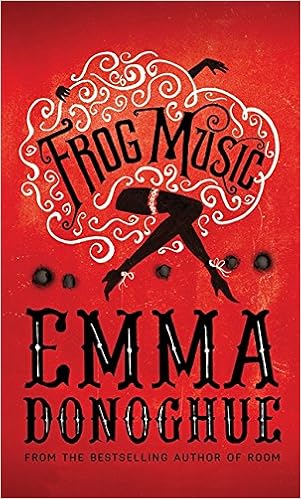
Birthday Review - "Frog Music" by Emma Donoghue


Today is Emma Donoghue’s 46th birthday.  She is best known for her novel Room of which a film version was recently released.  In honour of her special day, I’m posting my review of her latest novel. 

Review of Frog Music
4 Stars 
This historical fiction novel has received mixed reviews, but I thoroughly enjoyed it.

The setting is 1876 San Francisco which is in the midst of a sweltering heat wave and a devastating smallpox epidemic. The protagonist is Blanche Beunon, a circus horse rider in France before immigrating and becoming a burlesque dancer and occasional prostitute. She lives with her lover Arthur, an ex-acrobat who now spends his time gambling with Blanche’s earnings. Living with them is Ernest, Arthur’s former acrobatic partner who joins Arthur in his dissolute lifestyle. By chance, Blanche encounters Jenny Bonnet, a streetwise cross-dressing frog catcher. Jenny forces Blanche to examine her life, especially the care of her son P’tit, but a month after their meeting, Jenny is murdered. Blanche sets out to identify her friend’s killer.

The narrative moves back and forth through time, alternating between Blanche’s attempts to solve the murder and flashbacks to the evolution of her friendship with the free-spirited Jenny.

On the one hand, the book is a whodunit. Several suspects emerge, but it is not just the identity of the murderer that is a mystery. Was Jenny the intended victim or was Blanche actually the target? If the latter is true, Blanche is in danger. And then there’s the fate of P’tit to add to the suspense.

It is Blanche’s journey of self-discovery, however, that adds depth to the novel. Though she is not a conventional heroine, female readers should be able to identify with her. Her lifestyle may be unusual, but she shares a problem common to many women: the demands of motherhood. Becoming a mother was not in Blanche’s plans, so when faced with caring for her son by herself, she alternates between loving him and resenting him. Like many a stay-at-home mom, she craves adult companionship: “But she’s desperate for some lively company. Someone who sees her as something other than a vehicle or a bottle filler; someone who doesn’t wail at the sight of her face” (128). She suffers from exhaustion: “If someone would take P’tit off her hands for only an hour, even, carry him out of hearing range so she could get some sleep” (132). And she longs for her life pre-baby: “Frankly, she’s sick of waiting hand and foot on this tiny, unsmiling stranger. She wouldn’t drown him in a bucket, but she can’t say much more than that. Guilt hangs on her like a lead apron. There are moments, tying a diaper or transferring P’tit from one arm to the other, when Blanche begins to feel competent at this kind of drudgery, but that doesn’t help; it only sharpens the feeling of estrangement from herself” (146).

Of course, maternal love prevails. Eventually, it is not only P’tit’s well-being but that of all orphaned and abused and abandoned children that Blanche considers: “Blanche is almost too angry to speak. Another baby? . . . Was this one nudged along toward his death? she wonders. Did anyone in the asylum feed him even? Hold him? All the missing children. Washed into the world against their will, to do their time, a day or a year, before being sent out of it again” (300). Blanche’s growth as a parent is convincing too. She admits to her son that “Your Maman’s a flawed jewel . . . and there’s no fixing that. There’ll be no overnight metamorphosis” as she vows to “bind P’tit to her with indefatigable love” (371).

The book is full of interesting quirky characters. Jenny is perhaps the most eccentric of all, but Blanche comes a close second, an exploited woman who seeks her independence and happiness like a thoroughly modern woman would. There is no difficulty differentiating among the characters though, admittedly, the men are not usually portrayed in a very positive way.

It is clear that the author did considerable research into the case on which she based her fiction. She has even posted a 20+-page annotated list of sources on her website: (http://www.emmadonoghue.com/images/pdf/the-san-miguel-mystery-the-documents.pdf).  She succeeds in making San Francisco in the 1870s come alive, even including snippets of the lyrics of old songs popular in that era.

I certainly recommend this book. It provides material both exotic and familiar. Forget the naysayers; give the book a try. “How do you know until you try” (370)?