Ranked a Top Canadian Book Blog
Twitter: @DCYakabuski
Facebook: Doreen Yakabuski
Instagram: doreenyakabuski
Threads: doreenyakabuski
Substack: @doreenyakabuski
Bluesky: @dcyakabuski.bsky.social

Wednesday, March 16, 2016

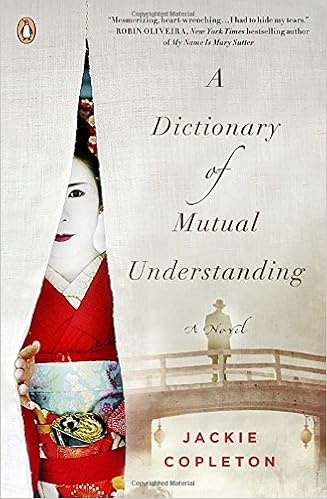
Review of A DICTIONARY OF MUTUAL UNDERSTANDING by Jackie Copleton

4 Stars
Forty years after the atomic bomb was dropped on Nagasaki, Amaterasu Takahashi, now living in the U.S., is visited by a badly scarred man who claims to be her grandson Hideo.  Amaterasu is skeptical having been convinced that her grandson and his mother, her daughter Yuko, died on August 9, 1945.  Yuko’s diaries, which she finally reads, and letters from Hideo’s adoptive parents force her to revisit her past:  her life before, during and after the war and her relationship with her daughter.  A lot of family secrets are revealed.

Each chapter begins with a thematically relevant Japanese word; each adds to the cultural context of the novel.  The reader learns the cultural influences which affect the behaviour of the characters.  For example, one of the first words is haji with the explanation that “the Japanese live in a typical shame culture” and “the Japanese have internal behavioural standards and a deep sense of conscience regarding personal conduct.”  Other words are seken-tei (decency) and yasegaman (endurance) and kenkyo (humility), all concepts of virtue to which Amaterasu adheres.

Amaterasu is a very complex character.  She has a great deal of regret and intense guilt.  She believes that she is responsible for her daughter’s death because she insisted on meeting Yuko at what became the epicentre of the bombing:  “my daughter might be here today if it had not been for me.  I tell myself I acted out of love and a mother’s selflessness but how important is the motivation when you consider the consequence?”  She admits that she has tried to forget the past so she can have “a bearable life” and “to ease the guilt just enough to function.”  She doubts that the man on her doorstep is Hideo:  “my grandson was too pure for any world that would keep . . . me alive but claim my daughter.  Only scavengers and liars and cheats survived.  The best of us died young back then.”

The book is an emotional roller-coaster ride.  There are times when the reader will be so angry with Amaterasu but then later will cry for her.  The same is the case for Sato, a family friend with whom Yuko has a relationship.  Sato is a villain and yet he has redeeming qualities.  In reality, humans are complicated with both positive and negative traits, and the characters in the novel are very realistic. 

There are a number of themes.  Obviously, the book examines why people make certain decisions and how they live with the repercussions of those decisions.  Amaterasu must try to find some peace when there may be no definitive answers to her questions:  What was Yuko going to tell her on the day of the bombing?  Is the man who claims to be her grandson related to her?  In her treatment of her daughter, was she motivated by love for her or by “hurt fossilised to anger, of rejection turned to hate”?

When I reached the end of the book, I promised myself that I would re-read it.  There is undoubtedly much I missed in my first reading.  I found this title on the longlist of the 2016 Baileys Women’s Prize for Fiction, and I certainly understand why it appears there.

Tuesday, March 15, 2016

Some JULIUS CAESAR Quotations for the Ides of March

Today is March 15, the Ides of March, the date of the assassination of Julius Caesar in 44 BC.  The day has me remembering the famous quotation from Shakespeare’s play, Julius Caesar:  “Beware the ides of March” (I, ii, 18).

Of course, this is not the only memorable quotation.  On this day, I thought I’d highlight my top ten from this particular play; these are not necessarily the most famous but ones I have found useful in everyday life.

Cowards die many times before their deaths;
The valiant never taste of death but once.
Of all the wonders that I yet have heard,
It seems to me most strange that men should fear;
Seeing that death, a necessary end,
Will come when it will come (II, ii, 32 - 37).
. . . when needing some courage?

Men at some time are masters of their fates:
The fault, dear Brutus, is not in our stars
But in ourselves, that we are underlings (I, ii, 139 - 141).
. . . when needing encouragement?

There is a tide in the affairs of men
Which, taken at the flood, leads on to fortune;
Omitted, all the voyage of their life
Is bound in shallows and in miseries (IV, iii, 217 - 220).
. . . when needing to avoid procrastination?

The evil that men do lives after them (III, ii, 77).
. . . when needing a reminder to do no evil?

You blocks, you stones, you worse than senseless things (I, i, 35)!
. . . when admonishing students for not doing their work? – in jest of course!

He reads much;
He is a great observer, and he looks
Quite through the deeds of men (I, ii, 201-203).
. . . when praising the benefits of reading?

You are my true and honourable wife,
As dear to me as are the ruddy drops
That visit my sad heart (II, I, 289 - 291).
. . . when needing a quotation for an anniversary card?

But I am constant as the northern star, 
Of whose true-fix'd and resting quality 
There is no fellow in the firmament (III, I, 61-63).
. . . when assuring someone of one’s loyalty?

Friends, Romans, countrymen, lend me your ears (III, ii, 75).
. . . when trying to get people’s attention for an important announcement?

It was Greek to me (II, ii, 284).
. . . when my husband started talking about mechanics!

Remember that 2016 is the 400th anniversary of Shakespeare’s death, so why not choose a play and make your own list of favourite quotations.

Sunday, March 13, 2016

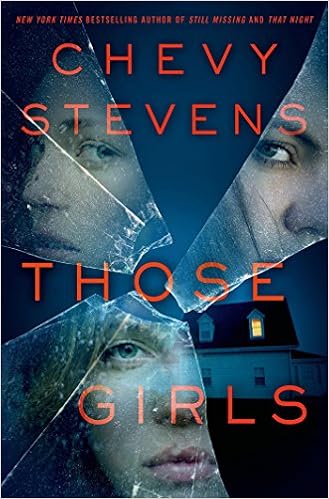
Review of THOSE GIRLS by Chevy Stevens

3.5 Stars
This thriller is set in rural Alberta and Vancouver.  The three Campbell girls (Dani, Courtney, and Jess) have to flee after an incident involving their abusive alcoholic father.  Enroute to Vancouver, they stop in Cash Creek, a small town where they encounter Brian and Gavin Luxton, and things go from bad to worse. 

The second half of the novel finds the girls in Vancouver 18 years later, living with new identities; they have become Dallas, Crystal and Jamie.  Crystal disappears and Jamie’s daughter, Skylar, sets off to find her aunt whom she believes has gone to Cash Creek on a revenge mission. 

The first part of the book is narrated by Jess, the youngest sister; the second part adds chapters narrated by Skylar, her daughter. 

The novel is fast-paced and action-packed so readers looking for a thriller will not be disappointed.  Some of the sections are difficult to read: there are graphic descriptions of violence made even more horrific because the narrators are young girls.

An issue I have with the book is characterization.  Brian and Gavin are pure evil; they have no redeeming qualities so they are not convincing characters.  The fact that they reside in a small town where everyone knows everyone’s business makes their hidden activities unrealistic.  Other supporting characters tend to be the opposite:  too good to be true. 

The characterization is also problematic when it comes to the three sisters.  They have been raised to be tough.  They have few illusions about life and people so their stupid and risky and naïve decisions just do not ring true.  And Skylar makes the same poor choices!

The aspect of the book that is a definite positive is its examination of the bond between sisters.  The three girls love each other and remain loyal regardless of what an individual sister does.  They are survivors because of this bond that gives them strength. 

There is a great deal of tension, but the plot is rather predictable and the characterization is weak.

Friday, March 11, 2016

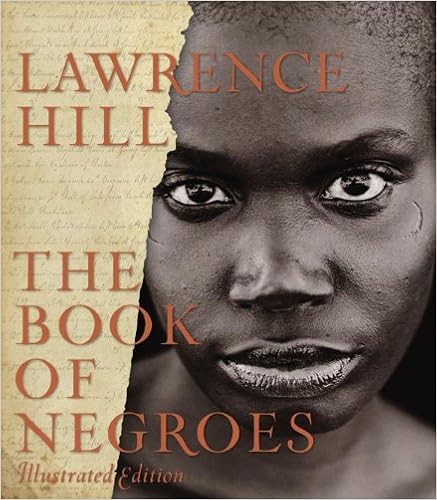
Notes on THE BOOK OF NEGROES by Lawrence Hill

At the Canadian Screen Awards, the big winner in drama was CBC’s miniseries The Book of Negroes, which took home nine CSAs, including best direction in a dramatic program or limited series for Clement Virgo, best original music score for a program for Philip Miller, best performance by an actor in a leading role in a dramatic program or limited series for Lyriq Bent, and best performance by an actress in a featured supporting role in a dramatic program or series for Shailyn Pierre-Dixon (http://www.theglobeandmail.com/arts/awards-and-festivals/film-awards/book-of-negroes-big-winner-at-canadian-screen-awards/article29105686/?cmpid=rss1&click=sf_globe).

These wins inspired me to post my notes on the book by Lawrence Hill which I read back in September of 2008.

4 Stars
The Book of Negroes is narrated by Aminata Diallo as an old woman.  She tells her story beginning with her life in Mali (1745), her abduction by African slavers, her voyage aboard a slave ship, and her work on an island off the coast of South Carolina.  She escapes to New York and then to Nova Scotia.  Eventually she makes her way to Sierra Leone and finally to London where she works with abolitionists of the slave trade.  This inclusive narrative around one memorable character is reminiscent of The Autobiography of Miss Jane Pittman.

I especially enjoyed the insight into Meena’s African childhood and the migration of the Black Loyalists to Shelburne and Birchtown (Nova Scotia) which I have visited. 

I admired Aminata’s struggle to control her own life.  She learns quickly the power of language and literacy and uses it to begin her political resistance against slavery.  Unfortunately, she was not totally realistic.  She is almost too good to be true.  She seems to lead a charmed life despite the horrors she endures.  She is intelligent and beautiful, with a facility for languages, traits that always distinguish her and ensure her survival.  And her unlikely discovery in a London crowd threatens the integrity of the narrative.

At times it seems that the author tried to put too much into the book.  I appreciated his historical research but felt that the focus was sometimes on history, not the narrative.  Though not totally engrossing, it is definitely a worthwhile read.  I would expect it to be picked for Oprah’s book club.

Thursday, March 10, 2016

Longlist for the 2016 Man Booker International Prize

The 13 books in contention for the Man Booker International Prize were revealed today.  It is given to a book in English translation, with a £50,000 prize for the winning title, to be shared equally between author and translator. Its aim is to encourage more publishing and reading of quality works in translation.

The longlist is as follows:  Author (nationality), TranslatorTitle
José Eduardo Agualusa (Angola), Daniel Hahn, A General Theory of Oblivion
Elena Ferrante (Italy), Ann Goldstein, The Story of the Lost Child  (I reviewed this title on December 18, 2015)
Han Kang (South Korea), Deborah Smith, The Vegetarian
Maylis de Kerangal (France), Jessica Moore, Mend the Living
Eka Kurniawan (Indonesia), Labodalih Sembiring, Man Tiger
Yan Lianke (China), Carlos Rojas, The Four Books
Fiston Mwanza Mujila (Democratic Republic of Congo/Austria), Roland Glasser, Tram 83
Raduan Nassar (Brazil), Stefan Tobler, A Cup of Rage
Marie NDiaye (France), Jordan Stump, Ladivine
Kenzaburō Ōe (Japan), Deborah Boliner Boem, Death by Water
Aki Ollikainen (Finland), Emily Jeremiah & Fleur Jeremiah, White Hunger
Orhan Pamuk (Turkey), Ekin Oklap, A Strangeness in My Mind
Robert Seethaler (Austria), Charlotte Collins, A Whole Life

A shortlist of six books will be announced on April 14 and the winner, on May 16

Wednesday, March 9, 2016

Longlist for 2016 Baileys Women’s Prize for Fiction

The longlist for the 2016 Baileys Women’s Prize for Fiction was released yesterday: http://www.womensprizeforfiction.co.uk/2016/announcing-the-2016-baileys-womens-prize-for-fiction-longlist.  The prize was established to recognize the literary achievement of female writers.  One of the United Kingdom's most prestigious literary prizes, it is awarded annually to a female author of any nationality for the best original full-length novel written in English and published in the United Kingdom in the preceding year.

Here are the 20 novels on that list:
Kate Atkinson:  A God in Ruins    (United Kingdom) – See my review posted on January 16, 2016
Shirley Barrett:  Rush Oh!    (Australia)
Cynthia Bond:  Ruby     (U.S.)
Geraldine Brooks:  The Secret Chord    (Australia)
Becky Chambers:  The Long Way to a Small, Angry Planet    (U.S.)
Jackie Copleton:  A Dictionary of Mutual Understanding    (United Kingdom)
Rachel Elliott:  Whispers Through a Megaphone     (United Kingdom)
Anne Enright:  The Green Road     (Ireland)
Petina Gappah:  The Book of Memory     (Zimbabwae)
Vesna Goldsworthy:  Gorsky     (Serbia)
Clio Gray:  The Anatomist’s Dream     (United Kingdom)
Melissa Harrison:  At Hawthorn Time     (United Kingdom)
Attica Locke:  Pleasantville     (U.S.)
Lisa McInerney:  The Glorious Heresies     (Ireland)
Elizabeth McKenzie:  The Portable Veblen     (U.S.)
Sara Nović:  Girl at War     (U.S.)
Julia Rochester:  The House at the Edge of the World     (United Kingdom)
Hannah Rothschild:  The Improbability of Love     (United Kingdom)
Elizabeth Strout:  My Name is Lucy Barton     (U.S.) – See my review posted on January 12, 2016
Hanya Yanagihara:  A Little Life     (U.S.) – See my review posted on August 10, 2015

The shortlist of six titles will be revealed on April 11 and the winner, who will receive £30,000, will be announced on June 8.  

Tuesday, March 8, 2016

Reading Lists for International Women's Day

Today, Tuesday, March 8, 2016, is International Women’s Day.  I came across a number of sites with lists of reading suggestions for the day.  Here are three I found interesting.


I am not a reader of much non-fiction but from these lists, two titles stand out as ones I might read:  I Am Malala by Malala Yousafzai and Enough is Enough: Aboriginal Women Speak Out by Janet Silman.