Ranked a Top Canadian Book Blog
Twitter: @DCYakabuski
Facebook: Doreen Yakabuski
Instagram: doreenyakabuski
Threads: doreenyakabuski
Substack: @doreenyakabuski
Bluesky: @dcyakabuski.bsky.social

Friday, July 8, 2016

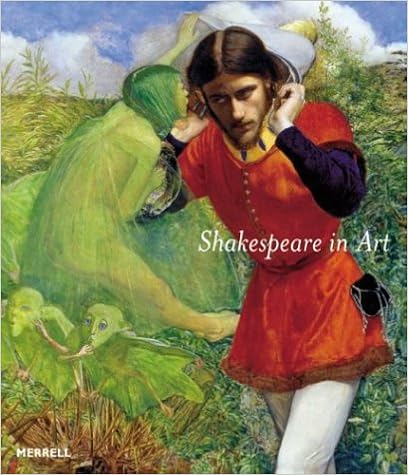
Shakespeare in Art

In this year marking the 400th anniversary of Shakespeare’s death, I have posted about a number of books about the playwright and his plays and poetry.  Today I thought I’d feature the Shakespeare book from Schatje’s Shelves which I probably browse most often:  Shakespeare in Art by Jane Martineau et al.

Here’s a summary of the book from the flyleaf: 
“Shakespeare is one of the most influential writers of all time, but it was the rediscovery of his work in the eighteenth century that was a key factor in launching the Romantic movement.  At the height of the Shakespeare craze of the early nineteenth century a handful of plays--Hamlet, Othello, Macbeth, King Lear and Romeo and Juliet--created the mindset of a generation, affecting every artist, writer, composer and politician in Europe. Shakespeare in Art tells the remarkable story of how one of many Elizabethan dramatists, for centuries virtually unknown outside England, became a truly European author, inspiring German nationalist thinkers, French dramatists, Italian opera composers, Russian novelists and painters everywhere. Everyone agreed that the plays were untranslatable and yet everyone tried to translate them.
“Shakespeare in Art looks especially at the huge variety of painters who made Shakespeare's extremes of passion, his evocations of nature, his spirit world and his eternally familiar characters the subjects of their own work. Also explored is the influence of Shakespeare on eighteenth- and nineteenth-century literature, theatre, music and printmaking.”

The book includes 11 in-depth essays by ten different contributors. One of my favourite is “Shakespeare and Music” by John Warrack (pp. 40 – 47).  But the highlight of the book is 88 full-page, colour reproductions of artworks.  Each plate is accompanied by particulars about the plate and an explanatory text.  21 of Shakespeare’s plays are represented. 

This is a book to treasure and savour.

Wednesday, July 6, 2016

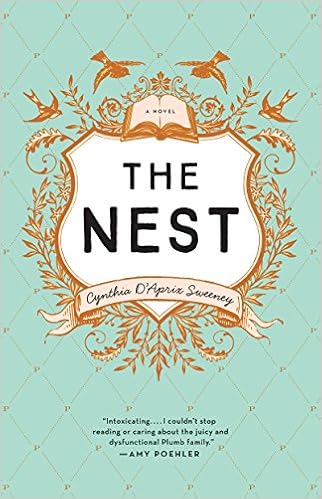
Review of THE NEST by Cynthia D'Aprix Sweeney


2.5 Stars

I chose this book because it appeared on a number of summer reading lists.  My conclusion is that it is indeed a book for the beach – entertaining but not requiring much thought.

The Plumb siblings expect an inheritance meant to be divided amongst the four of them when Melody, the youngest, turns 40.  Unfortunately, a few months before her birthday, Leo, the eldest Plumb, makes some choices that have disastrous consequences; to avoid publicity, the Plumb matriarch depletes the nest egg so there is only $50,000 for each rather than the $500,000 expected.  The problem, of course, is that they have pre-spent their anticipated portions, so they must now figure out how to deal with their financial problems.

The story is about four privileged, entitled adults who have built their lives on the promise of a trust fund.  I found it difficult to identify with any of them or to feel any sympathy for them.  They have only themselves to blame.  Leo is the most irresponsible but all are self-absorbed and shallow.  And they keep believing Leo’s lies because of his charm and charisma though he has repeatedly shown himself to be unreliable and selfish!  Their problems are definitely what one character identifies as “’luxury problems.’”  Their preoccupations make them blind to their advantages.

Obviously, the siblings have to learn a lesson.  Could it be that it is not wise to “count the chickens before they hatched”?  Could it be that with hard work and realistic ambitions, they can achieve their goals without relying on an inheritance?  Could it be that there are more important things in life than money (e.g. family, love)?  Can you guess that this is not a complex novel?

Apparently, the author received a million-dollar advance on the book, but I don’t understand why.  There are some humourous sections where the author pokes fun at the foibles of the four siblings and other idle rich New Yorkers, and the narrative is entertaining.  But there is nothing exceptional about the writing, and the ending is predictable and sentimental.

Pick up this book only if you want an unchallenging, feel-good read.

Monday, July 4, 2016

For July 4: Summer Reading Lists from the U.S.

Because I’ve been celebrating Canada Day, I’ve posted about Canadian books and Canadian summer reading lists.  I do, however, read reviews in a number of American publications.  On July 4, Independence Day in the U.S., I thought I’d mention the summer reading lists from 5 American sources:

Kirkus Reviews has two lists.  One is entitled “10 Summer Reads Everyone is Talking About”: https://www.kirkusreviews.com/lists/10-summer-reads-everyone-talking-about/.  And though many book clubs do not meet over the summer, Kirkus Reviews also offers 11 summer reads for book clubs:  https://www.kirkusreviews.com/lists/11-excellent-summer-reads-your-book-club/.

The Boston Globe suggests 80 books in different categories (fiction, non-fiction, mystery, and sports):  https://www.bostonglobe.com/arts/books/2016/06/22/fiction/agkgp2oPMk9FUe5UMEsMEK/story.html.

The Chicago Tribune offers 30 suggestions:

The New York Times recommends 18 books, some new, some not so:  http://www.nytimes.com/2016/05/27/books/12-new-books-were-reading-this-summer-and-6-not-so-new.html?_r=1

And the Washington Post has also released a list:  https://www.washingtonpost.com/graphics/entertainment/summer-reading-list-2016/.

Of course, I hope you’ll peruse my reviews on this blog for suggestions for good reads – in the summer or anytime of the year.


Happy July 4th to all my American readers!

Sunday, July 3, 2016

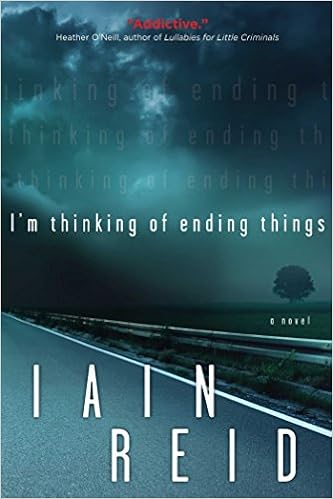
Review of I'M THINKING OF ENDING THINGS by Iain Reid


3.5 Stars

This psychological thriller is bizarre.  Beyond knowing this, the reader might be wise to just read the book before reading my analysis or any other book review because there will be inadvertent revelations in any discussion of this book.

Ostensibly the book is about a girl driving with her boyfriend Jake to meet his parents at the family farm.  She, the narrator, remains unnamed.  Her relationship with Jake is fairly new, but she is thinking of ending it.  An awkward visit with the parents is followed by the drive home in a snow storm with a detour to an empty high school where things become really strange.  And then there’s the ending which reveals that nothing is as it seemed.  The ending invites the reader to re-read the book from a different perspective:  “You should read it.  But maybe start at the end.  Then circle back.”

I did re-read it and certainly understood more than I did on my first reading.  I could probably go back and read it again, but more books await, and I’ve lost interest in puzzling this one out any more.  Admittedly, the second reading made me appreciate the many subtle clues dispersed throughout.  The author must be commended for being able to write in such a way that statements can have two different meanings right from the beginning:   “I’m thinking of ending things.  Once this thought arrives, it stays.  It sticks.  It lingers.  It dominates.  There’s not much I can do about it.” 

This book will appeal to readers who enjoy books who leave them feeling uneasy because things just don’t feel right.  The information given about Jake suggests he is an unusual person.  After all, who would want a trivia team to be called Ipseity, “just another way to say selfhood or individuality,” because “there are many of us but we aren’t like any other team.  And because we play under a single team name, it creates an identity of oneness”?  He calls his girlfriend “therapeutic”?  He claims a childhood photo is of him, but the girlfriend says, “It doesn’t look like Jake.  Not at all.  It looks like a little girl.  More precise: it looks like me.”  Who keeps an envelope labelled “Us” with close-up photos of body parts?  Yet, despite his oddities, the girlfriend feels “a real connection, a rare and intense attachment”?  Obviously, all of these statements are clues to what is really going on.  And, of course, it’s not only Jake who is quirky; there are other strange characters. 

The setting is also used to create suspense.  The family farm is remote, and its deteriorating state with its animal carcasses adds to the sense of unease.  The farm’s isolation is emphasized when Jake and his girlfriend drive through a storm on the way home.  It was a dark and stormy night . . .   The girlfriend’s anxiety is passed on to the reader, especially when she makes statements like, “I’m scared.  I feel a little crazy.  I’m not lucid . . .  I can feel my fear growing.”  Most interesting, at one point, the author even tells the reader how he is creating suspense:  “My story is not like a movie . . . It’s not heart-stopping or intense or bloodcurdling or graphic or violent.  No jump scares.  To me, these qualities aren’t usually scary.  Something that disorients, that unsettles what’s taken for granted, something that disturbs and disrupts reality – that’s scary.”

The book is really about how we cannot really know each other.  The girlfriend wants “someone to know me, really know me, almost like that person could get into my head.”   She realizes, however, that “We’re never inside someone else’s head.  We can never really know someone else’s thoughts.  And it’s thoughts that count.  Thought is reality.  Actions can be faked.”  And “We can’t and don’t know what others are thinking.  We can’t and don’t know what motivations people have for doing the things they do.  Ever.  Not entirely.”  

The novel also addresses the importance of memories and stories.  “Stories based on actual events often share more with fiction than fact.  Both fictions and memories are recalled and retold.  They’re both forms of stories.  Stories are the way we learn.  Stories are how we understand each other.”

If you are a reader who is a cruciverbalist and enjoys elaborate metaphors and symbols, this book is for you.  Be prepared to not “understand the [novel’s] world through rationality, not entirely . . . [but] to accept, reject, and discern through symbols [which are] important to our understanding of life, our understanding of existence and what has value, what’s worthwhile . . . ”  And when you’re done, why not read Pincher Martin by William Golding?
Saturday, July 2, 2016

Summer Reading Lists from Canada

Summer has well and truly arrived so it’s time for summer reading lists.  A number of such lists have been released.

Being Canadian, of course, I like a Canadian perspective.  CBC Books has two lists, a general list (http://www.cbc.ca/books/2016/05/cbc-books-summer-2016-reading-list.html) and a list of mysteries (http://www.cbc.ca/books/2013/06/this-summers-must-read-mysteries.html#igImgId_73070).   I also like 49th Shelf which focuses solely on Canadian books:  http://49thshelf.com/Blog/2016/06/23/Your-CAN-T-FAIL-Summer-Reading-List.

Of course, I hope you’ll peruse my reviews on this blog for suggestions for good reads – in the summer or anytime of the year.

Friday, July 1, 2016

Canadian Books for Canada Day

Today is Canada Day, the 149th birthday of the greatest country in the world.  I certainly won the birthday lottery when I was born in this country.

Obviously, it’s a great day to read some Canadian authors, and our national broadcaster has useful lists to help us select great Canadian books.

A couple of years ago, CBC Books compiled a list of 100 books that make us proud to be Canadian:  http://www.cbc.ca/books/books100.html.  I’ve read about half of the titles on the list so if I were to make a list of my own 100 must-read Canadian novels, it would include many of these.  (I’ll make that list one of my projects for Canada’s 150th birthday.)  Some of the authors who appear have several novels which I would recommend.

Last year, CBC Books added a list of 100 must-read young adult fiction (http://www.cbc.ca/books/books100ya.html), and this year compiled a list of 100 non-fiction books:  http://www.cbc.ca/books/books100truestories.html.

HAPPY CANADA DAY!

Thursday, June 30, 2016

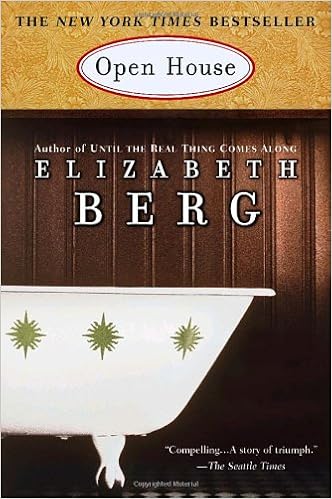
Review of OPEN HOUSE by Elizabeth Berg


2 Stars
This is another of those Oprah Book Club selections that lacks substance. 

Samantha Morrow is a middle-aged upper class woman whose husband David leaves her after 20 years of marriage.  A stay-at-home mother (for 11-year-old Travis), she has made little effort to have a life outside her family; she seems to have only one friend.  For financial reasons, she decides she needs to take in lodgers – a 78-year-old woman, a depressed university student, and a gay hair stylist.   These three people, and a neighbour who befriends her, help her create a new life.

Sam was my problem with the book.  She is a very unlikeable character so it is difficult to have any sympathy for her.  She has a good life despite the fact that her marriage has fallen apart; even money does not seem to be a real issue.  Certainly, her marriage breakdown does not have the catastrophic consequences many women experience.  Furthermore, she is so self-absorbed, so self-centred, and so full of self-pity.  All she does is whine.  Her friend tells her, “’I don’t feel sorry for a victim who keeps choosing to be a victim.  That’s what you’re doing.  You’re not even trying.  You’re just sinking deeper into feeling sorry for yourself.’”  This is a perfect description of her and, as a result, she comes across as just pathetic. 

Sam is also such a shallow person.  She tells Travis about the divorce (after stupidly telling David she wanted to do it) but, instead of worrying about the impact of the news on her son, she frets about halitosis because her breath smells “of garlic for three days after she eats it,” about gray hair “popping out all over my head”, about cellulite, and about snoring.  She constantly comments on other people’s appearances. 

The book is full of stereotypes.  It is a black woman who begs on the street (though she has a “lovely face"); Sam’s employer at a laundromat is a Chinese man with “tea-coloured teeth” who speaks in broken English; it is a black man, whose “eyes are bloodshot,” who comes into the laundromat with a blaring boom box (though he is “handsome”); and the third lodger is a flamboyantly gay hair dresser who describes himself as “’a walking cliché’” and when faced with danger says, “’We  need a man in the house!’”

The theme is anything but complex.  Samantha has to learn to appreciate the simple things.  And that message is repeated several times by several people:  Samantha thinks, “I was thinking that gratitude is too much absent in our lives now, and we need it back, even if it only takes the form of acknowledging the blue of a bowl against the red of cranberries. . . . This is the time in my life to do other things. . . . All right:  the red against the blue, the sound of the birds in the morning.  The sugar smell in bakeries.  The smoothness of fabric moving under my hands into the teeth of the sewing machine.  The movement of the ocean, the break of light every morning, every morning.”  And King says, “’I want to be appreciative of all that’s here, in a normal life.  I want to keep finding out about the things I see around me.’”  And Sam’s mother says, “’I think most young people today are so focused on tomorrow they forget all about today.’”

The plot is predictable.  It is obvious, from the first introduction of a character, that he will be Sam’s next romantic interest.  And that man is just too good to be true, a total contrast to the man who Sam says “almost” date-raped her.  The ending is just so optimistic and sentimental, exactly what the reader expects.

I wish I had not gone to this Open House.