Ranked a Top Canadian Book Blog
Twitter: @DCYakabuski
Facebook: Doreen Yakabuski
Instagram: doreenyakabuski
Threads: doreenyakabuski
Substack: @doreenyakabuski
Bluesky: @dcyakabuski.bsky.social

Sunday, March 12, 2017

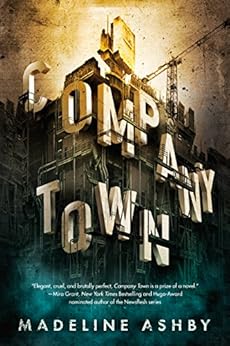
Review of COMPANY TOWN by Madeline Ashby


2.5 Stars
I decided to read this book because it is one of the five selections for this year’s Canada Reads.  Having finished it, I find myself shaking my head and wondering why it was chosen.

This crime story in a science-fiction setting takes place on New Arcadia, a near-future town-sized oil rig off the shore of Newfoundland.  The protagonist is Go Jung-Hwa who is a body guard for the sex workers.  When New Arcadia is bought by Lynch Ltd., Hwa ends up being hired to protect the family scion, Joel Lynch, a teenage genius whose life has been threatened by “a conspiracy of sentient artificial superintelligences” from the “deep future”  (43 – 44). Then some of her former clients and friends are killed in Jack the Ripper style and Hwa starts investigating.

Hwa is different from most other people in New Arcadia because she has no bioengineered enhancements while virtually everyone else has an augmented body.  She is supposed to be seen as the strong female lead, but I didn’t find her that smart or self-sufficient.  In fact, she comes across as a cliché of an action movie hero.  She barges in and intimidates and doesn’t let physical injuries stop her.  Yet there is an inconsistency in her portrayal; she’s either a badass or a damsel in distress who needs to be rescued.  Admittedly, there is some attempt to humanize her:  she has a difficult relationship with her mother and a neurological disorder has stained her skin and makes her susceptible to seizures.  As a result, she has little self-esteem; her physical appearance fills her with shame.    

Then there’s Joel, the 15-year-old, who seems too mature for his age.  He even handles a press conference with the adeptness of a seasoned politician.  And Daniel Síofra, Hwa’s boss, is just too perfect.  He is handsome and strong and sensitive and Hwa’s knight-in-shining-armour on more than one occasion.  A romance between Hwa and Daniel is inevitable from the moment they meet.

The narrative feels underdeveloped.  Some events mentioned seem to serve little purpose; the apartment break-in, for example, seems gratuitous.  There is a lack of transitions so the plot doesn’t hang together.  It also seems as if the book tries to be too many genres:  crime thriller, science-fiction, and romance.

I enjoyed the touches of Newfoundland local colour.  There are references to bakeapples and a visit to Terra Nova.  Occasionally, Hwa speaks in dialect though it’s largely limited to the use of “b’y.” 

The theme for this year’s Canada Reads is “What is the one book Canadians need now?”  I’m not sure how this novel fits this theme.  It portrays a single-industry town dependent on fossil fuel extraction.  Are we supposed to think of Alberta?  The corporation that owns New Arcadia acts like a government.  Is this book a warning about increasing corporatization where companies are like cults:  “’Is [the Lynch company] not a novel organization fanatically devoted to making possible the wishes and dreams of a single figure, based on his view of reality’” (225)?  Is the book a warning about where technology might take humans in the future?  Is it an indictment of society’s obsession with physical perfection?  [I couldn’t help but think of Donald Trump in this description:  “he was far too tanned . . . His skin . . . was a hell of a lot more orange . . . Nothing screamed ‘I’m terrified of aging!’ louder than a mela-nano infusion” (38).]   The novel addresses all these issues, but, again, it seems to try to be too many things and so lacks focus.

I do not often read speculative fiction, so perhaps this book was not meant for me.  I found it disjointed and just plain weird.

Saturday, March 11, 2017

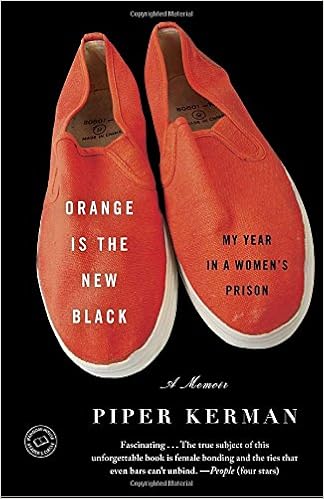
Review of ORANGE IS THE NEW BLACK by Piper Kerman


The last couple of blog entries have been about books and youth offenders and books in prison.  They brought to mind, a prison memoir I read three years ago, Orange is the New Black by Piper Kerman.  It has been made into a very popular Netflix series.  I haven’t watched the series because I found the book mediocre at best.  Could this be a case of the adaptation actually being better than the book?

2 Stars
Piper Kerman served a sentence in a federal prison for a drug trafficking charge. This memoir focuses on her 13-month incarceration.

This book is neither a compelling nor a harrowing read. Piper’s situation is less than ideal, but she is never in any real danger. Reading her account became tedious because there is no real tension. From the beginning, she is told, “’No one’s going to mess with you unless you let them. Now, women, they don’t fight much. They talk, they gossip, they spread rumors’” (39). Her life is boring and being strip-searched would certainly be humiliating, but her overall experience does not seem to have been especially difficult. She jogs and does yoga so that “every visitor who came to see me said with astonishment, ‘You look fantastic’” (126). She even picks up carpentry and electrical skills. She seems to fit in easily; everyone welcomes her and accepts her and likes her. The only violence she encounters is an argument over salad bar ingredients!

Piper mentions many of her fellow inmates, but they are barely differentiated, much less developed. It is very difficult to remember who is who; no one takes on any importance except in relation to Piper. Piper herself is shallow, focusing unnecessarily on people’s physical appearances: “Finally, a considerably less pleasant-looking woman entered the lobby. She had a dreadful scar down the side of her face and neck” (33) and “She was wearing a dowdy pantsuit and hideous costume jewelry” (55) and “A grizzled, steel-haired Irish woman with enormous breasts” (86) and “Caucasian girls from the wrong side of the tracks with big mouths and big attitudes, who weren’t taking shit from anyone (except the men in their lives). They had thinly plucked eyebrows, corn-rowed hair, hip-hop vocabularies, and baby daddies, and they thought Paris Hilton was the ne plus ultra of feminine beauty” (137). There always seems to be a judgmental tone to her voice so I found her difficult to like, especially since she does not hesitate to use her good looks to get what she wants: “my blond hair and blue eyes stood me in good stead, just as they had with Butorsky” (112).

Certainly, it is difficult to have any emotional connection with Piper. She keeps repeating how she is so different from everyone else because of her level of education, her socioeconomic status, and the never-faltering support of all family and friends: “I am fairly certain that I was the first Seven Sisters grad to eat duck liver chased with a Diet Coke in the lobby of a federal penitentiary” (33) and “Many times I fielded the sly question, ‘What is the All-American Girl doing in a place like this?’” (138).

For someone with a university education, Piper seems unintelligent. After graduating, she allows herself to be drawn into the world of drug trafficking, claiming she had “a thirst for Bohemian counter-culture . . . [and] a pent-up longing for adventure” (5). Her great epiphany while in prison is that her actions affected other people, but it occurs only after she has been in prison for over five months: “I finally understood the true consequences of my own actions. I had helped these terrible things happen. . . . Yet for the first time I really understood how my choices made me complicit in their suffering. I was the accomplice to their addiction” (180). She had never thought of people actually using the drugs she and her Bohemian friends brought into the country?! Does this strike only me as self-centred? Considering her focus on self, it is not surprising that she obsesses about the canvas slippers she is initially given to wear (36, 41, 47, 53, 54).

There is a fairy tale quality to Piper’s story which does not ring true. All of her friends are unfailingly supportive. When first told of her conviction, “Reactions were pretty consistent – our friends would laugh uproariously, then have to be persuaded of the truth, then be horrified and worried for me” (27). “Their collective response was . . . kindness and concern” (28) and she receives “an avalanche of letters” (69), more than all but one other prisoner, and so many books that she feels “embarrassed and . . . nervous” (78). There is no mention of anyone rejecting her or suggesting she was stupid to have done what she did. Everyone justifies her actions by saying, “’You were young!’” (27). She was 24!

The book could use some editing. Needless repetition is common. How many times does the reader need to be told, “It was amazing how many uses sanitary napkins had – they were our primary cleaning tool” (72) and “I had learned . . . how to clean house using maxipads” (150)? And some episodes just jar. For instance, Piper never mentions hating the woman who introduced her to drug running; she admits only to having “had occasional thoughts of Nora” (266). Then when she sees her, she feels “coiled, stymied rage” (273)? Piper is angry with the repercussions of the government’s war on drugs, and much of what she says gives one pause; however, some of her statements left me puzzled: “According to the CDC, cigarettes kill over 435,000 people a year in the United States. Most of us in Danbury were locked up for trading in illegal drugs. The annual death toll of illegal drug addicts, according to the same government study? Seventeen thousand. Heroin or coffin nails, you be the judge” (194). She is arguing that heroin use is better than cigarette smoking?

This memoir is a straightforward account of a woman’s year in prison. It provides no great revelations. My relief upon finishing the book may not have been as great as Piper’s relief at being released, but I did feel somewhat like I had completed a sentence.

Friday, March 10, 2017

Books in Prison


Yesterday, I blogged about how youth offenders in Virginia have been assigned some books to read, books of literary significance and with subject matter about race, religion and discrimination.  Some people did not like the idea of reading as a form of punishment, but the reading was intended to be educational. 

Of course, prisons, institutions of punishment, do have libraries.  Inmates require books to earn their high school diplomas or to prepare themselves for upcoming court cases.  A friend who taught in the prison system told me that some inmates learn to read while incarcerated. 

It goes without saying that prisoners have a right to read.  PEN Canada has a useful guide to a prisoner’s legal rights to free expression and privacy:  https://pencanada.ca/blog/prisoners-right-to-read/.

To celebrate World Book Day (celebrated on March 2 in England), Prisoners’ Education Trust, a British charity, published an article entitled “What Reading in Prison Means to Me”:  http://www.prisonerseducation.org.uk/news/world-book-day-in-prison.  It makes for good reading.

If you are interested in reading something written by inmates, check out https://www.vice.com/en_us/article/read-these-brilliant-short-stories-by-texas-prison-inmates.  Here you can read some memoirs written by participants in a creative writing course offered in a maximum-security prison in southern Texas.

If you are interested in reading what prisoners like to read, Bustle recently issued a list of the books most frequently requested in American prisons:  https://www.bustle.com/articles/120919-11-frequently-requested-books-in-american-prisons.

Apparently, books about crime and prison are often among the favourite reading choices for people in jail. Last year, The Guardian newspaper recommended five books about prison time:  https://www.theguardian.com/books/booksblog/2016/apr/11/books-behind-bars-five-best-stories-prison-life-alan-sillitoe-erwin-james.   And Goodreads has an extensive list of what they call Prison Books:  https://www.goodreads.com/list/show/175.Prison_Books.

There should be no bars to reading!

Thursday, March 9, 2017

Books to Educate Youth Offenders


After five teenagers defaced a historic black schoolhouse in Virginia with racist and anti-Semitic graffiti last September, Judge Avelina Jacob handed down an unusual sentence:  that they read one book each month for the next 12 months and write a report about it.

The graffiti sprayed on the schoolhouse included swastikas, sexual images and the phrases “brown power” and “white power.”

“It became very apparent to us as we reviewed the facts, and their statements to detectives, that these kids truly did not appreciate the significance or the meaning of what they were drawing on the building," said Commonwealth's Attorney Jim Plowman.  "Because of this, we are seizing the opportunity to treat this as an educational experience for these young men so they may better appreciate the significance of their actions and the impact this type of behavior has on communities and has had throughout history" (https://www.loudoun.gov/CivicAlerts.aspx?AID=3756).

The books were chosen based on their literary significance and/or their subject matter content surrounding race, religion and discrimination.  See the entire list from which the students can choose their books:  https://www.loudoun.gov/CivicAlerts.aspx?AID=3756. 

This story came to my attention though this article in The New York Times:  https://www.nytimes.com/2017/02/08/us/black-school-racist-sexist-graffiti.html?mwrsm=Facebook

Wednesday, March 8, 2017

Walt Whitman Novel Discovered


In 1852, The Sunday Dispatch, a New York newspaper, published a 36,000-word novella anonymously in six parts.  Then it disappeared.  Now, Zachary Turpin, a grad student at the University of Houston, unearthed it and discovered that Life and Adventures of Jack Engle was written by none other than Walt Whitman, the influential American poet best known for his Leaves of Grass, an experimental poetry collection which was very controversial when it was published in 1855 because of its overt sexuality.

Life and Adventures of Jack Engle has been classified as a mystery novel:  “A quasi-Dickensian tale of an orphan’s adventures, it features a villainous lawyer, virtuous Quakers, glad-handing politicians, a sultry Spanish dancer and more than a few unlikely plot twists and jarring narrative shifts” (https://www.nytimes.com/2017/02/20/arts/in-a-walt-whitman-novel-lost-for-165-years-clues-to-leaves-of-grass.html?_r=0).

David S. Reynolds, a Whitman expert at the Graduate Center of the City University of New York, said, “It’s not a great novel, though it’s not a bad read either.”  You can decide for yourself since the full book was published online in the literary journal Walt Whitman Quarterly Review:  http://ir.uiowa.edu/wwqr/vol34/iss3/3/.

Tuesday, March 7, 2017

Oscar-Winning Director to Adapt THE UNDERGROUND RAILROAD

Everyone is now aware of the error made in announcing the winner of the Best Picture Oscar at the Academy Awards.  I was pleased when Moonlight won since I found La La Land to be fluff.  (I will admit to cheering for Ryan Gosling since he’s a Canadian and even lived for a time where I now live.)

Barry Jenkins, the director of Moonlight has a new project:  he is teaming up with Plan B, the production company behind Moonlight, to adapt Colson Whitehead’s 2016 novel, The Underground Railroad.  Details are sparse at the moment but, apparently the adaptation will be a limited series (http://www.okayplayer.com/news/barry-jenkins-to-adapt-colson-whiteheads-best-selling-novel-the-underground-railroad-as-a-limited-series.html). 

The novel tells the story of Cora and Caesar, two slaves who make a bid for freedom from their Georgia plantations by following the Underground Railroad, which in this novel becomes an actual underground subway.  The book won the 2016 National Book Award for Fiction and the Andrew Carnegie Medal for Excellence.

LitHub even suggested whom he should cast in the various roles:  http://lithub.com/who-should-star-in-the-barry-jenkins-adaptation-of-the-underground-railroad/