Ranked a Top Canadian Book Blog
Twitter: @DCYakabuski
Facebook: Doreen Yakabuski
Instagram: doreenyakabuski
Threads: doreenyakabuski
Substack: @doreenyakabuski
Bluesky: @dcyakabuski.bsky.social

Sunday, July 9, 2017

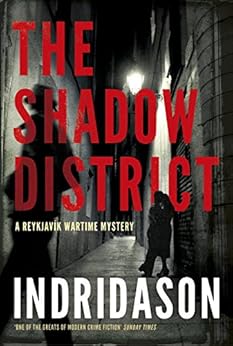
Review of THE SHADOW DISTRICT by Arnaldur Indriðason

3 Stars
Having read and enjoyed all of Indriðason’s Detective Erlendur books, I was anxious to read this first of a new series of historical crime novels set in Iceland during World War II.

In 1944, the semi-clad body of a young woman is found behind the National Theatre in Reykjavík.  Flóvent, an Icelandic detective with Reykjavík’s fledgling Criminal Investigation Department, and Thorson, an Icelandic-Canadian seconded to the American military police, collaborate to identify the victim and the killer.  In the present, Konrád, a retired police detective, helps look into the death of Stefán Thordarson whose personal possessions include newspaper clippings about the wartime murder. 

I did not find that this book measures up to the quality of the Erlendur books.  The slow pace of this police procedural was frustrating at times.  The dialogue was stilted.  And there were too many clichés:  “She nearly jumped out of her skin” and “He nearly jumped out of his skin” and “chatted to her about everything under the sun”. 

Perhaps these latter are a product of poor translation, but there are other weaknesses as well.  For instance, the links between the wartime murder and Konrád’s childhood seem too coincidental.  Then there’s the introduction, very late in the novel, of the point of view of Thordarson to explain the last few days of his life.  This technique seems like the author taking an easy way out. 

One of the aspects I most enjoyed is the novel’s touches on Icelandic history and culture.  I learned, for example, about the Situation, the liaisons between soldiers and Icelandic women; I had never considered the impact of tens of thousands of servicemen pouring into a city with a population of only 40,000.  The references to Icelandic folklore, especially the huldufólk or hidden people, are interesting. 

The independence of Iceland was also something I had known nothing about:  at Þingvellir on June 17, 1944, when Iceland was occupied by the Allies and Denmark was occupied by the Nazis, Iceland unilaterally declared independence from Denmark.  (Having recently visited Þingvellir, where the Alþingi, the world’s first parliament, was founded in 930 and where the Icelandic nation agreed to adopt Christianity in the year 1000, I understand why Icelanders chose this site for its declaration of independence and why the site is a national shrine.)

I’m not sure where the Reykjavík Wartime mystery series goes from here.  (Does it follow more of Flóvent’s cases during the war?  Unfortunately, I didn’t find that the detective is developed in sufficient depth.  Thorson had more interest for me but primarily because of his Canadian roots in Manitoba and because the information given about his personal life adds another dimension.)  I’m also not sure I will revisit the series when the next installment is released. 

Saturday, July 8, 2017

Flap Books for Adults

As a grandmother, I’m familiar with flap books, books where children get to lift flaps.  They are intended to make learning more fun and interactive, although there is debate as to whether they actually help toddlers learn new words (http://www.telegraph.co.uk/science/2016/09/14/lift-the-flap-books-may-stop-toddlers-learning-new-words-say-sci/). 

I hadn’t realized that such books had been around in the 16th century until I came across an interesting article earlier this year:  “The Scandalous Flap Books of 16th-Century Venice”.  Apparently “flap books were a fun innovation in publishing, used for purposes both serious and satirical.”  As the article shows, these flap books were definitely intended for an adult audience:  http://www.atlasobscura.com/articles/sexy-venice-flapbooks?utm_source=twitter&utm_medium=atlas-page.

Friday, July 7, 2017

Books with Unreliable Narrators

I don’t mind being challenged when I read, so I enjoy books with unreliable narrators whose credibility has been seriously compromised.  His/her story cannot be taken at face value because the narrator is insane, lying, deluded, immature, naïve, or for any number of other reasons.

If you are interested in books with unreliable narrators, here are three lists to help you choose your next read:
and
and

There is overlap in these lists, but one of my favourite books with an unreliable narrator is not mentioned:  William Golding’s Pincher Martin.

Thursday, July 6, 2017

Reading Classics

Every summer, I try to read or re-read a classic.  This summer it will be Dante’s Inferno; I’m using the 2004 Chronicle Books edition.  The text, adapted by Sandow Birk and Marcus Sanders and illustrated by Sandow Birk, is actually an imaginative, contemporary spin on the classic. 

Of course, this got me thinking about what makes a classic.  About a year ago, BookWitty had an article entitled “What Makes a Book a 'Classic'?” by Daniel O'hEidhin.  He quotes Italo Calvino’s 14 definitions of a classic: https://www.bookwitty.com/text/what-makes-a-book-a-classic/572f8474acd0d06f852d920f.

If you’re interested in ancient classics, this list might appeal to you:  http://www.telegraph.co.uk/culture/books/10610334/15-best-classics-books-of-all-time.html.

If you like more modern classics, you can try the 99 Classic Books Challenge:   http://www.listchallenges.com/100-classic-books-challenge. 

Personally, I prefer this exhaustive list:  http://thegreatestbooks.org/.  
And the Top 100 Works of World Literature compiled by the Nobel Institute is really interesting.  One hundred authors from 54 countries were polled on what they considered the “best and most central works in world literature”:  http://thegreatestbooks.org/lists/28.

Wednesday, July 5, 2017

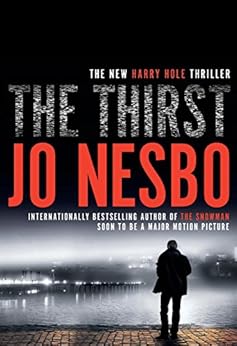
Review of THE THIRST by Jo Nesbø

3.5 Stars 
Women are being murdered by a killer who uses Tinder as his hunting ground, who uses spiked iron dentures as his weapon of choice, and who literally has a taste for blood.  Harry Hole has retired from the police force but he is lured back and begins a hunt for a particularly vicious serial killer.

If you haven’t encountered Harry Hole, he’s “Possibly the best, possibly the worst, but certainly the most mythologized murder detective in the Oslo Police” (91).  When Hole appears at his first meeting of the investigative team, a former colleague reflects:  “He may well have been Crime Squad’s drunk, arrogant enfant terrible, someone who had directly or indirectly cause the deaths of other officers, and whose working methods were highly questionable.  But he still made them sit up and pay attention.  Because he still had the same dour, almost frightening charisma, and his achievements were beyond question” (114).  Harry is torn between keeping his wife content and his family safe and “his compulsive attraction to hunting murderers” (298).  Does he have a “black heart” whose obsession with tracking down killers is a thirst “like a fire . . . [which] until it’s quenched, it’ll keep growing, devouring everything it comes into contact with” (154) or is he “a good person . . . [motivated by] the good herding instinct.  With morals and responsibility towards everyone” (298)?   It is this very conflicted Harry Hole who returns to detective work; as before, he disobeys rules and superiors, sometimes with very negative consequences. 

This same colleague muses that, “Off the top of her head, she could only think of one person he had failed to catch” (114).  Of course, it is this one person, the one who gets away at the end of Police, who challenges Harry’s skill as a detective.  The killer leaves clues to his identity so that Harry knows, “’He wants to play’” (113), and the two are soon engaged in an intricate cat-and-mouse game.  What follows is a very complex plot with lots of twists. 

Unfortunately, I found some of the plot broke the bounds of credibility.  Harry’s final encounter with the criminal mastermind, for example, had me shaking my head, as did the escape of a suspect from prison (147).  The plot seems very contrived in places.  A character’s illness, for instance, is just a ploy to add another suspect to the mix, and connections between characters are just too convenient.  Almost everyone is made to be suspect and some of the red herrings are rather heavy-handed.   And the intelligent Harry Hole makes decisions that are just plain stupid.  He seems to have learned nothing from his previous mistakes because he, as in previous books, puts others in harm’s way. 

This book can be read as a standalone, but readers who have read the entire series will have a better understanding of the complex Harry Hole and the developing relationships among characters.  Certainly a reading of Police is recommended because this is really a sequel to it.  Another Harry Hole book will definitely follow since the ending suggests a calm before another storm.  Obviously, Harry’s personal life will continue to be complicated, especially when a character regrets, “There was something she should have told [Harry]” (456) when she thinks he is dead. 

I have read all the Harry Hole books and I’ve enjoyed most of them very much.  I feel like a traitor but I must say that this novel is a weak addition to the series.

Tuesday, July 4, 2017

On Independence Day: Quintessential American Books?

On July 4, Americans celebrate Independence Day which commemorates the adoption of the Declaration of Independence in 1776.

In honour of the day, I thought I’d post a link to an article from Literary Hub which was originally published a couple of years ago.  Fifty writers, editors, publishers, critics, and translators, representing 30 countries, were asked to name three quintessentially American books, and to give a reason for their choices:  http://lithub.com/quintessential-american-fiction-according-to-the-rest-of-the-world/?src=longreads.   How many have you read?

Happy 241st birthday to the United States of America!

Monday, July 3, 2017

As Canada Day Weekend Ends: More Canadian Book Recommendations

On July 1, Canada’s sesquicentennial, I posted my 150 must-read Canadian works of fiction.  As the Canada Day weekend comes to an end, I thought I’d post lists compiled by others. 

The Toronto Star had their reviewers pick Canadian books they think are must-reads:  https://www.thestar.com/entertainment/books/2017/06/30/15-books-for-canada-150-our-reviewers-choose.html.

The Kingston Writer’s Fest asked people to nominate Canada's 150 Best Books Picks.  Here’s the complete list:  https://www.kingstonwritersfest.ca/150-2/.

BookNet Canada pulled together a list of 150 Canadian-authored (English language) bestsellers from the last 10 years:  http://www.booknetcanada.ca/blog/2017/6/13/150-bestselling-books-by-canadian-authors?utm_content=buffer080df&utm_medium=social&utm_source=twitter.com&utm_campaign=buffer.

Last year on Canada Day, I referred to CBC Book’s List of 100 Novels that Make you Proud to be Canadian:  http://www.cbc.ca/books/books100.html.  That list is still a good one. 

My favourite list, besides my own, is the one compiled by 49th Shelf.   150 Canadian authors were asked to recommend their favourite Canadian book:   https://49thshelf.com/150-for-150. 

When choosing your next book to read, you might want to peruse these lists.  Maybe choose a title that appears on more than one list?