Ranked a Top Canadian Book Blog
Twitter: @DCYakabuski
Facebook: Doreen Yakabuski
Instagram: doreenyakabuski
Threads: doreenyakabuski
Substack: @doreenyakabuski
Bluesky: @dcyakabuski.bsky.social

Thursday, September 7, 2017

Test Your Knowledge of Shakespeare!

Let’s have some fun with a few Shakespeare quizzes. 

Go to http://shakespeareandbeyond.folger.edu/2017/09/01/quiz-shakespeares-genres/#more-6301 to take a quiz testing your knowledge of the genres (comedy, history, tragedy, romance or poem) of The Bard’s works.

At http://shakespeareandbeyond.folger.edu/2017/08/01/quiz-props-shakespeare-plays/#more-6191, you can take a quiz to see if you can identify the play by a prominent prop found in it. 

http://www.shakespearesglobe.com/playground/read/quizzes offers nine quizzes to test your knowledge of the playwright, his plays, the theatre at the time, and the Elizabethan age. 

Can you differentiate between Biblical quotations and those written by the legendary scribe?  Go to http://blog.oxforddictionaries.com/2013/04/bible-or-bard/.

Can you correctly identify Shakespeare’s plays from emojis?  Go to https://www.buzzfeed.com/leilak46c14ea7e/guess-the-shakespeare-play-1bmnx?utm_term=.dj4Ev8nOp#.mgEvYPa12 to find out. 

And for Canadians, http://www.cbc.ca/arts/can-you-ace-our-shakespeare-in-canada-quiz-1.4262913 asks you to find connections between Canada and Shakespeare.

Make The Bard proud!

Tuesday, September 5, 2017

Review of THE GOLDEN HOUSE by Salman Rushdie (New Release)

4 Stars
This novel focuses on the Golden family, a very secretive, very wealthy family living in the most lavish mansion in an exclusive enclave in New York City.  Initially little is known about the members of the family.  They do not speak about where they came from, and their names are inventions; the patriarch calls himself Nero Golden and his three sons have names from Roman history and mythology.  One of their neighbours is René, a young, aspiring film-maker.  René decides the mysterious family would be a perfect subject for a film so he befriends them to learn their secrets; he ends up being more involved than he anticipated as he records their rise and fall. 

Characterization is definitely a strong element.  There are many characters but there is no difficulty differentiating them.  Each emerges as a unique individual with his/her distinct personality traits, strengths and weaknesses, and interests.  Petya, the eldest son, is the intelligent, agoraphobic, alcoholic with Asperger’s Syndrome; Apu, the middle son, is a gifted but attention-seeking artist; and D, the youngest, struggles with his identity.  The siren Vasilisa who seduces the much older Nero is one of the most memorable characters; her ruthlessness and amorality match those of her powerful husband and make her one “among the all-time pantheon of designing women.”

René, the narrator, is not a likeable character.  He inserts himself within the family and shamelessly uses their confidences for his own purposes.  He is a self-centred voyeur waiting for disaster to befall people who treat him kindly.  He also proves himself to be such a weak person.  Fortunately, he shows some maturity at the end of the novel. 

Though the novel is clearly set in the eight years of Obama’s presidency, I at first thought of Nero as a parallel to Donald Trump.  He is deeply involved in the construction and development business so the word “GOLDEN, a golden word, colored gold, in brightly illuminated gold neon, and all in capital letters of gold, began to be seen.”  This is certainly reminiscent of Trump Tower and Trump’s penchant for gold in his Trump Tower home and the Oval Office.  Nero believes that “the only virtue worth caring about was loyalty” and that mirrors the president who dismisses those who are not first and foremost loyal to him.  As Nero’s story of his corrupt rise to power emerges, there are obvious parallels with the rise of Trump.  Nero’s marriage to a much younger Russian model is similar to Trump’s marriage to the much younger model born in the Socialist Republic of Slovenia.  What about Vespa and Barron?

Then Rushdie mentions, “The Joker was on TV, announcing a run for president.”  There is no doubt who the Joker is:  “In Gotham we knew who the Joker was, and wanted nothing to do with him, or the daughter he lusted after, or the daughter he never mentioned, or the sons who murdered elephants and leopards for sport.”  The presidential election “became a contest between the Batwoman and the Joker – Batwoman, who owned her dark side, but used it to fight for good, justice, and the American way.”  The descriptions of the Joker are many and scathing so there is no ambiguity about Rushdie’s feelings about the current president.  Sometimes, the book seems almost prophetic.  As I write this review, the news is full of the investigations into Trump’s ties to Russian businesses and Trump’s unwillingness to denounce white supremacists,  so reading references to “Russian oligarchs propping up the Joker’s shady enterprises” and descriptions of the Joker’s skin  as “white as a Klansman’s hood” is chilling. 

The book asks a number of questions and examines a number of issues.  It asks whether it is possible for a person to totally reinvent him/herself?  Is it possible to escape one’s past?  Can a person be simultaneously good and bad?  It discusses how difficult it is to find the truth.   Several times it is repeated that truth lies beneath a veneer, that “the truth often lies below the surface,” and that “so much is hidden, now that we live in surfaces, in presentations and falsifications of ourselves, the seeker after truth must pick up his shovel, break the surface and look for the blood beneath.”  Rushdie suggests that people lie more often than they tell the truth:  “These are the times we live in, in which men hide their truths, perhaps even from themselves, and live in lies.”  A character says, “’True is such a twentieth-century concept.  The question is, can I get you to believe it, can I get it repeated enough times to make it as good as true.’”  When René is not privy to an event, he imagines it and passes on his fiction as a truth, so sometimes it becomes difficult to remember what is reality and what is one of René’s fictions.  He often uses the phrase “to tell the truth” to reassure the reader that he isn’t lying so the reader wonders whether at other times the narrator is lying.  At one point he admits, “I’m also finishing up my Golden screenplay, my fiction about these men who made fictions of themselves, and the two are blurring into each other until I’m not sure anymore what’s real and what I made up.”  Using René, a man whose career is based on the use of fiction, as an unreliable narrator is an ingenious way to emphasize the difficulty to getting to the truth.

Gender identity is also explored, primarily through the struggles of D.  The reader, like D, may have to think of gender identity in a new way.  Are you gay or straight and cis or trans?  D is told, “MTF was male to female, FTM was vice versa.  Now she was pouring words over him, gender fluid, bigender, agender, trans with an asterisk: trans*, the difference between woman and female, gender nonconforming, genderqueer, nonbinary, and, from Native American culture, two-spirit.’” 

The style of the book would undoubtedly be called “elitist” by some.  I agree with the narrator who says, “Americans tell you that knowing things is élitist and they hate élites, and all you have ever had is your mind and you were brought up to believe in the loveliness of knowledge, not the knowledge-is-power nonsense but knowledge is beauty, and then all of that, education, art, music, film, becomes a reason for being loathed.”  This sounds like Rushdie’s defense of his intellectual writing style for the book is full of allusions to literature, both ancient and modern, and to cinema.  René has an encyclopedic knowledge of films and film-makers and I don’t, so I know I missed a lot; I just didn’t have the time to research all of the references. 

Besides feeling somewhat intimidated by the number of cinematic allusions, I sometimes became irritated by the number of rambling tangents.  The paucity of dialogue and the lengthy sentences do not make his style accessible.  Here’s one sentence that is rather overwhelming:  “The person credited with making this profound change in Zamzama’s world view and range of interests was a demagogic preacher named Rahman, founder and secretary of a militant organization based in the city and calling itself the Azhar Academy, dedicated to promoting the thought of a nineteenth-century Indian firebrand, Imam Azhar of Bareilly, the town which gave its name to the Barelvi sect of which the preacher Rahman was the leading light.”  Another element of the style that bothered me is the excessive foreshadowing of impending doom with statements like “by the time I’m done, much will be said, much of it horrifying” and “I could have prevented what followed if I had been more vigilant” and “Maybe I could have prevented what happened.”

This novel is very broad in scope.  At one point René talks about the type of film he would like to make:  “a mighty film, or a Dekalog-style sequence of films, dealing with migration, transformation, fear, danger, rationalism, romanticism, sexual change, the city, cowardice, and courage; nothing less than a panoramic portrait of my times.”  All of these subjects are in the novel and there are more besides:  gun violence, political corruption in the U.S. and India, mental illness, etc.

The book is well worth reading.  It will not be a comfortable fit for everyone, but anyone who likes an erudite book that compels him/her to think and enjoys social, political and cultural commentary will love it.  In addition, there is a plot with mystery and strong characterization.  Though the book has some stylistic excesses, it has so much to recommend it.  

Note:  I received an eARC of this book from the publisher via NetGalley.

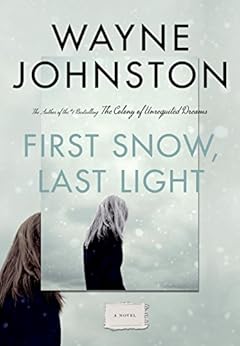
Review of FIRST SNOW, LAST LIGHT by Wayne Johnston (New Release)

4 Stars
Fourteen-year-old Ned Vatcher returns home from school one day in 1936 to discover that his parents, Edgar and Megan, have disappeared.  Though he has to live with his paternal grandparents, Nan Finn and Reg, it is Father Duggan, a Jesuit priest, and Sheilagh Fielding, a friend of his parents, who become his most stalwart supporters.  Cyril, Edgar’s brother, also remains an important character in Ned’s life, though not always in a positive way.  Various points of view are provided, but the focus is on Ned and Sheilagh. 

Ned’s entire life is driven by his parents’ disappearance.  He realizes that “to find out what had become of them would be the main goal of my life.”  He also decides that unlike his parents who were destitute and debt-ridden before their disappearance, “I would never want for money if I could help it, no matter what I had to do to get it.”  Unfortunately, he ends up losing himself.  He becomes “deaf to the tones of my own life” and feels “There simply was nothing at the innermost of me.”

Characterization is a strong element in the novel.  Ned is a dynamic character who changes as the years pass.  As mentioned, he is shaped by the mysterious disappearance of his mother and father; he spends his life “lamenting the loss of things [he] never had” and loses himself; at one point, he is pointedly told, “’I know who and what I am, Ned Vatcher.  Not everyone can say the same.’” 

Besides Ned, there are other characters who are fully developed.  Nan Finn and Sheilagh Fielding are among the most memorable.  Both are sharp-tongued, targeting those who displease them.  Nan Finn, for example, had no sympathy for Megan who was very unhappy in Newfoundland and yearned to return to London:  “’I can tell by those eyes of hers.  It’s a wonder dinner gets cooked what with her being so busy bawling and wishing she was there instead of here. . . . What do people do in London? . . . Sit around and talk to each other with their eyes closed.  I better keep busy or I’ll get bored and long for London.’”  Sheilagh’s targets are the rich and powerful; she writes a regular newspaper column in which she exposes their foibles and hypocrisies.

Sheilagh appears in the previous two novels of the Newfoundland Trilogy:  The Colony of Unrequited Dreams and The Custodian of Paradise.  Both titles are actually mentioned by Sheilagh.  It is not necessary to read these books first, but they do provide background to events which are mentioned in this third book.  This book brings Sheilagh’s story to a close.  It has been a while since I read the first two novels in the series and I think I may go back to them. 

Abandonment and disappearance are central motifs in the novel.  Edgar and Megan disappear and leave Ned feeling abandoned.  Sheilagh disappeared from the lives of her children and ends up feeling abandoned herself.  Prowse abandoned Sheilagh and his children and in the end “There was no sign in [his eyes] of anything.”  Phonse, Ned’s uncle, vanished at sea on a calm day and was never found; Nan Finn, in particular, tries to understand what happened to him.  Ned adopts a child but makes a fateful decision which he comes to regard as his worst mistake, “his sin against his son, which was all too similar to the one that Edgar and Megan committed against him – abandonment to the hands of strangers.”

Even Newfoundland is abandoned when there is a vote to join Canada; Sheilagh muses about “the colony of unrequited dreams that would never be acknowledged as a nation except by those of us who made it one.”  Appropriately, the books about Newfoundland that are collected by both Edgar and Ned are lost or damaged.  And it is surely significant that The Last Newfoundlander loses his voice because of a botched operation.

As a former English teacher, I loved the many literary allusions.  Sheilagh has a room in a brothel; she paraphrases T. S. Eliot’s “The Love Song of J. Alfred Prufrock”:  “I grow old, I grow old.  In the rooms the women come and go, talking of Mike and Al and Joe.”  Ned alludes to Joseph Conrad’s novel when he speaks of being “in quest of the heart of no one’s darkness but my own.”  Shakespeare’s Julius Caesar makes an appearance (“’I come to query Cyril, not to please him’”) as does The Tempest (“’We are all such stuff as murder is made of’”).

One theme is that “you can taint your whole life by doing one thing wrong” so “even a good man might be the engine of a tragedy.”  This theme is mentioned both at the beginning and the end and developed through the lives of several characters. 

Though the book is more than a mystery, interest is certainly maintained throughout as to what happened to the Vanishing Vatchers.  Just like Ned, the reader will find him/herself trying to learn what happened to Edgar and Megan and why no trace of them was found.  There are sufficient clues given so an astute reader may guess the solution. 

I have enjoyed Wayne Johnston’s previous novels and this one is no exception.  It is great literary fiction with memorable characters, carefully developed themes, and a strong sense of place.  

Note:  I received an eARC of this book from the publisher via NetGalley.
Monday, September 4, 2017

Discovering Hidden Poetry and Lost Languages

I recently read an interesting article in The Atlantic magazine about long-hidden poems being found in ancient parchments stored in a 1,500-year-old monastery on the Sinai Peninsula:  https://www.theatlantic.com/science/archive/2017/08/sinai-peninsula-hidden-texts/536313/?utm_source=atltw.

“The library at Saint Catherine’s Monastery is the oldest continually operating library in the world. Among its thousands of ancient parchments are at least 160 palimpsests—manuscripts that bear faint scratches and flecks of ink beneath more recent writing. These illegible marks are the only clues to words that were scraped away by the monastery’s monks between the 8th and 12th centuries to reuse the parchments. Some were written in long-lost languages that have almost entirely vanished from the historical record.”

“A small group of international researchers are using specialized imaging techniques that photograph the parchments with different colors of light from multiple angles. This technology allows the researchers to read the original texts for the first time since they were wiped away, revealing lost ancient poems and early religious texts and doubling the known vocabulary of languages that have not been used for more than 1,000 years.”

Use the link above to access the entire article; it is fascinating.

Sunday, September 3, 2017

Canadians and Reading

BookNet Canada, a nonprofit book industry research organization, recently did a survey of the reading habits of Canadians.  It provides some interesting information:  audiobooks are most popular amongst younger readers (18 – 44 years of age) whereas print books are favoured by those 55+.  Though digital books are more popular amongst younger readers, print books are not far behind.  Word of mouth is the most popular way for readers to choose their next book; 50% of Canadians prefer personal recommendations.  35% of readers say they participate in a book club, and 75% of readers read book reviews.  Check out all the results:

BookNet Canada also did a study of Canadian book buyers’ perceptions and attitudes towards Canadian authors and subject matter.  I love that 84% of book-buying Canadians are either “very” or “somewhat” interested in reading Canadian authors.  There’s a great infographic summarizing their findings:  https://www.booknetcanada.ca/blog/2017/7/26/canadians-reading-canadians-2017?platform=hootsuite.

In July, Ian Austen, writing for The New York Times, suggested that libraries in Canada are thriving.  Vancouver’s Central Library is expanding; Ottawa’s Central Library is being replaced; and Halifax’s Central Library has become a tourist attraction.  “This year, a public outcry led Saskatchewan’s government to acknowledge that it was wrong to cut library budgets by 4.8 million Canadian dollars. Afterward, officials restored the flow of money.  Similar protests last year led Newfoundland to suspend its library closings” (https://www.nytimes.com/2017/07/21/world/canada/summer-books-canadian-writers.html?em_pos=large&emc=edit_cnda_20170721&nl=canada-today&nlid=65852785&ref=headline&te=1).   

On the topic of libraries, The Globe and Mail recently had an article on the $12-million newly redesigned and rebuilt Albion library branch in Toronto's Rexdale which has seen a 45% upsurge in attendance since it opened in June:  https://beta.theglobeandmail.com/report-on-business/industry-news/property-report/whats-the-worth-of-your-publiclibrary/article36100795/?ref=http://www.theglobeandmail.com&cmpid=rss1&click=sf_globe.

And Newfoundland/Labrador readers received some good news last month.  Tom Osborne, the province’s minister of finance, announced that the 10 per cent tax on books, which was the first and only one of its kind for a Canadian province, will be lifted in January 2018:  http://www.cbc.ca/news/canada/newfoundland-labrador/provincial-tax-system-review-1.4257194.   

But though things look rosy for Canadian readers, BookRiot did point out that Canadian book lovers do experience some distinct problems:  https://bookriot.com/2017/06/12/canadian-book-lover-problems?utm_source=Sailthru&utm_medium=email&utm_campaign=Riot%20Rundown%20-%20June%2015%2C%202017&utm_term=BookRiot_TheRiotRundown_Tue-Thur.

Saturday, September 2, 2017

Review of SWIMMING LESSONS by Claire Fuller

3.5 Stars 
It is 2003, and Gil Coleman, famous writer of a scandalous novel, thinks he sees his wife Ingrid who went missing eleven years earlier.  Trying to follow her, he falls and suffers a number of injuries.  His daughters, Nan and Flora, rush to their former home to care for their aging father. 

Interspersed with this story is a second timeline from 1976 to 1992.  Ingrid, in the month leading up to her disappearance, writes a series of letters to Gil in which she tells the truth about their 16-year marriage:  “I’m sure I’ll write things you claim I imagined, dreamt, made up, but this is how I see it.  This, here, is my truth” (13).  She hides the letters in the many books collected by Gil. 

One of the mysteries of the book is whether Ingrid is alive.  She was presumed to have drowned but her body was never found.  Flora refuses to believe that her mother is dead, though Nan, the elder daughter, scoffs at the idea that Ingrid is alive.  It is this mystery that creates interest throughout.  In the end, the reader has to decide for him/herself what to believe, and the epilogue which ends on a very indefinite note will not please readers who yearn for more closure. 

Fuller clearly feels as Gil does.  He tells his writing students:  “’Writing does not exist unless there is someone to read it, and each reader will take something different from a novel, from a chapter, from a line. . . . A book becomes a living thing only when it interacts with a reader.  What do you think happens in the gaps, the unsaid things, everything you don’t write?  The reader fills them from their own imagination.  But does each reader fill them how you want, or in the same way?  Of course not. . . . all books are created by the reader’” (26).  The use of the “open verdict” (287) at the end is another way that Fuller lets the reader decide what happened. 

The events of 2003 are narrated in third person, using Flora’s point of view.  Flora is not a likeable character.  She is 22 years of age but she is very self-centred and immature.  Though she clings to things her mother owned (a suitcase, a dress, and even a swimming towel), she worships her father though it becomes obvious from Ingrid’s letters that Gil is not the man Flora imagines.  She seems to resent her sister because Nan took on the role of mother after Ingrid disappeared.  She is naïve and unaware. 

Flora was always closer to her father perhaps because the two are so much alike.  Nan even says, “’Like father, like daughter’” (247).  Gil has a public persona (a handsome man who mesmerizes people with his charm and wit), but as a husband and father, Ingrid shows him to be largely absent.  In her letters, he emerges as a narcissist unconcerned with the needs of his wife and family; the title of the novel that gains him fame and notoriety describes him perfectly. 

The book asks whether it is better to be a realist or a dreamer.  Flora argues that “’Not knowing is so much better’” whereas Nan has the opposite view:  “’I’d rather know the truth . . . I’d like to know what really happened’” (113).  As a young man, Gil argues that imagination can give people hope (167) but later seems to change his mind:  “’I’m beginning to think it’s better to know, one way or the other.  It’s taken me a long time to realize, but I don’t think it’s good to have an imagination which is more vivid, wilder, than real life’” (113). 

There are weaknesses in the book.  Characters do not always believe plausibly.  Gil’s appeal to Ingrid doesn’t make sense; he’s a man twice her age and he treats her abysmally from the beginning, both ignoring her and expecting her to pay his library fines.  She is supposedly an intelligent woman, yet she is so easily manipulated, even after warnings from both her and Gil’s best friends?  By the late 1970s, birth control was not uncommon so why she didn’t use it?  The ending has Jonathan and Louise behaving implausibly:  given the circumstances, their going to the pub for a sandwich does not make sense.

As I’ve already implied, this is a book in which much is not said.  This style is appropriate for a novel in which characters to do communicate well.  Ingrid writes to say “all the things I haven’t been able to say in person” (13) and Flora complains, “’Nobody told me anything . . . I had to work it out by listening at doors, overhearing snatches of conversation and filling in the gaps’” (247).  Like Flora whose “questions again went unanswered” (287), the reader will wonder about many things. 

People not liking ambiguity would probably find themselves frustrated with this novel.  Others might enjoy reading something that almost becomes a “choose your own adventure” book.  Symbolism abounds, beginning with the rain of fish (22); these await the reader to interpret.  I enjoy interpreting works of literature but I must admit to sometimes getting frustrated at what seemed to be the author’s unwillingness to be a factualist.  For those who prefer to use their own imaginations, here’s a warning from Ingrid:  “reality is so much more conventional than imagination” (275). 

Friday, September 1, 2017

Readings for Returning to School

For a retired teacher like me, September is always back-to-school month. 

On the topic of schools, Electric Lit has had a couple of interesting items.  There’s “10 Stories for the Back to School Season” which offers suggestions of stories that “envision schools of the future and recall the institutions of the past; they sympathize with the adjunct professor, the terrified elementary student, the awkward teen, and the flustered parent”:  https://electricliterature.com/10-stories-for-the-back-to-school-season-4f0f9f8d3f6c.

And then there’s “Famous Schools from Fiction”:  https://electricliterature.com/infographic-famous-fictional-schools-from-hogwarts-to-sunnydale-c810145ef8f3.  How many do you recognize?

Barnes and Noble prepared a list of 50 books about the high school experience:  https://www.barnesandnoble.com/blog/50-essential-high-school-stories/.

Though it is definitely sentimental, one of my favourite novels about schools is Goodbye, Mr. Chips by James Hilton which was first published in 1934.  The novella tells the story of a beloved schoolteacher, Mr. Chipping, and his long tenure at Brookfield School, a boys' public boarding school.