Ranked a Top Canadian Book Blog
Twitter: @DCYakabuski
Facebook: Doreen Yakabuski
Instagram: doreenyakabuski
Threads: doreenyakabuski
Substack: @doreenyakabuski
Bluesky: @dcyakabuski.bsky.social

Tuesday, December 14, 2021

Review of SILENT PARADE by Keigo Higashino (New Release)

3.5 Stars
This is the fourth installment in the Detective Galileo series.  Having enjoyed the previous books, I was happy to receive an advanced reading copy of this one. 

The skeletal remains of Saori Namiki are found three years after her disappearance.  They are found in the home of a woman connected to Kanichi Hasunuma, a man suspected of murdering a young girl over two decades earlier, though he was not convicted because of lack of evidence.  DCI Kusanagi of the Tokyo police is determined not to let that happen again.  Then another death occurs and there are a number of suspects with motives but all have an alibi.  Manabu Yukawa (a.k.a. Det. Galileo), a physics professor, is consulted and he uncovers hidden relationships and tragic events that led to murder.

Dr. Yukawa will remind readers of Hercule Poirot; certainly they share the same intelligence and ability to see clues and connections the police miss.  Yukawa, however, has more kindness and compassion.  There’s a type of locked room mystery and the reader may think of Murder on the Orient Express.  In fact, the Agatha Christie novel is directly referenced so the parallels are intentional. 

The book is typical of Higashino’s mysteries:  lots of twists and turns, secret relationships among characters, connections between past and present events, a detailed final reveal.  Yukawa comes up with theories which are modified when new information comes to light.  A reader will think s/he knows the truth until a new clue suggests s/he doesn’t. 

An additional element I enjoyed is the insight into Japanese culture.  Saori’s family owns a restaurant so references to Japanese cuisine are frequent.  The custom of gift-giving is mentioned:  when Yukawa is invited for a drink, he comments, “’You invited me for a drink, but I see no sign of a gift.’”  Readers also learn about the Japanese judicial system; for instance, the statute of limitations for certain crimes becomes relevant. 

Though there are clues and foreshadowing, most readers will not be able to unravel all the complexities.  The book certainly maintained my interest throughout.  I look forward to further translations of Higashino’s novels. 

Note:  I received a digital galley from the publisher via NetGalley.

Sunday, December 12, 2021

BOOK SUGGESTIONS FOR YOUR CHRISTMAS LIST

Here's the article I wrote for The Madawaska Valley Current in which I suggest novels to add to your Christmas wish list or shopping list.

Readers who believe they’re on Santa’s Nice List might want to include some of these fiction titles in their letters to him, whereas readers who suspect they might be on Santa’s Naughty List could perhaps gift these novels to themselves.  Everyone deserves a good book.   


Fight Night by Miriam Toews

A Miriam Toews novel is always a must-read.  This one focuses on the relationship between Swiv, the 9-year-old narrator, and her unconventional grandmother.  Despite having experienced several tragedies, Grandma Elvira believes people should live joyfully and fight ferociously to live on their own terms.  This is the lesson she tries to teach her granddaughter, though Swiv is often embarrassed by Elvira’s antics.   This book has memorable characters, humour, and thought-provoking ideas.  


What Strange Paradise by Omar El Akkad

This book, winner of the 2021 Giller Prize, explores the global refugee crisis in a way that will not leave readers unaffected.  Amir Utu, a 9-year-old Syrian boy, washes up on the beach of a Mediterranean island where he encounters a local girl, 15-year-old Vänna Hermes.  In chapters entitled “Before” we learn about Amir’s past and how he came to be on the boat; in alternating chapters entitled “After” we see how Vänna tries to help Amir escape authorities and get to safety.  The novel has many strengths:  realistic, well-developed characters, lots of suspense, and a theme which should have everyone thinking.


August into Winter by Guy Vanderhaeghe

This book illustrates the author’s master storytelling skills.  In 1939, Ernie Sickert brutally kills an RCMP police officer in rural Saskatchewan.  Making his escape, Ernie takes with him the girl with whom he is besotted.  A policeman in pursuit of Sickert enlists the help of two veterans of World War I.  They make their way to a schoolhouse where they believe Sickert may have sought shelter and where a new teacher has just moved.  The encounters at the school change the lives of all those present.  The reader will encounter action, suspense, humour, and romance.


The Lincoln Highway by Amor Towles

Another example of excellent historical fiction is this book set in June of 1954.  Emmett Watson, 18, arrives home after serving a sentence in a juvenile reformatory.  Since he and his eight-year-old brother Billy are orphans, they decide to leave their Nebraska home and set out for California in Emmett’s 1948 Studebaker to begin a new life.  Before they can leave, two of Emmett’s fellow inmates arrive with alternate travel plans.  Instead of heading west, the Watsons have to make a detour to New York City and not always in Emmett’s car.  The novel has something for everyone:  memorable characters, suspense, humour, and pathos. 


The Mystery of Right and Wrong by Wayne Johnston

This book, by another of my favourite Canadian writers, begins with Wade Jackson, a young man from a Newfoundland outport, falling in love with Rachel van Hout.  The smitten man travels to South Africa with Rachel and her parents and three sisters.  As more and more family secrets are revealed, Wade comes to realize that the van Hout family is very dysfunctional.  Though the novel’s pace is sometimes slow and sections are confusing, all is eventually made clear.  The villainy of one of the characters is almost unbelievable, but then the Author’s Note at the end delivers a gut punch. 


Undersong
by Kathleen Winter

This is a fictionalized account of the life of Dorothy Wordsworth, sister of the famous poet William Wordsworth.  Though the book will have particular appeal to lovers of English literature, I recommend it to everyone.  It focuses on Dorothy’s relationship with her brother and with James Dixon, the gardener/handyman for the Wordsworth household, and examines how women, especially those of a certain age, are often rendered invisible.  The complexity of the character development is amazing.  Were I to rank the books I read this past year, this one would definitely be at the top. 


The Creak on the Stairs
and Girls Who Lie by Eva Björg Ægisdóttir

I’d be remiss if I didn’t mention at least one mystery title, so for mystery lovers I’m recommending two.  This Icelandic author has written two books in a series she is calling Forbidden Iceland.  Elma, the protagonist, is recovering from a failed long-term relationship and has grudgingly returned to her hometown where she has taken a job with the police department.  In both books, Elma is soon investigating murders.  These police procedurals have multi-layered, intricate plotting and engaging characters with interesting backstories.


Complete reviews of all these books and many more can be found on my blog at https://schatjesshelves.blogspot.com/.

                                     Hopefully, Santa will bring you all the books you want. 

                                                    Happy holidays!  Happy reading!


Thursday, December 9, 2021

Review of THE LINCOLN HIGHWAY by Amor Towles

 4 Stars

Readers expecting another A Gentleman in Moscow will receive a surprise because this book is very different in terms of style.  But just like Towles’ previous book, it is a great read.

The novel covers ten days in June of 1954.  Emmett Watson, 18, arrives home after serving a sentence in a juvenile reformatory.  Since he and his eight-year-old brother Billy are orphans, they decide to leave their Nebraska home and set out for California in Emmett’s 1948 Studebaker to begin a new life.  Before they can leave, two of Emmett’s fellow inmates, Duchess and Woolly, arrive with alternate travel plans.  Instead of heading west, the Watsons have to make a detour to New York City and not always in Emmett’s car. 

The book is narrated from multiple perspectives, most in the third person.  Only Duchess’ chapters and those of Sally, a neighbour of the Watsons, are in first person.  Often the same event is seen from the viewpoint of more than one character.  Characters also reveal their opinions of others; for instance Duchess admires Emmett’s integrity and Woolly is well aware of Duchess’s tendency to exaggerate:  “For when it came to telling stories, Duchess was a bit of a Paul Bunyan, for whom the snow was always ten feet deep, and the river as wide as the sea.”

This structure allows all characters to be fully realized.  Emmett emerges as a decent young man who loves his brother and is determined to make a better life for both of them.  Billy is an endearing child, trusting and precocious but naïve.  Sally is stubborn and independent.  Woolly is kind and has a childlike sense of wonder.  Duchess is a charismatic charmer, described by one man as “one of the most entertaining shit slingers whom I’ve ever had the pleasure to meet,” but he is selfish and manipulative.  Because detailed backstories are provided for everyone, the reader comes to understand characters’ motivations and see that all are flawed.  No one is totally perfect or imperfect.  My one complaint about the characters is that they often seem older than their biological ages. 

Billy is obsessed with a book compiling stories of heroes and adventurers, some real and some mythical.  These stories are referenced often.  What is emphasized is that each of the characters in the novel sets out on a journey with a personal agenda.  Emmett wants to go to Texas but Billy convinces him to go to California because he wants to find someone.  Duchess and Woolly want to go to the summer home of Woolly’s family in the Adirondacks, though their specific reasons for that visit are different.

Billy’s book combines stories “of the greatest minds of the scientific age,” like Galileo, da Vinci and Edison, and legends of “mythical heroes” like Hercules, Theseus, and Jason, to suggest “That shoulder to shoulder they traveled through the realms of the known and the unknown making the most of their intelligence and courage, yes, but also sorcery and enchantment and the occasional intervention of the gods.”  Like legendary travellers and real-life discoverers, Billy and Emmett encounter obstacles, and both dangerous people and people who are genuinely kind.  They are sometimes taken off course.  They both learn lessons along the way.

The point seems to be that life is a journey, but people get to make choices about where they want to go:  “Maybe, just maybe what [God] requires of us, what He expects of us, what He hopes for us is that . . . we will go out into the world and find [our missions] for ourselves.”  Everyone can be a hero or adventurer.  Emmett’s father quotes Emerson to encourage his son to choose his own path “and in so doing discover that which he alone was capable of.”  We can determine our fates:  “For only when you have seen that you are truly forsaken will you embrace the fact that what happens next rests in your hands, and your hands alone.”  This lesson Billy takes to heart.  One elderly man chooses to follow in Ulysses’ footsteps (in both the literal sense and in the sense outlined in Tennyson’s poem “Ulysses”). 

There is something for every reader.  There is suspense when they face life-threatening danger.  There is pathos in the troubled histories of so many of the characters.  There is humour:  “On the shelf above the fish was a recent photo of four men having just finished a round of golf.  Luckily it was in color, so you could take note of all the clothes you would never want to wear.”  I loved the literary allusions:  a Walt Whitman impersonator is described so that “with the floppy hat on his head and his milky blue eyes, he was every bit the song of himself.”

The more I think about the novel, the more I find noteworthy.  A re-reading would not be amiss.  This is magical storytelling.  Though the book has almost 600 pages, it does not feel lengthy in the least.  

Tuesday, December 7, 2021

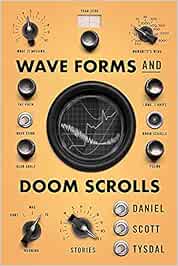
Review of WAVE FORMS AND DOOM SCROLLS by Daniel Scott Tysdal

 2 Stars

This short story collection was not for me.  It irritated me in so many ways. 

It is not hyperbole to state that the ten short stories are all over the place.  For example, one is about a teenaged fantasist whose intentions are misinterpreted; one consists of waveforms of cinematic scenes; one is about a Holocaust amusement park; and another is an homage to the humanities building at a university. 

In one of the stories “The Poem” there’s an editor who pans a poem by commenting, “’it’s like the main point is to make you feel stupid. . . . If you’ve got something to say, just say it!’”  This is the way I felt much of the time.  The author seems to want to impress the reader.  There are allusions to obscure films like “Varda’s The Gleaners and I” and “Ergüven’s Mustang” and “Tarkovsky’s The Mirror” and Kiarostami’s Close-Up.”  It may just be a layout issue, but it seems that at the beginning of "Doom Scrolls" a character from Shakespeare’s As You Like It is given a bastardized version of a quotation from A Midsummer Night’s Dream though it is identified as coming from Macbeth?  I guess it’s been too long since I earned my degrees in literature! 

When I taught creative writing, I would encourage students not to use trite similes and metaphors, but this author seems to go out of his way to be “creative.”  The results are sometimes bizarre:  “Those emails were the equivalent of trying to quench a baby Gargantua’s thirst for the milk of seventeen thousand, nine hundred and thirteen cows with a SlimFast 3-2-1 Plan Low Carb Diet Ready-to-Drink Shake” and “This feeling sickened the stomach of every cell in me from head to toe.”   Similes are piled on similes:  “Each time he said it, his eyes widened, as though he had been struck by the name of the thief in a heist flick, by the missing variable of a formula he’d wrestled for years, by the weight of missing years certain amnesiacs must feel while peeling page by page through piles of old photo albums and old diaries and old correspondence from strangers whose status as acquaintance or true friend remains as indeterminate and indefinable as your own reflected face would be if you spent a lifetime staring at the sun.”

Why do so many of the characters feel sensations in the same way:  “This smouldering travelled through his hand, up his arm to his shoulder, rising from his neck into his ears, which pulsed with sound, as though a winged-thing’s egg laid there long ago had finally hatched” and “The depth of her skin grew palpable along her arms and neck and back.  The sensation made her feel like she was filling with a colony of summer-heated ants” and “she would be overcome by the buzzing up and down her arms of a hive of candle-bearing bees” and “I could feel this body birthing beneath my skin, maturing rapidly from the baby-sized ball of sickness in my gut to a full-fledged nervous system-distending force with a voice” and “Her mother’s strike spreads an electric shiver along the sixteen-year-old girl’s spine and arms, from her shoulders to the hands she clenches to shake it away, a rage-rich burn tightening in her heart and stomach as though the two rulers of her insides are doing battle or trying to fuse into a new, unsustainable organ.”

Lists go on and on:  “artists of every ilk – creative non-fiction activists, sober novelists, splatterers of house paints on massive canvases, Hollywood producers with major pull, cynical minimalist poets, guerrilla graffitist, post-country but pre-robotronic steel guitarists, YouTube creators, the composer of mainstream operatic opuses, and on and on and on.”  One character goes to the storage room of his apartment building, and for no reason, we are given a description of various storage cages:  “Some were empty except for a few weeping cans of interior paints with names like “Roman Ruins,” “Lemon Tart” and “Samba.”  Another cage contained nothing but a framed velvet canvas that tackily preserved the wide eyes, pointy breasts and almond skin of a local’s take on a tourist’s vision of a resort-pocked nation’s “fairer sex.”  Another was packed with the ghosts of recreations past – golf clubs, tennis racquets, croquet mallets, snorkel gear – while another confined “the replaced” – the replaced microwave, the replaced mini-fridge, the replaced speakers and amp.” 

Some passages just don’t make sense:  “By the length of its lines, its steady patience in ink, the affable interaction of its infinite internal shapes with the ‘will be,’ ‘was’ and ‘is’ of our saintly, sailing selves, the Poem expressed the manacle-smacking desire to free stuff from its silence, its impermanence, its pseudo-salves and mock healings, all the et ceteras of the sources of impossible vision.  It wanted to be the 12-step program to beauty, the thief who snuck truth into the pockets of the masses mobbed by the miserly vitality of ignorance and the inane.  The Poem wanted to un-break us.  It wanted to be the crazy cowboy who rode us in reverse and made us wild.”  Perhaps I’m just not intelligent enough to decipher the meaning. 

A pet peeve is an author unnecessarily inserting him/herself into stories.  In this collection, the author appears in “Year Zero” and “Dear Adolf” and is undoubtedly the narrator in “Wave Forms.”  He teaches at the University of Toronto Scarborough and so ends this collection with “Humanity’s Wing” which focuses on the humanities building at that university, and it’s not difficult to determine which professor represents him. 

As I said at the beginning, these stories left me unimpressed and uninspired.  Perhaps they’re just too esoteric for me.

Saturday, December 4, 2021

Review of ANIMAL by Lisa Taddeo

 3 Stars

Though I understand the author’s intention, this book just didn’t work for me because it comes across as unrestrained in several ways.    

Joan drives from New York City to Los Angeles to track down Alice, a celebrity yoga instructor who has some mysterious connection to Joan’s past.  Her developing relationship with Alice serves as the catalyst for Joan’s slowly revealing the traumas which have left her “depraved.”  Joan describes her life as ending at the age of 10 when traumas occurred which defined the intervening 25+ years.  A recent event sends her over the edge:  a scorned lover recently shot himself in front of her while she was having dinner with another man.  Though she describes herself as a survivor, she is filled with a rage which has destroyed her human self so that her animal nature takes control.

Joan is the narrator.  Periodically she directly addresses someone using the second person pronoun; the reader can guess the identity of this person being addressed, and the mystery is eventually clarified.  The problem is that, given the identity of her intended audience, what Joan reveals is almost too honest and borders on inappropriate because, though this is not Joan’s intention, what she tells would be traumatizing to the listener.

Joan is not a likeable character.  Initially, I had some sympathy for her, especially when she demonstrated some positive qualities like generosity, but her negative traits are so dominant that my sympathy waned.  She is devious and ruthless.  She uses her beauty and sexuality to manipulate everyone she meets.  One-night stands and affairs with married men are routine for her.  She sexualizes every interaction with men.  Even her memories of her parents are sexualized:  when she is sexually aroused, she thinks of her father, and she seems unusually focused on her mother’s breasts so that even when she has a gun pointed at her, she thinks of her mother’s enormous nipples.  She has few interests apart from sex; Joan spends her time not reading, listening to music, or even watching television, but drinking and taking pills.  She says, “There was no way to hear my story and still hate me.”  I didn’t hate her, but her despicable acts didn’t make me like her. 

The plot becomes increasingly far-fetched and unbelievable.  The lack of an investigation into one man’s death is totally unrealistic.  The book includes rapes, suicides, and murders.  The piling on of trauma, often graphically described, becomes almost pornographic.  In Joan’s opinion, men are always degenerates:  “All my life, all the men taking what they wanted and leaving when it was over.”  She despises men who are guilty of infidelity, yet she never experiences guilt for her role in infidelities?  The author becomes almost didactic as she stacks the deck to illustrate her theme. 

I can applaud the writer’s wanting to show the effects of trauma; however, I found the constant descriptions of men’s depravity excessive.  The plot becomes almost grotesque.  Also, I was unable to connect with the main character and so didn’t feel invested in the story.  Writing a book that has so many over-the-top elements is not the way to convince me of the relevance of its theme. 

Wednesday, December 1, 2021

Review of INTIMACIES by Katie Kitamura

 3 Stars

I came across this title on Barack Obama’s 2021 reading list and so decided to pick it up.  Perhaps my indifference comes from my reading the book while on a travelling vacation, but it left me underwhelmed. 

An unnamed protagonist is working as a translator at The Hague for the International Criminal Court.  In her professional life, she works at the trial of a West African former president charged with crimes against humanity.  In her personal life, she becomes involved with Adriaan, a Dutch man who turns out to be married.  She moves into his apartment while he goes to Lisbon to see his estranged wife to seek a divorce.

Though she performs her job very well, she seems utterly adrift.  She has a temporary contract at work and lives in a furnished apartment intended for temporary residence.  She is stuck between languages and cultures and is involved with a man who is himself adrift.  She spends her time observing and making as “little disturbance” as possible.

One of the themes is that of superficiality:  “people behave with such conscious and unconscious dishonesty all the time” and “our own behavior shifted according to whether or not we thought we were being seen.”

Another theme is that our perceptions of people are based on contexts that can change quickly:  “Every certainty can give way without notice.”  In her work, for instance, she is aware that tone and word choice while translating can affect the court’s perception of what was said and the person who spoke.  Her opinion of people changes often when she learns more details or sees people in a different setting.  For example, she has one impression of a friend’s brother but then when she sees him with a woman in a restaurant, she concludes, “I understood that Anton was attractive, a man with no small powers of fascination.”  She also notices how a comment causes a woman to change “her image of me.”

I found the book scattered; there are a number of scenes which are intended only to convey the theme in yet another way.  The main character attends an art exhibit and muses on the superiority of painting to photography in being able to capture more than one emotion.  Paintings have laying, “in effect a kind of temporal blurring, or simultaneity.” 

The writing style is dense.  Diction is complex; for instance, logorrheic is not a word used in ordinary conversation.  There are no chapter titles.  Quotation marks are eschewed, but comma splices abound.  I kept looking for a rationale for the grammatically non-traditional style. 

Other readers will probably find a great deal in this book, but it didn’t grab my attention and I just don’t care enough to give more thought to it. The characters are not interesting; the protagonist left me unmoved and the word milquetoast perfectly describes Adriaan.  If I became more intimate with Intimacies, perhaps my perception would change, but other more interesting books beckon. 

Tuesday, November 30, 2021

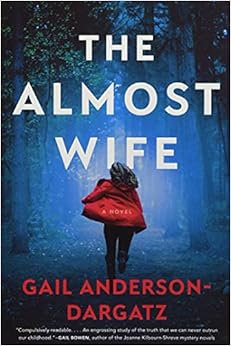
Review of THE ALMOST WIFE by Gail Anderson-Dargatz

 2.5 Stars

I enjoyed the author’s previous books, especially The Cure for Death by Lightning and A Recipe for Bees, but I was disappointed with this domestic thriller.

Kira is engaged to Aaron, an older, financially successful man.  She has a good life with a daughter Evie and a nice house.  Her only problems are an anxious teen step-daughter Olive and Madison, Aaron’s second wife who is stalking Kira and Olive.  Madison’s erratic behaviour has the emotionally fragile Kira desperately trying to protect her family.  She flees and takes Evie and Olive to Manitoulin Island where she spent her youth and owns a cottage. 

A major problem is that events make little sense.  After having a child, Kira is worried about announcing her engagement with the man who is presumed to be the child’s father?  Olive’s behaviour in Little Current stretches credulity.  And such an anxious teen would just run into the bush?  Kira, who has lived in the city for years, has a basic outdoor survival kit with her?  A mother would leave her infant alone in the truck, not once but several times?!  Someone breaks a window to get into a building and then locks the door afterwards? 

Being familiar with Manitoulin Island, I loved the setting.  The dark and stormy night cliché, however, I could have done without.  It is so obviously used to create suspense, but it is so contrived.  The flashbacks to Kira’s childhood when her mother poisoned Kira’s relationship with her father are so obviously a parallel to what is happening to Olive – I can picture the storyboard here. 

Imagery is also forced and unnatural:  “Spiderwebs, covered in dew and catching the low sun, were suddenly visible in the long, uncut grass of the yard, hundreds of them, thousands of them.  They shimmered, vibrating in the morning breeze.  Until now, I’d had no idea they were there – these traps, all these fucking traps”  and “the heavy birds lifted into the air, flying so low as they passed that I could not only hear the whistling of their wings, but feel the rush of air dislocated by their labored flight.”  And why the American spelling?

The characters are difficult to like or care about.  Kira, for instance, is so scattered and reckless.  Everyone seems shallow.  The fact that more than one person blames problems on a difficult childhood suggests a general lack of maturity.  The motivation of the villain for all behaviour is fear of abandonment?    

The author’s attempt to write a thriller is not successful.  The result is trite, contrived, and predictable.  This seems a degradation of her writing skills.