Ranked a Top Canadian Book Blog
Twitter: @DCYakabuski
Facebook: Doreen Yakabuski
Instagram: doreenyakabuski
Threads: doreenyakabuski
Substack: @doreenyakabuski
Bluesky: @dcyakabuski.bsky.social

Saturday, July 30, 2016

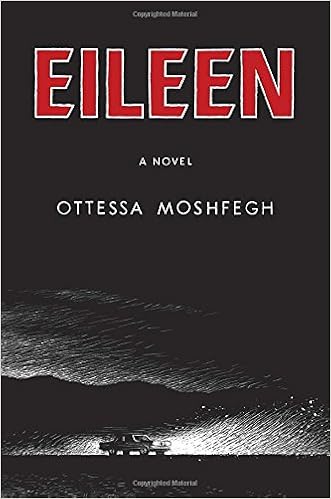
Review of EILEEN by Ottessa Moshfegh

3.5 Stars
I came across this title a couple of times because it was nominated for a couple of literary awards.  When it appeared on the longlist of the 2016 Man Booker Prize for Fiction, I decided it was one I should read.

The narrator is Eileen Dunlop, a woman in her 70s.  She tells us the events in her life during a week around Christmas 1964 when she was 24 years of age, events which cause her to “run away from home and never go back.”  As she says, “This is the story of how I disappeared.”   Eileen lives with her drunken, emotionally abusive, and paranoid father, a retired policeman, in X-ville, near Boston.  She works in a detention centre for teenage boys.  Her life is regimented and seems pointless to her.  Then Rebecca is hired on staff and everything changes. 

There is a mystery in the novel.  We know that Rebecca is the catalyst to Eileen’s disappearance since there is the repeated refrain of “until Rebecca” but we don’t know exactly how.   The arrival of Rebecca “marked the beginning of the dark bond” but it is not until the last quarter of the book that events come to a climax and Eileen ceases to exist:  “There’s no better way to say it:  I was not myself back then.  I was someone else.  I was Eileen.” 

Though there is suspense in the book which has been classified as a psychological thriller, it is, more so, a character study of a troubled woman.  Eileen was full of self-loathing.  Early on, she admits, “I hated my face with a passion.”  She details what she hated:  “I felt my mouth was horselike and ugly, and so I barely smiled” and “My own eyes, I thought, were like shallow lake water, green, murky, full of slime and sand.”  Even “having to breathe was an embarrassment in itself.”

Eileen was emotionally repressed.  She describes herself as “terribly sensitive, and determined never to show it” so she wore what she calls a “death mask.”  She even practiced her death mask – “face in perfect indifference, no muscles twitching, eyes blank, still, brow furrowed ever so slightly.”  She admits she was “very unhappy and angry all the time,” so “I looked so boring, lifeless, immune and unaffected, but in truth I was always furious, seething, my thoughts racing, my mind like a killer’s.”  There’s a great image she uses to describe her life:  “life itself was like a book borrowed from the library – something that did not belong to me and was due to expire.”  She felt invisible though she didn’t want to be:  “I hoped they saw right through my death mask to my sad and fiery soul, though I doubt they saw me at all.”  She was self-obsessed:  “I was selfish, solely concerned with my own wants and needs.”

Her behaviour does not make her a likeable person.  She states honestly, “I was a shoplifter, a pervert . . . and a liar.”  Though she hid her body in her dead mother’s too-large, matronly clothes, she was fixated on her “nether regions”:  “I worried that when anyone’s eyes cast downward, they were investigating my nether regions and could somehow decipher the complex and nonsensical folds and caverns wrapped up so tightly down there between my legs.”   Though she calls herself a prude and admits that “sexual excitement nearly always made me feel sick,” she had dreams of rape:  “Of course I hoped to be raped by only the most soulful, gentle, handsome of men, somebody who was secretly in love with me.”  She “didn’t wash my hands after using the toilet” and didn’t shower, liking “to stew in my own filth sometimes.”   She had a peculiar way to keep her composure:  “When I was very upset, hot and shaking, I had a particular way of controlling myself.  I found an empty room and grit my teeth and pinched my nipples while kicking the air like a cancan dancer until I felt foolish and ashamed.” 

By chance, I just finished reading Martin John by Anakana Schofield which is also a character study of a misfit.  Like the protagonist of that book, Eileen arouses the reader’s sympathy and revulsion at the same time.  It is uncomfortable to be in Eileen’s head because she focuses so much on all that is ugly.  Unlike Schofield’s book, however, this one offers hope because we know that Eileen goes on to become a better person:  “I watched that old world go by, away and away, gone gone gone, until, like me, it disappeared.”

As a psychological thriller, this book is less successful.  Its pace is too slow.  But as a character study, it definitely succeeds.


Thursday, July 28, 2016

Workplace Fiction by Women

I came across an interesting article in The New Yorker which I thought I’d share.
 
“The last two decades have seen a boom in workplace novels written by and mostly marketed to women, from books put out by major publishing houses, to cheaply produced small-press books, to self-published titles. If the author is a woman, workplace fiction is also domestic fiction, easily disguised as “chick lit,” “girlfriend literature,” or even “erotica.” Regardless of the packaging, these books provide mapping, contextualizing, and rich illustration of women’s working lives. They form a kind of counter-tradition of office literature, dealing with the same bureaucracies and white-collar doldrums that have inspired male novelists but reflecting the particular challenges and preoccupations of women in the workforce” (http://www.newyorker.com/books/page-turner/the-office-politics-of-workplace-fiction-by-women). 

The article mentions a number of books.  Workplace fiction by women is a genre that is particularly appropriate at the moment as Hillary Clinton tries to break the ultimate glass ceiling in American politics.  And if you are missing your workplace during your summer vacation, you might want to read one of the titles mentioned.

Wednesday, July 27, 2016

Longlist of the 2016 Man Booker Prize for Fiction

The longlist for the 2016 Man Booker Prize for Fiction was released today.

The Sellout by Paul Beatty (U.S.)

The Schooldays of Jesus by J. M. Coetzee (South African-Australian)
Serious Sweet by A. L. Kennedy (U.K.)
Hot Milk by Deborah Levy (U.K.)
His Bloody Project by Graeme Macrae Burnet (U.K.)
The North Water by Ian McGuire (U.K.)
Hystopia by David Means (U.S.)
The Many by Wyl Menmuir (U.K.)
Eileen by Ottessa Moshfegh (U.S.)
Work Like Any Other by Virginia Reeves (U.S.)
My Name is Lucy Barton by Elizabeth Strout (U.S.)
All That Man Is by David Szalay (Canada-U.K.)
                                              Do Not Say We Have Nothing by Madeleine Thien (Canada)

The shortlist of six books will be announced on September 13 and the winner, on October 25. 

I’ve read only one of the books thus far.  See my review of My Name is Lucy Barton at http://schatjesshelves.blogspot.ca/2016/01/todays-new-release-review-of-my-name-is.html.  I was so pleased to see the names of two Canadian writers.

The Man Booker Prize for Fiction, worth £50,000, is open to writers of any nationality, writing originally in English and published in the U.K. between October 1, 2015, and September 30, 2016.  For more information, see http://themanbookerprize.com/fiction/news/man-booker-prize-announces-2016-longlist.

Tuesday, July 26, 2016

Review of MARTIN JOHN by Anakana Schofield

4 Stars
Martin John by [Schofield, Anakana]
I first came across this book when it appeared on the longlist and shortlist of the 2015 Giller Prize.  It didn’t win but after reading it and the winner, Fifteen Dogs by André Alexis, I’m even more disappointed with the jury’s verdict.  Fifteen Dogs is lackluster next to Martin John.  (See my review of the former at http://schatjesshelves.blogspot.ca/2015/11/review-of-fifteen-dogs-by-andre-alexis.html.)

This book is a look into the dark and chaotic mind of Martin John, an exhibitionist, public masturbator, and aggressive sexual molester.  In the end, though the reader will be disgusted and repulsed by Martin John’s behaviour, he/she will also feel sympathy for this lonely, confused man who struggles with his compulsions, delusions, and paranoia. 

The portrait of Martin John is discomfiting and incomplete.  We see his use of work routines and daily rituals to distract himself from his sexual compulsions.  We see him distancing himself from his responsibility for his actions by his refusal to answer questions about incidents (“To every question he said he did not know”), by his use of the passive voice (“Harm was done”), and by his insistence that his victims enjoy his actions (She must have liked it.  That was it”).   But just like the mental health care system which doesn’t understand his sexual deviance, the reader does not fully understand him either.  The reader is even warned at the beginning, “There are simply going to be things we won’t know.  It’s how it is.  As it is in life must it be unto the page.  There’s the known and the unknown.  In the middle is where we wander and wonder.”  But though we may not be able to totally comprehend Martin John, we come to understand his fear.  His continual references to Baldy Conscience, a (probably imaginary) tenant who lives above him “stamping all over my head”, clearly convey his paranoia. 

As the novel progresses and it becomes clear that denial of Martin John’s culpability is futile, the descriptions of his behaviour, including sexual assaults, become more detailed.  These explicit descriptions make the reader feel like a voyeur, and the narrator’s comment to the reader that “You’re involved now.  You have a role.  See?” is unsettling. 

One of the things that is emphasized is that Martin John has no support system.  Mental health professionals and institutions seem to be able to do little for him.  Mam, his Irish mother, is overbearing and has dominated his life so much that Martin John constantly hears her voice in his mind.  After her son was involved in an incident, she sent him away to London to protect him but also so she doesn’t have to deal with him.  It seems that her treatment of her son contributed to his behaviours; to her credit, she does think about her role:  “She did not like the idea she had a role in it. . . . Did she have a role in it?” 

The style of the novel is unconventional.  Paralleling Martin John’s fractured mind, chronology is unclear.  The gaps in his narrative suggest the many unanswered questions that remain.  Throughout, there are chapters with headings beginning with “What they don’t know.”  Repeated phrases mimic the endless circuits Martin John walks as part of his daily calming rituals.  The cryptic style, episodic vignettes, non-sequiturs, lists of words, and stream-of-consciousness passages are disorienting and that’s precisely the point. 

This book is not an easy read.  Because of its subject matter and its style, it is at times a very difficult read.  The narrator even admits, “this hasn’t been an easy book for any of us.”  Nonetheless, it is a compelling, worthwhile book that should be read.  And it should have won the 2015 Giller Prize!

Sunday, July 24, 2016

Merciful Minerva! Some Reading about Wonder Woman

Earlier this month, I wrote about how comics were one of my favourite genres when I was young.  I specifically mentioned Wonder Woman.  Well, a movie featuring that heroine will be released on June 2, 2017, but the official trailer was released yesterday: https://www.youtube.com/watch?v=5lGoQhFb4NM.

Wonder Woman turns 75 this year, and earlier today, NPR featured a story about her entitled “At 75, Wonder Woman Lassos In A New Generation With An Ageless Fight”:  http://www.npr.org/2016/07/24/487225973/at-75-wonder-woman-lassos-in-a-new-generation-with-an-ageless-fight?utm_source=twitter.com&utm_medium=social&utm_campaign=books&utm_term=artsculture&utm_content=20160724.

There’s a book I’ve been meaning to add to Schatje’s Shelves entitled The Secret History of Wonder Woman written a couple of years ago by Jill Lepore.  You can find  a review of the book at http://www.npr.org/2014/10/17/356989560/the-freaky-fabulous-feminist-secret-history-of-wonder-woman and highlights of an NPR interview with Lepore:  http://www.npr.org/2014/10/27/359078315/the-man-behind-wonder-woman-was-inspired-by-both-suffragists-and-centerfolds.

Thursday, July 21, 2016

Ernest Hemingway's Birth Day

117 years ago today, Ernest Hemingway was born.  One of my favourite Hemingway quotes is “There is no friend as loyal as a book.”  

Hemingway was one of the most influential writers of the 20th century who often commented on the craft of writing.  When I was a teacher of creative writing, I often referred to one of his statements:  “There is nothing to writing.  All you do is sit at a typewriter and bleed.”  Here is some more of his advice to writers:  http://thewritepractice.com/hemingway-quotes/.

I have never been a great fan of Hemingway’s because of his macho male characters, but I know he is loved by many.  If you are a fan of his, why not try this 10-question quiz to test your knowledge of this American writer:  http://www.cbc.ca/books/2013/07/quiz-how-well-do-you-know-hemingway.html.

Wednesday, July 20, 2016

Review of BEFORE THE FALL by Noah Hawley

3.5 Stars
Before the Fall by [Hawley, Noah]
This book has appeared on a number of summer reading lists, so I thought I’d add it to mine.  It proved to be an enjoyable psychological novel.

The book introduces us to David Bateman and his family.  He is a media mogul married to Maggie, a former teacher, and they have two children:  Rachel and JJ.  They board a private jet for a short trip from Martha’s Vineyard to New York City.  Travelling with them is Ben Kipling, a Wall Street player, and his wife Sarah.  Maggie also invited a friend and artist, Scott Burroughs, to take the plane since he too needed to get to New York.  A Bateman bodyguard, a flight attendant, and the pilot and co-pilot are the others onboard.  “[None] of them has any idea that sixteen minutes from [takeoff] their plane will crash into the sea.”  Only Scott and four-year-old JJ survive. 

The book then follows the investigation into the crash and also gives the back stories of each of the people on the plane.  There are various theories as to the cause - mechanical error, pilot error, sabotage, and terrorist attack – and all must be investigated.  However, a talk show commentator, Bill Cunningham, suggests a fifth theory centered on Scott.  Focusing only on ratings, he uses illegal methods to advance his theory. 

A major theme detailed is that of random coincidences.  In the opening, the author suggests, “How any two people end up in the same place at the same time is a mystery.”  Later, Scott muses, “Two things happen at the same time.  By mentioning them together they become connected.  Convergence.  It’s one of those things that feels meaningful, but isn’t.”  A major investigator scolds a colleague:  “’you just can’t accept that life is full of random coincidence, that not everything that seems meaningful is meaningful . . . ‘” And Scott tells Bill, “’The universe is filled with things that don’t make sense.  Random coincidences.’” 

The novel is definitely character driven.  The reader comes to know each of the passengers and crew as well as JJ’s aunt and uncle and Bill Cunningham.  Bill, who wears suspenders like Larry King, is a conservative commentator, similar to Bill O’Reilly of Fox News.  He is not beyond relying on half-truths to cast aspersions and ruin someone’s reputation though he makes comments like “’I’ll fight to the death before I let this administration take away our right to due process.’”  The character with whom I take exception is Doug, JJ’s uncle; everyone else is realistic, but he just doesn’t feel like a writer to me.  For instance, he doesn’t know the meaning of “pied-à-terre” but knows what a koan is?

Though there is suspense, I would not call this book a thriller.  The ending is not a surprise; in fact, the denouement is exactly like an actual 2015 event from the news, an event to which the chief investigator actually refers and which had regulatory agencies implementing new flight regulations.  From the beginning, the clues are just too obvious.

Despite its flaws, this book is indeed a good summer read.  It has sufficient suspense to keep the reader on task.  And I loved its skewering of archconservative media outlets and commentators.