Ranked a Top Canadian Book Blog
Twitter: @DCYakabuski
Facebook: Doreen Yakabuski
Instagram: doreenyakabuski
Threads: doreenyakabuski
Substack: @doreenyakabuski
Bluesky: @dcyakabuski.bsky.social

Friday, July 14, 2017

On Bastille Day: Must-Read French Books


Today is la Fête nationale in France.  The day, known by many as Bastille Day, commemorates the Storming of the Bastille on 14 July 1789, a turning point of the French Revolution.


In honour of the day, I thought I’d share a list of 100 Must-Read Books Translated from French.  The list appeared on the BookRiot site last year:  http://bookriot.com/2016/07/25/100-must-read-books-translated-from-french/.   There are books from Québec and Belgium and various French-speaking African countries as well as France itself.

Happy Reading!
Bonne Lecture!

Thursday, July 13, 2017

Lucy Maud Montgomery's Missing Stories

Lucy Maud Montgomery, author of Anne of Green Gables, has been in the news recently.  This past spring, CBC and Netflix released the first season of the latest version of the much-adapted story of Anne Shirley.  I have yet to watch the series but its reviews have certainly caught my attention.  The series has been called grim, bleak, and gloomy (http://www.vanityfair.com/hollywood/2017/05/anne-of-green-gables-netflix-review-anne-with-an-e-bleak-sad-wrong).  Others have called it “the darkest, truest rendering to date of what being a redheaded orphan in 1890s Prince Edward Island would have been like” (https://www.theglobeandmail.com/arts/television/breaking-bad-writer-brings-dark-sensibility-to-anne-of-green-gables/article34336503/).  It has also been labelled super dark and feminist: http://www.huffingtonpost.ca/2017/03/16/cbc-anne-the-series_n_15406054.html.

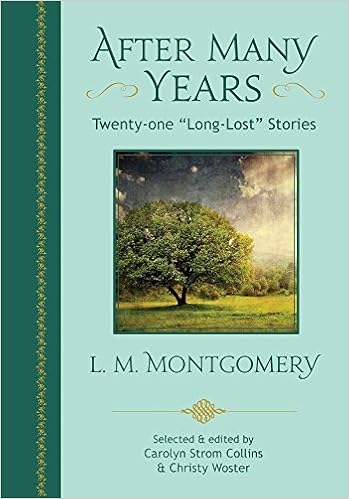
Last week a collection of 21 newly-discovered L. M. Montgomery stories was published.  After Many Years: Twenty - One "Long Lost" Stories by L.M. Montgomery brings together pieces originally published between 1900 and 1939 that haven't been in print since their initial periodicals.  While Montgomery's early works were geared for children, her stories written after Anne of Green Gables (published in 1908) featured more adult characters and appealed to more adult readers.  Apparently, the hunt is still on for about 50 more missing stories.  See http://www.cbc.ca/news/canada/prince-edward-island/lucy-maud-montgomery-lost-stories-published-1.4189787 for the story behind the search. 

Wednesday, July 12, 2017

Þrístapar and BURIAL RITES by Hannah Kent

My husband and I recently returned from a week in Iceland.  One of the places we came across in our travels around the Ring Road was Þrístapar.


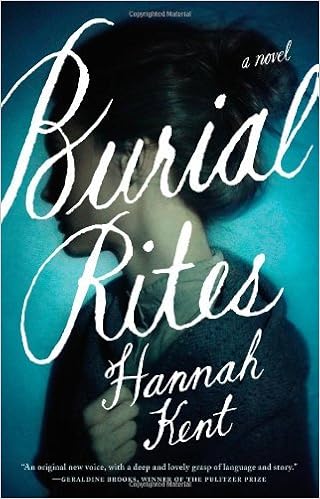
Þrístapar was the site of the last execution in Iceland in 1830.  Two people were executed at that time, one of them being Agnes Magnúsdóttir.  What does this have to do with books and reading?  Well, the book Burial Rites by Hannah Kent is a fictionalized account of the final months in the life of Agnes Magnúsdóttir.  I posted my review of the book a couple of years ago, but I thought I’d repost it.  It is certainly a book worth reading, and it has special meaning for me now that I’ve visited Iceland.

Review of Burial Rites
4 Stars
 This is a fictionalized account of the final months in the life of Agnes Magnúsdóttir, the last person to be executed in Iceland. It is 1829 in northwestern Iceland; Agnes is placed in the custody of a farmer in the months leading up to her execution. As she awaits her end, she helps with the farm chores and comes to know the family who are her custodians. She also meets with a clergyman, Thorvadur “Tóti” Jónsson, who is to serve as her spiritual guide but who becomes her confidant; it is to him that she relates much of the story of her “miserable, loveless life” (211).

Agnes emerges as a fully realized character. There is a great deal of sympathy for her since her life was nothing but “a dull-eyed cycle of work . . . nothing but chores, chores, chores . . . the stifling ordinariness of existence” (210). There is also much to admire about her: intelligence and compassion. She even shows compassion towards a woman who spreads gossip about her. She is not perfect, however. Because her life was circumscribed by isolation, loneliness and abandonment, she naively fell in love with a man who paid her some attention: “For the first time in my life, someone saw me, and I loved him because he made me feel I was enough” (210). And she was certainly slow in realizing the truth about her relationship with this man.

One of the themes is that truth is not simple and straightforward, but open to interpretation. Agnes herself claims that there is “’No such thing as truth’” (105) because different people think different things are important, and for her, “There is only ever a sense that what is real to me is not real to others” (106). Agnes tells Tóti “’All my life people have thought I was too clever. . . .If I was young and simple-minded, do you think everyone would be pointing the finger at me’” (126). She believes she is not believed because, “’how other people think of you determines who you are. . . . People around here don’t let you forget your misdeeds. They think them the only things worth writing down’” (104).

Agnes tells Tóti her version of the crime, but it does not tally with what the officials believe happened. Does she tell him the truth or is the District Commissioner correct when he says, “’I do not doubt that she has manufactured a life story in such a way so as to prick your sympathy’” (162)? Does she choose a “young and inexperienced” churchman believing that she can manipulate him into appealing her death sentence? Certainly her thought that, “I will have to think of what to say to him” (97) could suggest forethought and planning.

There is no doubt that being an audience “to her life’s lonely narrative” (158) influences the listeners. At the beginning everyone is reluctant to have anything to do with Agnes; Lauga, the younger daughter, is openly hostile. Margrét fears for her family’s safety with a murderess in the house, and Jón worries about the influence Agnes might have on his daughters. Their attitudes change gradually. Margrét, who initially speaks of Agnes as a murderess and a criminal, later tells Agnes, “’No one is all bad’” (259) and “’You are not a monster’” (307). Margrét realizes that her relationship with Agnes has become “more natural and untroubled” but what is also interesting is that “Margrét worried at this” (192).

Tóti’s reaction to Agnes is also interesting. Agnes tells him that they had met years previously when he had helped her ford a river, yet he “couldn’t remember meeting a young woman” (78). Later, however, he “thought again of their first meeting . . . a dark-haired woman preparing to cross the current . . . Her hair had been damp against her forehead and neck from walking. . . . Then, the warmth of her body against his chest as they forded the foamy waters on his mare. The smell of sweat and wild grassing issuing from the back of her neck” (200). Does he really remember this first meeting?

The Icelandic setting is almost another character in the narrative. The descriptions of the harsh climate, the increasing darkness as winter looms, and the barren landscape certainly reflect Agnes’ feelings of loneliness. There is also no doubt that such an environment can have an influence on people’s actions. At one point, Margrét says, “’It’s hard to be alone in winter’’’ (260). As winter advances so do the reader’s feelings of dread about what will happen to Agnes.

It is evident that the author did considerable research and she gives a vivid picture of rural life in Iceland in the early 19th century. I was not aware of the high level of literacy amongst Icelanders as far back as that time period. The inclusion of historical documents provides some facts about the case and stylistic contrast to Agnes’ interior monologues.

There is much to like about this book. It is not perfect because some of the minor characters, especially District Commissioner Björn Blöndal, are stereotypes, but it does have much to recommend it: suspense, a great mystery, a wonderfully atmospheric setting, and interesting character development.

Tuesday, July 11, 2017

Bredevoort, The Netherlands - A Book Town

My husband and I recently spent three weeks in Europe.  On the first day of our travels, I posted about book towns:  https://schatjesshelves.blogspot.ca/2017/05/book-towns.html.

As it turned out, we were able to visit one of those book towns in The Netherlands:  Bredevoort

Bredevoort has a population of about 1,600 but has about 20 second-hand/antiquarian book shops.  Every third Saturday of the month a specialized book market takes place on ‘t Zand, a large square with tall trees.

I thought I’d share some of my photos of the town.  There are book stands on virtually every corner.


Reading will set you free?

Monday, July 10, 2017

On Alice Munro's Birthday: Read one of her Amazing Short Stories

Today is Alice Munro’s 86th birthday.  In honour of the occasion, I thought I’d share links to two articles focusing on other writers and their relationships with our beloved Canadian short story writer.

The first article appeared in The New Yorker in 2013 when Munro was awarded the Nobel Prize for Literature:  http://www.newyorker.com/books/page-turner/writers-on-munro.  Seven writers discuss what Alice Munro’s fiction has meant to them.  I love the comment by Julian Barnes:  “her short stories have the density and reach of other people’s novels. I have sometimes tried to work out how she does it but never succeeded, and I am happy in this failure, because no one else can—or should be allowed to—write like the great Alice Munro.”

On Munro’s special day, it would be appropriate to read/re-read a Munro story.  Since Munro has written 139 stories, choosing one might be difficult, so why not check out this article from last year:  http://www.cbc.ca/books/2016/07/lorrie-moore-guy-vanderhaeghe-share-their-favourite-alice-munro-short-stories.html.  CBC Books asked prominent writers and broadcasters to choose their favourite Munro short story or collection. 

Happy birthday, Alice Munro!

Sunday, July 9, 2017

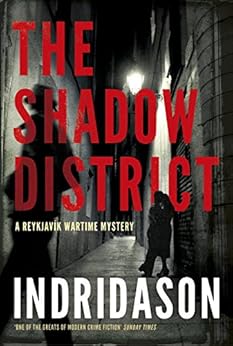
Review of THE SHADOW DISTRICT by Arnaldur Indriðason

3 Stars
Having read and enjoyed all of Indriðason’s Detective Erlendur books, I was anxious to read this first of a new series of historical crime novels set in Iceland during World War II.

In 1944, the semi-clad body of a young woman is found behind the National Theatre in Reykjavík.  Flóvent, an Icelandic detective with Reykjavík’s fledgling Criminal Investigation Department, and Thorson, an Icelandic-Canadian seconded to the American military police, collaborate to identify the victim and the killer.  In the present, Konrád, a retired police detective, helps look into the death of Stefán Thordarson whose personal possessions include newspaper clippings about the wartime murder. 

I did not find that this book measures up to the quality of the Erlendur books.  The slow pace of this police procedural was frustrating at times.  The dialogue was stilted.  And there were too many clichés:  “She nearly jumped out of her skin” and “He nearly jumped out of his skin” and “chatted to her about everything under the sun”. 

Perhaps these latter are a product of poor translation, but there are other weaknesses as well.  For instance, the links between the wartime murder and Konrád’s childhood seem too coincidental.  Then there’s the introduction, very late in the novel, of the point of view of Thordarson to explain the last few days of his life.  This technique seems like the author taking an easy way out. 

One of the aspects I most enjoyed is the novel’s touches on Icelandic history and culture.  I learned, for example, about the Situation, the liaisons between soldiers and Icelandic women; I had never considered the impact of tens of thousands of servicemen pouring into a city with a population of only 40,000.  The references to Icelandic folklore, especially the huldufólk or hidden people, are interesting. 

The independence of Iceland was also something I had known nothing about:  at Þingvellir on June 17, 1944, when Iceland was occupied by the Allies and Denmark was occupied by the Nazis, Iceland unilaterally declared independence from Denmark.  (Having recently visited Þingvellir, where the Alþingi, the world’s first parliament, was founded in 930 and where the Icelandic nation agreed to adopt Christianity in the year 1000, I understand why Icelanders chose this site for its declaration of independence and why the site is a national shrine.)

I’m not sure where the Reykjavík Wartime mystery series goes from here.  (Does it follow more of Flóvent’s cases during the war?  Unfortunately, I didn’t find that the detective is developed in sufficient depth.  Thorson had more interest for me but primarily because of his Canadian roots in Manitoba and because the information given about his personal life adds another dimension.)  I’m also not sure I will revisit the series when the next installment is released. 

Saturday, July 8, 2017

Flap Books for Adults

As a grandmother, I’m familiar with flap books, books where children get to lift flaps.  They are intended to make learning more fun and interactive, although there is debate as to whether they actually help toddlers learn new words (http://www.telegraph.co.uk/science/2016/09/14/lift-the-flap-books-may-stop-toddlers-learning-new-words-say-sci/). 

I hadn’t realized that such books had been around in the 16th century until I came across an interesting article earlier this year:  “The Scandalous Flap Books of 16th-Century Venice”.  Apparently “flap books were a fun innovation in publishing, used for purposes both serious and satirical.”  As the article shows, these flap books were definitely intended for an adult audience:  http://www.atlasobscura.com/articles/sexy-venice-flapbooks?utm_source=twitter&utm_medium=atlas-page.