Ranked a Top Canadian Book Blog
Twitter: @DCYakabuski
Facebook: Doreen Yakabuski
Instagram: doreenyakabuski
Threads: doreenyakabuski
Substack: @doreenyakabuski
Bluesky: @dcyakabuski.bsky.social

Saturday, November 7, 2015

Reviews Archive - "Tell It To The Trees" by Anita Rau Badami

Today I thought I’d feature Anita Rau Badami who has written four novels:  Tamarind Mem, The Hero’s Walk, Can You Hear the Nightbird Call? and Tell it to the Trees.  I’ve thoroughly enjoyed all of these.  Here’s my review of her most recent book.

Review of Tell it to the Trees
4 Stars
The book tells the story of the Dharma family living outside an isolated small town in northern British Columbia. Its members include Vikram, who went to India to arrange his second marriage to Suman, a quiet, gentle woman. The couple has a son, Hemant, but Suman is also stepmother to Varsha, a teenager who, because of the loss of her mother, fears losing Suman and becomes very possessive of her half-brother as well. Akka, Vikram's elderly and sickly mother, is the fifth member of the household.

Shifting narrators gradually reveal the story of this family. Though they appear to be a loving and closely knit Indo-Canadian family, it soon becomes obvious that they are not. Early in the novel the reader is told that "truth [is] a shifting, shy thing, like sunlight changing from moment to moment" (19). The truth is that the Dharmas are a damaged dysfunctional family.

To maintain a good family name, the five members must keep family secrets, telling them only to an old tree. These secrets hold the family together but also tear it apart.

A weakness of the book is that much of the family's past is left unexplained. What motivated Akka's husband to choose such an isolated place as his family's home? What few hints are given about Akka's past suggest that her story is worthy of an entire book. Furthermore, the circumstances of the death that begins the novel are rather unbelievable.

Despite its weaknesses, this cautionary tale about the cycle of family behaviour is a good read. It is both a psychological drama and a mystery, a chilling read in keeping with its wintery setting.

Friday, November 6, 2015

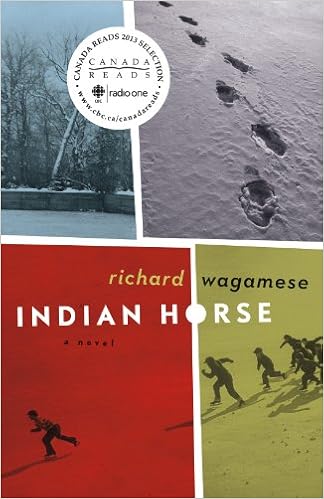
Matt Cohen Award winner Richard Wagamese and "Indian Horse"


Earlier this week Richard Wagamese was awarded the Matt Cohen Award which “recognizes a lifetime of distinguished work by a Canadian writer, working in either poetry or prose in either French or English”.  In awarding the $20,000 prize to Wagamese, the Selection Committee stated, “Over a career spanning more than 30 years and numerous honours, Richard Wagamese has become a vital voice in Canadian letters” (http://www.writerstrust.com/Awards/Matt-Cohen-Award--In-Celebration-of-a-Writing-Life.aspx).


Here’s my review of Wagamese’s novel Indian Horse which I read back in July of 2013.

4 Stars

The narrator of this novel is Saul Indian Horse, a First Nations former hockey star undergoing treatment for alcoholism. In rehab he is encouraged to tell his story as a form of healing and so he writes what amounts to his autobiography.

Saul is an Ojibway from northern Ontario; at the age of eight, in the early 1960s, he is placed in a government-sanctioned, church-run residential school where “There were no grades or examinations. The only test was our ability to endure.” There, like so many Native children, he experiences and/or witnesses beatings, rapes, and countless humiliations. He describes life at the school, the place which “took all the light from my world,” as hell on earth: “When your innocence is stripped from you, when your people are denigrated, when the family you came from is denounced and your tribal ways and rituals, are pronounced backward, primitive, savage, you come to see yourself as less than human. That is hell on earth, that sense of unworthiness. That’s what they inflicted on us.”

What saves Saul is the game of hockey introduced to him by a young priest, a game for which Saul proves to have an almost preternatural understanding. His natural talent and determination to perfect his skills make a career in the sport a possibility, but as his opportunities increase so does the racism he faces.

I know a bit about the abuse faced by children who were forcibly removed from their families and suffered physical, sexual, and emotional abuse in residential schools, but this is the first novel I have read written from the perspective of a survivor. It is the details of the abuse that are shocking, but it is their very specificity that adds credibility to this work of fiction. The author’s emotionally restrained style in which he avoids gratuitous details and an accusatory tone - and even remains polite - ensures that the reader cannot dismiss the novel as a bitter diatribe which exaggerates for the sake of effect.
It is clear who bears responsibility for the abuse and its consequences for future generations, but Saul is also given some advice about healing: “’They scooped out our insides, Saul. We’re not responsible for that. We’re not responsible for what happened to us. None of us are. . . . But our healing – that’s up to us. That’s what saved me. Knowing it was my game.’”

The one part of the book I did not enjoy is the descriptions of the many hockey games. I am not a fan of hockey (a blasphemous admission for a Canadian) and know little about it and so found my eyes glazing over in the sections detailing technicalities of the sport. It is not necessary to become tediously repetitive to make it obvious that hockey provides an escape Saul and that he is an exceptionally talented player. I will admit, however, that the use of Canada’s national game as a metaphor for Saul’s plight (and that of other aboriginal youth) is genius: a young man has the talent and work ethic to strive for the dream of Canadian youth – a shot at the National Hockey League – but the dream may be unattainable because of systemic racism.

Stories are an integral part of Saul’s culture. One man tells Saul, “’Ojibways are the best storytellers I know’” although Saul thinks that his people have “stepped beyond the influence of our legends. That was a border my generation crossed, and we pine for a return.” But in rehab Saul is told that it is necessary for him to know and understand his story in order to heal his broken spirit. Likewise, it is necessary for all of us to know and understand our hiSTORY.

I’m starting a list of should-read novels for all Canadians; in the First Nations category, I have thus far included Three Day Road by Joseph Boyden and Incidents in the Life of Markus Paul by David Adams Richards. Indian Horse now joins the list. It forces us to face the shameful part of our history in which it was not the victims of residential schools that were the savages.

Thursday, November 5, 2015

Review of "Walking Mountain" by Terry Cassidy

   3 Stars

This YA historical novella is set in April of 1903 in Frank (in what is now Alberta).  Two young people, Burt Delaney and Laura Freeman, meet just days before the rockslide in which 90 million tons of rock destroyed much of the town and killed at least 70 people.  That event changes their lives in several ways.

The rockslide is the pivotal event, and it is obvious that the author did considerable research into the Frank Slide.  Actual events such as the entrapment of 17 coal miners in tunnels under Turtle Mountain, the heroics of Sid Choquette, and the survival of Lillian Clark are woven into fictional ones.  The novel will undoubtedly have more than one reader researching this disaster.

Sometimes there is perhaps too much history.  Burt’s uncle gives a lengthy summary of the Northwest Rebellion; names like Louis Riel, Poundmaker, Big Bear, and William Otter are mentioned.  This account serves little purpose except to contrast Canadian and American history.  Laura’s letter to her parents, though its formal tone is explained, reads like a history lesson about the effects of the slide.

The relationship between Burt and Laura is developed well and in keeping with societal standards at the time.  When Burt invites Laura to dinner in a restaurant, her brother is also included; they address each other as Mr. Delaney and Miss Freeman; physical contact is minimal; and any suggestion of a romantic relationship has them blushing.

Both Burt and Laura are well-developed characters, though I have one problem with Laura.  There are inconsistencies in her portrayal.  When Burt mentions he once lived in Minneapolis, Laura says her home town is “’not glamorous like Great Falls or Minnea . . . whatever you said’” (14), and later, she stumbles over the word “collaborating” (81).  Yet we learn that she is an avid reader (26) and at one point compares the rockslide to “that poem by Lord Byron about the Assyrian army being swept over by the Angel of Death” (67)?  Are we to see her fumbling dialogue as a sign of nervousness?

Burt has been estranged from his father and stepmother for years and the reason for that estrangement is clear.  Considering the circumstances, Burt’s feelings are totally understandable.  At the end, however, there is a change in that relationship which I did not find convincing.  Burt’s trauma is certainly a motivation for his behaviour, but he says only that “’I did some thinking today, and most of it was about how I wasn’t thinking too straight before’” (83).  He has an epiphany in the mine (61 – 62) but it is not sufficiently developed when contrasted with the amount of bitterness expressed earlier.  More problematic, Burt’s explanation for his stepmother’s actions (92) seems glib.

The novel starts slowly, but gains momentum.  It provides an interesting perspective of a Canadian disaster and has the requisite conflict and suspense, along with a romance element.

Wednesday, November 4, 2015

2015 Rogers Writers’ Trust Fiction Prize Winner - "Fifteen Dogs" by André Alexis

Last night the winner of the Rogers Writers’ Trust Fiction Prize was announced.  It went to Fifteen Dogs by André Alexis.  This $25,000 prize “recognizes Canadian writers of exceptional talent for the year's best novel or short-story collection” as selected by a judging panel.

The book “begins with a bet between the gods Hermes and Apollo: “that animals would be even more unhappy than humans are if they were given human intelligence.” This leads them to grant human consciousness and language to a group of dogs overnighting at a Toronto veterinary clinic. Suddenly capable of more complex thought, the pack is torn between those who resist the new ways of thinking and those who embrace the change. The gods watch from above as the dogs venture into their newly unfamiliar world, as they become divided among themselves, as each struggles with new thoughts and feelings. By turns meditative and devastating, charming and strange, André Alexis's contemporary take on the moral fable offers a compelling and affecting look at the beauty and perils of human consciousness” (http://writerstrust.com/Awards/Rogers-Writers--Trust-Fiction-Prize.aspx).
 The Jury’s Citation:  “In Fifteen Dogs – André Alexis’ powerful apologue – questions of knowledge and happiness, fidelity and fate are grounded in the real-world adventures of a group of dogs. Here is a beautifully written allegory for our times: one in which man’s best friend shows us the benefits of higher consciousness – the favoured bone of fact buried where we might all find it. Fifteen Dogs is an original and vital work written by a master craftsman: philosophy given a perfect form” (http://writerstrust.com/Awards/Rogers-Writers--Trust-Fiction-Prize.aspx).

Fifteen Dogs is also on the Scotiabank Giller shortlist; the winner will be announced next Tuesday, November 10.

For the other four finalists, check my blog of September 29, and for the winners of the other six prizes awarded by the Writers’ Trust of Canada, check out their website:  http://writerstrust.com/News/Events-(1)/Writers--Trust-Awards.aspx.

Tuesday, November 3, 2015

Today's New Release - "The Girl from the Train" by Irma Joubert

  2 Stars
I requested this book from the publisher via NetGalley because its subject matter sounded interesting.  It offered a different perspective of World War II, that of a child; she is the daughter of an SS soldier but she also has a Jewish grandmother.  It was a bestseller in its original language, Afrikaans, and its Dutch translation.  I had high hopes, but I was disappointed.

Gretl Schmidt is six when she escapes from a train headed for Auschwitz.  She is rescued by Jakób Kowalski, a 21-year-old member of the Polish resistance.  She is sheltered by his family for several years, but after the war, Jakób takes her to Germany so, as a German orphan, she can be taken to South Africa for adoption.  There she becomes the adopted daughter of a wealthy Afrikaans family.

The novel is narrated from both Gretl and Jakób’s points of view so we see their views of events that they share and also what happens to them when their lives diverge.  Fifteen is a recurring number:  the novel covers 15 years (Gretl from age 6 to 21), and 15 years is the age difference between Jakób and Gretl. 

There is no doubt that the author did considerable research.  Unfortunately, sometimes the book readsmore like a Polish history lesson.  Jakób and his brother repeatedly argue about whether Poland should join forces with Russia in order to fight the Germans.  And there are sentences like, “University students organized a revolution against Stalinism.  Workers demanded that the dethroned Gomulka, a politician with ties to the old Polish Worker’s Party, be reinstated as first secretary of the Politburo . . . ”  Since my heritage is Polish, I am interested in Polish history, but sometimes it seemed that the book read more like non-fiction with plot being a secondary concern.

The one historical element about which I knew nothing is the fate of German orphans.  This book details the adoption of German orphans with pure Aryan bloodlines by Afrikaners who had been supporters of Nazi Germany.  The attitudes of the Afrikaners are clearly expressed:  “’The Roman Catholic Church is the Catholic Threat against which we have to protect our faith.  Anything that comes from Poland is Communist and part of the Red Danger, against which we must protect our country.  And the Jews are non-Aryans, against whom we must protect our blood.’”  And Gretl’s adoptive father also expresses his view of the Holocaust in clear terms:  “’I agree with the people who believe that the so-called Holocaust never took place, that it was just a ploy by the Communists to vilify the Germans. . . . I don’t believe it for a moment. . . . that such a highly civilized, proud nation could descend to such depths.’”

Characterization is problematic.  Gretl and Jakób are likeable because they have so many admirable qualities:  both are strong and determined and loyal.  The difficulty is that they seem to have no negative traits so they seem too good to be true.  Sometimes characters do not behave consistently; Gretl’s adoptive father, for example, insists on a pure Aryan child and sees Jews as a threat, yet he married a woman whose grandmother was Jewish?  Drobner, Jakób’s boss at one time, is “a hard-bitten Communist” and “a staunch Communist” yet he warns Jakób that he is being followed by the secret police: “’Take care.  You don’t want the Party to find anything against you.’”

Gretl’s religious views are ever changing.  She goes to Mass with Jakób:  “And she knew God was waiting inside [the cathedral].  Much more than in the sweltering bushveld church, where the sun beat mercilessly through the uncovered windows and the organ wailed out the glory of God.”  Then shortly afterwards, she says, “”I don’t feel ill at ease in the Catholic Church, because it’s so familiar to me.  But I was confirmed in the Protestant church and that’s where I belong.’”  Yet, earlier, it is stated that “She had been confirmed in the Catholic Church . . . “!?  She has forgotten her Catholic confirmation?  Her religious persuasion changes as often as her name:  Magrieta, Gretl, Gretz, Griet, Grietjie.

The novel is a translation so perhaps that explains the static sentence structure:  “She was relieved to hear the pickup.  Her father had come to fetch her before dark.  She went to meet him.  He opened the door from the inside.  She got in.”  Dialogue seems unnatural:  “’Your hair is long,’ he said. “Here, I brought you something.’”  Exposition is also strange:  “She found the standard five sums easy, because Jakób had already taught her most of the work.  She had nearly forgotten what Jakób looked like.  The only subject she found really hard was English.”  Sometimes things are mentioned for no apparent reason; for instance, there’s a statement that “Horst Bremer’s football – big Horst, not the little one – landed in the cake” yet there has never been mention of two Horsts. 

There is romance, but it didn’t ring true for me.  The age difference is not necessarily a problem, but considering Jakób and Gretl’s initial relationship, the romance just doesn’t seem appropriate.  Certainly, the happy ending will appeal to many readers, but it seems like plot manipulation to me. 

Many readers will find this a heartwarming story about how love can conquer all:  “their belief that the human spirit can triumph over the ravages of war have formed a bond of love that no circumstances can overcome.”  Perhaps I am in the minority, but its many weaknesses make this a book I cannot rate highly.

Note:  I received an ARC of this book from the publisher via NetGalley.

Monday, November 2, 2015

"Half of a Yellow Sun" by Chimamanda Ngozi Adichie - Baileys Women's Prize for Fiction Decade Winner

Chimamanda Ngozi Adichie’s novel of the Biafran war, Half of a Yellow Sun, has been named the best winner of the Baileys Women’s Prize for Fiction of the last decade – by both the public and a judging panel.  The award chose to mark its 20th anniversary by asking the chairs of judges of the past 10 years to pick their “best of the best” winner from the last decade (http://www.theguardian.com/books/2015/nov/02/baileys-prize-crowns-chimamanda-ngozi-adichie-as-its-best-of-the-best?CMP=twt_books_b-gdnbooks?CMP=twt_books_b-gdnbooks).  Here are some notes I made on that book which I read back in July of 2008.

Review of Half of a Yellow Sun
4.5 Stars
The novel is set in Nigeria during the 1960s, the early optimistic years and the civil war period at the end of the decade when Muslim-dominated forces from the north lay siege to the Christian Igbo of the south who sought to secede after the widespread massacre of their people.  The Biafran war is remembered for the famine but this book gives the religious, social and political background.  The novel puts blame on the colonial powers who set nonsensical national boundaries trying to unite disparate tribes.

The five main characters are developed thoroughly and shown as dynamic:  Odenigbo, an intellectual Pan-Africanist; Ugwu, Odenigbo’s houseboy; Olanna, Odenigbo’s mistress; Kainene, Olanna’s fraternal twin and foil; and Richard, Kainene’s principled English lover.

Olanna and Kainene have an uneasy relationship symbolic of the relationships between Nigeria’s postcolonial peoples; they are involuntarily joined and must choose between a difficult unity and a difficult separation. 

The characters are very realistic.  Even the most honourable have humanizing flaws.

The book depicts the impact of war on a variety of people:  peasants, intellectuals, the elite.  It touches on a number of topics:  world politics, colonial policies, religious differences, tribal influences, geographical prejudices, racism, economic class consciousness, business activities, family connections and obligations, friendship, and sexual desire.

Sunday, November 1, 2015

Literary Travel

Since reading and travel are my two passions, I’m always on the lookout for books that combine those interests.  Schatje’s Shelves has a number of books about literary travel:


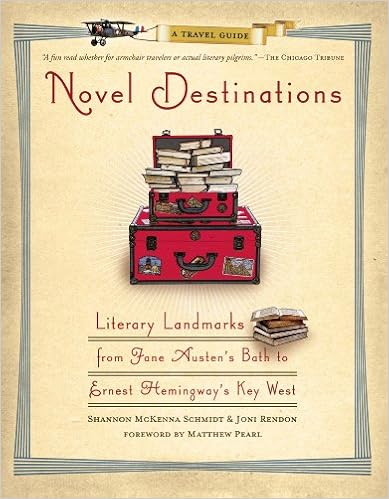
Novel Destinations:  Literary Landmarks from Jane Austen’s Bath to Ernest Hemingway’s Key West by Shannon McKenna Schmidt and Joni Rendon
This is a guide to more than 500 literary sites in the U.S. and Europe.


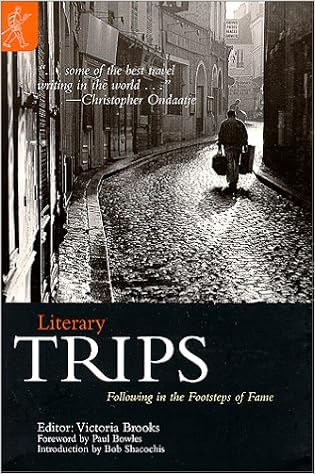
Literary Trips:  Following in the Footsteps of Fame edited by Victoria Brooks
This is a collection of 23 essays focusing on famous writers and the locales for which they were well known.
There are two essays featuring Canada:  “Malcolm Lowry: Paradise in Vancouver” and “Elizabeth Smart:  Poetry and Passion in Ottawa.”


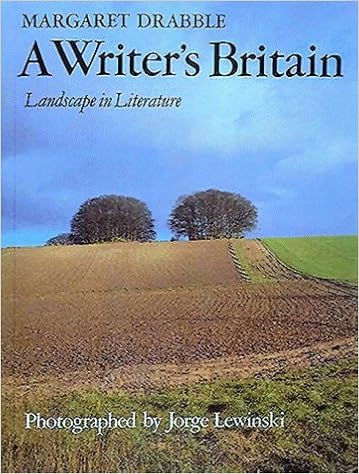
A Writer’s Britain:  Landscape in Literature by Margaret Drabble

The purpose of this book is “to present an image of Britain as seen by writers of different regions and periods, and also to illuminate the way in which their work has changed our visual attitudes, our taste in landscape and our relation to nature.”


Literary Walks of Britain edited by Donald Veall
This is an anthology of prose and poetry written by British writers who walked for pleasure through various parts of the country.  Photographs illustrate the source of the writers’ inspirations.


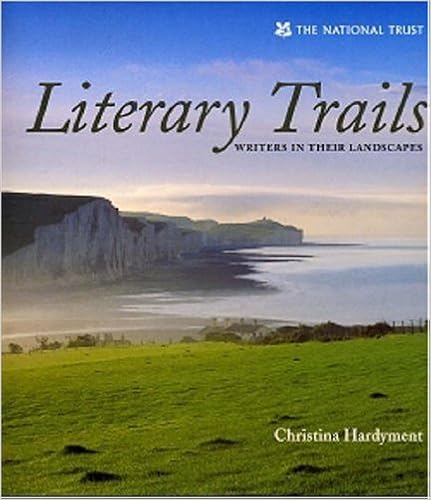
Literary Trails:  British Writers in Their Landscapes by Christina Hardyment

This book outlines a series of trails through Britain’s literary landscapes.  As a lover of mysteries, I enjoyed the chapter entitled “The Scene of the Crime” which focuses on the landscapes of various British mystery writers.


Suggestions/recommendations of other titles on this subject are always welcome.