Ranked a Top Canadian Book Blog
Twitter: @DCYakabuski
Facebook: Doreen Yakabuski
Instagram: doreenyakabuski
Threads: doreenyakabuski
Substack: @doreenyakabuski
Bluesky: @dcyakabuski.bsky.social

Tuesday, December 15, 2015

Book Advent Calendar (Day 15) - "Jack of Spades" by Joyce Carol Oates

The 15th day of my Book Advent Calendar and the letter “O” bring me to Joyce Carol Oates, an award-winning, prolific writer.  I’m recommending her most recent novel, published earlier this year.
 Day 15:  Jack of Spades by Joyce Carol Oates
4 Stars
 
Andrew J. Rush is a successful, award-winning mystery writer. In secret, he also writes a series of ultraviolent noir thrillers under the pseudonym “Jack of Spades.” His dual identities exist in harmony until Rush is accused of plagiarism by C. W. Haider, a wannabe writer. Feeling threatened and under stress, Rush becomes subsumed by his dark Jack of Spades persona who wants revenge against Haider.

The point of view is first person with Rush as the narrator. It soon becomes obvious that he is an unreliable narrator so what he says cannot be taken at face value. The opposing forces within his mind become clearer as his knavish alter ego takes precedence. Then, as a childhood incident is described and Rush’s relationship with his family more closely examined, one begins to wonder whether the Jack of Spades personality is the true one and Andrew J. Rush is merely the public façade.

In many ways, the story is an homage to Edgar Allan Poe. Allusions, both direct and indirect, are made to several of Poe’s stories. At the beginning, Oates quotes from Poe’s story “The Imp of the Perverse,” and her story does suggest there is an imp inside each of us – we are all susceptible to impulses which may lead us to perform irrational acts.

Numerous studies have demonstrated correlations between creative occupations and mental illnesses, and this novel does reinforce the idea that there could be a connection. Certainly, there is almost a “madness” to how the Jack of Spades novels are written: after midnight in “a protracted siege of concentration” so “entire passages and pages, even chapters, by ‘Jack of Spades’ passed in a rabid blur leaving [Rush] exhausted.” (Edgar Allan Poe is thought to have had bipolar disorder.)

This book is best described as a psychological suspense novel. Certainly there is a great deal of suspense as aspects of Rush’s personality are revealed and his downward spiral continues. Will Rush be able to resist the dark side of his soul? My one complaint is that there is, however, a predictability to some events. I guessed, for example, what Rush would find in Haider’s house. Anyone who has read Poe will certainly see similarities and so be able to predict events.

But what is to be made of Haider’s writing of works like The Glowering, Sister Witches of Hecate County, Ghost-Tales of the Chilliwick Club, and Murder at Dusk? What Rush discovers cannot be dismissed as mere coincidence. Unfortunately no explanation is offered. Could cryptomnesia be so prevalent?

Perhaps the best indication of the quality of this book is that it is one I will probably re-read in the future. Even a quick second skim hints at wonderful touches (like the misspelling of Rush’s surname and the mishearing of Haider’s) which might be initially missed.

Monday, December 14, 2015

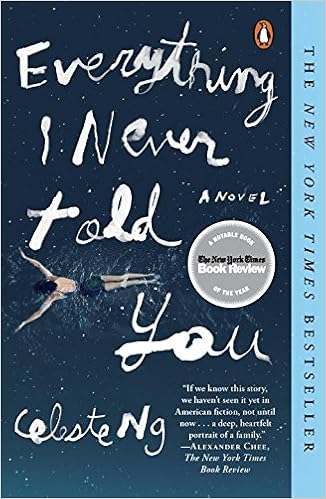
Book Advent Calendar (Day 14): "Everything I Never Told You" by Celeste Ng

For the 14th day of my Book Advent Calendar and the letter “N”, I am recommending a debut novel which I read earlier this year.  It appears on the longlist for the 2016 Dublin Literary Award.
Day 14:  Everything I Never Told You by Celeste Ng
4 Stars
Set in 1977 in Ohio, the novel begins with the death of 16-year-old Lydia Lee, the favourite child of James, a Chinese-American history professor, and Marilyn, a Caucasian woman who dropped out of medical school to become a mother. The book is a mystery and a family drama which uncovers how she came to drown and what the impact of her death has been on her parents and two siblings.

The point of view is third person with the perspective shifting from one family member to another. These transitions between characters and time periods are done smoothly. In the end readers know the characters better than they know each other because we learn everything they have never told anyone else. Even Lydia’s viewpoint is included, so the reader knows her better than anyone else in the family. The siblings prove to be quite perceptive about their lost sister, but they too are missing pieces of the puzzle.

A major theme is the lack of understanding due to poor communication. There are so many missed opportunities for connections; feelings are not expressed “to ensure the terrain of the family did not change” (161). It is not just Lydia who kept secrets; everyone in the family has secret desires and motivations. James and Marilyn, for instance, do not discuss the past; when they married they made a pact “to let the past drift away, to stop asking questions, to look forward from then on, never back” (49). Hannah, the youngest child, often “vanishes into her room without a word” (68), her bedroom being “in the attic, where things that were not wanted were kept” (160). Nath and Lydia have a strong bond at first; the brother “as the only other person who understood their parents . . . had absorbed her miseries” (168); however, Lydia’s position as the favoured child causes Nath to become resentful and their relationship deteriorates.

Another theme is how our pasts affect our lives and those of our children though we may think otherwise. Because of their upbringings, the parents take actions that impact their family; several times, for instance, we are reminded that Marilyn’s absence from her family for nine weeks had an influence for ten years. Certainly James wants Lydia to be popular because as a child he had no friends, and Marilyn wants Lydia to become a doctor because she was not able to do so. And much of Lydia’s behaviour is explained by her having “absorbed her parents’ dreams” (160).

Prejudice is another theme. James feels he is not accepted because he is a visible minority, and certainly he has received his share of taunts. His children, the products of a biracial marriage, are also subjected to racial slurs. The newspaper headlines announcing “Oriental Girl Found Drowned in Pond” (60) highlight societal attitudes.

What is particularly impressive about the book is its realism. Because we are given characters’ backstories, their motivations and behaviour are totally understandable. How they react makes perfect sense.

I highly recommend this novel. Its three-dimensional characters, realistic plot, and thematic development make it a book of exceptional literary quality.

Sunday, December 13, 2015

Book Advent Calendar (Day 13) - "The Last Days of Ptolemy Grey" by Walter Mosley

Day 13 of my Book Advent Calendar brings us to “M”.  My recommendation is a book which I voted as one of the best I read in 2012.
 Day 13:  The Last Days of Ptolemy Grey by Walter Mosley
5 Stars
Ptolemy Grey, a 91-year-old Black man, is suffering from the early stages of dementia. After the death of his primary caregiver, Robyn Small, a 17-year-old family acquaintance, comes forward to help him. She challenges his hoarding and hermit existence. As Robyn tries to get medical treatment for Ptolemy, she inadvertently brings him to a Mephistophelean doctor who offers him an experimental drug that will give him lucidity for a short period of time, lucidity which Ptolemy desperately craves so he can get his affairs in order. Think of Flowers for Algernon for dementia sufferers.

Ptolemy is a character who will stay with the reader long after the last chapter has been read. He is a wise, gentle soul who lives by the simple truths he was taught by his mentor, Coydog McCann. Some of these life lessons he passes on to Robyn. Even though he is frail in body and increasingly feeble in mind, he struggles against injustice and tries to live like a rich man whom Coydog defined as "the man [who can] live in his own skin."

Much of Ptolemy's life is narrated via flashbacks as he increasingly lives in his past, especially the memorable people and life-shaping events in it. Various racial issues are addressed since Ptolemy and his family were not always treated fairly by Whites, but members of Ptolemy's family are not portrayed as totally innocent either. Characters are realistic and neither demonized nor sanctified.

It is the portrayal of Ptolemy's thought processes that struck this reader. His thoughts are fragmented as one would expect in someone suffering from his medical condition, but gradually the reader can construct the pivotal events in his life and thereby understand the emotions that colour his life.

This book has it all - suspense, historical accuracy, a memorable protagonist, and themes applicable to contemporary times. It would take a very unfeeling person lacking in empathy not to be moved by this novel.

Saturday, December 12, 2015

Review of "Those Who Leave and Those Who Stay" by Elena Ferrante


4 Stars

The third of the Neapolitan novels continues the story of the lifelong relationship between Elena Greco, the narrator, and Lila Cerullo who grew up together in poverty in post-war Naples.  The book covers eight years (1968 – 1976) when the two young women are in their twenties and early thirties.  The focus is on Elena’s engagement and marriage to the son of prominent intellectuals, the birth of her children, and the publication of her first book.  Lila works in a factory and is raising her son virtually single-handedly but begins studying computer technology and working in this nascent field. 

As in the previous books and as this title suggests, one of the young women leaves and one stays.  Elena has left her home neighbourhood and ventured out into the larger world; in much of this novel, she lives in Florence.  Lila, on the other hand, does not venture far.  She describes their situation:  “’You’re strong . . . I have never been.  The better and truer you feel, the farther away you go. . . . I’m scared’” (177).  But Elena admits that there is courage in staying:  “I feel like the knight in an ancient romance as, wrapped in his shining armor, after performing a thousand astonishing feats throughout the world, he meets a ragged, starving herdsman, who, never leaving his pasture, subdues and controls horrible beasts with his bare hands, and with prodigious courage” (172).  At one point, Elena regrets, “How much I had lost by leaving, believing I was destined for who knows what life” (346). 

And of course the two women take turns leaving the other behind.  One will come to help her friend but will eventually feel, “I absolutely had to go” (217) and “it was really time to get out” (224).  When the life of one is happy and successful, that of the other takes a downturn.  For example, when the career of one stalls, the other finds a new career which brings wealth.  Elena admits, “I had wanted to become something . . . only because I was afraid Lila would become someone and I would stay behind” (347).

One of the themes that takes prominence in this novel is that of the limited role of women in a male-dominated society.  Elena discovers feminism and also the restrictions of marriage and motherhood.  She marries an intellectual but he is very narrow-minded, objecting to her taking birth control pills.  She explains that “my husband never praised me but, rather, reduced me to the mother of his children; even though I had had an education he did not want me to be capable of independent thought, he demeaned me by demeaning what I read, what interested me, what I said, and he appeared willing to love me only provided that I continually demonstrate my nothingness” (298). 

The book also addresses sexuality and male sexual self-centredness.  “To be made badly when it comes to sex means, evidently, not to be able to feel pleasure in the male’s thrusting; it means twisting with desire and rubbing yourself to quiet that desire, it means grabbing his hands and placing them against our sex . . . ignoring his annoyance, the boredom of one who has already had his orgasm and now would like to go to sleep” (176).  Elena describes sex with her husband:  once satisfied, he did not seem “to understand that I wanted some part of his body to consummate, in turn, my desire” (253). 

The two women remain true to the traits indicated in the previous novels.  Lila is as mercurial as always and Elena as insecure as ever.  It is increasingly obvious, however, that Elena can be as selfish, ruthless and manipulative as the friend she has described as mean.    A mutual friend tells Elena, “’What you have, you deserve, you got it with hard work, without hurting anyone, without bullshitting with other people’s husbands’” (338), but that analysis proves not to be entirely correct.  An acquaintance of both women says to Elena, “’You’re two pieces of shit and nothing can change you, two examples of underclass filth.  But you act all friendly and Lina doesn’t’” (287).

Elena’s husband tells his wife that, “’[Lila] wasn’t at all my friend, that she hated me, that she was extraordinarily intelligent, that she was fascinating, but her intelligence had been put to bad use’” (340), yet the emotional attachment continues.  Elena relies on Lila “to set my imagination in motion” (261), and claims that Lila’s intelligence has “influenced everything I’ve done” (225).  On the other hand, Lila tells Elena, “’you’ve helped me since we were children, without you I’m not capable of anything’” (273).  Elena claims that she is going to change:  “I had to start again to become, but for myself, as an adult outside of her” (347), but that seems unlikely.  Lila tells Elena that she cannot protect herself, “’Not from me’” (29) and Elena is the one who writes about her relationship with Lila after she disappears. 

And now I’m off to begin the last installment in that story!

Book Advent Calendar (Day 12) - The Rainbow Fairy Books by Andrew Lang

It’s Day 12 of my Book Advent Calendar; we are halfway through and at the letter “L”.  This time, I’m going to suggest twelve books which I was given as a child and which I still possess:  the Rainbow Fairy Books of Andrew Lang.

category-header

Between 1889 and 1910, Andrew Lang published twelve collections of fairy tales, each with a different coloured binding, with a total of 437 stories collected, edited and translated.  These tales are from cultures and countries around the world. The books, ordered chronologically, are as follows: The Blue Fairy Book, The Red Fairy Book, The Green Fairy Book, The Yellow Fairy Book, The Pink Fairy Book, The Grey Fairy Book, The Violet Fairy Book, The Crimson Fairy Book, The Brown Fairy Book, The Orange Fairy Book, The Olive Fairy Book, and The Lilac Fairy Book.  All have illustrations.  It's the ultimate fairy tale collection.

I recently learned that The Folio Society is publishing the full series of Lang’s fairy books in beautiful hardback editions with classic illustrations (http://www.foliosociety.com/category/9319/andrew-lang-s-fairy-books).  I don’t usually recommend specific publishers and with each book costing $94.95(CAN), this set is pricey, but the few Folio Society books I have are wonderful – heirlooms to be sure.  Maybe Santa can bring me one a year for the next twelve years?

Friday, December 11, 2015

Book Advent Calendar (Day 11) - "Flight Behavior" by Barbara Kingsolver

Day 11 of my Book Advent Calendar brings us to “K” and I’ve opted for a well-known author, Barbara Kingsolver.  I could have chosen any number of her books, The Poisonwood Bible being one of my favourite, but I thought this one was appropriate considering the climate change conference in Paris.

Day 11:  Flight Behavior by Barbara Kingsolver
5 Stars
 
Near her hardscrabble sheep farm in Tennessee, Dellarobia Turnbow discovers millions of monarch butterflies who have deviated from their normal migration pattern to Mexico. The discovery brings the world to her doorstep, the tourists, the eco-activists, and the media among them. Also to arrive is Ovid Byron, a lepidopterist who hires Dellarobia to help research why the butterflies have arrived in Appalachia.

The answer soon becomes clear: climate change as a result of global warming. The butterflies’ Mexican home has been destroyed by flooding exacerbated by deforestation. Initially, Dellarobia is not a believer in climate change; gradually, however, she changes her mind as evidence is presented to her. Unfortunately others in the community are not so open-minded; her father-in-law, for example, wants to log the mountain which the butterflies have chosen for their winter home. The blindness of climate change deniers is addressed strongly by Ovid: “’What scientists disagree on now . . . is how to express our shock. The glaciers that keep Asia’s watersheds in business are going right away. . . . The Arctic is genuinely collapsing. Scientists used to call these things the canary in the mine. What they say now is, The canary is dead. We are at the top of Niagara Falls . . . in a canoe. . . . We got here by drifting, but we cannot turn around for a lazy paddle back when you finally stop pissing around. We have arrived at the point of an audible roar. Does it strike you as a good time to debate the existence of the falls?’’’ (367)

The serious social message is expertly intertwined with a personal story. Dellarobia is unhappy and frustrated with her life. She feels trapped in her marriage to Cub, a dim-witted, unimaginative, passive man overshadowed by his parents. Though he is decent, good-hearted, and well-meaning, he cannot provide her with an escape from their economically and intellectually impoverished life. Working for Ovid serves as an awakening for Dellarobia. She gains self-confidence as her horizons expand and decides to seek personal fulfillment, searching, like the butterflies, for the place where she belongs. Obviously she metamorphoses from caterpillar to butterfly, although at the end she, again like the butterflies, is faced with an uncertain future.

There are many Biblical allusions in the novel. Dellarobia sees a flaming forest, like Moses saw a burning bush. References to Noah’s flood appear more than once. I foresee students of English literature writing essays analyzing Kingsolver’s use of Biblical allusions to add depth to her novel.

This is literary fiction at its best; it combines an interesting plot and a dynamic protagonist with an urgent message: the world is a “mess made by undisciplined humans” (25) who must stop behaving like “ignorant little dumb-heads” (41) or “the world [will] fall down around them” (25).

Thursday, December 10, 2015

Book Advent Calendar (Day Ten) - "The Son of a Certain Woman" by Wayne Johnston

Day Ten of my Book Advent Calendar means an author whose surname begins with the tenth letter of the alphabet.  I’ve decided on a Newfoundland writer, Wayne Johnston.  My review is of his most recent novel, though several of his others I would also recommend:  The Colony of Unrequited Dreams, The Navigator of New York, and A World Elsewhere.

Day Ten:  The Son of a Certain Woman by Wayne Johnston
4 Stars

The “son” is Percy Joyce, a disfigured child born in the 1950s in St. John’s, NL. The “certain woman” is Penelope, Percy’s unwed mother, whose Elizabeth Taylor beauty and Sophia Loren voluptuousness are such that Percy begins his story with this statement: “Most of the people who knew my mother either slept with her or wished they had, including me, my aunt Medina and a man who boarded with us” (3). These four people live secret lives in the shadow of the Basilica-Cathedral of St. John the Baptist: Penelope and Medina are lovers, although Penelope occasionally has sex with Pops, the boarder, so he will help pay the mortgage. Penelope justifies her actions by saying, “Better I be a prostitute than we all be destitute’” (113).

Of course living in the middle of “Catholicism Central . . . [where] there were seven Christian Brothers-and-nuns-run schools within a stone’s throw of each other” meant there was “no separation between Church and Fate” (23). The Archbishop interprets Percy’s birth on June 24, the feast day of St. John’s patron saint, as an indication of his specialness and so “directed his assistants to find out everything they could” (45) about Percy and his family. Brother McHugh, the principal of the boys’ Catholic school across the street from the Joyces, is set the task of bringing Percy, “an unbaptized, non-denominational renegade,” and Penelope, “a recalcitrant, non-churchgoing maverick,” (9) into the church. The scrutiny placed on their home is not welcomed: “It was not a good time or place for anyone to be known to be sleeping with anyone they weren’t at least engaged to. A woman caught with a woman or known to be in love with one would likely be sent to jail or deemed to be insane and committed until she was ‘cured.’ For certain [Percy would] have been taken away” (22-23).

A main conflict is the residents of 44 Bonaventure who wish to live as they see fit versus the power of the Catholic Church. The institution is repressive and corrupt; members of the Archbishop’s congregation have “the power to do his bidding without discovery and with impunity” (388). Brother McHugh, the main representative of the Archbishop, for example, brags about how he can punish students who misbehave: “’I know how to hurt boys in ways that leave nothing but little red marks that can easily be explained away’” (229). He places the Joyce family under constant surveillance and bullies them into doing his bidding. The price of non-conformity is high in a place where earning the ire of church leaders would “lead to being snubbed or ostracized . . . [because] to disobey the Archbishop was to disobey God and there was no telling what would come of that” (45).

The portrayal of the almost reptilian Brother McHugh is rather stereotypical, but the social control of the Catholic Church in the 1960s is shown very realistically. As a child growing up in a predominately Catholic community, I heard priests using sermons to tell people what films not to see; I attended a wedding where the bride was not allowed to wear white because she had had a child out of wedlock; and I witnessed sadistic punishment meted out by a nun to a child who was academically challenged. I have no disagreement with the author’s indictment of the church, but some readers may take exception to his biting critique.

The novel also examines the impact of beauty and ugliness. Percy, who is perceived as a “slobbering, jabbering aberration,” (6) muses, “I admit that it might be that my inner self has been altered by my outer one. It might be, as my mother suggested, that a life of looking as I did made me think and act the way I did” (184) and wonders “how I would have turned out if I had not been so different” (211). On the other hand, Penelope, who is renowned for her beauty, suggests that exceptional beauty can also be a curse: “My mother had several times read to me [Yeats’] ‘prayer’ for his daughter: that she not be granted beauty overmuch . . . lest she consider beauty a sufficient end . . . and never find a friend” (252).

There are some very funny scenes in the book. The exchanges between Pops and Medina are scathing but hilarious, as are Penelope’s skewerings of the church. Her “Yeah Papists” cheerleader chant (86-87) and her rambling speech about the church’s misogyny (364-368) are comically brilliant. The author’s wit and literary knowledge are obvious throughout; I particularly enjoyed his almost page-long list of oxymoronic names for St. John’s (17) and the many literary allusions, both direct (33) and indirect (256).

My complaint about the book is its length. Parts of it are repetitive. Percy’s attention-seeking lies (“give me myth or give me death”) and his constant lusting after his mother become tedious. The plot also becomes predictable: Percy constantly misbehaves and so Brother McHugh and Penelope end up in constant confrontations. The book could have been about 100 pages shorter and still have achieved its aim.

I understand why the book made the 2013 Scotiabank Giller Prize longlist: it is intelligent and will make readers laugh and cry. I also understand why it did not win: it addresses some controversial issues and may make some people very uncomfortable.