Ranked a Top Canadian Book Blog
Twitter: @DCYakabuski
Facebook: Doreen Yakabuski
Instagram: doreenyakabuski
Threads: doreenyakabuski
Substack: @doreenyakabuski
Bluesky: @dcyakabuski.bsky.social

Monday, March 6, 2017

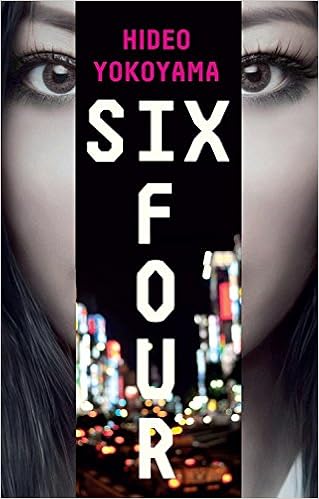
Review of SIX FOUR by Hideo Yokoyama


4 Stars
This novel was a huge seller in Japan and is the first of Yokoyama’s to be translated into English.

Six Four is the code name for a fourteen-year-old cold case, the kidnapping and murder of a 7-year-old girl named Shoko.  Yoshinobu Mikami, press director for the Profecture D police, is charged with organizing a visit by the police commissioner to Shoko’s family.  The ostensible reason of the visit is to publicize a renewed effort to solve the case, but Mikami discovers there is a hidden agenda.  Mikami, who was a detective for most of his career and had some involvement in the investigation, begins revisiting the Six Four case.  In the process, as he faces professional crises with the press, he uncovers police cover-ups and inadvertently becomes involved in police department machinations and power plays.  At the same time, he is dealing with the disappearance of Ayumi, his teenaged daughter, who has run away from home. 

Though there is a case to solve, this is not a typical police procedural or crime thriller.  Much of the focus is on Mikami’s investigation into the real reason for the commissioner’s visit and on his difficulties with the media outlets who feel that Mikami and the three other members of the Media Relations department are not sufficiently forthcoming with information about various cases.  Surprisingly, I found myself being drawn into the infighting and bureaucratic maneuverings. 

Mikami is an interesting protagonist.  He is conflicted since his transfer to Media Relations was unwelcomed, and he hopes to someday return to Criminal Investigations where apparently he distinguished himself.  He has much less success in his current position and finds himself being manipulated by officers who have little respect for it and want to use him for their own purposes.  He must tread carefully or jeopardize his return to his coveted role of detective. 

And then there’s his personal life.  Mikami’s wife has become withdrawn after Ayumi’s disappearance three months earlier.  Mikami also feels responsible for his daughter’s unhappiness.  She inherited her looks from her father rather than from her beautiful mother; though “Ayumi’s looks were no different to those of any other normal girl, the kind you saw everywhere,” she suffers from dysmorphophobia and hates her resemblance to her father.  He realizes that he has not really made much effort to understand his wife and daughter:  “A gentle wife who kept to herself.  A daughter, spoiled but kind at heart.  He’d been quick to label them for whatever reason, then leave the classification unchecked, unaltered, as five, then ten years had gone by.  Had he known Ayumi at all?”

Mikami is not naturally an introspective person, but he is forced to do some self-examination.  As a result, he comes to some realizations and grows and changes.  Since his thoughts are so thoroughly detailed, his character change is totally convincing.  The ability to portray a dynamic character realistically is always an indication of good writing.

The book is a great immersion in Japanese culture.  The hierarchical nature of Japanese society is amply obvious as is the concern to avoid losing face.  The tradition of buying rice crackers as a home-visiting gift was new to me.  Even the role of women in Japanese society is touched on. 

The relationship between police and media is examined in considerable detail.  I wouldn’t have thought the subject to be especially interesting, but it proved to be.  The point of view of each side in the debate is given.  Perhaps the issue of freedom of the press has become more important because of events in the U.S. since the election of Trump?

There is suspense throughout:  Will Ayumi be found?  Will Mikami be able to solve the mystery surrounding the commissioner’s visit?  Will Mikami be able to convince Shoko’s father to accept a visit from the commissioner?  Will the conflict with the media be resolved in time or will Mikami be held responsible for a media boycott of the visit?  Will Mikami be transferred back to Criminal Investigations or will his actions and his confrontations with certain officials ruin his chances?  Can the cold case be solved before the looming statute of limitations comes into effect?  There are several twists and turns and the ending comes as a surprise, though a totally credible one.  There are some loose ends, but they are appropriate. 

This book requires a patient, intelligent reader.  Non-Japanese readers may find some difficulty with the many “M” names (Mikami, Mizuki Murakushi, Minako, Mikumo, Matsuoka, Meikawa, etc,) and the various positions within the police force.  But one’s patience will be rewarded. 

The novel is complex and demanding and totally immersive.  It was first published in Japan in 2012 in two volumes, so it is not just dense, but lengthy as well.  It is definitely recommended to anyone willing to expand his/her reading horizons.

Sunday, March 5, 2017

Kellyanne Conway: A Literary Critic?


In my last two blog entries, I’ve written about presidential literature:  Barack Obama’s book deal and two Trump-inspired books.  And then I came across a wonderful satirical article in The New Yorker entitled “Kellyanne Conway Spins Great Works of Literature” written by Bob Vulfov.

Vulfov imagines how Kellyanne Conway, the political activist currently serving as Counselor to the President for Donald Trump, would spin The Great Gatsby, Don Quixote, A Christmas Carol, Moby Dick, and The Lion, the Witch and the Wardrobe:  http://www.newyorker.com/humor/daily-shouts/kellyanne-conway-spins-great-works-of-literature?mbid=social_twitter.

Saturday, March 4, 2017

Trump-Inspired Novels


Yesterday, I blogged about the book deal Barack and Michelle Obama have made with Penguin Random House, the world’s largest publisher.  Details of the agreement have not been disclosed but interest in their books reportedly sparked a record-setting $60 million bidding war.

Perhaps Donald Trump should be told since he always boasts about doing everything so much better than Former President Obama; however, Trump can take credit for inspiring at least two works of fiction. 

On February 8, (http://schatjesshelves.blogspot.ca/2017/02/what-to-read-during-trumps-presidency.html), I mentioned that Howard Jacobson has written a comic fairytale novella which will be published in April.  Apparently, the novella, entitled Pussy, “tells the story of Prince Fracassus, heir to the Duchy of Origen, famed for its golden-gated skyscrapers and casinos, who passes his boyhood watching reality TV shows and fantasising about sex workers.  Idle, boastful and thin-skinned as well as ignorant and egotistical, Fracassus seems the last person capable of leading his country. But what seems impossible becomes reality all too readily” (https://www.theguardian.com/books/2017/jan/24/howard-jacobson-writes-donald-trump-novella-pussy?CMP=twt_books_b-gdnbooks).

Now it has been announced that Alec Baldwin, famous for his Donald Trump impression on Saturday Night Live, and Kurt Anderson, editor and co-founder of Spy magazine, are writing a parody political memoir lampooning Trump’s first year in office called You Can’t Spell America Without Me: The Really Tremendous Inside Story of My Fantastic First Year as President Donald J. Trump.  The book is currently set for publication in November, around the first-year anniversary of Trump’s surprise victory over Hillary Clinton. There will also be an audiobook version, to be read by Baldwin in his Trump voice (http://ew.com/books/2017/03/01/alec-baldwin-trump-book/).

Neither man is new to writing.  Anderson has written both fiction and non-fiction; his three novels are True Believers and Heyday and Turn of the Century.  In 2008, Baldwin wrote a book A Promise to Ourselves: A Journey Through Fatherhood and Divorce, and last year, Nevertheless: A Memoir.

Friday, March 3, 2017

Obamas Make Book Deal


Penguin Random House, the world’s largest publisher, announced earlier this week that it will be publishing books by former President Barack Obama and the former first lady Michelle Obama.  Details of the agreement have not been disclosed but interest in their books reportedly sparked a record-setting $60 million bidding war.

“Titles and release dates were not immediately available. The books will reflect on the Obamas' White House years, although Penguin Random House declined to give further details. A publishing official with knowledge of the negotiations said that Barack Obama's book will be a straightforward memoir about his presidency, while Michelle Obama plans to write an inspirational work for young people that will draw upon her life story” (http://www.cbc.ca/news/entertainment/obamas-book-deal-penguin-1.4004196).

It has been suggested that the competition for the Obamas’ was particularly fierce “because Barack can actually write, and already has best-selling books to his name, including Dreams from My Father: A Story of Race and Inheritance and The Audacity of Hope: Thoughts on Reclaiming the American Dream.  Michelle Obama published a book about the White House garden in 2012 [American Grown], and has carved out a reputation as a strong, and eminently quotable, speechwriter in her own right” (http://nymag.com/daily/intelligencer/2017/02/publishers-will-pay-a-lot-of-money-for-obamas-memoirs.html?mid=facebook_nymag).  Barack Obama also released a children’s book in 2010 while he was in office:  Of Thee I Sing: A Letter to My Daughters.

“The publisher plans to donate one million books in the Obama family’s name to First Book, a nonprofit organization that provides books to disadvantaged children, and Open eBooks, the Washington-based partner for the 2016 White House digital education initiative. The Obamas also plan to donate part of their advances to charity, including the Obama Foundation” (https://www.nytimes.com/2017/02/28/business/media/obama-book-deal-penguin-random-house.html?_r=0).

Thursday, March 2, 2017

André Alexis Wins One of World's Richest Literary Prizes


It has been announced that André Alexis has won one of the Windham-Campbell Prizes administered by the Beinecke Rare Book and Manuscript Library at Yale University.  Each of the eight winners will receive $165,000 (USD), or approximately $215,000 (CAN).

The Prizes were established in 2013 with a gift from the late Donald Windham in memory of his partner of forty years, Sandy M. Campbell.  English language writers from anywhere in the world are eligible; prize recipients are nominated confidentially and judged anonymously.  Winners are recognized not for a single book but their body of work. This year’s recipients of one of the world’s richest literature prizes for the first time include poets, alongside writers of fiction, nonfiction, and drama (http://windhamcampbell.org/). 

Alexis is known for his 2015 novel Fifteen Dogs, which won both the Scotiabank Giller Prize and the Rogers Writers’ Trust Fiction Prize.  It is also one of the contenders on this year’s Canada Reads (March 27 – 30, 2017).  His latest novel, published this past fall, is The Hidden Keys.

The judges commented that “Across all genres, [Alexis] works in astonishingly clear, supple prose that propels readers through the complex philosophical questions—How does an awareness of mortality shape consciousness? What is the relationship, if any, between love and reason?—that have pre-occupied him through two decades of work. . . . Alexis has time and again proven himself to be a provocative and modern thinker; his work feels ever current, even as it delivers all the humor and warmth of a well-told tale” (http://windhamcampbell.org/2017/winner/andr%C3%A9-alexis).


Wednesday, March 1, 2017

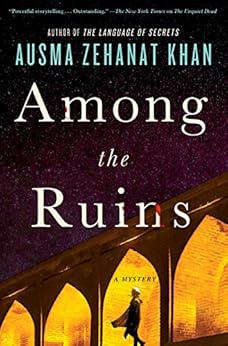
Review of AMONG THE RUINS by Ausma Zehanat Khan


3 Stars
This is the third book in the series featuring a Muslim Canadian police officer, Esa Khattak, and his partner, Rachel Getty.

Esa is vacationing in Iran when he is approached by a Canadian agent and a group of dissidents who ask him to look into the government-sanctioned torture and killing of an Iranian-Canadian filmmaker, Zahra Sobhani.  Among the questions he must ask is why she would have risked returning to Iran after making a film critical of Iran’s human rights record.  Esa quietly investigates in Iran while trying to avoid the attention of government handlers; Rachel and Nathan Clare, Esa’s best friend, follow up leads in Canada.

The plot is very convoluted and can sometimes be difficult to follow.  There are so many twists and turns in the investigation and so many unknowns that I was sometimes confused.  For example, cryptic messages/codes feature prominently.  Esa receives cryptic messages from an unknown writer; letters between a former minister of Iran and his activist friend could have played a role in Zahra’s capture; letters of the alphabet written on a sleeve become a crucial clue; encoded messages and drawings are written on the wall of a house; and diary entries or letters from a prisoner are interspersed throughout.  So much deciphering just gets annoying, and some of it just seems illogical.  The letters of the alphabet written on a sleeve are certainly a stretch!

What is also annoying is the many romantic tensions between characters.  Esa seems attracted to Rachel but he is also fascinated by Nasreen and finds himself thinking often about Sehr?  Rachel seems attracted to Esa but she is also interested in Nate?  Vicky and Touka are both attracted to Esa.  Nathan likes Rachel but then there’s an episode with Laine?

One of the things that the book does well is to reveal the contradictions in Iranian society.  The beauty of the mosques is contrasted with the ugly brutality of a repressive regime.  Some knowledge of Iranian history is certainly needed to understand the plot.  I knew of some of the events since I’m old enough to have lived during some of them:  the rule of Shah Reza Pahlavi, the 1979 revolution, the election of Ahmadinejad, the nuclear agreement with which President Trump disagrees.  It also became obvious to me that the murder of Zahra Sobhani was inspired by the real-life murder of Canadian-Iranian photojournalist Zahra Kazemi.  Fortunately, for those not familiar with Iranian history, there is a timeline of major political events provided at the beginning. 

The author’s sympathy for Iran certainly comes across.  At one point, she has Rachel make a telling observation:  “What must it be like to know your civilization possessed of such celestial beauty, and to find yourself the object of diminishment?”  Rachel had imagined Iran “as a place of violence and turmoil” but a visit to a mosque amazes her with its “sublimity” and “perfect cohesion of light” and “tranquility” and “dignity.”  “This amphitheater of joy” allows her to experience a “soaring elevation of spirit” and her impression of the country is changed:  “Her lens was correcting itself.”  Obviously, the author thinks that many people need to have their opinions of Iran re-adjusted. 

There is also the suggestion that many people have misconceptions about Muslims.  Esa behaves as he does because of the assumptions made about Muslims:  “Careful and measured consideration was the only way he knew to answer the assumption of Muslim rage.”  He feels he is not able to ever be totally at ease to express “the different sides of himself, the things that enriched him.”

Unfortunately, the book sometimes becomes bogged down.  There are long passages of exposition:  “There were an estimated one million Sunnis in Tehran alone who were not permitted to build schools or places of worship, or to disseminate their own religious teachings.  And though this treatment of non-Shia minorities was unjust, the fate of ethnic and religious minorities in many Sunni-majority countries was exponentially worse.  [Esa] had only to think of the violence against Shia processionals in Pakistan, or the increasingly disturbing attacks against Pakistan’s Christian and Hindu minorities.  The country’s Hazara population, who were largely Shia, suffered extensive persecution by the Taliban, that was typically met with indifference by the state.”  A discussion of religious repression in Pakistan is used to suggest that Iran’s mistreatment of its religious minorities is not that bad?  None of this has any bearing on the plot.

I would advise readers to read the first two books in the series (The Unquiet Dead and The Language of Secrets) if they have not done so.  The relationships between the characters are developed in these earlier books, and in Among the Ruins, there is repeated reference to the events of the second novel.  I did not find this novel as interesting as the previous two, but it provides wonderful insight into a culture foreign to many Canadians.

Tuesday, February 28, 2017

Yell Out Your Frustrations with Literary Quotations!

I’ve had some serious blog entries lately, so I thought I’d lighten things up a bit.  A while back Electric Literature had a list of “Literary Quotations That Sound Better When Yelled.”  See how many you can recognize:  https://electricliterature.com/literary-quotations-that-sound-better-when-yelled-781a75b4878b#.s8tpflxzi.

One of my favourites didn’t make the list.  “You blocks, you stones, you worse than senseless things” from Shakespeare’s Julius Caesar was a quotation I use when people make stupid comments or politicians make stupid decisions.