Ranked a Top Canadian Book Blog
Twitter: @DCYakabuski
Facebook: Doreen Yakabuski
Instagram: doreenyakabuski
Threads: doreenyakabuski
Substack: @doreenyakabuski
Bluesky: @dcyakabuski.bsky.social

Wednesday, September 13, 2017

2017 Man Booker Prize Shortlist

The shortlist for the prestigious Man Booker Prize was revealed earlier today.  There are six finalists on the list:

4321 by Paul Auster (US)

History of Wolves by Emily Fridlund (US)  - See my review at https://schatjesshelves.blogspot.ca/2017/08/review-of-history-of-wolves-by-emily.html.)

Exit West by Mohsin Hamid (UK-Pakistan)

Elmet by Fiona Mozley (UK)

Lincoln in the Bardo by George Saunders (US) – See my review at https://schatjesshelves.blogspot.ca/2017/08/review-of-lincoln-in-bardo-by-george.html.

Autumn by Ali Smith (UK)

The Man Booker Prize is considered one of the leading prizes for high-quality literary fiction written in English.  This is the fourth year that the prize has been open to writers of any nationality.  The winner, who will receive £50,000, will be announced on Tuesday, October 17, in London.

For more information about the announcement, go to http://themanbookerprize.com/news/man-booker-prize-announces-2017-shortlist. 

Tuesday, September 12, 2017

Review of LOST IN SEPTEMBER by Kathleen Winter (New Release)

4 Stars
I read and enjoyed Kathleen Winter’s debut novel, Annabel, so I was excited to read her second novel. 

In present-day Montreal, Jimmy, a young man who bears a striking resemblance to General James Wolfe, visits the city for 11 days.  General Wolfe died September 13, 1759, on the Plains of Abraham in a pivotal battle in Canadian history, but Jimmy seems to have Wolfe’s memories.  In 1752, Wolfe lost an 11-day leave in Paris because of the switch from the Julian to the Gregorian calendar; now Jimmy takes that leave in Montreal. 

The mystery, of course, is who Jimmy is.  Surely he can’t be who he claims to be, and there are hints and clues that suggest Jimmy is very much a contemporary man.   Wolfe fought battles at Culloden and Dettingen, but he wouldn’t have been in Ghundy Ghar which Jimmy mentions in the first few pages.  The best description of Jimmy is as a figure on a Tarot card:  “The man does not appear to know where to go or how to move beyond loss.”  At the beginning, Jimmy speaks of his “waiting for the crater that might jolt me properly into being in the present instead of floating in the past.”   It is difficult to believe that Jimmy is Wolfe, but it becomes clear that he is certainly a veteran damaged by his experiences in war; he describes himself as having “no shield against reliving war in Technicolor, all night, every day.”

Obviously, the book focuses on the futility of war.  If a soldier were able, in the future, to return to the battlefield on which he died, would he find that his sacrifice had been worthwhile?  Wolfe won Canada for England and had believed “there would grow a people here, out of our own little spot in England, to fill this space and become a vast Empire, the seat of power and learning,” but Jimmy, during a visit to Costco, concludes, “It is as if England has had a nightmare in which the Empire’s crowning achievement has been to inflate the size of material goods.”   Wolfe hoped “boys who became soldiers with me . . . I really thought the New World was supposed to give them a chance at a parcel of ground” but Jimmy finds only “the old, weary bondage” because “the poor toil here unexalted as ever.  As for the well-provided, their banal crowing echoes the clang of trussell on planchet under every New World moment: a relentless strike of metal into coin.”  Jimmy concludes that it is “ludicrous to call the land owned, conquered, taken by one small group of men who do not even plan to stay on it.”

The time and place of a war is unimportant:  “I have surveyed moor . . . desert . . . does the terrain’s name matter?  Land outspans army and king.  It outlives us, and will outbreathe us.  Does the year of any given campaign – Dettingen, Culloden, Quebec, Ghundy Ghar – do its dates mean a thing?  I dig up human bones everywhere – no matter where we fight a war, that land holds bones in it from previous warriors.”  And history has not had a paucity of battlefields:  “’There have been a lot of enemies in a few well-chosen hellholes.’”  The suggestion is that war and soldiers have always been with us and always will be:  “All warriors descend from a single, ancient Council of War forged at the dawn of manhood.”  It is easy to draw men into war:  “How little deception is needed when men believe so fervently in bits of bright cloth.”  And the result is always the same:  broken men. 

There is some commentary about contemporary life in la belle province.  Jimmy is aghast at how little English he encounters since Wolfe won the country for England in 1759.  In Quebec City, Jimmy sees the monument shared by Montcalm and Wolfe and makes a telling observation:  “It came to me then, that every monument, every object in the plains museum, every rose and bleeding heart nodding its head in the Joan of Arc garden bejewelling the Plains of Abraham, every citizen and every ship and bird and fish in and on the river, attest to the continued life in Quebec of the people of Wolfe and Montcalm, standing on the same ground but, like the names on the plinth overlooking the river, never seeing each other.”

I knew little about General James Wolfe other than what I was taught in high school Canadian history classes so many years ago.  It is obvious that Kathleen Winter did considerable research.  I advise readers to do some reading about the man before reading the book; even the Wikipedia article would be helpful in explaining some of the references.  Look at Benjamin West’s painting entitled “The Death of General Wolfe” (https://www.google.com/culturalinstitute/beta/asset/-/MQGJPSKUj9ySHg?hl=en) to appreciate Jimmy’s comment:  “a literary person called Margaret Atwood claimed West made me appear like a dead, white codfish, and I had to agree.”

At first I struggled with the book.  It is sometimes difficult to know what is real and what isn’t.  Jimmy is the narrator and his thoughts wander so a reader may find him/herself confused at times.  After finishing the novel, I went back to the beginning and did a quick second reading.  This book is the type that needs a re-reading to highlight Winter’s accomplishment.  Images and symbols clarify themselves.   The book is not perfect because it does drag at times and some of the events are predictable, but it has much to recommend it:  the protagonist, the setting, and the themes are all well-developed. 

Note:  I received an eARC of this book from the publisher via NetGalley.

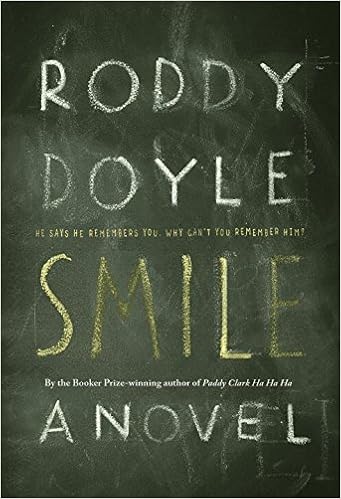
Review of SMILE by Roddy Doyle (New Release)

4 Stars
This is a very difficult book to review without ruining it for others, but I will try my best.

Victor Forde is a middle-aged, recently divorced man who has returned to the neighbourhood of Dublin where he grew up.  He starts going to a nearby pub where he encounters a man named Eddie Fitzpatrick.  Though Victor has no clear memory of him, Eddie remembers Victor from secondary school; in fact, it is surprising how much Eddie knows about Victor:  “He’d know – he knew – more than I’d want known.  He’d know facts and lies.”   

Victor has an ambiguous relationship with Eddie.  He admits, “I didn’t like him.  I really didn’t like him.  He made me nervous.  And he bored me.  I hated it when he stood too close, or when he sat back, right in front of me, and scratched his crotch or walloped his stomach.  And I couldn’t remember him.  He’d been in school with me; I didn’t doubt that.”  One of the reasons he dislikes Eddie is that he stirs up memories of his difficult high school years.  Nonetheless, Victor continues to return to the pub:  “The point was, I knew we’d be meeting again and I’d done nothing to avoid it.”

Victor also reminisces about his life after graduation, especially his meeting Rachel Carey who became his wife.  A very beautiful woman, she became a celebrity as a television chef while Victor gained some notoriety as a provocateur on radio talk shows.  For many years he has been writing a book about “the rot that was at the heart of Ireland.”

There is a great deal of mystery throughout the novel.  One of the major questions is why Victor keeps going back to the pub knowing that Eddie may very well be there.  There is an aura of menace around Eddie; his is a threatening presence so is it their shared experiences, like both having lost their fathers at a young age, that are the draw?  Others at the bar even mistake them for brothers or cousins.  Victor tries to explain the attraction (“But there was something about him – an expression, a rhythm – that I recognised and welcomed”), but it isn’t convincing.  Why is it that Eddie remembers so much about Victor but Victor’s memories are much less clear?  Why does Eddie wear the same clothes every time he comes to the pub?

There are other unanswered questions as well.  Victor’s attraction to Rachel is understandable, but the reader, like one of Victor’s acquaintances, wonders “What did she see in you?”  It is easy to see that Rachel was good for Victor; he says, “She saved me and, later, she carried me.  Her assertiveness . . . her willingness to cry, the way she took sex, took and gave – I can see now that it saved me.  It stunned me and made me.”  The reason for the marriage break-up is also not clarified; the only indication of a problem is Victor’s wanting to hear his wife explain about her day:  “I’ll listen this time.”  And then there’s a son who is mentioned only occasionally?

The characterization of Victor is wonderful.  He is not a likeable person at the beginning.  He admits that he was envious of others; as a young man, he wrote music reviews and ruined careers with his scathing reviews:  “I didn’t hate [the bands].  I envied them, and that was far worse.  They could do it, and I couldn’t.  It was the start of my career, and I tore into them.”  He admits that “I was being a prick, but it gave me power.”  He also describes himself as being rigid:  “I was inflexible – still am.  I loosened a bit, for [Rachel], but it was always a fight.  My place was mine; hers was hers.  I like order.”   And he acknowledges, “I was just angry – and vain.”  But slowly Victor gets the reader’s sympathy as we learn about his life in school.  He describes himself as a bit of a misfit as a teenager so I found myself wishing that as an adult he would get what he wanted from his evenings at the local pub:  “companionship, the ease of it, the acceptance.”

And then there’s the ending!   It forces the reader to reconsider everything he/she has just read.  Some may think the ending is too shocking and unforeshadowed, but that is not true.  I couldn’t resist re-reading the book and found numerous clues I had missed on first reading.  Some clues are obvious but others are exceedingly subtle.  A second reading is really necessary to fully appreciate Doyle’s accomplishment.  The ending is discomfiting but crucial in developing the novel’s theme. 

Those who enjoy Doyle’s style – the quick dialogue, the humour, the sense of place – will not be disappointed.  I had not read anything by Doyle since Paddy Clarke Ha Ha Ha, but I’m ever so glad I read this book.  I definitely recommend it.

Note:  I received an eARC of the book from the publisher via NetGalley.
Monday, September 11, 2017

One Book for Each American State

My husband and I are planning a short trip into the U.S.  We will be concentrating on the northeastern part of the country and visiting either New Hampshire, Vermont, or New York.  Researching for the trip reminded me of an article I read last month.

Travel and Leisure “selected the best books based in every state by looking for titles that almost use their state as another character. The setting is so deeply entwined with these texts, the story couldn't even exist in another place or time.”  Alabama gets To Kill a Mockingbird; Georgia, Gone with the Wind; Oklahoma, The Grapes of Wrath; Washington, Snow Falling on Cedars; and Missouri, The Adventures of Huckleberry Finn. 

If we decide to visit New Hampshire, I need to read Frindle by Andrew Clements; if, Vermont, All the Best People by Sonja Yoerg; and if, New York, A Tree Grows in Brooklyn by Betty Smith.  I have a problem with the last option since we will visit the state, not the city of New York.

Sunday, September 10, 2017

2017 Kirkus Prize Longlist

The Kirkus Prize is a $50,000 prize sponsored by Kirkus Reviews.  Finalists are chosen from books that earned a Kirkus Star which is given to books of “exceptional merit.”  I do not find the reviews in the magazine to be especially thorough or insightful, tending more towards plot summary than literary analysis.  Books that earned the Kirkus Star with publication dates between Sept. 1, 2016 to Aug. 31, 2017 are automatically nominated for the 2017 Kirkus Prize.  See the fiction list at https://www.kirkusreviews.com/prize/nominees/fiction/.

The list is extensive; there are 423 titles on the list.  A shortlist of six should be released sometime in the near future.  The winner will be announced on Nov. 2, 2017.

Here are my reviews of the books which I have read on the longlist:


Saturday, September 9, 2017

Trumpian Satire Courtesy of The New Yorker

I know I’ve mentioned previously that I have a subscription to The New Yorker.  I read the print edition though I also check out the digital version almost daily.  The humour section is great for providing a few chuckles in a world where the news is relentlessly depressing.

The Borowitz Report by Andy Borowitz is a must-read; his satire targeting Trump never disappoints. Where else can you find pieces like “Eight Hundred Thousand People with Dreams to Be Deported by One with Delusions” and “Obama Cruelly Taunted Trump in Letter Riddled with Multisyllabic Words” and “Trump’s Horrific Spelling Reassures Nation That He Cannot Correctly Enter Nuclear Codes” and “Trump Says Sun Equally to Blame for Blocking Moon” and “Ivanka and Jared Vacationing in Moral Vacuum”. 

The most recent issue (Sept. 11) has another wonderful piece entitled “Jared Kushner’s Harvard Admissions Essay” written by Megan Amram:  https://www.newyorker.com/magazine/2017/09/11/jared-kushners-harvard-admissions-essay.   This ranks up there with one of my other favourites which I linked on my blog last March:  “Kellyanne Conway Spins Great Works of Literature” by Bob Vulfov: https://schatjesshelves.blogspot.ca/2017/03/kellyanne-conway-literary-critic.html .

The New Yorker is one of Trump’s fake news outlets.  What better recommendation for taking out a subscription?!

Friday, September 8, 2017

International Literacy Day: Review of MURDER BELOW ZERO by John Lawrence Reynolds (New Release)

Today, September 8, is the United Nations’ International Literacy Day; its purpose is “to raise people's awareness of and concern for literacy issues in the world.”

“Whether it’s reading or writing, literacy is an outlet to an untouchable world – your imagination. Not only is literacy a basic human right, it is a fundamental building block for learning as well as a personal empowerment tool. It is the catalyst for social and global progress” (http://internationalliteracyday.org/).  To celebrate the day, I read a novella, one of a series of books called Rapid Reads published by Orca Book Publishers. 

On the publisher’s website, the purpose of these novellas is explained:  “Author Ian McEwan once wrote that ‘the novella is the perfect form of prose fiction.’  In our increasingly fast-paced world we believe there is a need for well-written, well-told books that can be read in one sitting. Rapid Reads are short books for adult readers. They are intended for a diverse audience, including ESL students, reluctant readers, adults who struggle with literacy and anyone who wants a high-interest quick read” (http://orcabook.com/rapid-reads.com/). 

Review of Murder Below Zero by John Lawrence Reynolds 
3 Stars


A man’s body is found in a ditch in a small town in Ontario’s Muskoka region.  The police chief, Maxine Benson, sets out to find the murderer though a detective with the Ontario Provincial Police tells her, “‘So don’t try to play detective, okay?  You’ll just get in the way’” (12).  Max feels she is being dismissed because she’s a female, small-town cop, and she wants to prove that she is quite capable of solving the case.

The identity of the killer is fairly obvious because of the number of clues.  A few more red herrings might have been useful because the case is solved in a very straightforward manner.  Much of the interest in the novel lies in seeing how Max can prove that the main suspect is guilty, especially when the OPP are not co-operative.  Of course, I understand that Rapid Reads books are intended to be short books which can be read in one sitting. 

The characterization of Max is strong.  She is an intelligent, determined officer who stands up for herself.  She doesn’t mind not following all the rules when they don’t serve her purpose.  For example, she feels that the OPP are not sharing information with her so she isn’t always forthcoming with her information; she is reminded “‘to share data with the OPP’” (53) and “‘to send some stuff to Boucher’” (86).

Constable Ronald Boucher, however, is rather one-dimensional.  Repeatedly he is described as having a “cold manner” (18) and “a cold smile” (11).  His temperament matches the unusually cold June weather.  His treatment of Max is so condescending, though his behaviour does have the reader hoping that Max can best him. 

According to the publisher’s website, Rapid Reads books, like this one, “are short books for adult readers.  They are intended for a diverse audience, including ESL students, reluctant readers, adults who struggle with literacy” (http://orcabook.com/rapid-reads.com/about.html).  For this audience, this is a great book.  It has adult topics, providing interesting reading for adults wanting to improve their literacy skills.

This is the second book in the series.  The first is A Murder for Max.  I imagine there will be at least a third book.  Will there be more confrontations between Max and Boucher?

Note:  I received an ARC of this book from the publisher via LibraryThing.