Ranked a Top Canadian Book Blog
Twitter: @DCYakabuski
Facebook: Doreen Yakabuski
Instagram: doreenyakabuski
Threads: doreenyakabuski
Substack: @doreenyakabuski
Bluesky: @dcyakabuski.bsky.social

Tuesday, February 21, 2017

Dystopian Literature


Since the election of Donald Trump as U.S. President, the popularity of dystopian literature has risen dramatically.  For example, sales of 1984 and The Handmaid’s Tale have soared.  It seems readers are searching for stories that describe what’s currently happening and what has the possibility of happening due to recent events.

Various publications have prepared lists of dystopian books and I thought I’d recommend a couple of sites:

The Savvy Reader includes both Orwell and Atwood and also mentions Station Eleven by Emily St. John Mandel which I reviewed (http://schatjesshelves.blogspot.ca/2016/01/review-of-station-eleven-by-emily-st.html).

Refinery29 also suggests Orwell, Atwood and St. John Mandel.

Wikipedia lists dystopian novels chronologically.  

https://www.theguardian.com/books/2017/feb/03/americanism-us-writers-imagine-fascist-future-fiction
The Guardian listed books about American authoritarianism. 

Over the years, I have read and taught a number of dystopian novels.  Here are a dozen authors I recommend:
The Handmaid's Tale and the MaddAddam Trilogy (Oryx and Crake, The Year of the Flood, and MaddAddam) by Margaret Atwood
Fahrenheit 451 by Ray Bradbury
La Planète des Singes by Pierre Boulle
The Hunger Games Trilogy (The Hunger Games, Catching Fire, and Mockingjay) by Suzanne Collins
Brave New World by Aldous Huxley
The Children of Men by P. D. James
It Can't Happen Here by Sinclair Lewis
The Road by Cormac McCarthy
Animal Farm and Nineteen Eighty-Four by George Orwell
Station Eleven by Emily St. John Mandel
Zazen by Vanessa Veselka
The Chrysalids by John Wyndham

If you don’t have the time to read a book, how about a short story?  "By the Waters of Babylon" is a post-apocalyptic short story by Stephen Vincent Benét.  You can read it here:  https://www.gutenberg.ca/ebooks/benetsv-thirteen01-watersofbabylon/benetsv-thirteen01-watersofbabylon-00-h-dir/benetsv-thirteen01-watersofbabylon-00-h.html.

Monday, February 20, 2017

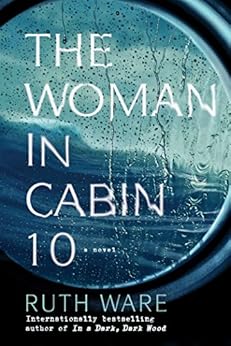
Review of THE WOMAN IN CABIN 10 by Ruth Ware


2.5 Stars
This is a locked-room mystery à la Agatha Christie (e.g. Murder on the Orient Express, And Then There Were None).

Lo Blacklock, a travel journalist, is given a dream assignment aboard a luxury cruise ship.  She thinks she hears a body being thrown overboard from the cabin next door to hers, but there is no evidence of an occupant in that cabin, though she encountered a woman there earlier.  Her reliability as a witness is called into question for a number of reasons so Lo investigates on her own.

I found the book was heavy-handed in a number of ways.  First of all, Lo’s unreliability as a witness is emphasized so much:  she is suffering trauma after a recent home burglary, she suffers from anxiety attacks, she is sleep deprived, and she drinks excessively.  Her heart is always thumping (12 references), or pounding (7 references) or beating hard/fast (9 references).  She vomits three times.  And she never speaks in her own voice:  “I wanted it to sound like a command, but it came out like a plea” and “I tried for a laugh, but it came out sounding fake and shaky” and “It came out harsher and louder than I meant” and “It came out like the growl of an animal – not quite human” and “I didn’t mean it to sound the way it came out” and “My voice came out cracked and hoarse” and “I didn’t mean to sound quite so curt” and “I said at last, in a voice that didn’t seem to be mine” and “my voice low and hard and totally unlike my own” and “there was a note in my voice that sounded like a whining little child”!  At least three times, she screams and doesn’t recognize that she is the one doing it!

Lo is irritating, rude, and shallow.  For instance, she makes observations like, “There was a little knot in the far corner who looked like they could survive for several weeks off their fat reserves, if we were ever shipwrecked” and describes people as “sleek and rotund as a walrus” or “whippet-thin and wearing jewelery weighing more than she did”.  At least a dozen times she refers to doing something stupid and even makes comments like “I groaned, at my own stupidity . . . ” and “groaning with my own stupidity”  and “Stupid, stupid Lo” and “Stupid, stupid, stupid” and “I should have thought of that” and “How could I not have thought of it?” – comments with which the reader can only agree. 

There are some other things that had me shaking my head in disbelief.  An adult would pack her copy of Winnie-the-Pooh every time she travels:  Pooh has always been my comfort read, my go-to book in times of stress”?  A journalist reads so little that a children’s book is the only one that gives her comfort? 

The book supposedly has “surprising twists” but I found none.  The ending is certainly not a shock and in some ways lacks logic.  The murderer at the end takes some actions that match Lo’s in terms of stupidity.

I read the author’s In a Dark, Dark Wood and was disappointed.  I wish I hadn’t given her a second chance. 

Sunday, February 19, 2017

R.I.P. Stuart McLean - Canada's Storyteller

Today is Sunday, and for years and years, I spent an hour each Sunday listening to Stuart McLean’s The Vinyl Café on CBC Radio.

Many of the stories from the radio show were compiled in books:  
Stories from the Vinyl Cafe (1995)
Home from the Vinyl Cafe (1998)
Vinyl Cafe Unplugged (2001)
Vinyl Cafe Diaries (2003)
Secrets from the Vinyl Cafe (2006)
Extreme Vinyl Café (2009)
The Vinyl Cafe Notebooks (2010)
Revenge of the Vinyl Cafe (2012)
Time Now For The Vinyl Cafe Story Exchange (2013)
Vinyl Cafe Turns the Page (2015)

He received the Stephen Leacock Memorial Medal for three times and was named an Officer of the Order of Canada for his contributions to Canadian culture as a storyteller and broadcaster, as well as for his many charitable activities.  I’ve mentioned more than once how the reading of Stuart’s story “Dave Cooks the Turkey” is a Christmas tradition in my home. 

As I’m sure all Canadians know, Stuart McLean died earlier this week.  There will be a hole in my weekly listening to CBC.  Thankfully, many of the stories are available in both print and audio form so it is possible to read the stories only Stuart could write and listen to them as only he could read them.  I know I will be revisiting Dave and Morley and their family and friends for years to come.

R.I.P. Stuart McLean 
An entire country thanks you.

Saturday, February 18, 2017

Another Literary Destination: the World's Oldest Library


For your next vacation, why not visit the oldest library in the world?

The al-Qarawiyyin Library in Fez, in northeastern Morocco, was founded in the year 859.  Until recently, it was reserved for academics and theologians, but following an extensive renovation, the library opened its doors to the public this past summer. 

The al-Qarawiyyin library was founded by a woman.  Fatima al-Fihri, the daughter of a wealthy merchant from Tunisia, arrived in Fez in the ninth century and began laying the groundwork for a complex that included the library.  Inside were kept many prized tomes, works of such immense import that the iron door leading to the library had four locks; each of the four locks had separate keys held by four different individuals, all of whom had to be present for the door to be opened.  The library now houses 4,000 rare texts and ancient manuscripts; among its most valuable texts is a ninth-century copy of the Qur’an written in ornate Kufic script on camel skin.

The library had several small additions and renovations over its millennium-long existence, but it has now been totally restored by a Canadian-Moroccan architect, Aziza Chaouni. 


Friday, February 17, 2017

Now That's an Overdue Book!


A short story collection, ironically titled Forty Minutes Late, was recently returned to a San Francisco library.  The book, published in 1909, had been checked out by Phoebe Webb in 1917.

Webb died one week before the book was due.  Webb Johnson, the borrower’s great-grandson, discovered the overdue book in 1996 but hung onto it.  Johnson knew the book was not legitimately part of his relative’s estate and, eventually, his conscience persuaded him to return the book.

At the 2017 rate of 10 cents a day, the overdue fine would have come to $3,650 (US), but under the library’s current amnesty program for overdue books, there was no fine at all.

The book was written by F. Hopkinson Smith who is best remembered as the engineer who built the foundation for the Statue of Liberty.  The first story in the collection is about a cranky man who nearly misses a speaking engagement because of a late train. The author, in the story, suggests there are worst sins than being late, such as being cranky. 

Thursday, February 16, 2017

Read Actively by Questioning What you Read

Towards the end of my career as a teacher –librarian, I kept hearing that librarians would no longer be needed when the internet, not books, became the main source of student research.  Of course, my colleagues and I pointed out that students had to be taught information-literacy skills:  how to determine if a source was reliable and how to evaluate the information they found.

I taught students to ask questions when reading an article:
Is the source of the article reliable or deceptive?
Does the evidence provided to support claims include verifiable facts? 
Are any logical fallacies used (eg. ad hominem, evading the issue, faulty generalization)?
Is the author an expert on the topic and possess some credibility?
Does the writer try to show both sides or does he/she have a bias?

Obviously, those who argued that librarians were going to be obsolete were wrong.  Today, in the era of fake news, the critical-thinking skills that are part of information literacy are more important than ever as students need to differentiate between lies/distortions and truth.

Of course, it’s not just students who need these skills; everyone needs them in daily life as we navigate online data.  There’s a useful website, people can try: http://www.allsides.com/.   This website rates the bias of news stories and other articles, labelling them according to where they fit on a political spectrum from left to center to right.  It posts multiple versions of major stories and their positions on the spectrum.  It is even possible to do a search for stories on topics or issues.  This is an American site so the focus is on stories about the U.S., but I searched for stories on Canadian topics and had success, though the stories were not ranked on the political spectrum. 

So read – but read with an active, questioning mind.

Wednesday, February 15, 2017

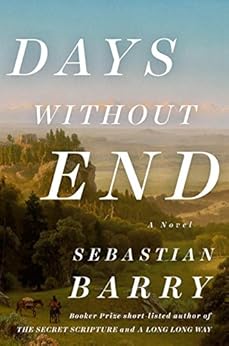
Review of DAYS WITHOUT END by Sebastian Barry


4 Stars 
This novel won its author an unprecedented second Costa Book of the Year award.  I certainly understand why.

The narrator, Thomas McNulty, recalls the days of his youth when “Time was not something then we thought of as an item that possessed an ending, but something that would go on forever . . . the days without end of my life.”  After losing his family in Ireland because of the potato famine, he makes his way to America where he meets John Cole.  The two of them, “wood-shavings in a rough world,” make their way together in that world by being saloon entertainers before joining the U.S. cavalry to fight Indians and then joining the Union Army to fight Confederate rebels. 

The book examines a number of issues, including friendship, love, and family.  Thomas has lost his family in Ireland and becomes one of what he calls, “Nothing people”:  “We were a plague.  We were only rats of people.”  When he meets John, Thomas changes:  “First time I felt a human person again.” Thomas declares, “John Cole was my first friend in America and so in the army too and the last friend for that matter” and soon “John Cole was my love, all my love.”  Together they persevere through life’s travails and as a couple adopt a young Sioux girl whom they name Winona.  The three of them form a “Holy Family” which Thomas will do anything to protect.  It is this love and this family that give Thomas hope and sustain him. 

A major theme of the book is the paradox of the world.  Almost everyone and everything possesses contrasting dualities.  There is always a “sense of two worlds rubbing up.”  At the beginning, Thomas describes the Irish:  “He may be an angel in the clothes of a devil or a devil in the clothes of an angel but either way you’re talking to two when you talk to one Irishman.  He can’t help you enough and he can’t double-cross you deep enough ever either.  An Irish trooper is the bravest man in the field and the most cowardly.  I don’t know what it is.  I seen killer Irishmen and gentle souls but they’re both the same . . . I was never no different neither.”  And it is not just the Irish.  The Indians fight savagely but leave food for starving soldiers.  A major in the cavalry strives for compromise with the Indians yet also leads a vicious assault on an Indian village.  That major has twin daughters:  “Hephzibah was the black-haired girl and the fair one was Angel.”   Winona is a Sioux but after living with whites, Thomas asks, “What is she now?  Plucked all two ways . . . ”  As teenagers, John and Thomas perform in drag for miners who are described as liking “rough food, rough whisky, rough nights” but they are also “gentlemen of the frontier” who when dancing with the boys “were that pleasing d’Artagnan in the old romances.”  Army life is full of brutality yet Thomas says “army was a good life”; it was bloody but full of camaraderie. 

Even nature is full of contradictions:  “The old Mississippi is a temperate girl most times and her skin is soft and even.  Something so old is perpetual young.”  And even the beauty of nature has threat in it:  “Vines climb into the halted trees and frost wraps round their limbs till you think the woods be full of icy snakes.”  He describes seeing a country “whose beauty penetrates our bones.  I say beauty and I mean beauty,” but then follows up with, “Oftentimes in American you could go stark mad from the ugliness of things.”

Of course Thomas is the best example of duality.  He is a man who dresses as a woman:  “I am easy as a woman, taut as a man.  All my limbs is broke as a man, and fixed good as a woman.  I lie down with the soul of woman and wake with the same.  I don’t foresee no time where this ain’t true no more.  Maybe I was born a man and growing into a woman.”  Thomas explores gender fluidity; he is fascinated when in an Indian encampment he “spied out the wondrous kind called by the Indians winkte or by white men berdache, braves dressed in the finery of squaws. . . . The berdache puts on men’s garb when he goes to war, this I know.  Then war over it’s back to the bright dress.” 

Considering all that the men experience, it is not surprising that Thomas thinks, “No such item as a virtuous people.”  He argues, “They say we are creatures raised by God above the animals but any man that has lived knows that’s damned lies.”  When he sees freed blacks working and not looking like slaves, he is happy, concluding “this looks like to be better,” but then he adds, “We ain’t lingering to find out the weevils and the bad worms in these new visions.”  Nonetheless, “Every life has its days of happiness despite the ugly Fates.” Though it may seem “Life wants you to go down and suffer” and “The world don’t care much, it just don’t mind much,” sometimes it is possible to “rob from injustice a shard of love.”  And “All that stint of daily life we sometimes spit on like it was something waste.  But it all there is and in it is enough.  I do believe so.”

The language is very poetic and that sometimes strains the reader’s credulity.  Would a man such as Thomas be capable of such wonderful turns of phrase?  After one particularly brutal attack on Indians, Thomas muses about the settlers who are invading Indian lands:  “This was the section of humanity favoured in that place, the Indians had no place no more there.  Their tickets of passage were rescinded and the bailiffs of God had took back the paper for their souls.  I did feel a seeping tincture of sadness for them.  I did feel some strange toiling seeping sadness for them.”  The combination of poetry and ungrammatical expressions is sometimes jarring, but that duality is undoubtedly intentional. 

I can see the book being made into a sweeping, epic movie.  It has ferocious battles, plot twists, hairbreadth escapes, and tests of endurance against heat, cold, and starvation.  There are several instances where suspense is ratcheted up to an extreme.  And there’s a story about friendship, loyalty, and love. 

Readers should be forewarned that some suspension of disbelief is required.  For example, there’s a marriage that is totally anachronistic, and the fortuitous arrival of a former comrade-in-arms in the midst of a gunfight is just too coincidental.  They should also be warned that the violence is graphic; battles and suffering are described with realistic brutality. 

I loved The Secret Scripture, the other novel that won Sebastian Barry the Costa Book of the Year award.  This one is as deserving.