Ranked a Top Canadian Book Blog
Twitter: @DCYakabuski
Facebook: Doreen Yakabuski
Instagram: doreenyakabuski
Threads: doreenyakabuski
Substack: @doreenyakabuski
Bluesky: @dcyakabuski.bsky.social

Tuesday, December 11, 2018

Review of MIDWINTER BREAK by Bernard MacLaverty

4 Stars
This quiet, reflective novel is a portrait of an ageing couple who have been married “for a protracted period.”  Gerry and Stella Gilmore travel to Amsterdam for a few days.  Gerry sees the trip as a holiday, but Stella has another agenda:  she wants to explore how “to live a more devout life,” a life which may not include Gerry whose excessive drinking troubles her.  They have many shared experiences and obviously love each other, but there are fissures in their relationship which may mean they will not be able to continue living as a couple. 

This is a tender, sympathetic examination of that relationship and the complexity of love.  Gerry and Stella love each other.  They hold hands, kiss whenever they’re alone in an elevator, and make love regularly.  Their familiar bantering suggests they enjoy each other’s company.  They even have the same mannerisms:  “Gerry joined his hands behind his back as he walked” while “Stella stood almost on tiptoe with her hands joined behind her back.”  Stella does things to make life easier for Gerry and he is attentive to her:  “her hand-eye co-ordination was a lot poorer than his, so generally he travelled behind her [on an escalator] in case she stumbled.  If they were descending he would go in front.”  Gerry’s extended interior monologue about what he knows Stella knows reads like a love poem, and the closing lines of the book may inspire tears. 

Nonetheless, there are problems.  Just as “nobody could peer into a relationship – even for a day or two – and come away with the truth,” Gerry looks at Stella and sees her “Like someone he did not fully know.”  This image is repeated:  “Seeing her as if he didn’t know her well” and “He was seeing her as someone he didn’t fully know.”  And Stella does not always help Gerry understand her; when he asks about a conversation she had with someone, she replies that it “’would be of little interest to you.’”  When she feels Gerry is dismissive of her views, she gets up and leaves, thereby dismissing his opinion. 

Gerry and Stella’s shared history includes a traumatic experience in Northern Ireland during The Troubles; that incident, which they do not directly discuss, affected them deeply.  They cope in different ways but their lack of communication means there are unresolved issues and a lack of understanding.   Gerry’s drinking is also driving a wedge between them; Gerry describes their “skidding off each other” and their becoming “ships that pass in the night.”   

The husband and wife are quite different in some ways.  Stella is very religious; she prays daily, attends Mass every Sunday, and is a Eucharistic minister in her parish.  In fact, “Her church was her everything” and she tells Gerry, “’Mass is the most precious thing in my life.’”  Gerry, however, is a non-believer who thinks religion is “’the greatest deception of our lives’” and often mocks Stella’s piety.  His devotion lies elsewhere:  “A poured, but as yet untouched, pint of Guinness has a slight dome to it which reminded him of the faint curvature of the outer wall of Burt Chapel.” 

This is not a plot-driven book.  There are no dramatic incidents except one event described in flashbacks.  It is very much a novel of character. Both are realistic characters with positive and negative qualities.  Gerry, for example, is not a caricature of a drunk, and Stella, though focused on living a good life, is not perfect.  Since the perspectives of both are given, the reader gets to know them better than they know each other. 

This understated novel about ordinary people with everyday frustrations is definitely worth a read.  It is relatively short, but with its careful attention to detail, it packs an emotional punch.

Friday, December 7, 2018

Review of BRIDGE OF CLAY by Markus Zusak

4 Stars
This is Zusak’s first novel after his almost-universally-loved The Book Thief.  Bridge of Clay is not in the same league but this story of love, grief and forgiveness is worth reading nonetheless.

The five Dunbar brothers (Matthew, Rory, Henry, Clay and Tommy), “a family of ramshackle tragedy” (8), live in a suburb of Sydney, Australia.  There are no adults in the home but there is a menagerie, “a small roster of dysfunctional pets” (15) which includes Achilles, a mule; Hector, a cat; Agamemnon, a goldfish; and Telemachus, a pigeon.  One day, the boys’ father, who abandoned them after the death of their mother, visits and asks his sons to help him build a bridge across a river near his home.  The boys refer to their father only as “the Murderer”, so Clay’s decision to join him is seen as a betrayal.  What follows is the story of Clay’s helping build a physical bridge while also trying to reconnect a fragmented family:  “The bridge will be made of [Clay]” (180).

Matthew, the eldest, is the narrator, but he focuses on the fourth brother, Clay:  “Everything happened to him.  We were all of us changed through him” (9).  Clay is the quiet, enigmatic brother who serves as the family historian; as a child he always asked his parents for stories about their pasts.  Clay is also fascinated with Michelangelo and with Carey Novac, a neighbourhood girl focused on becoming a jockey.  For a reason not divulged until the end, Clay carries a clothes peg with him.  It is repeatedly mentioned that he has great heart:  “’He’s got a heart like Goddamn Phar Lap’” (473). 

At first, the book is a challenging read.  A large cast of characters is introduced and it is initially difficult to keep track of who is who.  Gradually, distinct personalities emerge.  Each of the Dunbar boys has one specific trait that differentiates him.  For example, Rory is the one always looking for a fight while Henry is the one always looking for a way to make money.  The narrative moves back and forth to different times and places.  There is a linear plot in the present but it is chopped up with flashbacks to past events in the lives of various people, especially those of the boys’ parents and grandparents.  Like the blocks used to complete a bridge, these flashbacks gradually provide a complete picture by explaining the reasons for people’s behaviours, behaviours which at the beginning are indeed perplexing.

Matthew’s description of his family illustrates the style used throughout the novel:
                “Us Dunbar boys
                From oldest to youngest:
                Me, Rory, Henry, Clayton, Thomas.
                We would never be the same.
                To be fair, though, neither would he – and to give you at least a small taste of what the                 Murderer was entering into, I should tell you what we were like:
                Many considered us tearaways.
                Barbarians.
                Mostly they were right:
                Our mother was dead.
                Our father had fled.
                We swore like bastards, fought like contenders, and punished each other at pool, at table tennis (always on third- or fourth-hand tables, and often set up on the lumpy grass of the backyard), at Monopoly, darts, football, cards, at everything we could get our hands on.
                We had a piano no one played.
                Our TV was serving a life sentence.
                The couch was in for twenty” (14-15).
Anyone not liking this style should perhaps pass on the book because it has 500+ pages.

Chapters often end with teasers like “In those lives before they had us, there were still two chapters left” (213) and “It was all in what was to come” (285) and “We loved what you did next” (114) and “it was strange to think,  but he’d marry that girl one day” (143).  This heavy-handed foreshadowing becomes annoying after a while, especially because revelations are meted out slowly, in dribs and drabs. 

Like in The Book Thief, death shows up as a character:  “She’d go straight back to work, of course, though death was at her shoulder.  No more hanging from the power lines for that old guy.  Or draping round the fridge.  But he was always out there somewhere:  On a train or a bus, or footpath.  On the way back home to here” (478) and “There was no point closing the curtains, or locking any of the doors.  It was in there, out there, waiting.  It lived on our front porch” (479). 

The bridge is a metaphor for reconnecting a fractured family.  Clay builds both a physical bridge across a river and a metaphorical bridge between his father and his brothers.  In many ways, reading this book is like building a bridge: it is a task requiring work and patience, but the effort is worthwhile. 

Monday, December 3, 2018

Review of FRENCH EXIT by Patrick deWitt

2.5 Stars
A minor character in this novel states, “’I feel uneasy when things don’t make sense.’”  That could be one description of how I felt when I finished reading.  I definitely wondered, What did I just read?  What was that all about?

Frances Price is a 65-year-old socialite living in New York; she is the widow of Franklin Price who had a reputation “as the most vicious, the most tenacious litigator, defending only the indefensible” and taking “one repugnant case after another.”   Living with Frances is her 32-year-old son Malcolm, a man-child who is aptly described by his fiancée as “this lugubrious toddler of a man.”  On the brink of insolvency because of her extravagant lifestyle, Frances, Malcolm and their cat Small Frank leave for Paris with what little is left of the family money.  Once in Paris, they attract a number of eccentric and rather pathetic followers while Frances devotes her time to spending her remaining money, even “flushing hundreds [of euros] down the toilet each morning.”  The ending will be no surprise to anyone who knows the meaning of the title. 

Frances is an unlikeable but interesting character.  She is both respected and feared by high society.  Her handling of her husband’s death, going skiing after finding his body, caused considerable scandal.  Though she had totally neglected Malcolm for years, once her husband died, she removed her son from his boarding school; now she can hardly bear to have him out of her sight.  The feelings of others are not her concern so she most enjoys gatherings replete with “implied insults and needling insinuations.”  She mellows towards the end of the novel, but after a lifetime of disregard for others, her maintaining her air of superiority would be more convincing.  

Malcolm is like his mother.  He drinks to excess, steals items from party hosts, and has never worked in his life.  Even his fiancée considers him “a pile of American garbage.”  What he also shares with his mother is a lack of love when young; Frances describes how her mother never spoke to her, refusing to even acknowledge her presence, so it’s not surprising she describes her mother as “’a demon.  And if such a place as hell exists then that’s where she collects her mail.’” Frances’ behaviour as an adult is perhaps the result of arrested emotional development.  Certainly, Malcolm, neglected as he was for over a decade, has an “inability to experience emotion.”  

The novel is labelled “a tragedy of manners” which suggests a combination of two genres:  tragedy and comedy of manners.  It has more elements of the latter than the former.  It certainly has the witty dialogue and social commentary; the repartee between characters includes many clever lines and the book does satirize the conspicuous consumption of the world’s 1 percent.  The tragedy is perhaps the plight of the placeless immigrants who serve as entertainment for the wealthy who, both literally and figuratively, look down on them.  

I preferred the first part of the book while Frances and Malcolm are still in Manhattan.  Once they arrive in Paris, the events become more farcical.  The deliberate absurdity of farces has never appealed to me.  Finding a “hefty, flesh-colored, frost-coated dildo” in a freezer strikes me as just too much bizarreness.  

This is perhaps a book which should just be enjoyed and not scrutinized too seriously.  Unfortunately, there was just too much ridiculousness and oddity for my tastes so I didn’t enjoy it.  I didn’t like The Sisters Brothers, but I thought I’d give the author another try.  Now I’m concluding I’m not the audience for Patrick deWitt. 

Thursday, November 29, 2018

Review of CODE BLUES by Melissa Yi

2 Stars
This is the first in the Hope Sze series; I’m afraid that this first does not instill in me any desire to read more of the series.

Dr. Hope Sze arrives for her first year of residency at St. Joseph’s Hospital in Montreal.  The day after she arrives, when she is working her first shift, the body of Dr. Kurt Radshaw, a dedicated and respected physician, is discovered.  Since his death is suspicious, Hope immediately sets out to find the killer.  

My first issue with the book is Hope’s motivation for wanting to find the murderer.  She has just begun working at the hospital and meets Dr. Radshaw once; nonetheless, she appoints herself the lead investigator?  She states, “But something in me wasn’t content to sit around and wait for the [autopsy] report.  The more I found out about Dr. Radshaw, the more I wanted to uncover the truth” (75).  Later, she explains, “’I guess I was one of the first people to find him.  When I met him, he seemed like a nice guy.  And everyone loved him so much.  I just wanted to make it up to him somehow’” (90).  Minutes later, she thinks, “Maybe if we looked into his death, it would help free Alex [from Dr. Radshaw’s shadow]” (97).  In case the reader is not convinced, she repeats, “But the more I got to know about Dr. Radshaw, the more curious I got” (113).  A few pages later, she adds, “Even though I never really knew Dr. Kurt alive, I still respected him and wanted him to be at peace” (121) and “I hadn’t been able to bring him back to life.  But maybe I could make sure he hadn’t died in vain” (121).  Yet again, “His death wasn’t right.  I wanted to fix it’ (158).  None of these statements convince me.  Would she react the same way if one of her patients died?

Then there are the gaps in logic.  A code blue is called for the operating room but the body is found in the men’s change room?  While having lunch with Hope, Alex says, “’You don’t even like rum balls’” (96); what a stupid comment since there is no way he would know this, especially when she had just joked that she’d like all the desserts (87).  How is it that they have two different desserts when their lunch included “the dessert of the day” (88)?  One minute a bed has “an orange, plaid blanket and white sheets” (188) and the next minute it has “orange plaid sheets . . . [with] their pattern of red, yellow, and green stripes” (189).  At one point, Hope says, “Alex had turned off the air conditioning” (200) but then he “flicked off the air conditioning” (202) again? 

Hope is new to the hospital, yet she knows a lot about its functioning:  “I heard you needed a numerical access code for the elevator” (43) and “Bob Clarkson was originally a family doctor, but he’d cut his patients loose after he’d gone into administration” (129).  Then at other times, she is so stupid.  She actually feels she has to call the police and tell them that if they found  Dr. Radshaw’s pager, they could trace who might have called him (226)?  She can spot an abused woman, based on contact for a few minutes, yet she can’t recognize drug usage in someone with whom she has regular contact?  What “had been nagging at the back of [her] head” (176) should have been at the forefront!

The book has a lot of extraneous detail.  Do we always have to be told, in detail, what someone is wearing?  “She was wearing a non-descript, black shirt and white, knee-length shorts” (161) and “My gaze moved to his walnut dress pants and leather sneakers.  They were like old Adidas, with the stripes and little lace-ups, except instead of red and white canvas, they were made of medium-brown leather” (228) and “a grey shirt with solid red sleeves, ‘80s style, dark olive cargo pants, and sandals” (229) and “A full-length, stretchy black skirt, a white cotton shirt, even a chunky bead necklace” (122) and “a fitted, ultramarine blouse and white, pleated skirt which fell about mid-thigh” (165).  Hope’s descriptions of people suggest a shallowness:  “Her square-jawed face might have been pretty, if she hadn’t been forcing a smile” (10) and “her eyes a little close-set for classic beauty” (44) and “His features were too coarse to be good-looking” (110).

Did a copyeditor not proofread this book before publication?  A couple of errors can be excused but there are just so many.  I started keeping track only after the first 100 pages:  “we’d only suffered once suspicious death recently” (129) and “I seemed to be doing a lot sneaking around today” (131) and “If I hadn’t been still been breathing hard . . .” (141) and “Those are two the specialties where the nurses are notoriously protective . . . ” (149) and “I check out her way her shoulders seemed to huddle against him” (161) and “released me enough to flick the on the light switch” (188) and “I have to go outside the soak the speculum in warm water” (219) and “I bet attrition took its toll over course of the afternoon” (240).

This is supposed to be a mystery but the mystery is often in the background.  I would have preferred more mystery and less romance.  That detailed sex scene seems to have been included just to titillate.  And don’t get me started on the melodramatic scenes.  For example,  Mireille’s visit to Hope’s apartment has a lot of “up close” action:  “We were so close that I could see the small brown freckles on her nose, cheeks, and forehead” (101) and “Up close, [her eyes] were hazel, green with brown webs in her irises” (102) and “She pressed so close that our noses almost touched” (102) and “She pushed her face in mine” (103) and “She came close enough that  I could smell her breath” (103).

From the perspective of an Ontarian living close to the Quebec border, I chuckled at some of Hope’s commentary.  “When I hit the Quebec border . . . I noticed that my Ford Focus began bouncing over more frequent potholes” (7) and “Some planning committee thought it was a good idea to run Highway 20 through the heart of little bergs” (7) are comments my husband and I have made on our way east to Montreal.  But then, Hope goes on and on about the police:  “I never wanted to meet the Sûreté de Québec.  The only time they make the national news is when they shoot young black men for no defensible reason.  When I got my match results, that I’d be doing family medicine in Montreal, one unbidden thought was, I hope they don’t shoot me.  They didn’t regularly mow down young Asian women, but I figured, once unbalanced, always unbalanced” (38).  After these remarks, her complaint that “Some people meet you and immediately think they know you through the o-so-true stereotypes” (100) seems hypocritical.  

I know my review is harsh, but I honestly found little to like about the book.  It should have been more carefully revised and edited.  Perhaps the later books in the series are better in this respect?  As is, the writing of this book is the equivalent of my doing surgery with only the knowledge gained from a basic first aid course and medical dramas on television.

Sunday, November 25, 2018

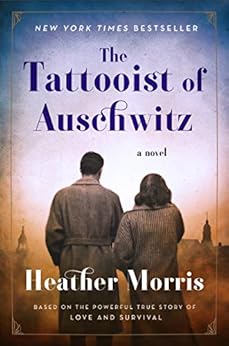
Review of THE TATTOOIST OF AUSCHWITZ by Heather Morris

2.5 Stars
I don’t understand why the story of Lale and Gita was not written as non-fiction.  Why tell a fictionalized version?  This latter approach leaves the reader wondering what is true and what is the creation of the author’s imagination.

In 1942, Ludwig Eisenberg (Lale), a Slovakian Jew, is taken to Auschwitz and becomes its tattooist, tasked with numbering each new inmate upon arrival at the concentration camp.  It is love at first sight when Lale tattoos the arm of a new arrival, Gita Furman.  What follows is the story of how they strive to survive their time in Auschwitz; their wish is to be together after the war.  

Lale’s portrayal makes him almost too good to be true.  As the Tätowierer, he has a rather privileged, position in both Auschwitz and Birkenau.  He has a private room, is given extra food, and has freedom of movement within the camps.  He always shares his extra food, and any black market items he manages to procure are used for the benefit of others.  He always responds “with words of encouragement, trying to turn their fear into hope” and when faced with abuse, “he tries to shrug the words off and meet the glares with a smile.”  He befriends people who immediately risk much to help him.  Because of these acquaintances who see him as “someone worth saving,” he survives typhus and evades execution.  He even manages to manipulate Baretski, his sadistic SS guard, into doing favours for him?  By his own definition, he is a hero because “’Choosing to live is an act of defiance, a form of heroism.’”

So much is left unexplored in this novel.  For instance, Lale says, “’I can only hope I am not one day judged a perpetrator or a collaborator.’”  Certainly there are ambiguities in Lale’s protected position:  is he doing just what he needs to do to survive or is he facilitating the functioning of the camps?  This theme of forced collaboration deserves more than just a mention, especially since one inmate who has much less choice than Lale is eventually convicted as a Nazi conspirator and sentenced to fifteen years of hard labour.  Lale experiences no survivor’s guilt?

So much about this book feels flat.  There is certainly a lack of emotional depth.  When Lale learns that thousands of Romany, many of whom are his friends, were sent to the gas chamber, the author describes his reaction:  “Lale is seeing red.  He is out of control.”  The romantic scenes between Lale and Gita are reduced to romance novel clichés.  The plot follows a he-did-this and then-this-happened structure.  Coincidences abound.  

The author, in a note at the end, writes about how she became close with Lale, visiting him two or three times a week for three years.  I think the problem is she became so close to him that she could not portray him objectively.  There is also the impression that she embellished his story in a way that makes it less convincing.  I know British prisoners of war played football in a camp adjacent to Auschwitz, but would SS officers really play soccer against prisoners in Auschwitz, prisoners who would have been emaciated and exhausted?  

I think Lale and Gita’s story is worth telling; unfortunately, it is not well told here. 


Wednesday, November 21, 2018

Review of UNSHELTERED by Barbara Kingsolver

4 Stars 
Kingsolver weaves two parallel stories separated by almost 150 years; in both plots, people find themselves living in a collapsing house, with insufficient income, and in a world where familiar beliefs are threatened.

In Vineland, New Jersey, in 2016, Willa Knox lives with her multi-generational family in a collapsing house.  While her husband works for less than his qualifications should earn, she cares for her infant grandson and her infirm father-in-law.  Their adult daughter lives with them, while their son struggles with crushing student debt.  Willa asks, “How could two hardworking people do everything right in life and arrive in their fifties essentially destitute” (11)?  Hoping to access grant money to help restore their historic house, Willa starts researching Mary Treat, a naturalist who may have lived in the home.  

In the same area, in the 1870s, Thatcher Greenwood, a new science teacher, also living in a house in need of major rehabilitation, finds himself torn between providing financial security for his wife, mother-in-law, and sister-in-law and staying committed to his staunchly-held principles of scientific inquiry.  He feels his students should learn about evolution but if he teaches the theory, he will lose his job.  He becomes friends with a like-minded neighbour, Mary Treat.  

The novel combines fictional and historical figures.  Mary Treat was a real person, a self-taught naturalist who corresponded with Charles Darwin, and Vineland as depicted in the novel was a real place founded by Charles Landis who promised a Utopian existence to those who lived by his rules.  Landis, in 1875, was accused of killing a man but pleaded innocence because of temporary insanity, the first time in American judicial history where a person claimed insanity as a reason for being not guilty.

The two stories are intricately woven together.  The last phrase of one chapter dealing with one plot serves as the title of the following chapter about the other plot.  Besides the multigenerational families living in precarious financial circumstances in a house that should be torn down, there are other parallels.  People find themselves unsheltered in that the old beliefs about how the world works are being challenged.  In 1870, Americans recovering from the civil war, find their beliefs threatened by new scientific knowledge.  In 2016, Americans find the American dream being upended: hard work is not guaranteeing success and prosperity.  

Donald Trump appears as an unnamed character in the novel.  Willa speaks of The Bullhorn, “a crazy presidential candidate” (100) who said “he could stand in the middle of Fifth Avenue and shoot somebody, and people would still vote for him” (345).  His parallel in 1870 is Charles Landis who promises a utopia he does not deliver, though he becomes apoplectic when challenged by anyone.  Hillary Clinton is even evoked.  Thatcher says, “’I wonder what service is possible, Mary.  When half the world, with no understanding of Darwin at all, will rally around whoever calls him a criminal and wants him hanged.’”  He mentions seeing a “murderous crowd chanting Lock him up!” around an effigy of Darwin (205).

Mary Treat offers an explanation for those who follow Landis:  “’When men fear the loss of what they know, they will follow any tyrant who promises to restore the old order’” (206).  Tig, Willa’s daughter explains Trump’s appeal:  people think “’this dude must have put in the time and gamed the system to get his billions, because that’s how it works in America. . . . There’s a lot of white folks out there hanging on to their God-given right to look down on some other class of people.  They feel it slipping away and they’re scared.  This guy says he’s bringing back yesterday, even if he has to use brass knuckles to do it, and drag women back to the cave by their hair.  He’s a bully everybody knows that.  But he’s their bully’” (248-249).

The book is very much a social commentary.  A number of subjects are discussed by Willa and her family:  climate change, the American health care system, education, and consumerism.  The problem is that Kingsolver’s opinions are often delivered in a heavy-handed manner.  In a chapter that references both the devastation of Hurricane Sandy and the spread of the Zika virus northward, the reader is told, “The Supreme Court had put the EPA’s carbon rule on hold, siding with industry groups that wanted to do as they pleased while fighting a legal battle against regulation.  Shares had dropped in several solar power companies as they fell short of their installation goals” (349).

Members of Willa’s family are intended to represent different political ideologies.  Nick, Willa’s father-in-law, was a blue-collar worker who was forced to take early retirement because “’The laws changed so plant owners could break strikes and bust up the unions . . . [so] the pay scale collapsed’” (102) but he blames immigrant workers for his lack of job security and has become a supporter of The Bullhorn.  Zeke, Willa’s son, is the capitalist willing to abandon his family to chase the almighty dollar.  Tig is an adherent of left-wing politics who bemoans “the global contempt for temperance and nurture, the fierce entitlement to every kind of consumption” (370).  Tig is very much Kingsolver’s mouthpiece; she is the one to explain things to her confused mother who feel anxious and overwhelmed by the collapse of social order she sees around her.  Unfortunately, Tig comes across as the lecturer.

Despite its occasional didactic tone, I enjoyed this book.  There is rich storytelling behind the commentary, a commentary that is certainly relevant, though a reader’s enjoyment of the book will definitely be determined by his/her political leanings.  The novel certainly offers food for thought:  how should we react when our assumptions about the world are challenged?  And though its subject matter is serious, the book offers hope:  humans have survived upheavals in the past and have adapted and survived.  First we must face the truth, “stand in the clear light of day . . . unsheltered” (205).

Saturday, November 17, 2018

Review of WASHINGTON BLACK by Esi Edugyan

4 Stars
Set in the 1830s, this novel, shortlisted for both the Man Booker Prize and the Giller Prize, covers about eight years in the life of its narrator, George Washington Black (Wash).

Wash was born into slavery on a sugar plantation in Barbados.  When he is 11, he is rescued from the brutality of field work when chosen by Christopher Wilde (Titch), a naturalist and inventor and the brother of the plantation owner, to be his manservant and to assist him in his scientific endeavours.  Wash’s intelligence and his aptitude for drawing pique Titch’s interest so he nurtures his talent and introduces him to the wonders of the natural world.  The death of a man leaves Wash with a bounty on his head so Titch and Wash flee the island.  This is the beginning of Wash’s travels as he eventually finds himself in far-flung locales as he tries to make his way in a world, “trying my best . . . to be my own free man” (231).

In some ways this is an adventure tale.  Wash travels the world:  Virginia, the Arctic, Nova Scotia, London, Amsterdam, and Morocco.  He gets to fly in a hydrogen balloon, sail the sea and dive into its depths, and see the high Arctic and the desert.  It is also a coming-of-age story showing Wash’s psychological growth from youth to adulthood.  Most importantly, it asks the question, What is true freedom?

As a child, Wash asks his surrogate mother, “’What it like, Kit? Free?’”  She tells him, “’When you free, you can do anything. . . . You go wherever it is you wanting.  You wake up any time you wanting.  When you free . . . someone ask you a question, you ain’t got to answer.  You ain’t got to finish no job you don’t want to finish’” (9).  As a slave, Wash has no freedom; his owner even takes measures to ensure that his slaves aren’t free to choose death by suicide.  So Wash dreams of freedom, though Titch warns him, “’Freedom, Wash, is a word with different meanings to different people’” (154).  

When Wash escapes the plantation and Titch offers him freedom in Upper Canada, Wash admits, “’I was terrified to my very core, and . . . the idea of embarking on a perilous journey without Titch filled me with a panic so savage it felt as if I were being asked to perform some brutal act upon myself, to sever my own throat” (182).  This reaction reveals that Wash remains a slave; he knows no life but being the property of someone else, though it upsets him when Titch, to avoid confrontation, tells someone, “’Indeed, the boy is my property’” (140).  In a telling comment, Titch laments, “’You will never leave me, Wash . . . Even when I am gone.  That is what breaks my heart’” (216).

Eventually, Wash must live on his own.  Once he is forced “to leave behind Titch’s coddled world,” he discovers he will never be free of “the brutality of white men.  To be called nigger and kicked at in disgust like a wharf rat” (231).  Though he is technically a free man in Nova Scotia, he hides from a bounty hunter he fears is looking for him.  Though he becomes an accomplished illustrator and a pioneering zoologist, he cannot get the recognition he has earned:  “in the end my name would be nowhere” (385).  At one point, Wash makes a conclusion that his time with Titch “had schooled me to believe I could leave all misery behind, I could cast off all violence, outrun a vicious death.  I had even begun thinking I’d been born for a higher purpose, to draw the earth’s bounty, and to invent; I had imagined my existence a true and rightful part of the natural order.  How wrong-headed it had all been.  I was a black boy, only – I had no future before me, and little grace or mercy behind me.  I was nothing, I would die nothing” (165).  

Just as Wash always carries physical scars of his slavery, he can never be truly free of the psychological trauma of his enslavement.  For example, he has difficulty trusting people; whenever he meets someone, he remains suspicious:  “Despite his general mildness, I feared him, of course” (80) and “no part of me did trust him” (177) and “But it is also true that there was something in him I did not fully trust” (234).  After he lives without Titch in his life, he feels he has no identity because he had one only in relation to Titch:  “I became a boy without an identity, a walking shadow” (230).  His sense of wonder at the natural world and his sketching of it cover his fear and loneliness because he remains a lost soul with a “sense of rootlessness” (400).

Of course, the concept of freedom is examined through other characters as well.  Does Titch’s father stay in the Arctic to be free of familial ties?  Titch is an abolitionist who believes “Slavery is a moral stain” which “will keep white men from their heaven” (105), but in order to do his research and create his inventions, he requires access to money made by the sugar cane plantation where slaves labour and are inhumanely treated so he can never be truly free of family duties.   Though Titch has more personal freedom than his family’s slaves, feelings of guilt haunt him, and he is like Wash who cannot be free of his past.  Wash recognizes that “wounds had arrested [Titch] in boyhood” (416) and because of Titch’s background, Wash even speculates that perhaps for Titch “any deep acceptance of equality was impossible” (322).

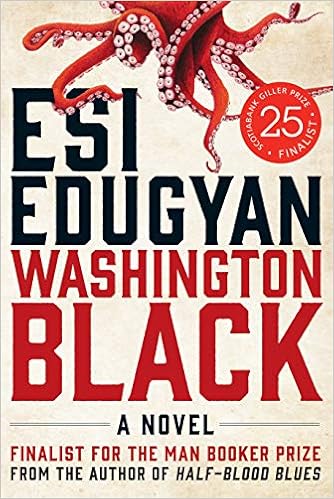
The cover of my copy has a sketch of an octopus which proves to be a symbol in the novel.  On a diving expedition, Wash finds an octopus that “swam directly into my hands” (274) and he wishes to keep it alive and protect it.  The octopus is, of course, an exotic creature, and Wash sees himself as an oddity:  “a creature . . . a disfigured black boy with a scientific turn of mind and a talent on canvas, running, always running, from the dimmest of shadows” (230-231).  When taken captive, the octopus becomes ill in her tank; “I looked at the octopus, and I saw not the miraculous animal but my own slow, relentless extinction” (337-338).

There are some elements in the novel that irritated me.  For instance, there are quite a few coincidences where people appear almost magically.  Wash’s narration also bothered me:  though he is obviously intelligent, he is an uneducated boy born into slavery who struggles with learning to read, yet he has such an extensive vocabulary?

Though not perfect, this is a book I can see myself re-reading.  It has a depth that invites a second look.