Ranked a Top Canadian Book Blog
Twitter: @DCYakabuski
Facebook: Doreen Yakabuski
Instagram: doreenyakabuski
Threads: doreenyakabuski
Substack: @doreenyakabuski
Bluesky: @dcyakabuski.bsky.social

Friday, December 26, 2025

Review of THE HALLMARKED MAN by Robert Galbraith

 3 Stars

This is the eighth Cormoran Strike novel; it’s not the longest of the series but has over 900 pages.

A mutilated and dismembered corpse is found in the vault of a silver shop that specializes in selling Masonic artifacts. Police identify the victim, but Decima Mullins, a woman with loose family connections to Strike’s former fiancĂ©e, is convinced that the dead man is the vanished father of her newborn son. She hires Strike to prove her theory. Strike and his partner, Robin Ellacott, discover that there are other missing men whose descriptions match the corpse, so they need to find each of these men to eliminate or confirm him as the murder victim. And then their investigations uncover more victims.

As in the previous installments, the personal relationship between Cormoran and Robin plays an important role in the narrative. Robin is in an increasingly deepening relationship with CID Officer Ryan Murphy. Will Cormoran finally speak of his feelings for his partner before Ryan cements their relationship? I must say that Cormoran and Robin’s see-saw relationship is becoming tiresome. After 7 years, there has been no progress. I find myself becoming increasingly exasperated with Strike’s constant hesitating and Robin’s inability to be honest with herself and others. The pointless keeping of secrets causes unnecessary conflicts between the two.

Labyrinthine is the best adjective to describe the plot. There are so many characters in the convoluted investigation that it is difficult to keep track of all the characters and remember the relationships among the large cast. And on the topic of characters, am I the only one who thinks that Ryan is just another Matthew? Robin’s ex-husband was jealous of Cormoran and subtly manipulated Robin, and Ryan is equally guilty.

Parts of the book are predictable. The trajectory of the plot involving Kim Cochran is so obvious. She flirts with Cormoran and disrespects Robin so what happens is inevitable. An important question involves how the murderer got into the vault, yet neither Robin nor Strike investigate the solution that will occur to anyone familiar with crime fiction and dramas?!

As the series continues, my enjoyment of the books is lessening. I’m not sure how much longer I will continue. Perhaps I’ll just stream Strike.

Monday, December 22, 2025

Review of THE LAND IN WINTER by Andrew Miller

 3 Stars

I picked up this book because it was shortlisted for the 2025 Booker Prize and won the Walter Scott Prize for Historical Fiction. Unfortunately, I wasn’t as impressed as the judges of these awards.

Set in England’s rural West Country in 1962-63, the novel focuses on two couples, neighbours, who are discontented and whose marriages are emotionally disconnected. Eric Parry is a doctor married to Irene who has left behind London literary life. Bill Simmons is a rookie farmer married to Rita, a former showgirl, who is having difficulty adapting to the life of a farmer’s wife. The winter, with its historically cold temperatures and blizzard conditions with record snowfall, imposes physical isolation that exacerbates tensions and resentments.

Each of the four characters is developed in depth. Eric is not a pleasant person; arrogant and self-serving, he carries on an affair with a married woman while virtually ignoring Irene. Well-educated and sensitive Irene seems lost, passively accepting the role of doctor’s wife. Bill is an idealistic dreamer trying his hand at farming about which he knows little. He has doubts about his marriage “to a woman more suited to being a mistress than a wife, whose past he thought he would be better off not knowing too much about.” Rita is vivacious but scattered and also troubled; she misses the excitement of the big city. Irene and Rita become friends. Both are pregnant and so share similar concerns: their lives are about to be dramatically changed. Though the four protagonists have complexity, I felt disconnected from them. Perhaps this feeling is what the author strove to illicit in order to emphasize the disconnectedness of the characters’ lives. Unfortunately, because I didn’t feel invested, I didn’t much care about their fates.

The narrative begins very slowly. There is little plot and everything is described in great detail. The author excels at painting a picture but some of those descriptions feel unnecessary and certainly slow the novel’s pace. The final section, however, has so much action that it feels chaotic. There is more tension and suspense, but by then I didn’t really care about what happened to the characters. To state that the ending is abrupt is almost an understatement.

The book is bleak in many ways. Winter and darkness are not just part of the landscape, but deep within the lonely, empty lives of the four main characters. The tone is set early in the novel; it opens with the suicide of a young man and the birth of a stillborn calf. Even the writing, with its meandering prose, feels cold and dispassionate. The dialogue is stilted and unnaturally formal, mirroring the shallow and distant connections. World War II and the Holocaust still loom large. Not only is there repeated mention of the destruction in London which is still re-building, but there are also references to concentration camps like Bergen-Belsen and what was discovered there. More than one person has suffered war-time trauma.

Interestingly, the character about whom I would have liked to learn more is Gabby Miklos, Eric’s partner in the medical practice. He appears periodically and is the person who tries the hardest to connect with others. His conversation with Bill at the dinner party and Eric’s visit with him near the end are revealing. His would be an interesting story.

The author excels at creating the tediousness of dissatisfied people living isolated lives. But for me, the book was often a tedious read. I felt only a shallow connection to the characters and the plot left me dissatisfied.

Friday, December 19, 2025

Review of SEASCRAPER by Benjamin Wood

 4 Stars

This novel was brought to my attention when it appeared on the 2025 Booker Prize longlist.

The novel is set in the early 1960s in a coastal village in northwestern England. Twenty-year-old Thomas Flett earns his living as a shanker: he rides a horse up and down the beach scraping the sand for shrimp. His is a hard life that has taken its toll so he shambles along “with all the spryness of a nursing-home resident.” He yearns for more than his life which is “just a mindless trudge of work”; he dreams of performing folk songs in the local pub and courting a local young woman. Unfortunately, he lacks the courage to do either.

Thomas’ life changes with the arrival of Edgar Acheson, a fast-talking American who claims to be a film director scouting locations for a movie. Though Thomas is reluctant at first, he eventually agrees to act as Edgar’s guide. It’s not just the money: “It’s a bridge he wants – between Longferry and the world beyond – and Mr Acheson could be the one to help him build it.” But is Edgar all that he claims to be?

And that’s the reason why I found much of the novel to be suspenseful. Aspects of Edgar’s behaviour cast doubt on his claims. Perhaps I was overly skeptical of Edgar because the novel reminded of Whale Fall by Elizabeth O’Connor in which a young girl yearns for life in the wider world but ends up being manipulated by visiting ethnographers who lie to her and steal from her. I was concerned that he is being led down the garden path. And my concern increased as Thomas becomes more invested in Edgar’s plans: “He gets the sense that something’s turning in his fortunes. All those dreary shifts at sea, gone unrewarded. All his ma’s relentless praying before bedtime. Well, at last a table scrap of luck’s been thrown to them to gnaw the meat off.”

And then there’s tension because of the danger involved in Thomas’ work. There are sinkpits everywhere which can claim a person’s life yet Edgar insists on Thomas taking him out on a foggy night. I found myself even worried about Thomas’ horse: Thomas warns, “’The horse’ll tire out and catch a chill if we stay out in [the cold, deep water] too long’” but Edgar ignores him and even admires the horse’s colour when it has worked up a sweat: “’It’s got a lustre to it now it’s got a sweat on – really great.’”

It is impossible not to like Thomas. His intelligence is obvious. Unfortunately, he is forced to leave school in order to help his family, though he had “an awareness of his own capacity.” His life is difficult; the novel begins with details about his daily routine, details which emphasize how harsh and monotonous his life is. And all that work barely guarantees that he and his mother can survive. His comments about Edgar reveal such humanity; even when disheartened, Thomas is capable of understanding and compassion. His mother may be a nag but Thomas remembers her sacrifices for him so it’s obvious he could never abandon her.

The novel is a coming-of-age story. Thomas learns that he’s lost joy in his life: “most folk seem to carry on undaunted, just like children gaily sliding down a sand dune. When did he stop sliding for the fear of broken glass and bloody knees?” He also realizes the power of art. Edgar tells him that “’Art’s the only way I’ve ever had of making any sense of [life].’” Later Thomas thinks that though the sea provides his livelihood and he can respect himself for being steadfast to his work, “there’s no meaning in it any more,” but music would provide him “with a better purpose” because “a song belongs to someone. To whoever dreamed it up. Yesterday it wasn’t even born, and now it’s in the world.”

This is more a novella than a novel, yet it has so much in it. I can understand why it has been applauded so widely.

Monday, December 15, 2025

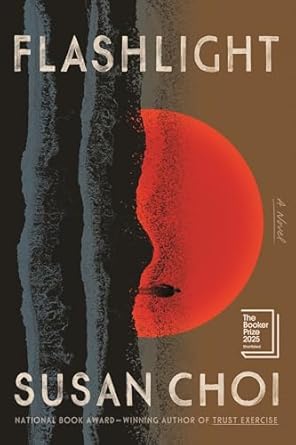
Review of FLASHLIGHT by Susan Choi

 4 Stars

This novel caught my attention when it appeared on the shortlist for the 2025 Booker Prize.

In 1978, ten-year-old Louisa Kang goes for a walk on a Japanese beach with her father Serk. The next morning she is found unconscious on the shore, but Serk has vanished. From this pivotal event, the novel moves back and then forwards in time. There are flashbacks to Serk’s childhood. Known as Hiroshi, he was born in Japan to Korean parents born on the island of Jeju. After the war, they leave for North Korea, lured by promises of a socialist paradise. Serk, however, moves to the U.S. where he becomes a professor and marries Anne, an American white woman. Louisa is their only child, though Anne, when she was nineteen, had a son Tobias whom she relinquished to his father. Serk agrees to an exchange year in Japan from which he never returns. What happened to him? Though he is presumed to have drowned, a body is never found, and the reader comes to suspect that Serk’s disappearance may in fact be connected to geopolitical events.

At over 450 pages, the book is fairly lengthy. It is also dense and so sometimes feels like an intellectual exercise. Choi loves complex sentences and em dashes. For instance, Serk, upon seeing Anne take their daughter to swimming lessons reacts with rage: “Only the inhibition that overcame Serk in those settings in which he was unusually anomalous, as he was at the YMCA pool – not just the only foreigner but the only person in a suit, his shirt sticking to his sides in the chemically pungent humidity, his dress shoes slipping on the pool deck as though he were trespassing in some stranger’s giant bathroom, the incessant thundering echo of screaming and splashing almost, but not quite, emboldening him to give vent to his rage on the spot – had prevented him from giving vent to his rage on the spot.” Sometimes sentences need to be re-read because their purpose gets lost in the numerous phrases and clauses.

The novel used third person omniscient narration but each chapter focuses on a different character, mostly Serk, Anne, or Louisa. This approach means that we learn of Serk’s fate even though it remains unknown to his family. Of course, readers also come to know each of these characters very well: their thoughts, feelings, hopes, and dreams. All three, however, are difficult to like. All are stubborn and self-centred; they all seem to lack empathy. Serk, for instance, is impatient and arrogant and constantly aggrieved; he has no empathy for Anne or Louisa when he decides unilaterally to move them all to Japan. When Anne reunites with Tobias, she has little concern for how that might affect Louisa. When her mother’s health becomes a concern, Louisa shows no sympathy whatsoever.

What stands out is that there often seems little connection among the three; they interact but remain loners, alienated from each other. In many ways, the book is about secrets and their consequences. Serk never tells Anne about his childhood in Japan and his family’s emigration to North Korea. He doesn’t share that his return to Japan has a hidden agenda: seeing his sister and perhaps bringing his family back to Japan. Anne reunites with her son without telling her husband. Just before they leave for Japan, she begins to experience symptoms of an illness but keeps them to herself until it’s impossible to hide them. Pre-occupied with their private concerns, neither parent shares with Louisa so she feels isolated from them just as she also feels alienated in a new culture. At one point, Louisa thinks, “The sum of the things she knows about her father could fit inside the sum of the things she’ll never know about him an infinite number of times. The things she knows about him are as meager as a pair of backgammon dice rattling in their cup.” This statement applies to all of them. If, instead of silence, there had been real communication, the dynamics would have been very different. The metaphor of the flashlight works well in emphasizing how each character tends to see only what is in front of him/her. So much remains in darkness so they all stumble along.

Of course the remoteness that develops is understandable. They build walls to protect themselves and so end up joyless. Serk, though born in Japan, is a second-class citizen there and is also never accepted as an American. When just a young man, he loses his entire family. Anne, at nineteen, is placed in a position where she must give up her child. As an adult, she is ostracized because she married a foreigner. Then she becomes a widow. Louisa, because of her parentage and appearance, feels out of place. Then she loses her father, with whom she was very close, just as Anne’s diagnosis means she must prioritize her own health. So despite the three characters being rather unlikeable, readers cannot but have sympathy for them.

There is much to parse in this book. The effect of world politics on individuals deserves discussion, but that would be a spoiler. I recommend the book but advise that readers set aside considerable time to read it; it deserves to be read slowly and to be given careful thought.

Friday, December 12, 2025

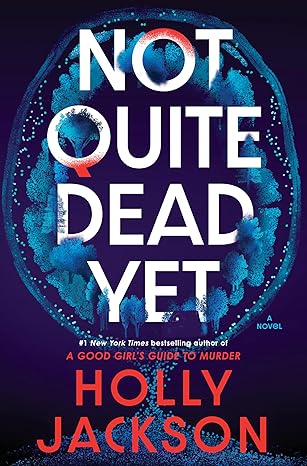
Review of NOT QUITE DEAD YET by Holly Jackson

 2.5 Stars

After some heavy reads with complex themes, I decided to pick up some light reading. I chose this book because it has an interesting premise: someone solving her own murder.

Twenty-seven-year-old Jet Mason is violently attacked by an unseen intruder. She suffers a catastrophic head injury which her doctor tells her will trigger a deadly aneurysm within a week. Jet decides she wants to spend her remaining time solving her assault case which she knows will soon be upgraded to a murder case. She is assisted by her childhood friend, Billy Finney.

Unfortunately, from the beginning, I had difficulty suspending disbelief. Jet has major head trauma; the doctor tells her, “’you were comatose, had to be intubated. Suffered cardiac arrest from blood loss shortly after.” She had a fractured skull and had surgery and a lethal aneurysm looms, yet she leaves the hospital almost immediately after regaining consciousness. And the doctor’s only instruction is, “’Just change the dressings every day’”? Shortly afterwards, she starts slinging a sledgehammer. She starts losing feeling in various parts of her body, but she is able to physically exert herself in ways that would be daunting for someone healthy and fit?!

The other problem with Jet is her immaturity. She behaves like a bratty teenager rather than someone in her late twenties. She even runs away from home! She has no plan for her life. She’s always procrastinating, her favourite expression being, “’I’ll do it later.’” She blames others, like her dead sister and her demanding mother and her undemanding father, for her lack of accomplishments.

And then there’s Jet’s relationship with Billy. The entire thing seems so juvenile. Billy has had a crush on Jet since their childhood, but Jet doesn’t realize it? From the beginning, the author makes it so obvious that Billy is smitten. Does there have to be a romance element added? Can’t people just be friends?

The secondary characters tend to be one-dimensional. Virtually everyone is self-centred and unlikeable. Besides the person responsible for Jet’s attack, there’s at least one other murderer and an arsonist. One person should surely be charged with attempted murder and another should be charged with fraud. Women cheat or abandon families. Billy is one positive figure but the constant repetition of his need to help others becomes tedious.

Holly Jackson is best known as a YA author. Though this book is marketed as her first foray into adult fiction, my impression is that she continues to use the type of characterization and writing style that appeal to less sophisticated readers. The novel has an original premise, but its execution is unimaginative.

Monday, December 8, 2025

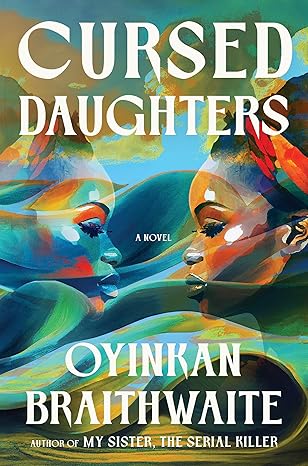
Review of CURSED DAUGHTERS by Oyinkan Braithwaite

 3.5 Stars

I loved the author’s first novel, My Sister, the Serial Killer, so was curious to read her second one.

The Falodun women are cursed to be heartbroken and unable to hold on to a man: “’all the women . . . will suffer for man’s sake.’” Over time, all end up returning to the family home in Lagos. The novel focuses on three of those women: Ebun, Eniiyi, and Monife. The plot begins in 2000 with Monife committing suicide by drowning. On that same day, her cousin Ebun gives birth to her daughter Eniiyi. Eniiyi bears an uncanny resemblance to Monife and she begins to wonder if she is the reincarnation of her aunt.

The narrative moves back and forth in time, ranging from 1994 to 2025, and amongst the three women. What comes to the forefront is the similarities between Monife and her niece: physical appearance, including an almost identical scar, depressive episodes, and the same relationship dynamics with their boyfriends who are also very similar. Eniiyi hates the constant reminders of her resemblance to Monife and wants to be her own person. She also wants to break free and defeat the curse that seems to have affected the women in her family. There are seven chapters, all entitled “Falodun Family Curse,” each of which details how the curse impacted the life of a Falodun woman.

What I did not like is that the Falodun women are all obsessed with men. They envision no other path to happiness and see their worth only in relation to a man. For instance, Bunmi, Monife’s mother, is a respected headmistress at the local school but “behind closed doors, . . . flirted with strange spirits and gods.” She spends her money on the services of a mamalawo who performs rituals she claims will lure back Bunmi’s husband, “despite the fact that he had a new wife and two children.” Kemi, Ebun’s mother, is always disappearing “with one of several wealthy suitors into Lagos society. She was caught up in a quest to ensnare a fourth husband.” This obsession with men is also seen in the romances of both Monife and Eniiyi. Monife falls in love with a man she calls Golden Boy as soon as she sees him. This love-at-first-sight trope is then repeated with Eniiyi who has the same reaction to Zubby.

Women in the family teach their fatherless daughters to prepare for betrayal and abandonment by men. Ebun wants no discussion of the curse in front of her daughter, but her behaviour towards men, especially towards Osagie, suggests her belief in its existence. She refuses to give a man a choice in a relationship, claiming that he might not have a choice because of the curse. This comment suggests to me that the curse is just a self-fulfilling prophecy: the constant references to the curse influence the women’s behaviours which over time become generational patterns.

The frequent switching among perspectives and time periods can be confusing. But I did find that the women emerge as interesting and distinct characters. The trait they share is obstinacy. Because they are all headstrong, there are inevitable clashes. But what is also clear is the love that binds them. What is particularly sad for me is how damaged the lives of the women are because of their belief in the curse. Happiness and fulfillment are possible, but they don’t see a way forward because of their fixations on men and the curse.

I did not find this novel as entrancing as My Sister, the Serial Killer but enjoyed it. I especially liked the characterization, the occasional touches of humour, and the cultural elements.

Friday, December 5, 2025

Review of NEEDLE LAKE by Justine Champine (New Release)

 4 Stars

This is a coming-of-age story.

Fourteen-year-old Ida lives with her mother in the small logging town of Mineral, Washington. Her life consists of attending school, helping her mother in their convenience store, and studying geography and maps which are almost an obsession for her. The arrival of her sixteen-year-old cousin Elna changes everything. Elna seems to be all that Ida is not, so Ida is soon enchanted. After a tragedy, however, their relationship becomes more complicated and slowly Ida’s adulation of her cousin becomes mixed with fear.

This is a character-driven novel in which both girls emerge as complex individuals. Ida, the narrator, is immediately endearing. She is shy and introverted. She does not fit in at school: noises bother her, she is sensitive to touch, loves orderliness, and speaks tonelessly. As a result of her differences, which suggest she is on the autism spectrum, she is bullied and lonely. The world has taught her that because she is a girl, “the best thing I could be was mild. Sweet. Yielding. Endlessly tolerant. A fawn nestled in the grass.” The fact that she has a hole in her heart, which restricts her involvement in physical activities, only adds to her exclusion. At one point, she comments, “’I don’t feel at home in the world.’”

Elna is Ida’s foil. She is glamorous and sophisticated and charming. Ida describes her cousin as “self-possessed, confident, a little standoffish.” In some ways, Elna behaves like she inhabits the world of boys “where anger and mischief and bold, unabashed confidence were permissible.” It is perfectly understandable why Ida becomes enamoured, especially when Elna treats her like a normal person and introduces her to a wider world.

Of course, the reader soon suspects that there may be more to Elna than Ida sees. Certainly her actions immediately upon arrival in Mineral, when the girls visit a variety store, leave the reader wondering about Elna. Jen, a friend of Ida’s mother, feels it necessary to warn Ida about Elna: “’I think she’s a different sort of kid than you. . . . I think maybe you should take it a little slow. . . . I want you to be safe and careful wherever you go, whoever you go with.’” A random woman even tells Elna, “’There’s something very dark in you.’” And her behaviour starts to suggest that this statement is an astute observation. What Ida sees as brave and daring behaviour may, in fact, be seen as recklessness. Is Elna sincere in befriending Ida or is she manipulating her naive and vulnerable younger cousin?

The book is advertised as an exploration of teenage girlhood. I must comment that what is portrayed is very typical behaviour of teenaged girls: problem-solving and decision-making skills are weak but the propensity for risk-taking is strong. Emotions are felt deeply but proper coping mechanisms are lacking. What struck me is Ida’s repeated references to her anger, and though Elna’s strongest emotion is not specifically named until later, it’s obvious that it has influenced her actions from an early age.

There are a couple of issues about the ending that bothered me. Ida suffers no consequences for either the event at the lake or the event in San Francisco? The novel is slow paced, but then there’s an abrupt ending, followed by an epilogue that covers years in a few paragraphs. This contrast in pacing is jarring.

Readers will find much to appreciate in this book.

Note: I received an eARC from the publisher via NetGalley.

Monday, December 1, 2025

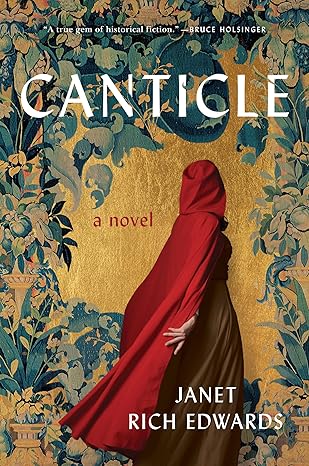
Review of CANTICLE by Janet Rich Edwards (New Release)

 3 Stars

This historical novel is set in the late thirteenth century in Bruges, Belgium.

Aleys is an unusual child. From early childhood, she is fascinated by her mother’s psalter and the stories of saints and martyrs. She learns to read and later learns Latin as well. When her father promises her in marriage to a merchant, she runs away. She wants to join the Franciscan friars but because of her gender is given shelter by the beguines, a community of religious laywomen focused on religious devotion and charity. While working in a hospital, Aleys seems to perform miracles so she comes to the attention of the ambitious bishop. She chooses to become an anchorite, living a solitary life of prayer. However, agreeing to be walled into a small cell from which she is forbidden to ever leave does not end her spiritual journey or her sacrifices.

I did not find Aleys relatable or particularly likeable. As a child, she has a spark: she is intelligent, spirited, and stubborn. Despite visions, she has a sense of humour. For instance, when she has a vision, “She hopes the angel will return. Just so long as he doesn’t announce she’s pregnant.” Once she chooses a religious life, she loses this spark and becomes just bland. The Magistra, the leader of the beguines, describes Aleys very aptly: “’She has a calling, . . . I can see that. It doesn’t mean she has charisma.’” At times she is the opposite of what would be expected. For instance, she comes across as conceited: she doesn’t want to be an ordinary beguine but “wants to be more than another thread in the cloth.” She wants ecstasy: “Aleys left home to fly.” Her attitude does change somewhat, but she certainly seems to be full of herself, in love with the idea that God has chosen her. To say she is obsessed is not an overstatement. Sometimes there seems little difference between Aleys and Lukas, her confessor, who ends up suffering what I can only think of as a form of insanity.

I found the book slow. From the beginning, we know Aleys’ fate so all that remains is how she gets to that end. For long periods of time, nothing happens. Her time as an anchorite is just pages of her praying, listening to petitions, experiencing visions, and then despairing when her visions cease. The descriptions of visions are problematic; they’re largely undecipherable. This obscurity is obviously intentional, but paragraphs of unintelligible prose do not make for interesting reading.

There are elements I liked. For example, there are some wonderful turns of phrase: “Eventually, her siblings leave her alone with her saints. Griete discovers the looking glass, Claus deserts martyrs for marbles, and Henryk, growing firm of jaw, decides that virgins are, in fact, interesting.” The book clearly shows the views of women at the time: a friar thinks “Women are easily tempted, prone to deception by demons. It’s hardly their fault. They’re daughters of Eve.” I loved the version of the Sodom and Gomorrah story from the perspective of Lot’s wife and the conclusion, from a woman’s perspective, that Abraham failed God’s test. I appreciated the message that “’heaven is on earth, before us, if only we can see it’” and “everyone [speaks with God]. It’s just so hard to hear.”

The Church’s control over the populace is emphasized. When the bishop finds translations of the Bible into Dutch, the common language, he declares them a heresy. Ecclesiastical power is diminished if “people are asking why they can’t speak directly with God” without the intercession of clergy. In particular, “’The Church wants to silence difficult women.’” Corruption in the Church, as in the sale of indulgences and relics, is emphasized, so much so that the bishop wonders, “Why would God get involved in the affairs of his own church? He’s turned a blind eye to the corruption for centuries.”

The book offers insight into Christianity in medieval times: mysticism, beguines, and anchorites. Unfortunately, the pace is slow so it is sometimes difficult to maintain interest.

Note: I received an eARC from the publisher via NetGalley.